Managed IT Services for Healthcare: PHIPA in Canada
Get managed IT services for healthcare in Canada. Ensure PHIPA compliance, boost security, and improve patient care with expert IT partnership.

Get managed IT services for healthcare in Canada. Ensure PHIPA compliance, boost security, and improve patient care with expert IT partnership.

A Canadian study reported that 48% of all reported Canadian breaches in 2019 occurred in the health sector, and cyberattacks can delay care, divert patients to other sites, and increase mortality. The Canadian study makes the operational reality clear: healthcare IT isn't a back-office convenience. It supports clinical decisions, patient privacy, communication, and continuity of care.
For Canadian clinics and hospitals, managed IT services for healthcare must therefore combine technical support with privacy-aware governance, resilient infrastructure, and security operations. A provider that only fixes computers after they fail isn't addressing the full risk. Healthcare organizations need continuous oversight that helps keep systems available, limits unauthorized access, and gives administrators an organized response when something goes wrong.
The risk profile changes how healthcare leaders assess technology spending. If an attack can interrupt clinical operations, monitoring, endpoint protection, secure backups, and incident response belong in the same planning discussion as staffing, facilities, and emergency preparation.
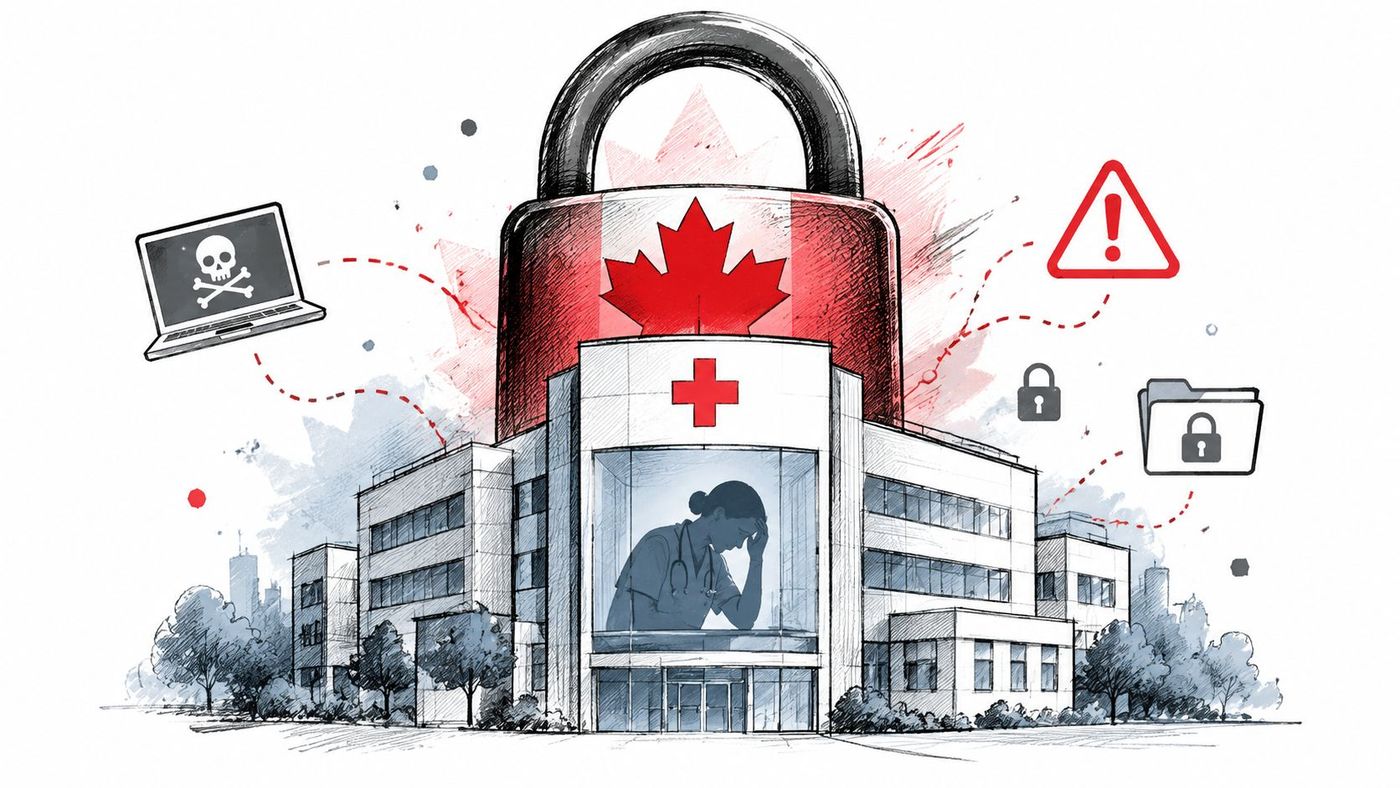
Canadian healthcare organizations carry several connected responsibilities. They must protect personal health information, preserve access to electronic medical records, support distributed teams, and keep services dependable when systems face pressure. Clinics may also depend on cloud applications, connected medical devices, online booking, digital communications, and third-party platforms. Each dependency needs clear ownership, monitoring, and a response plan.
Canadian research identified at least 14 major cyberattacks on Canadian health information systems since 2015, including ransom attempts and incidents involving personal health information. Those same findings show why reactive support falls short. Once staff discover encrypted files or unauthorized account use, patient access, productivity, and reporting obligations may already be affected.
A record system outage can leave staff working without information during consultations, referrals, diagnostics, and follow-up care. Communication failures can slow coordination between clinicians and administrative teams. A compromised account can expose information and provide access to connected systems.
Practical rule: Treat every system that supports patient care as part of the clinical environment, even when it sits in an office or cloud platform.
Specialized managed IT services help healthcare leaders replace uncertain, break-fix support with planned resilience. The provider should understand clinical priorities, privacy obligations under PHIPA and PIPEDA, escalation paths, and the difference between a minor inconvenience and an outage that affects care delivery. Controls should cover access, backups, monitoring, documentation, and incident response.
Administrators formalizing their risk program can review healthcare IT compliance requirements alongside internal policies and provincial obligations. The objective is operational stability that protects patient trust while keeping care available.
A general-purpose IT provider may know how to configure laptops, reset passwords, and maintain office networks. Those skills matter, but they don't automatically translate into healthcare readiness. A healthcare environment requires the provider to connect technical controls with privacy obligations and clinical workflows.
Under Ontario's PHIPA, healthcare providers must notify affected individuals of a data breach at the “first reasonable opportunity.” The Canadian healthcare privacy guidance highlights why rapid detection, usable audit records, and a rehearsed response process need to exist before an incident occurs. A provider that can't identify what happened, which accounts were involved, or when the organization contained the threat will leave administrators trying to reconstruct an event under pressure.
PIPEDA and provincial privacy laws also create a broader governance challenge. The applicable obligations depend on the organization, the information involved, and the province or territory in which services are delivered. A managed service must account for access permissions, retention practices, encryption, logging, vendor relationships, and documented procedures rather than treating compliance as a one-time checklist.
A generic service desk often prioritizes tickets by workplace inconvenience. Healthcare support needs a more precise model. An unavailable EMR, failed authentication service, or broken network connection can affect a consultation, delay access to a patient history, or force staff into manual workarounds.
The provider should understand:
A low-cost contract can become expensive if it excludes after-hours coverage, security monitoring, backup verification, or incident coordination. The trade-off isn't just between cheap and expensive IT. It's between a service designed around office productivity and one designed around patient care continuity.
A credible healthcare managed IT service defines what it monitors, protects, and does during an incident. Broad promises such as “secure support” do not tell an administrator whether the provider can identify a suspicious login, restore a clinical application, or preserve evidence after a breach. Each component should connect technical controls with patient care continuity and the privacy obligations that apply under PHIPA or PIPEDA.
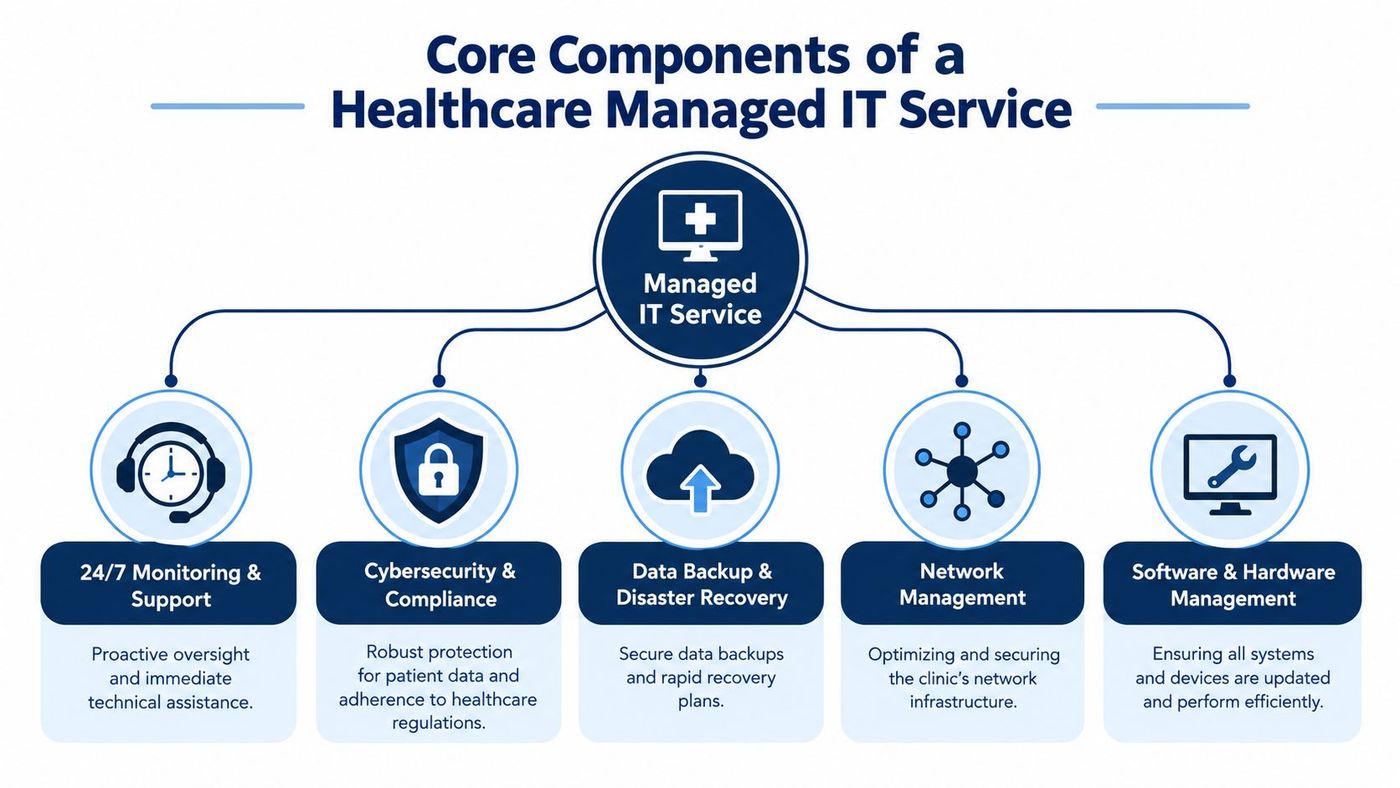
Continuous monitoring checks system health, unusual activity, device failures, and service degradation before staff report a problem. Support also needs a defined escalation model, rather than only a ticket portal. The team should understand clinical applications, location-specific dependencies, and the difference between a workstation fault and an outage affecting the whole practice.
The arrangement may be fully managed or co-managed. Responsibilities must be documented so internal staff and the provider do not duplicate work or leave a security alert without an owner. Coverage outside regular hours should match the clinic's clinical schedule and operational risk.
Canadian healthcare security programmes commonly include endpoint detection and response, advanced email filtering, multi-factor authentication, firewall management, security awareness training, and dark web monitoring. A Canadian healthcare IT provider's service description provides a practical basis for discussing which controls belong in the service scope.
Integration determines how well these controls work together. Multi-factor authentication is stronger when identity policies are applied consistently. Endpoint detection has greater value when alerts reach a monitored response team. Awareness training should include participation tracking and follow-up on recurring risks. The provider should also document how security activity supports privacy reviews and incident records.
Backups should be encrypted, access-controlled, monitored, and protected from unauthorized deletion or tampering. The provider must explain how recovery is tested, which systems return first, and how staff continue essential work while systems are unavailable.
A backup that has never been restored remains an assumption. The agreement should assign responsibility for backup alerts, recovery coordination, documentation, and post-incident review. Recovery priorities should reflect clinical dependencies, not only the order in which systems were purchased.
Network management covers connectivity, segmentation, firewall policies, wireless access, remote access, and devices connecting staff to clinical systems. The provider should maintain an accurate asset inventory, remove unsupported equipment, and identify exposed devices before they interrupt care.
Administrators seeking background on outsourced network oversight can review this resource on how to simplify IT with network experts. The practical test is whether the provider can identify a weak connection, capacity issue, or unmanaged device early enough for the clinic to respond.
Incident response must be documented before an emergency. A healthcare cybersecurity provider should offer a pre-agreed playbook with named contacts, a clear response window, and integrated 24/7 security operations centre monitoring. Service scope should also state who communicates with clinic leadership, coordinates technical recovery, and maintains the incident record.
Reviewing a managed IT service overview alongside the proposed agreement can help administrators distinguish routine support from the security, recovery, and governance capabilities a clinical environment requires. The final contract should make those responsibilities measurable and assignable.
The business case for healthcare IT management becomes stronger when administrators translate technical controls into operational outcomes. Monitoring isn't valuable because a dashboard looks impressive. It's valuable when the provider identifies a failing service early enough for staff to keep working, or when an escalation reaches the right person without delay.
A managed model can also make IT spending easier to plan. Instead of relying entirely on emergency repairs, the clinic pays for defined coverage, maintenance, security operations, and strategic oversight. The exact value depends on the agreement, but predictable service responsibilities are easier to govern than a series of unplanned technical events.
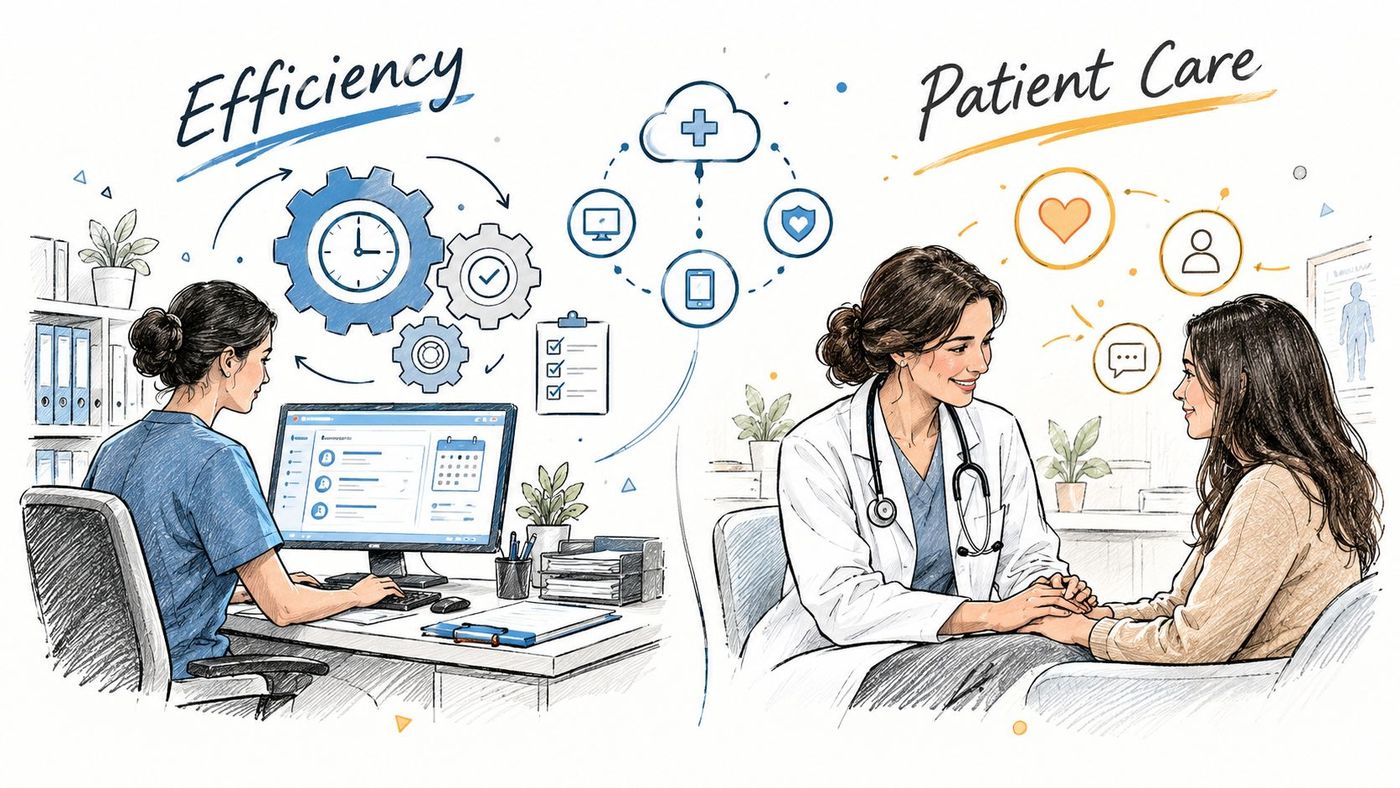
Proactive maintenance reduces the likelihood that staff discover problems during a patient interaction. A provider can monitor critical services, keep systems updated, identify capacity concerns, and coordinate planned maintenance outside the busiest clinical periods.
No IT service eliminates every outage. The meaningful difference is whether the organization has visibility, prioritization, and a recovery path when one occurs.
Patients expect healthcare providers to handle personal information carefully. Consistent access controls, secure authentication, monitored endpoints, and documented response procedures help the clinic demonstrate that responsibility through daily operations.
Resilience matters particularly because Canada's federal cyber threat assessment reported that over 400 healthcare organizations in Canada and the United States experienced a ransomware attack since March 2020. The federal assessment, published through the Canadian Medical Association Journal, also highlighted a 2021 incident that heavily affected Newfoundland and Labrador's healthcare system and disrupted medical services across the Eastern Health region.
A small internal team may understand the clinic's people and processes but lack round-the-clock security coverage, specialized recovery skills, or time for structured vulnerability management. An external provider can supply that additional capability while internal staff retain responsibility for business priorities and clinical context.
The right arrangement doesn't have to remove internal IT. Co-managed support can add after-hours monitoring, security expertise, project capacity, or escalation support while preserving institutional knowledge.
For a broader explanation of how these arrangements can support operational planning, administrators can review the benefits of managed IT services. The strongest outcome is not technology for its own sake. It's a clinic where staff can focus on patients because the underlying systems receive consistent attention.
Vendor selection should be based on evidence, not a polished sales presentation. Ask each provider to explain how it manages healthcare-specific risks, then request documentation that supports those answers. The goal is a partner that protects clinical continuity, patient information, and compliance obligations under PHIPA, PIPEDA, and applicable provincial requirements.
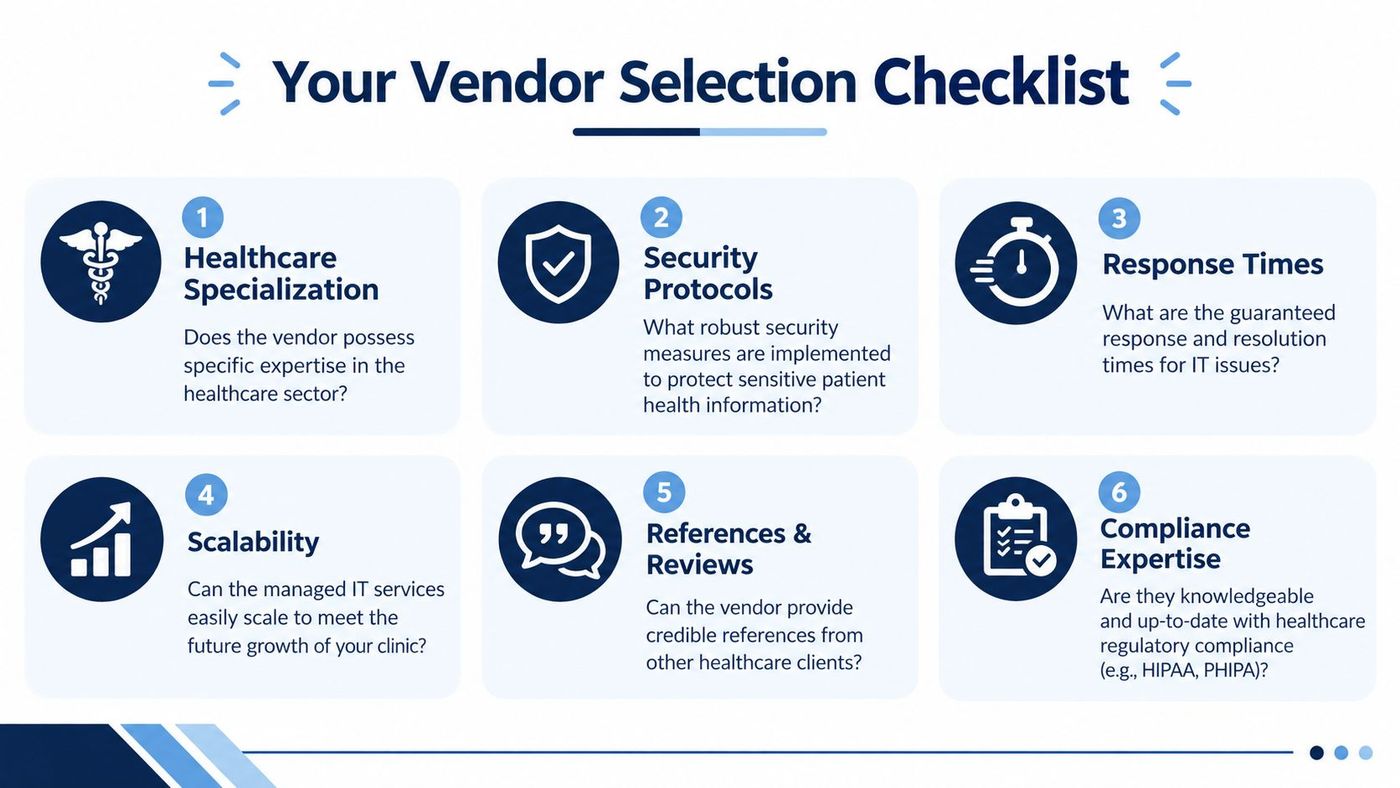
Ask whether the provider has direct experience supporting Canadian clinics, hospitals, or care networks. Look for specific examples involving clinical applications, privacy-sensitive workflows, remote access, device management, and outage escalation.
A provider does not need to claim that every environment is identical. It should show that its engineers understand why a healthcare incident has different priorities from an ordinary office outage, including patient access, appointment operations, and privacy reporting.
Request a plain-language explanation of endpoint protection, email filtering, multi-factor authentication, firewall management, vulnerability management, logging, and security awareness training. Ask who reviews alerts and what happens outside normal business hours.
A useful response identifies the tools, responsible teams, escalation path, and reports provided to administrators. “We take security seriously” is not an operating model. The provider should show how controls are configured, monitored, tested, and improved.
Service-level agreements should define response expectations for different incident categories. They should also explain escalation, communications, resolution responsibilities, maintenance windows, and the process for reviewing missed commitments.
Do not evaluate response time in isolation. A fast acknowledgement without a qualified person available to contain the issue may provide little protection. Confirm whether the stated commitment applies to evenings, weekends, third-party systems, and incidents affecting clinical operations.
The provider should maintain a pre-agreed incident response playbook, named contacts, a clear response window, and integrated 24/7 SOC monitoring. Ask practical questions:
The answers should be documented before an incident occurs, not negotiated during one.
The provider should support additional locations, new clinical applications, remote staff, and changing security requirements. Ask for references from organizations with comparable complexity, not only large enterprises with very different resources.
Confirm that the provider understands PHIPA, PIPEDA, and the privacy requirements relevant to your province and services. This knowledge should appear in access reviews, audit support, incident procedures, documentation, and contract language.
CloudOrbis's managed services questionnaire can structure vendor conversations and help administrators cover questions that might otherwise disappear during procurement.
Switching providers doesn't have to mean disrupting patient appointments or abandoning systems that staff rely on. A careful transition starts with controlled discovery, clear ownership, and a plan that separates urgent risks from longer-term improvements.
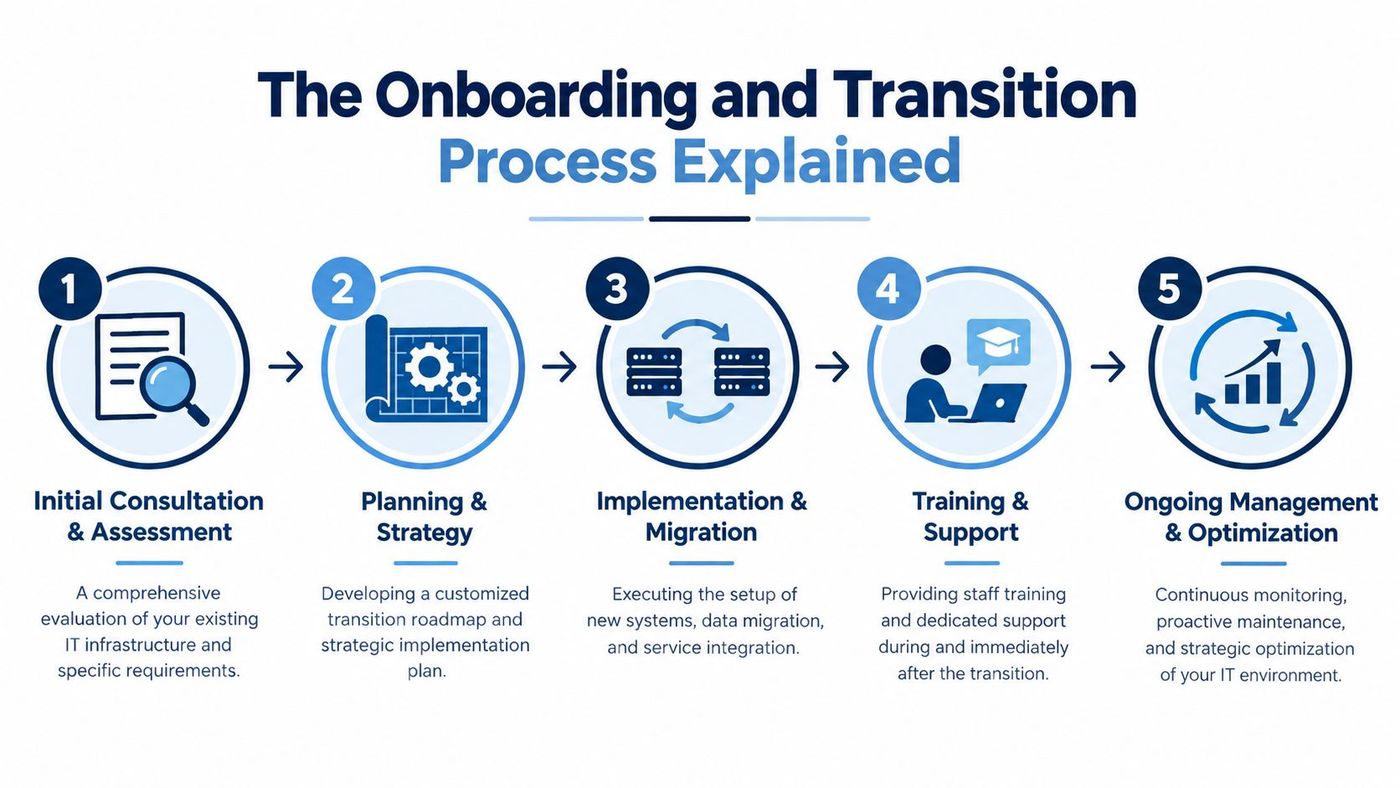
The incoming provider inventories users, devices, applications, networks, vendors, backups, administrative accounts, and clinical dependencies. It should also review existing documentation, security alerts, contracts, and known weaknesses.
This stage gives the clinic a factual starting point. It can expose unsupported equipment, unclear ownership, backup gaps, or access that no longer matches current responsibilities.
The provider then creates a roadmap with priorities, dependencies, owners, communications, and maintenance windows. Critical changes should be scheduled around clinical operations, with contingency plans if a migration or configuration change doesn't proceed as expected.
Administrators should receive a clear explanation of what will change, what won't change, and how staff can request help during the handover.
Technical implementation may include monitoring deployment, identity and access changes, endpoint configuration, backup validation, network adjustments, and documentation updates. Work that could affect users should be planned carefully, often during agreed maintenance periods.
The provider should not treat onboarding as complete when tools are installed. It should confirm that alerts reach the right team, staff can access required systems, and recovery procedures are understood.
Staff need practical guidance on authentication, phishing, incident reporting, support requests, and any new procedures. Training should reflect how the clinic works rather than relying on generic security language.
After transition, regular reviews should examine open risks, recurring tickets, asset changes, backup status, security findings, and upcoming business needs. A structured change management process helps the organization adopt improvements without creating avoidable disruption.
For Canadian healthcare providers, specialized managed IT services are a foundation for resilience, privacy, and continuity of care. The risks involve more than lost productivity. A security incident or prolonged outage can affect records, communications, treatment coordination, reporting obligations, and patient confidence.
PHIPA and PIPEDA-aware management gives administrators a practical framework for protecting information and responding responsibly. Continuous monitoring, controlled access, tested backups, endpoint protection, vulnerability management, and a rehearsed incident process turn that framework into daily practice.
The right provider won't promise that technology will never fail. It will show how the team detects problems, limits their impact, restores essential services, communicates with decision-makers, and learns from each event. That level of preparation is what makes managed IT a patient-care investment rather than a routine support expense.
CloudOrbis Inc. provides managed IT support, 24/7 Canada-based helpdesk coverage, cybersecurity, compliance guidance, cloud services, and backup and disaster recovery for healthcare organizations. Visit CloudOrbis Inc. to request a no-obligation consultation and discuss a practical plan for strengthening your clinic's systems, security, and continuity of care.
Book a 30-minute call with a senior engineer. No sales script, just straight answers about your environment.


