Hiring an IT Consultant in Toronto: A Practical Guide for Businesses
Discover how to hire the right it consultant toronto for your business. Learn needs assessment, vetting tips, and key questions to avoid pitfalls.

Discover how to hire the right it consultant toronto for your business. Learn needs assessment, vetting tips, and key questions to avoid pitfalls.
Finding the right IT consultant in Toronto is about more than just fixing tech problems. It's about securing a strategic partner who can weave technology into your business goals, strengthening your security, uptime, and capacity for growth. This isn't just about IT support; it's about building a real competitive edge in one of Canada's most dynamic markets.

In Toronto’s fast-paced business environment, technology is the engine that drives success. For many medium-sized organizations, however, IT often feels more like an anchor, a constant source of frustration holding them back.
Many businesses are stuck in a reactive, break-fix support model, which is a significant pitfall. This approach means you only call for help after something breaks, leading to expensive downtime, lost productivity, and a team that’s constantly putting out fires. The real cost isn’t the repair bill; it’s the drag on your operations and the missed opportunities that result.
A genuine IT partner completely flips this script. Instead of waiting for things to go wrong, they work proactively to prevent problems before they start. This shift is fundamental for any business serious about growth.
A proactive partner will focus on:
This approach transforms your IT from a nagging cost centre into a powerful driver of your return on investment. The goal is simple: build a reliable and secure technology foundation that lets you focus on running your business.
Hiring an IT consultant in Toronto requires more than just finding a technical expert. You need a partner who understands the local business landscape and its unique challenges. For example, a law firm in the Financial District has completely different compliance and security needs than a manufacturing plant in Scarborough.
A true partner doesn't just manage your technology; they manage your risk. They understand the specific regulatory requirements of your industry, like PIPEDA in healthcare or strict data-handling protocols in finance, and build solutions that ensure you remain compliant.
This guide is your roadmap to finding that kind of partner. We’ll walk you through defining your needs, evaluating different service models, and, most importantly, asking the right questions. Choosing an IT consultant is a critical business decision. If you're exploring how different IT support models work, you can learn more about the benefits of Toronto IT managed services in our detailed article. Ultimately, the objective is to break the cycle of IT headaches and lock in a partnership that delivers security, scalability, and genuine peace of mind.
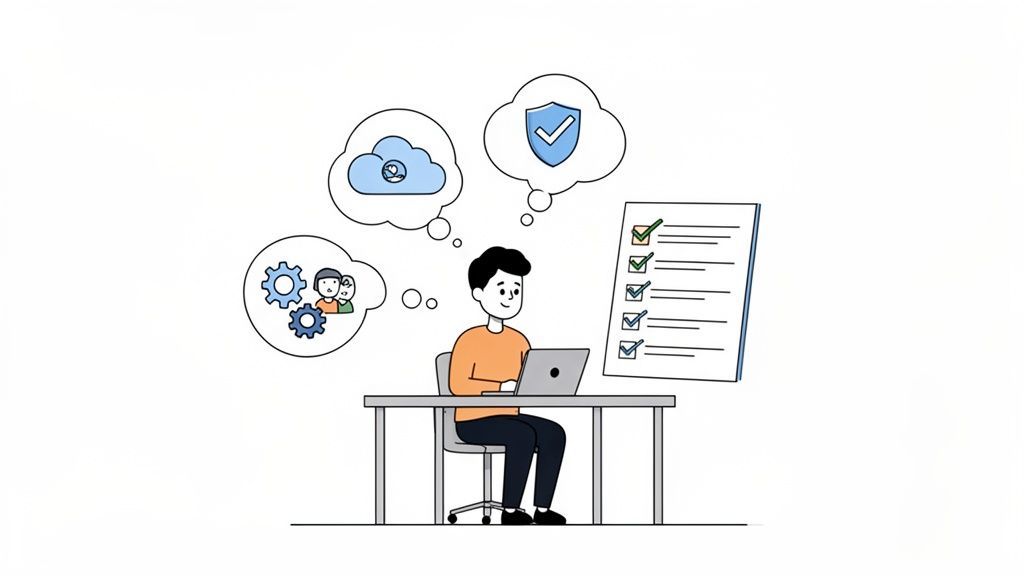
Before you even think about looking for an IT consultant in Toronto, you need to do some internal homework. Walking into vendor meetings without a clear idea of your needs is a recipe for disaster. You’ll either be sold on services you don't require or completely miss the solutions that could solve your core problems.
Taking the time for this internal audit is the most important part of the entire process. It helps you find a partner who fits your specific situation, saving you from a bad match and unexpected costs later on.
To get started, we've created a simple checklist. Use it to score your organization's IT needs across key service areas. This exercise will help you pinpoint exactly what kind of IT consultant you should be looking for.
| Service Area | Current State (1-5 Scale) | Key Questions to Consider | Potential CloudOrbis Solution |
|---|---|---|---|
| Day-to-Day Operations | Are slow systems or clunky software hurting team productivity? What are the biggest IT headaches for your staff? | Managed IT Services | |
| Remote/Hybrid Work | How effective is your remote work setup? Do employees struggle with access, collaboration, or connectivity? | Cloud Migration & Microsoft 365 | |
| IT Support | What kinds of support tickets do you see most often? Are you just fixing symptoms instead of the root cause? | Managed IT Helpdesk | |
| Cybersecurity | How confident are you in your defences against ransomware or phishing? Are you just guessing about your security posture? | Managed Cybersecurity | |
| Compliance | Do you meet industry-specific rules (e.g., PIPEDA, legal, finance)? Is your data handled according to regulations? | Compliance & vCIO Services | |
| Strategic Growth | Can your current tech support your 1- and 3-year business goals? Will it scale with you or hold you back? | vCIO & IT Strategy |
Once you've run through this checklist, you'll have a much clearer picture of your priorities. It’s the first step toward having a focused, productive conversation with a potential IT partner.
Think about the daily grind. What are the recurring technical issues that get in your team's way? It’s not just about what’s broken, it’s about what’s slowing you down.
A key part of this is knowing what kind of support you actually need. Understanding the difference is vital when choosing between helpdesk and service desk models.
A good IT consultant doesn’t just put out fires; they help you build for the future. Your technology must support your business ambitions. Where do you want to be in one, three, or five years?
If you plan to double your revenue or open a new office, can your current IT infrastructure keep up? A forward-thinking consultant will create a technology roadmap that enables your vision, ensuring IT becomes a growth driver, not a bottleneck. For business leaders, this is about shifting from reactive support to strategic partnership, a core concept in IT management consulting.
Cybersecurity isn’t just an "IT thing" anymore, it’s fundamental to business survival. A single data breach can result in massive financial losses, reputational damage, and legal trouble. You must be honest with yourself about where you stand.
Are you sure your client and business data is truly safe from threats like ransomware and sophisticated phishing attacks? More importantly, does your setup meet the compliance rules for your industry? If you’re in healthcare (PIPEDA), finance, or law, getting compliance wrong simply isn’t an option.
The demand for this expertise is high in Toronto. As of 2024, the average salary for an Information Technology (IT) Consultant here is C$88,127. Seasoned professionals can earn up to C$125,000 annually, reflecting the value businesses place on experts who can handle today’s complex digital challenges.
By documenting your operational pain points, strategic goals, and security gaps, you build a detailed scope of work. This document is your North Star, ensuring every conversation with a potential IT consultant in Toronto is productive and focused on finding the right fit for your business.
Now that you have a good handle on your business needs, it's time to sift through the IT services available in Toronto. This is about more than just picking a company; it’s about choosing the right service model. You need to look past the sales pitch and determine which approach genuinely fits your daily operations and long-term goals.
The right partnership can turn your IT from a necessary expense into a real strategic advantage. Conversely, the wrong one can lead to blown budgets, constant friction, and security vulnerabilities. Let's break down the most common service models you'll find when looking for an IT consultant in Toronto so you can make an informed choice.
Think of this as the all-in-one option. You’re essentially outsourcing your entire IT department to a single partner who takes full responsibility for everything, from daily helpdesk support and 24/7 network monitoring to long-term strategic planning and cybersecurity.
This model is a perfect fit for many medium-sized businesses, especially if you:
For instance, a busy logistics company in Toronto might choose managed IT to ensure their critical systems, like dispatch and inventory software, are always available, secure, and running at peak performance. It lets them focus on their core business, not on rebooting servers. If that sounds like your situation, you can get a better sense of how a full partnership works in our guide on selecting an IT outsourcing company.
Co-managed IT, or "Co-MITs," is about collaboration. It doesn’t replace your internal IT staff; it supports them. An external consultant comes in to fill specific gaps, bringing specialized expertise, advanced tools, or just an extra pair of hands that your team might not have.
This hybrid approach is ideal for organizations that already have a skilled IT manager or a small team but need to scale their capabilities without increasing payroll.
Key Takeaway: Co-managed IT is about partnership, not replacement. It allows your internal team to offload time-consuming tasks like helpdesk support or patch management, freeing them to focus on high-value, business-specific projects.
Imagine a construction firm with an on-site IT generalist. They could partner with a co-managed provider to handle advanced cybersecurity monitoring and cloud infrastructure, highly specialized areas where their in-house person lacks deep expertise.
Sometimes you don’t need the whole orchestra, just a specialist for a specific piece. You might have a single, well-defined project, like moving your servers to the cloud, preparing for a compliance audit, or recovering from a security incident. Specialized consulting is designed for these targeted projects.
A Toronto healthcare clinic, for example, might bring in a cybersecurity consultant for the sole purpose of conducting a PIPEDA compliance assessment and implementing the required security controls. Once the project is complete and patient data is secure, the engagement ends.
This kind of focused expertise is in high demand. We’re seeing strong hiring in Toronto's IT consulting sector, with over 106 statistical and analytics consultant roles recently posted. This signals a significant need for data-driven IT skills across the GTA, making it easier to find specialists for everything from threat detection to Microsoft Dynamics 365 optimizations.
A Virtual Chief Information Officer (vCIO) provides access to high-level strategic thinking without the hefty salary of a full-time C-suite executive. A vCIO works alongside your leadership team to ensure technology directly supports your business goals. They'll help you build a long-term IT roadmap, manage technology budgets, and ensure your investments are delivering a positive return.
This service is all about strategy, not day-to-day fixes. For a deeper dive into the selection process and what to expect when bringing in this level of expertise, this guide on Finding a Consultant for Hiring is an excellent resource. It clarifies how to integrate this role into your organization effectively.
This is where the real work begins. Every IT provider’s website looks polished, promising proactive support and strategic genius. But once you’re sitting across from them, how do you cut through the sales pitch to find a genuine partner?
It’s about more than just verifying technical skills. You need to uncover their service philosophy. Are they truly proactive, or just good at putting out fires? Coming prepared with the right questions helps you see what’s happening behind the curtain and find an IT consultant in Toronto who is genuinely invested in your success.
When you meet with a potential IT partner, move past basic pricing discussions. You’re trying to understand how they operate, what they value, and the results they deliver for businesses like yours.
Here are a few questions we always recommend asking:
These questions will give you a real sense of their experience and whether their approach aligns with your business goals.
Just as important as asking the right questions is recognizing a bad sign when you see one. A slick presentation can easily hide a disorganized operation that will cause you headaches down the road.
Key Insight: A consultant's support model reveals their business philosophy. A purely reactive team profits when you have problems. A proactive partner is invested in your stability and uptime because their success is tied to yours.
Keep an eye out for these warning signs during your evaluation:
Let's discuss the financial aspect. When you start receiving proposals from IT consultants in Toronto, the numbers can vary significantly. That's because the way a provider structures their pricing says a lot about their entire service approach. Understanding these models is key to finding a partner whose financial interests are aligned with yours.
You're not just buying a service; you're entering a partnership. The right pricing model ensures you receive real value, not just a recurring bill.
You'll typically encounter three main ways IT providers bill for their work. Each has its place, but your choice will have a big impact on your budget and the kind of support you receive.
For most growing businesses, the smartest path forward is a flat-rate managed services model. You pay one consistent monthly fee for proactive, all-inclusive support. This model aligns the provider's goals with yours, they profit when your systems run smoothly and securely, not when they're on fire.
It’s time to stop thinking of IT as just a business expense and start seeing it as a strategic investment. One of the biggest advantages of partnering with an IT consultant in Toronto is getting a whole team of specialists for less than what it would cost to hire a single expert yourself.
Consider the cost of just one specialized hire. According to a detailed salary guide, top-tier ERP Consultants in Toronto can command an average salary of $150,000, with hourly rates around $120. Even a mid-level specialist, as noted by Robert Half, will earn over $104,000, and that’s for expertise in just one area.
For a predictable monthly fee, a managed services provider gives you an entire team of experts in cybersecurity, cloud systems, network engineering, and high-level strategy. This collective knowledge delivers far more capability than any single person could. You can dig deeper into what this looks like by reading our post on what to expect from a managed IT service.
Ultimately, it’s about getting enterprise-grade IT stability and security without paying an enterprise-level price.
Signing on with a new IT partner is a significant step. The initial transition is the first real test of the relationship, and a clunky, disruptive handover can sour things from the start. A smooth onboarding isn't just about installing new software; it’s a detailed, well-managed plan that sets the tone for the entire partnership.
When you’re looking for an IT consultant in Toronto, finding one with a transparent, documented process is non-negotiable. It proves they respect your time, understand the need to keep your business running without interruption, and have the experience to manage a complex transition. A clear process is a sign of a professional and accountable partner.
A great onboarding experience is a series of well-defined phases, starting with a deep dive into your operations and ending with your team feeling confident and fully supported. A good partner will guide you through every step, keeping communication lines open.
This is where the consultant validates everything discussed during the sales process. They’ll conduct technical assessments, map your network, and speak with key staff to get a real-world view of your daily workflows and biggest pain points.
The goal is to build a rock-solid plan that covers everything, from security policies to user permissions, before making any changes in your live environment. A professional onboarding moves from strategy to execution, confirming your needs, creating a detailed project plan, implementing solutions with minimal disruption, and then transitioning smoothly into ongoing support.
A structured onboarding ensures nothing falls through the cracks and that everyone knows what’s happening and when. While every business is unique, the core stages should always include the following:
Part of this initial discovery will also involve a deep dive into costs. This diagram breaks down the common pricing models you'll encounter.
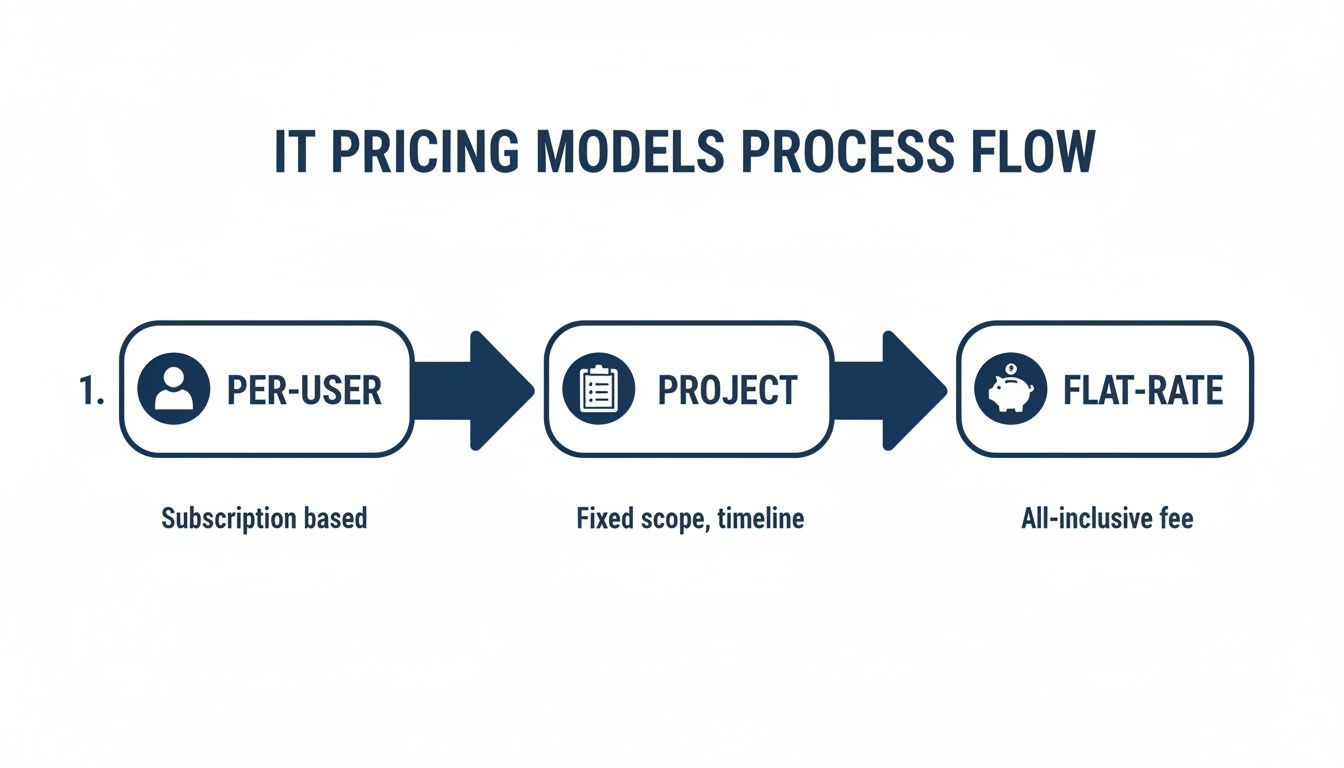
Understanding these models is critical. The right one, particularly a flat-rate model, aligns your consultant's goals with your own by prioritizing uptime and stability. A chaotic onboarding is often a sign that a provider lacks a mature, client-focused process, a major red flag for the long-term health of the partnership.
As you prepare to make a decision, it's natural to have a few last-minute questions. We've heard them all from Toronto business leaders over the years, so let's tackle some of the most common ones.
The price can vary significantly depending on how you engage a provider. A one-off project, like a major cloud migration, will usually come with a fixed price. Conversely, emergency break-fix support is almost always billed by the hour, which can get expensive fast.
Many Toronto businesses find the best value in a flat-rate managed services model. It provides a predictable monthly cost and prevents the kind of expensive downtime that cripples productivity. When you consider that the salary for a single, specialized in-house IT expert in Toronto can easily exceed $100,000, a managed service partnership often delivers a much higher return on investment.
While the lines can blur, it often comes down to the scope of the relationship. An IT consultant is typically brought in for a specific, time-sensitive project, think a cybersecurity audit, strategic planning (like a vCIO), or a complex system upgrade.
An MSP, however, is your long-term partner. They provide ongoing, comprehensive management of your entire IT environment, from day-to-day helpdesk support to 24/7 security monitoring. Many firms, including CloudOrbis, offer both, allowing you to start with a consulting project and grow into a fully managed partnership.
A key advantage of working in-house is the built-in team infrastructure. You don't have as many non-editing tasks as when you work for yourself. You can ask for help or hand off tasks. This "symbiotic quality," as one Toronto-based senior editor puts it, is what a great MSP partnership recreates, a dedicated team you can always rely on.
A proper, thorough onboarding process should take a few weeks, not a few days. Be wary of anyone promising an instant switch.
A professional provider will guide you through a multi-stage process. This includes a deep-dive discovery to understand your business, strategic planning, and a meticulous implementation, often scheduled after hours to ensure zero disruption to your team. A rushed or chaotic onboarding is a serious red flag.
This really depends on the service model you choose. For most small and mid-sized businesses, a fully managed IT plan means the provider effectively becomes your IT department, making a full-time in-house role unnecessary.
However, in a co-managed IT model, the provider works with your existing staff. This can be a powerful combination, as the consultant augments your team's skills with specialized expertise and access to enterprise-grade tools they wouldn't have otherwise.
Ready to move from IT headaches to a strategic partnership that drives growth? CloudOrbis Inc. provides proactive managed IT services, advanced cybersecurity, and strategic consulting tailored for Toronto's ambitious businesses. Our 100% Canada-based team is ready to become your competitive edge.
Book a 30-minute call with a senior engineer. No sales script, just straight answers about your environment.


