What Is a Technical Account Manager & Why You Need One
Discover what a technical account manager does, the benefits for Canadian SMBs in healthcare & manufacturing, and how this strategic IT partner drives growth.

Discover what a technical account manager does, the benefits for Canadian SMBs in healthcare & manufacturing, and how this strategic IT partner drives growth.
If you're running a clinic, a plant, a law office, or a growing back-office team, you’ve probably felt the same frustration. You buy the right tools, pay for support, and still spend too much time chasing updates, escalating recurring issues, and wondering whether your IT setup is helping the business move forward or just keeping the lights on.
That gap is where a technical account manager earns their keep.
Most business owners don’t need another person who can only speak in tickets, server names, or vendor jargon. They need someone who can translate technical risk into business impact, turn a roadmap into action, and keep support, security, compliance, and growth pointed in the same direction. In regulated Canadian industries, that role matters even more because the cost of “good enough” IT shows up fast in downtime, failed audits, workflow disruption, and delayed decisions.
A technical account manager is the general contractor for your technology infrastructure. You might have electricians, plumbers, and framers on a construction site. Someone still has to coordinate the work, sequence the tasks, spot conflicts early, and make sure the finished result supports the owner’s goals. In IT, the TAM plays that coordinating role.
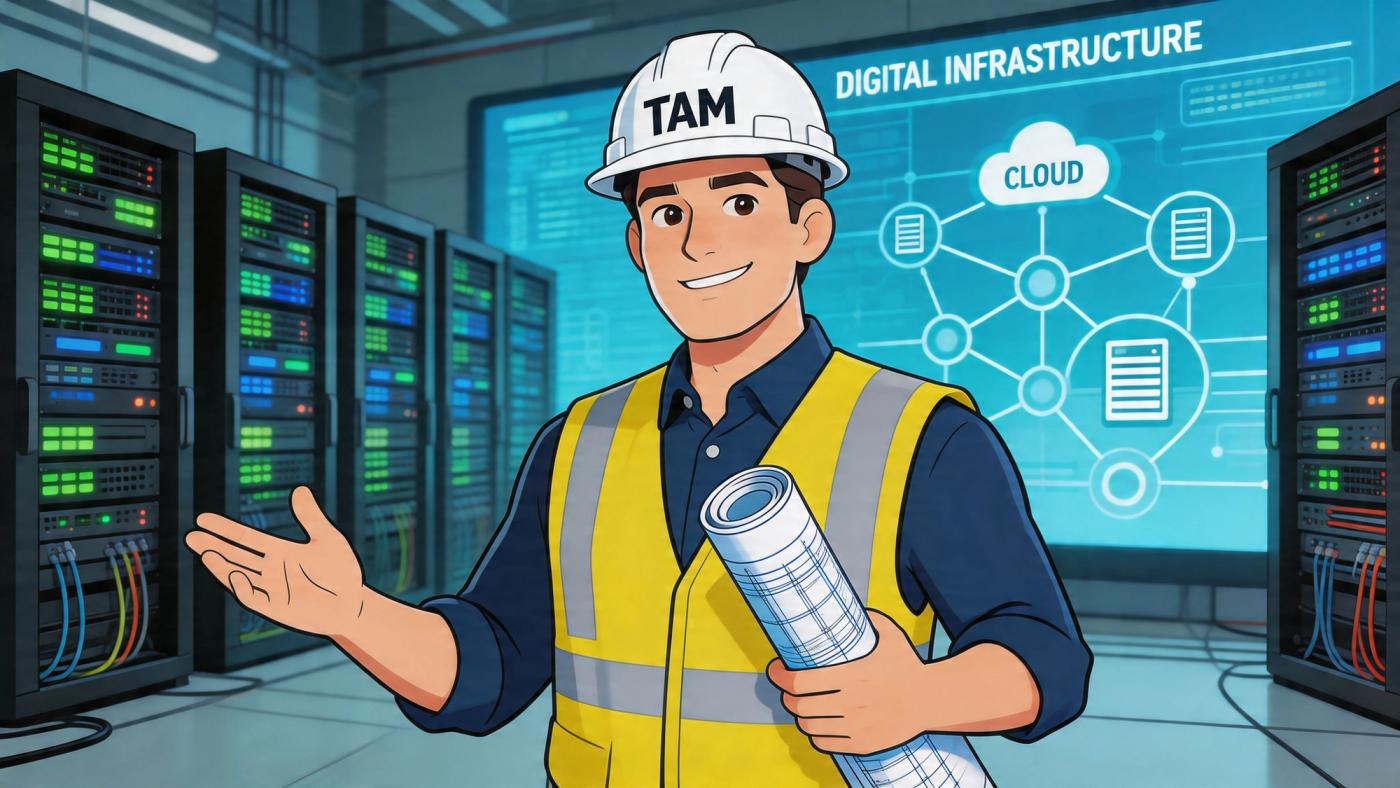
A helpdesk can solve incidents. Engineers can build solutions. Vendors can sell licences. What many organisations still lack is the person who ties those moving parts to business priorities. That’s the TAM’s core mission. They align IT decisions with what the business is striving to achieve, whether that’s smoother patient intake, more reliable production systems, safer document handling, or less disruption during expansion.
That strategic alignment is one reason the role keeps gaining traction. Firms with dedicated TAMs for SMBs in healthcare, manufacturing, and finance achieved 27% higher customer retention rates than firms without them, according to the 2023 Canadian ICT Sector Profile cited here. Retention isn’t just a service metric. It reflects whether clients feel their technology partner understands their business, prevents avoidable pain, and creates confidence over time.
The strongest TAMs don’t operate like occasional reviewers who join a quarterly call and disappear. They function as an embedded advisor who understands your systems, your pressure points, your compliance exposure, and your growth plans.
That usually means they do four things at once:
Practical rule: If your IT provider knows how to fix a problem but doesn’t know which problem matters most to your business, you don’t have strategic account management. You have reactive support.
For many SMB leaders, this is also the difference between managed services and managed outcomes. A business can buy managed IT services and still feel unsupported if nobody owns the bigger picture. The TAM fills that ownership gap.
At a business level, a TAM protects continuity. They reduce the chance that your Microsoft 365 rollout, cybersecurity controls, cloud migration, VoIP setup, endpoint policies, and compliance requirements all move on separate tracks.
When that role is missing, companies often get fragmented decisions. Security tightens in one area but blocks workflow in another. A migration goes ahead before training is in place. The helpdesk resolves the same class of issue repeatedly because nobody has authority to step back and fix the pattern.
A good TAM keeps technology from becoming a series of disconnected projects. They turn it into a managed business capability.
On paper, the job can sound broad. In practice, the work usually falls into two buckets. One is proactive planning. The other is high-level reactive coordination when something important goes wrong.
A technical account manager primarily generates long-term value in this manner. Good TAMs spend less time waiting for trouble and more time reducing the chance that trouble becomes expensive.
A TAM isn’t the person resetting passwords or closing basic access tickets. They step in when the issue is bigger than the incident itself.
A useful test is simple. After a serious issue, does anyone own the prevention plan, or does everyone just move on to the next ticket?
That ownership matters most when support is busy. A capable TAM works closely with the operational team but isn’t swallowed by day-to-day queue pressure. They preserve the strategic view while still helping direct immediate action. That’s one reason businesses with a dedicated managed help desk often get more value when a TAM is attached to the relationship.
Some organisations assign the title without the function. The result is a role that behaves like a sales contact with a technical vocabulary. That doesn’t help much.
A TAM isn’t effective if they only appear at renewal time, can’t challenge poor-fit technology decisions, or don’t have enough technical depth to coordinate engineers. The job works when the person has both business judgement and enough credibility to influence architecture, security, support, and vendor conversations.
A technical account manager matters most when the environment is messy, regulated, or operationally unforgiving. That’s why the role stands out in Canadian sectors such as healthcare, manufacturing, logistics, legal, and finance.

A clinic doesn’t just need systems that work. It needs systems that are secure, predictable, and compliant without slowing staff down. That’s harder than it sounds.
A common scenario looks like this. The practice has Microsoft 365, endpoint protection, some remote access, and a backup product. On paper, that sounds mature. In reality, permissions have drifted, mobile devices aren’t governed consistently, and nobody has connected monitoring, response, and policy enforcement into one operating model.
That gap is widespread. 68% of small Canadian healthcare practices report cybersecurity gaps, which is why TAMs play such an important role in bridging proactive monitoring with PHIPA and HIPAA-aligned requirements, as noted in this Canadian healthcare TAM overview.
A good TAM closes that gap by tying technical controls to actual clinic workflows. They work through questions such as:
In healthcare, the wrong IT decision often fails twice. First in security, then again in staff workflow.
Manufacturing leaders usually care less about technical elegance than operational reliability. Fair enough. If production systems, warehouse access, VoIP, or cloud-connected tools lag or fail, the business feels it immediately.
A TAM earns trust not merely by asking whether a system is available, but by inquiring what happens to production, shipping, inventory, customer commitments, and floor communication when it isn’t.
One plant may need tighter endpoint controls around shared workstations. Another may need a phased cloud approach because a hard cutover would create too much operational risk. Another may need better coordination between network changes and plant schedules. The TAM turns those realities into a practical plan instead of a generic “modernisation” pitch.
For firms in this space, industry-specific support matters. Businesses looking at IT support for manufacturers often discover the core issue isn’t only support speed. It’s whether someone understands the dependency chain between production uptime, user access, cybersecurity, and vendor coordination.
Legal and financial teams live with a different kind of pressure. Their reputational risk often sits inside document access, audit readiness, secure collaboration, and staff handling of sensitive information.
A TAM helps by reducing silent exposure. They review permission structure, retention policies, endpoint controls, and collaboration settings through the lens of how the firm works. That usually means balancing stronger controls with realistic user behaviour. If security is too rigid, staff find side routes. If it’s too loose, risk accumulates unnoticed.
The business value here is simple. Better control, fewer surprises, and clearer decisions about where to invest next.
Confusion around the technical account manager role is common because several jobs touch the client relationship from different angles. The difference comes down to scope, depth, and accountability.
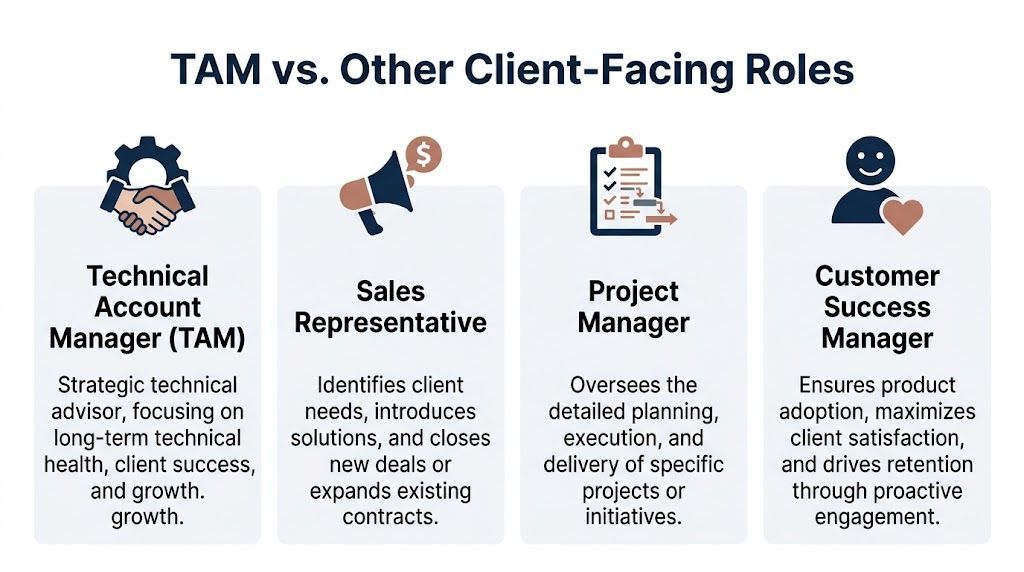
An account manager protects the commercial relationship. A customer success manager drives adoption and satisfaction. A helpdesk technician resolves immediate user issues. A technical account manager sits where technical strategy and business continuity meet.
That overlap is why businesses sometimes assume the TAM is redundant. Usually, the opposite is true. Without the TAM, important work gets split across roles that each see only one part of the picture.
| Role | Primary Focus | Key Activities | Success Metric |
|---|---|---|---|
| Technical Account Manager | Long-term technical health aligned to business goals | Roadmaps, escalation oversight, risk reviews, optimisation, business translation | Stable operations, reduced risk, stronger alignment between IT and growth |
| Account Manager / Sales Representative | Commercial relationship and solution fit | Renewals, pricing, proposals, expansion discussions | Revenue growth, retention of contract value |
| Project Manager | Delivery of a defined initiative | Plans, milestones, stakeholder coordination, deployment tracking | Project delivered on scope and schedule |
| Customer Success Manager | Product adoption and satisfaction | Check-ins, onboarding support, usage guidance, engagement | Adoption, satisfaction, continued usage |
| Helpdesk Technician | Immediate issue resolution | Troubleshooting, access requests, device support, incident handling | Resolution quality and service responsiveness |
Some firms ask an account manager to play technical strategist. Others expect the helpdesk to surface long-range risk while they’re buried in daily incidents. Some rely on a project manager after implementation and then wonder who owns continuity once the project closes.
If no one owns the long-term technical relationship, the business drifts from project to project without a true operating strategy.
This is also why the TAM pairs well with advisory models such as fractional IT leadership. The fractional leader may shape executive direction. The TAM helps operationalise that direction day to day, connect it to support reality, and keep momentum from fading between leadership meetings.
A technical account manager shouldn’t be measured by activity alone. More meetings, more tickets touched, or more recommendations written don’t automatically mean more value. The useful KPIs are the ones that show whether the business is safer, steadier, and easier to scale.
Retention is one of the cleanest indicators because it captures trust over time. If the client keeps the relationship and expands it, that usually reflects confidence in both advice and execution.
Client feedback matters too, but it should be structured. If you’re refining your own scorecards, this guide on how to measure customer experience is useful because it separates sentiment from actionable signals. For a TAM, feedback should ask whether the client feels informed, prepared, and strategically supported, not just whether support was polite.
One of the strongest TAM KPIs is a measurable reduction in incident impact. In oil and gas, TAM-led cybersecurity initiatives have delivered a 78% reduction in ransomware recovery time, from 14 days to 3, according to this analysis of the TAM role in technology and business success.
That kind of metric matters because it reflects more than fast technical work. It suggests planning, architecture, response readiness, and cross-team coordination were already in place before the incident occurred.
A TAM also creates value when users adopt the right tools in the right way. That doesn’t mean forcing every new feature into production. It means improving uptake where adoption supports workflow, security, or visibility.
Useful questions include:
The best KPI set mixes business outcomes with operational leading indicators. If you only measure satisfaction, you miss technical drift. If you only measure incidents, you miss whether the relationship is helping the business grow.
If you’re hiring a technical account manager directly, or evaluating one through a service partner, look for a person who can move comfortably between technical detail and business judgement. That combination is harder to find than many organisations expect.
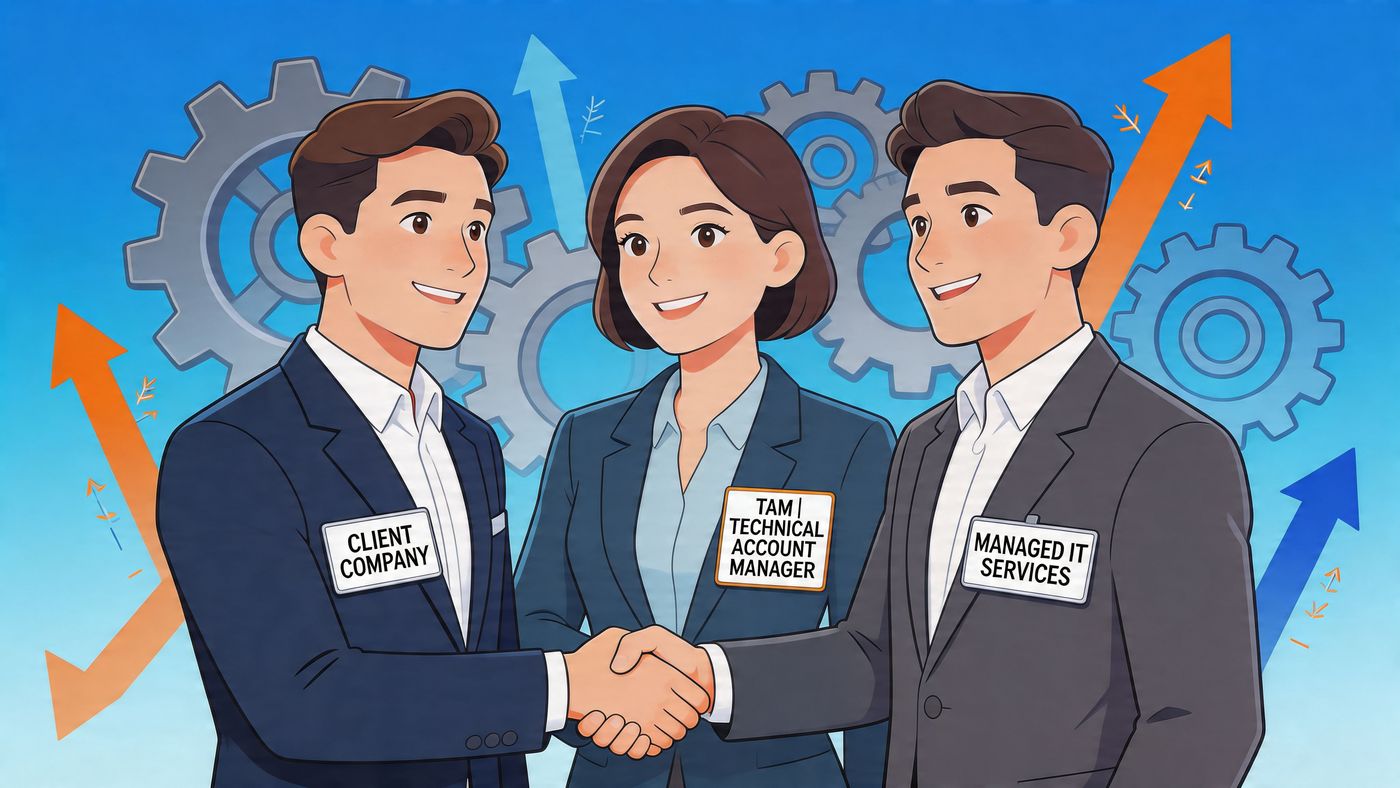
The market reflects that demand. For specialised Canadian sectors such as oil and gas in Alberta, the role is expanding into co-managed IT and AI optimisation. U.S. TAM salaries average $97k, while Canadian equivalents command $110k to $140k, according to this salary comparison for technical account managers.
Technical depth matters, but it isn’t enough on its own. A high-impact TAM should also be able to challenge assumptions, prioritise trade-offs, and communicate clearly with non-technical leaders.
Strong signs include:
Use open questions that force judgement, not memorisation.
The best answers show prioritisation, restraint, and the ability to connect technical choices to business reality.
If you’re building a broader hiring process, these talent acquisition best practices are a solid companion resource because they help structure evaluation beyond a résumé and a strong first conversation.
Even a strong TAM underperforms if the business keeps them at arm’s length. Give them access to business context early. Include them in planning discussions around expansion, compliance changes, office moves, or workflow redesign. Share what “success” means inside the company.
The partnership works best when the TAM isn’t treated as a vendor contact who gets copied after decisions are made. They should be involved before major choices lock in cost, risk, and complexity.
The value of a technical account manager comes from continuity, judgement, and follow-through. When the role is integrated properly, you don’t just get someone who understands your systems. You get someone who keeps support, security, cloud decisions, compliance needs, and business priorities aligned over time.
That’s why this role works best when it’s part of the service model rather than an add-on. In a structured engagement, the TAM helps carry the client from assessment through strategy, implementation, optimisation, and ongoing review. They make sure technical recommendations stay connected to what leadership is trying to achieve, and they give the business a consistent, informed point of accountability.
That approach also depends on the kind of qualities strong teams value in any strategic operator. This short piece on 10 great employee characteristics is useful because many of the same traits apply here, especially judgement, communication, adaptability, and ownership.
If your organisation wants that kind of guidance built into a broader service relationship, explore managed IT services from CloudOrbis.
CloudOrbis Inc. helps Canadian SMBs turn IT from a recurring frustration into a managed growth asset. If you need a technical account manager who can align support, cybersecurity, cloud, compliance, and long-term planning, contact CloudOrbis Inc. to start the conversation.
Book a 30-minute call with a senior engineer. No sales script, just straight answers about your environment.


