

September 22, 2026
Security Audit Services Guide for SMBs in CanadaDiscover why security audit services are vital for Canadian SMBs. Explore typical scope, deliverables, timelines, and tips to choose the right provider.
Read Full Post%20(1).webp)
Usman Malik
Chief Executive Officer
March 26, 2026

When most people think of IT support, they picture a help desk that exists to fix things when they break. A managed help desk is different. It’s a service where you partner with a specialized third-party provider to handle all your team's technical issues.
This team moves far beyond just fixing problems. They become a strategic partner focused on keeping your business running smoothly and fuelling its growth.
Think of your IT support less like a reactive queue of problems and more like a professional pit crew for your business. A pit crew doesn't just sit around waiting for a tire to blow; they are constantly monitoring engine performance, tweaking fuel efficiency, and spotting issues before they can slow the car down.
That’s exactly how a modern managed help desk works. It’s a complete shift away from the old-fashioned idea of an outsourced call centre that just logs tickets and fixes whatever is broken. Instead, a true help desk partner integrates right into your daily operations, empowering your team with instant, expert support that keeps business moving.
This proactive approach is what turns IT from a necessary cost into a powerful driver of productivity and business continuity.
To understand the difference, it helps to see a direct comparison. Here's a quick look at how a managed help desk stacks up against a traditional internal IT team across key business functions.
| Feature | In-House IT Team | Managed Help Desk |
|---|---|---|
| Availability | Typically limited to business hours (9-to-5) | Often 24/7/365, including holidays |
| Cost Model | Fixed overhead (salaries, benefits, training) | Predictable monthly subscription fee |
| Expertise | Limited to the skills of a small internal team | Access to a broad team of certified specialists |
| Focus | Juggles daily support with long-term projects | Dedicated to resolving user issues quickly |
| Proactive Care | Often reactive due to workload | Focuses on prevention and continuous monitoring |
| Scalability | Difficult to scale up or down quickly | Easily scalable to match business needs |
While an in-house team can offer deep institutional knowledge, a managed help desk provides unmatched flexibility, round-the-clock availability, and a wider range of expertise without the high overhead.
The old break-fix IT model forces your business into a constant state of reaction. An issue pops up, an employee loses valuable time creating a ticket, and then everyone waits for a fix while productivity grinds to a halt. A managed help desk flips this entire model on its head.
The focus shifts to preventing problems before they ever start. This is achieved through:
This transformation is more critical than ever. Recent threat intelligence shows that cybercriminals are increasingly targeting help desks as an entry point to compromise entire organizations. A proactive partner doesn't just resolve user issues—they actively harden these entry points against attack. You can learn more about this proactive approach in our article comparing in-house IT and managed IT support services.
A managed help desk is less about closing tickets and more about opening opportunities. By taking the day-to-day technical burdens off your plate, it frees your team to focus on high-value initiatives that drive real innovation and revenue.
Ultimately, the right partner does not just solve problems. They optimize performance, strengthen your security posture, and provide the reliable technological foundation your business needs to thrive.
So, what does a managed help desk look like in action? Let's go behind the curtain to understand the daily workflow. Seeing how it operates day-to-day clarifies how this service is much more than a simple fix-it line—it’s a strategic part of your business. The entire process is built for efficiency, clarity, and most importantly, getting your team back to work with minimal disruption.
It all begins the moment an employee hits an IT snag. It could be anything—a software glitch, a printer that won’t cooperate, or a spotty network connection. Instead of wasting valuable time figuring out who to call, they have a single, direct path to immediate support.
The first step has to be as simple and frictionless as possible. Your team can usually reach out for help through several channels, which means support is always just a few clicks or a call away.
Once a request is submitted, it does not just sit in a long queue. An automated system immediately gets to work, categorizing and prioritizing the ticket based on its urgency and business impact. This kicks off a structured, immediate response.
This is where a combination of smart automation and human expertise really shines. For common, high-volume requests like a password reset or granting software access, AI-powered systems can often provide an instant resolution, getting your employee back to their tasks in minutes.
More complex problems are escalated seamlessly. The ticket is intelligently routed to a specialized technician with the exact skills needed for that specific issue. This tiered approach ensures that simple problems are solved quickly without tying up senior engineers, who can then focus their energy on tackling the bigger, more difficult challenges. It's a world away from the old-school single queue where everyone just waits their turn.
The journey to resolution starts the second the ticket is logged. The goal is to transform IT support from a frustrating bottleneck into an engine for business growth.
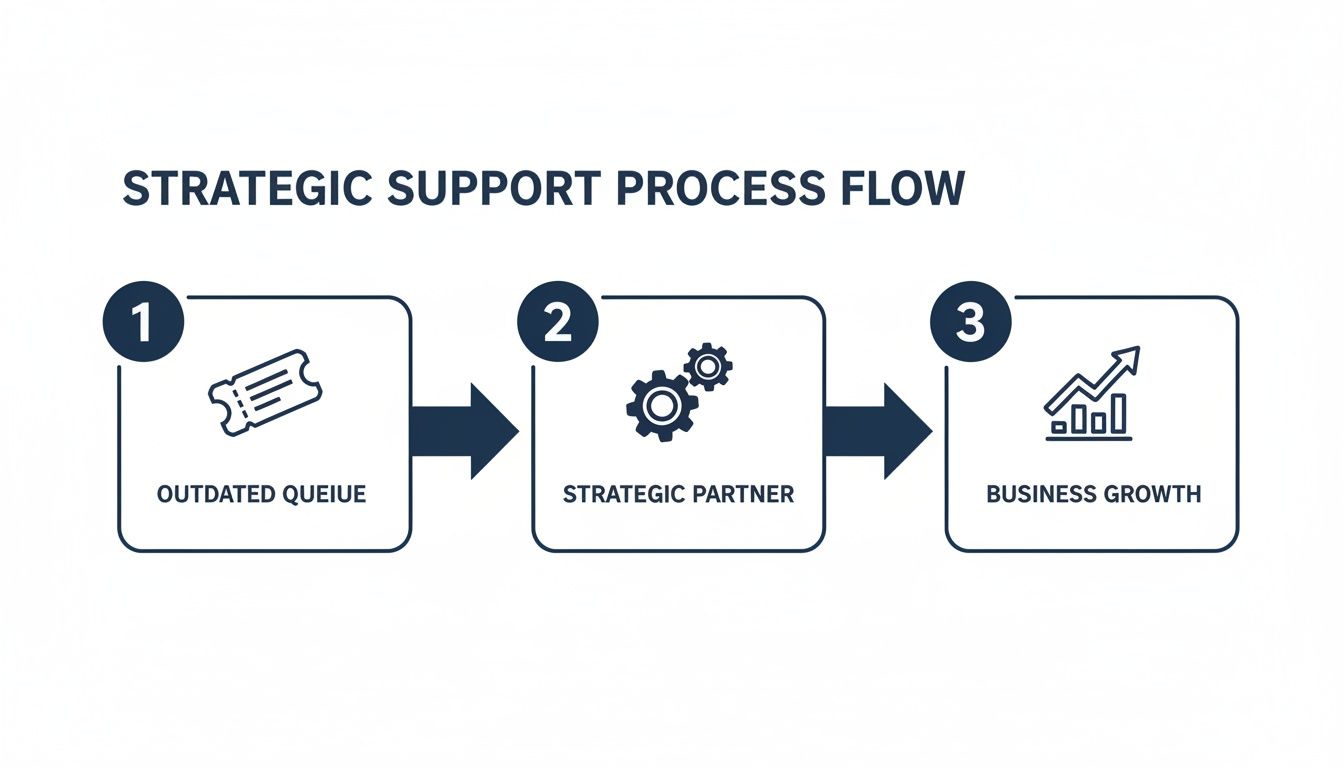
A truly effective managed help desk does more than just wait for things to break. Some of the most valuable work happens quietly in the background, focused on preventing issues from ever disrupting your business in the first place. This involves continuous, 24/7 system monitoring.
A proactive help desk operates on a simple principle: find and fix potential problems before they can impact your people or your profits. This shifts your IT from a reactive, firefighting mode to one of pre-emptive optimization.
This is where you start to see the real strategic value. A managed service provider uses advanced tools to keep a close eye on the health and performance of your entire IT infrastructure. You can learn more about how this works in our guide on remote monitoring and management.
For example, they can spot a server that’s about to run out of storage space, notice unusual network traffic that might signal a security threat, or identify a piece of hardware that’s starting to fail before it actually goes offline. By getting ahead of these issues, they prevent costly downtime and keep your operations running smoothly.
This proactive stance is quickly becoming the new standard in Canada. In fact, 50% of mid-market companies already outsource their help desk operations, and 91% plan to either maintain or increase this trend. By 2026, help desks will be judged not just on speed, but on their proven ability to boost productivity and ensure business continuity. Moving beyond a reactive ticket system to a more strategic approach, often supplemented by resources like outsourced call center solutions, is the key to getting there.
Choosing a partner for your managed help desk is easily one of the most important IT decisions you’ll make. The reality is, not all providers are created equal, and the differences in service quality can directly impact your team's productivity and your company's security.
To make the right call, you need to know which features are non-negotiable. These are the elements that separate a true IT partner from a basic, reactive service. When you're evaluating your options, it's vital to realize why a careful selection of an outsourcing partner is critical for hitting your long-term business goals.
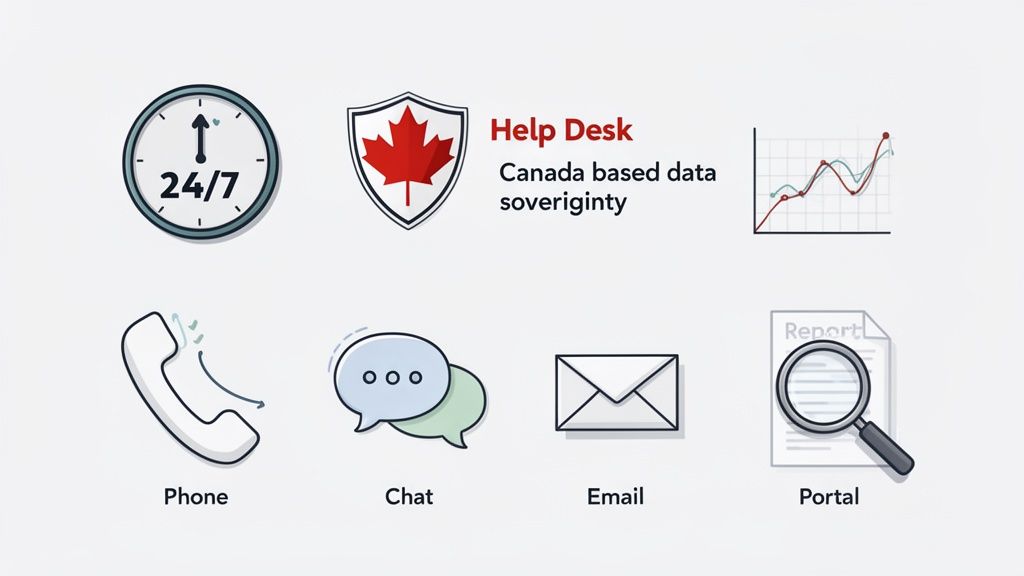
The 9-to-5 workday is a thing of the past. With remote teams, flexible hours, and clients across different time zones, your business needs IT support that never sleeps. That's why 24/7/365 availability should be at the very top of your list.
A critical system failure or a security incident will not wait for standard office hours. Having to wait until the next morning for a fix is not just an inconvenience—it can lead to serious financial losses and damage your hard-earned reputation. A partner offering round-the-clock support means urgent issues get addressed immediately, keeping downtime to a minimum.
Where your support team is located matters far more than you might think. Insisting on a 100% Canada-based team is about much more than just clear communication; it’s a matter of security, compliance, and accountability.
When your IT support is managed entirely within Canada, you gain peace of mind knowing your sensitive business data is protected under strict Canadian privacy laws, including PIPEDA. This helps ensure data sovereignty and simplifies your compliance efforts.
A local team also means no frustrating language barriers or cultural misunderstandings. Your employees get clear, concise help from technicians who understand the nuances of the Canadian business landscape. You can learn more about how CloudOrbis delivers this standard of service through our Canada-based IT helpdesk support.
Your employees need help that meets them where they work. A top-tier managed help desk partner gives your team multiple, easy-to-use ways to get support, creating a frictionless experience.
Essential support channels should include:
This multi-channel approach empowers your staff to use the method that works best for them, which is a simple way to boost both efficiency and user satisfaction.
A truly great help desk partner does not just sit back and wait for things to break. They actively work to prevent problems before they start. Proactive system monitoring is one of the most valuable features you can get, as it helps identify and resolve potential issues before they can impact your business.
This involves keeping an eye out for security vulnerabilities, monitoring server health, and making sure all your software is up to date. This is especially vital today, as cybercriminals increasingly target help desks as a gateway to an entire network.
Finally, your partner must provide transparent reporting. These reports should give you a clear, data-driven overview of your IT environment’s health, ticket trends, and performance against Service Level Agreements (SLAs). This transparency builds trust and shows you the tangible value your partner delivers every single day.
When you sign on with a managed help desk, how do you actually know you’re getting the performance and value you paid for? The answer is in the Service Level Agreement (SLA). But an SLA is much more than a technical document—it's a commitment from your provider, outlining specific, measurable standards of service.
The problem is, many SLAs are packed with jargon that can make your head spin. To really gauge the success of your partnership, you need to cut through the noise and focus on the key performance indicators (KPIs) that directly impact your business. These metrics tell the real story of your provider's performance.
To properly evaluate your managed help desk, you only need to focus on a few core metrics. These KPIs paint a clear, data-driven picture of how effectively your provider is supporting your team and protecting your bottom line. They show you not just how busy your provider is, but how effective they are.
Three of the most important metrics to watch are:
A strong SLA doesn't just promise fast response times; it guarantees effective resolutions that keep your business moving. When evaluating a managed help desk, ensure their KPIs are aligned with your strategic goals, like minimizing employee downtime and maximizing productivity.
Understanding these numbers is so important because they connect directly to real-world business results. A high FCR score means your employees get back to work faster. A low MTTR slashes the cost of lost productivity.
Picture this scenario: An employee’s essential software crashes right in the middle of a critical project.
This is the tangible difference a focus on the right KPIs makes. High CSAT scores are not just nice to have; they signal a support service that is actively helping your team succeed. For business leaders in competitive Canadian markets, a reliable support system is a major advantage. If you're looking for support, our guide on choosing an MSP in Edmonton offers insights that apply right across the country.
Ultimately, a great managed service provider uses SLAs and KPIs not just to report on their activity, but to prove their value. They deliver transparent reports showing exactly how their performance contributes to your success, turning your IT support from a cost centre into a true strategic asset.
A modern managed help desk is about much more than just quick fixes for tech problems. Think of it as a genuine competitive advantage, one that can transform your IT from a frustrating cost centre into a strategic asset that actually drives your business forward. For Canadian small and mid-sized businesses (SMBs), finding the right partner unlocks real, measurable benefits that directly boost your bottom line, tighten up security, and clear the way for growth.
This is not just a passing trend. The Canadian managed services market is seeing huge adoption for a reason. Projections show the sector growing from an estimated USD $24.5 billion in 2025 to an incredible USD $52.1 billion by 2033. This massive shift shows that Canadian businesses are getting smart about offloading routine IT management to specialists, freeing up their own teams to focus on innovation.
One of the first and most powerful benefits you'll notice is the impact on your budget. Building and running an effective in-house IT department is a serious financial undertaking, and the costs go far beyond just salaries.
When you start adding up recruitment fees, benefits, continuous training, expensive certifications, and the specialized software needed to do the job right, the total investment can become overwhelming. A managed help desk sweeps away all those unpredictable and climbing costs, replacing them with a single, predictable monthly fee.
This model gives you access to an entire team of certified experts for a fraction of what it would cost to hire even a single senior IT professional. The math is simple: you get enterprise-level support without the enterprise-level price tag.
Business is never a straight line. You might hit a period of rapid growth, deal with seasonal rushes, or need to tighten the belt during slower times. An in-house IT team offers almost no flexibility—you're stuck with that fixed overhead no matter what your immediate needs are.
A managed help desk, on the other hand, is designed for exactly this kind of change. You can easily scale your support services up or down as your business evolves.
This ability to adapt on the fly means you only ever pay for what you actually need, turning your IT support into a flexible operational expense instead of a rigid capital one. You can explore a deeper dive into the strategic value and ROI in our article on the benefits of managed IT services.
In an age of relentless cyber threats, a strong security posture is not just a "nice-to-have"—it's non-negotiable. A dedicated managed services partner brings specialized security expertise that most SMBs simply cannot afford to build and maintain on their own. They make sure your systems are consistently patched, monitored 24/7 for threats, and kept in line with Canadian data privacy laws like PIPEDA.
For Canadian businesses, a managed help desk acts as a powerful line of defence. It ensures your data stays within Canada, your systems are hardened against attack, and your compliance obligations are met, mitigating significant financial and reputational risk.
Perhaps the most valuable benefit is the one that’s hardest to put a number on: freedom. When you and your leadership team are no longer distracted by constant IT headaches and firefighting, you can pour that energy back into what really moves the needle—innovation, customer relationships, and strategic growth.
Instead of troubleshooting network glitches or managing software updates, you can focus on developing new services, entering new markets, and building your business. A reliable managed help desk gives you peace of mind, knowing your technology is not just working, but actively supporting your vision for the future.

The help desk of tomorrow is intelligent and predictive, thanks to Artificial Intelligence. But AI is not here to replace human experts. Instead, it’s making them better, creating a hyper-efficient support system by pairing machine intelligence with human skill. This partnership is completely changing what’s possible for a managed help desk.
The most immediate impact is on high-volume, repetitive tasks. Think about how much time is lost to simple issues like password resets, software access requests, or basic troubleshooting. AI-powered automation handles these instantly, giving your team immediate answers without needing to log a ticket and wait for a technician.
This frees up our skilled Canadian IT professionals to focus on what they do best: solving the complex, strategic challenges that demand critical thinking and deep expertise. Rather than getting bogged down in routine requests, they can focus on optimizing your systems and strengthening your security.
Beyond simple automation, AI gives a managed help desk powerful predictive abilities. By analyzing patterns and data from across your entire IT environment, AI algorithms can spot potential problems long before they ever affect your team.
This could be anything from identifying a server that’s starting to underperform to flagging unusual network activity that might signal a brewing security threat. It’s like a pit crew noticing a tiny vibration in an engine and fixing it before it fails mid-race.
Partnering with an AI-forward provider is essential for future-proofing your business. It allows you to move from a reactive support model to a proactive one, where issues are resolved before they cause operational drag or security risks.
This proactive approach is fast becoming the standard for modern IT. In fact, 87% of managed service providers plan to increase their AI investments by 2026. This push is driving real productivity gains, with service desk automation expected to cut ticket volume by 40-60%. Meanwhile, AI agents are delivering resolution times 3x faster for common issues. You can explore more on these trends in recent managed service provider findings.
In the world of cybersecurity, AI is a genuine game-changer. Cybercriminals are using increasingly sophisticated methods, and traditional security tools often struggle to keep pace. An AI-augmented managed help desk adds a critical layer of defence.
AI systems can analyze massive amounts of data in real-time, detecting anomalies that would be impossible for a human to spot. This allows for proactive threat detection and a much faster response to potential attacks. For instance, by recognizing patterns associated with groups like Scattered Spider—who often target help desks to gain initial access—an AI system can flag and block suspicious activity instantly.
By combining the analytical power of AI with the strategic oversight of human security experts, your business gets a far more resilient defence system. This partnership is no longer a luxury—it's a necessity for protecting your data against modern threats.
Deciding to partner with a managed help desk naturally brings up a few key questions. For Canadian business leaders, it comes down to understanding what this partnership really means for their budget, their control over IT, and their day-to-day work. Getting clear, straightforward answers is the only way to make a confident choice.
Pricing is almost always a predictable monthly fee, typically structured per-user or per-device. This model makes budgeting simple and gets rid of any nasty surprises. Your final cost will depend on the specifics, like whether you need 24/7 support or just coverage during business hours.
While it is a recurring operational expense, it’s consistently more cost-effective than trying to fund an entire in-house IT department. Once you factor in the high costs of salaries, benefits, continuous training, and specialized software tools, a managed help desk almost always delivers a clearer and more significant return on investment.
Quite the opposite. A great partnership actually gives you more control by providing far better visibility into your IT environment. You are not just handing over the keys and walking away; you're bringing on a strategic ally.
A common misconception is that outsourcing means losing control. In reality, it means gaining focus. You retain full strategic command while your provider handles the day-to-day execution, freeing you to concentrate on the bigger picture.
Through detailed performance reports and regular strategy meetings, you get clear insights into IT performance, your security posture, and overall user satisfaction. You absolutely remain in the driver's seat for all strategic decisions.
A professional provider makes sure the transition is seamless. The entire goal is to avoid any interruption to your business while immediately upgrading the quality of your support from day one.
At CloudOrbis, we follow a proven onboarding process that kicks off with a thorough assessment of your current IT setup. From there, we create a detailed migration plan, handle all the technical heavy lifting, and provide training for your team on how to use the new support system. Our process is designed for zero business disruption and an instant improvement in support quality.
Ready to see how a strategic IT partnership can transform your business? The team at CloudOrbis Inc. provides a 100% Canada-based, 24/7 managed help desk designed to boost your productivity, strengthen your security, and give you back the freedom to focus on growth. Learn more about our proactive approach to managed IT services.
September 22, 2026
Security Audit Services Guide for SMBs in CanadaDiscover why security audit services are vital for Canadian SMBs. Explore typical scope, deliverables, timelines, and tips to choose the right provider.
Read Full Post
September 21, 2026
Secure File Sharing Guide for Canadian BusinessesLearn secure file sharing essentials for Canadian SMBs — encryption, compliance, protocols and best practices to protect data and stay compliant.
Read Full Post
September 20, 2026
Disaster Recovery Plan Business Continuity for SMBsBuild a disaster recovery plan business continuity strategy tailored for Canadian SMBs. Covers risk assessment, RTO/RPO, backup, testing, and ownership.
Read Full Post
