
September 22, 2026
Security Audit Services Guide for SMBs in CanadaDiscover why security audit services are vital for Canadian SMBs. Explore typical scope, deliverables, timelines, and tips to choose the right provider.
Read Full Post%20(1).webp)
Usman Malik
Chief Executive Officer
August 8, 2026
In North America, 4.16% of employees clicked simulated phishing emails, 1.71% submitted forms, 0.39% opened attachments, and only 10.91% reported the message in the 2025 benchmark dataset, drawn from more than 750,000 simulated clicks and more than 250,000 password submissions (Fortra's 2025 Phishing Simulation Benchmark Report). That is why I don't treat phishing simulation as a scorecard. I treat it as a behaviour-change programme, because the job is to get people to report faster, hesitate earlier, and make fewer risky mistakes when the pressure is real.
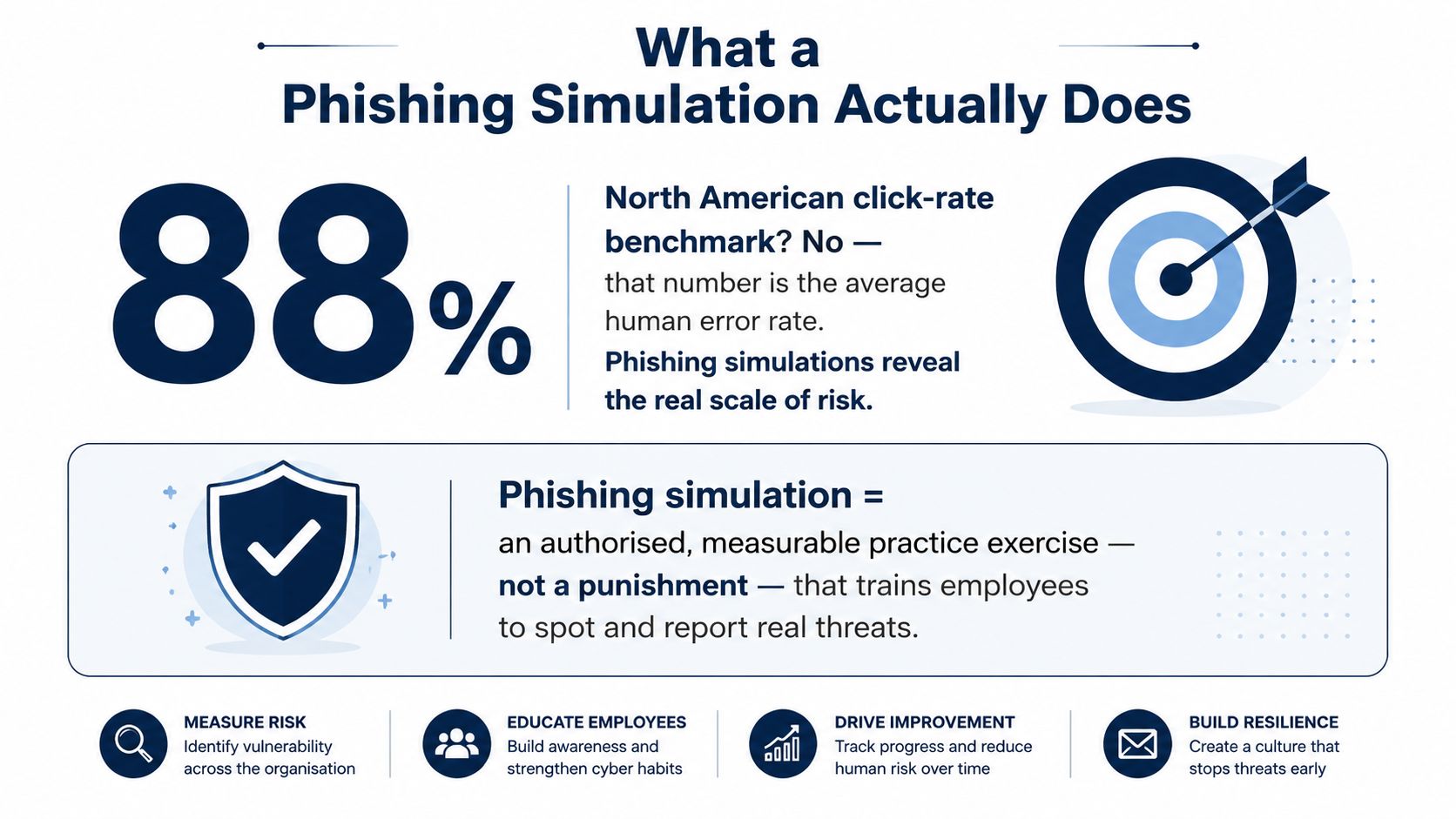
A phishing simulation is an authorised, measurable practice exercise that tests whether employees can recognise and report a fake attack before it becomes a real one (PMC article on phishing simulation mechanics). It works like a fire drill for email, except the risk is social engineering and the exit route is the report button, not the stairwell. The point is not to humiliate staff or build a scoreboard. The point is to change behaviour so people pause, verify, and report when something looks wrong.
A lot of SMBs still frame phishing simulation as a click-rate exercise. That misses the job. Clicks matter, but only because they show where people are still vulnerable to urgency, authority, and distraction. In a Canadian business, that matters for more than cyber hygiene. It ties directly to PIPEDA, Law 25, and sector rules such as HIPAA and PHIPA, because a staff member who mishandles a message can trigger a privacy issue just as fast as a security one.
The North American benchmark matters because it shows how common risky reactions still are. A 4.16% click rate is not a badge of honour, and a 10.91% report rate means many organisations still need to make reporting the default habit. Those numbers tell you where the behaviour gap is, not where to stop.
Practical rule: if your phishing simulation only tells you who failed, you've built a trap, not a training loop.
That is the mindset shift I push with SMBs. One-off awareness emails are easy to ignore. Repeated simulations, paired with immediate feedback, build the habit that changes outcomes. If you want the surrounding email controls to match that habit, a solid email security best practices guide gives you the baseline rules that make simulation work better.
Phishing also does not stay in the inbox. A simple test can expose weak approval habits, rushed payment checks, and sloppy reporting lines that affect more than email. If you want a broader reminder that the problem extends beyond one message type, protect your Atlanta business from hackers is a useful reminder that phishing sits inside a wider attack surface, not apart from it. Value of simulation is that it trains people to respond under pressure, with the report button becoming a normal reflex instead of an afterthought.
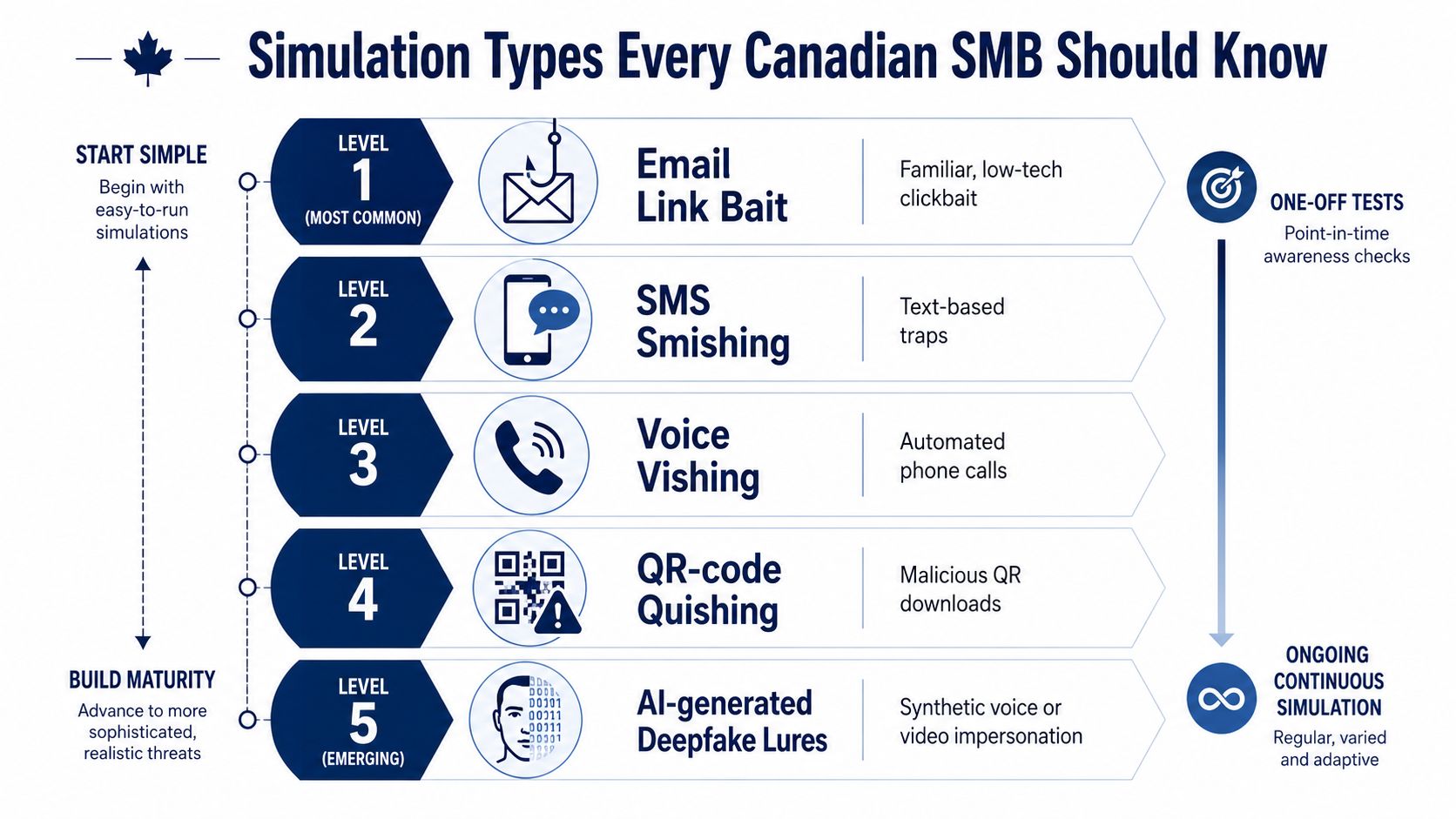
The basic email lure is still the starting point, but it's no longer the full picture. Most SMBs begin with link bait because it's familiar and easy to explain to staff. That's fine, but a serious programme doesn't stop there. Today's attackers use SMS smishing, voice vishing, QR-code quishing, and even AI-generated deepfake lures, so your simulations need to reflect that reality.
A useful way to think about this is as a progression, not a menu of gimmicks. One-off tests can show you an initial weakness, but continuous simulation builds muscle memory. Proofpoint said customers sent 135 million+ simulated phishing attacks in 2022, up from 96 million in 2021, and that volume tells you this has moved well beyond novelty (Proofpoint's State of the Phish 2023).
Start with email link bait because it teaches the core habit, then widen the channels. SMS is a better test for mobile-heavy teams. Voice lures work well for executive support, finance, and reception staff, where a quick phone call can still bypass caution. QR-code tests matter because people scan first and think later. AI-crafted lures and deepfake-style pretexts are the emerging edge, and they're exactly where static annual training falls apart.
Good simulations teach recognition, not paranoia. If a programme makes people suspicious of every message, it's failed on trust even if the click rate looks lower.
Your vendor should be able to show how it handles all of these without turning the office into a circus. Ask whether campaigns are customized to your industry or just recycled templates with a logo swap. A generic test might catch carelessness once. A relevant simulation teaches people what your actual business threats look like, which is a much better use of everyone's time.
The right question isn't “How many traps can we set?” It's “Which attack paths do our staff face, and which ones do we need to practise before the actual incident occurs?” That's the difference between theatre and risk reduction.
The business case is simple. A single convincing lure can give an attacker a foothold, expose credentials, or push your team into incident response when they should be doing real work. The cost goes beyond IT. It shows up as lost time, interrupted operations, difficult client conversations, and, in regulated sectors, privacy review and reporting obligations that consume management attention.
KnowBe4's benchmarking research found a global phish-prone percentage of 33.1%, while North America was 37.1% before training. Later reporting cited an 86% reduction in phishing susceptibility after security awareness training, from 33.1% down to 4.1% (KnowBe4 research summary). That is the number owners and boards need to understand. Training and simulation are not soft extras. They are one of the few controls that can change human behaviour at scale.
Healthcare, legal, and finance teams do not get to brush off one bad click. A stolen credential can lead to account abuse, privilege escalation, client exposure, or a privacy incident that drags on for weeks. In Canada, that can mean PIPEDA questions, Law 25 scrutiny, and sector-specific obligations under frameworks such as HIPAA or PHIPA when they apply to your business. The technical blast radius may be limited. The reputational fallout usually is not.
The old mindset says, “We already did awareness training once this year.” That is not enough. Human risk does not reset after a slide deck. If you are spending money on endpoint protection, backups, and Microsoft 365 hardening while staff behaviour stays untested, you are betting the business on luck.
A board does not need a lecture on phishing templates. It needs to know whether people report suspicious messages early enough to reduce damage.
That is the investment logic. A phishing simulation programme is worth paying for because it builds staff habits that lower incident frequency and shorten response time. It also gives you evidence for leadership and audit conversations, especially when you need to show that privacy and security controls are more than policy statements on paper. For a practical way to connect training to business outcomes, CloudOrbis' data security and privacy guidance and how to measure training effectiveness are useful companion reads if you are building a reporting pack for leadership.
If you want the owner-level summary, use this: phishing simulation is worth it when it reduces risky behaviour, raises reporting behaviour, and keeps small mistakes from becoming larger incidents. That is a better return than hoping annual awareness training will somehow stick on its own.
The most effective programmes are simple enough to run and strict enough to measure. I'd start with a quarterly cadence for most SMBs, then add lighter monthly refreshers for high-risk roles or repeat clickers. Weekly testing can be powerful, but it's a stronger operational lift, and the evidence says it pays off when you keep it frequent and consistent. Groups doing weekly phishing tests were 2.74 times more effective at reducing risk than groups testing less than quarterly, and users receiving both monthly-or-more-frequent training and weekly-or-more-frequent simulated phishing tests improved their Phish-prone Percentage by 96% compared with less-trained groups (KnowBe4 white paper).
Start by defining scope and goals. Decide which departments matter most, what behaviour you want to change, and what counts as a useful report. Then run a baseline test that reflects an ordinary threat, not a ridiculous trap. If someone clicks, deliver coaching immediately. The research is clear that timing matters more than fancy content, and training given immediately after a click can reduce susceptibility by an average of 40% (SoSafe summary of a 2024 meta-analysis).
Use that moment well. The person who clicked should see a short explanation, not a shame screen. HR or the office manager can handle the communication tone, while IT makes sure the report button works and the campaign data is clean. Monthly refreshers can be light and role-based, then a quarterly retest shows whether the behaviour is changing.
Use CloudOrbis's security awareness training guidance if you want a practical companion to the campaign itself. The best teams I've worked with don't chase perfection. They build a repeatable loop that gets easier to manage over time.
A phishing simulation policy has to respect privacy law from day one. At the federal level, PIPEDA sets the baseline for personal information handling. If you have Quebec-based staff or data, Law 25 raises the bar on consent, transparency, and rights handling. In healthcare, PHIPA and, where relevant, HIPAA expectations for Canadian clinics serving US patients add another layer of care. The practical rule is simple. Don't collect more data than you need, and don't use simulation results as a disciplinary weapon.
Your one-page policy should cover opt-out handling, what data you capture, how long you keep it, and who can see it. It should also say, in plain language, that simulation results are for training and risk reduction, not punishment. That matters because shame kills reporting. If people think a click gets them in trouble, they'll hide mistakes instead of escalating real threats.
There's also a privacy boundary around monitoring. Overly intrusive tracking can create its own complaint risk, especially if you start treating every action as a surveillance event. Keep the data minimised. A report that tells you who clicked, who reported, and when is usually enough to improve the programme without building a shadow HR file.
Practical rule: if your policy would make a reasonable employee feel watched instead of trained, it's too aggressive.
For organisations still trying to map the privacy side, CloudOrbis's data security and privacy guide is a sensible internal reference point. The goal isn't to turn cybersecurity into legal theatre. It's to make sure your simulations are defensible, respectful, and aligned with the way Canadian organisations handle staff data.
If you operate in healthcare, legal services, or finance, get a privacy review before launch. Not after. A clean policy protects both the programme and the people in it.
Click rate is a weak executive metric on its own. It shows who interacted with a lure, but it does not show whether the organisation is getting safer. I want a balanced scorecard that includes click rate, report rate, time-to-report, repeat-offender rate, and training completion rate. If you only report one thing, make it the report rate, because that is the clearest sign that people are learning to escalate suspicious messages instead of freezing or ignoring them.
Leadership also needs context around the volume and consistency of the programme. Proofpoint's reporting shows how quickly simulated attacks can scale, which is a reminder that these programs need steady cadence, rotating content, and clean reporting. A clunky internal process usually collapses under that operational load.
| Metric | What it tells you | How to use it |
|---|---|---|
| Report rate | Whether staff recognise and escalate suspicious messages | Treat it as a leading indicator of resilience |
| Time-to-report | How quickly employees act after spotting risk | Shorter is better, because it limits damage |
| Repeat-offender rate | Whether the same people need more coaching | Use it for support, not shaming |
| Training completion rate | Whether the learning loop is actually being consumed | Pair it with behaviour data, not in isolation |
| Click rate | Whether the lure worked | Keep it, but don't worship it |
A one-page executive brief works better than a long report. Owners want to know whether the team is getting safer and whether the programme is causing friction. HR wants to know whether staff feel ambushed. IT wants to know whether the report process is useful. If the answers are clear, the next campaign gets easier to approve.
For a practical framework on turning training data into leadership-ready reporting, CloudOrbis's analytics and reporting article is a good internal cross-reference. For a more complete view of training impact, use how to measure training effectiveness alongside your phishing results. The rule I use is blunt. If leadership cannot read the result in under two minutes, the report is too complicated.
| Criterion | In-House Tool | Managed Provider |
|---|---|---|
| Setup effort | Your team configures templates, users, and reporting | The provider handles campaign design and rollout |
| Expertise required | Someone internal has to understand the programme deeply | You use experience from people who run these campaigns often |
| Time-to-first-campaign | Usually slower, because you're learning as you go | Faster, because the process is already defined |
| Tuning and follow-up | Easy to postpone when the team gets busy | More consistent if the provider owns the cadence |
| Integration with Microsoft 365 and endpoint tools | Possible, but usually requires more internal lifting | Usually easier when the partner already works in that stack |
| Sustained reporting | Can slip when staff change roles or get overloaded | More stable if the provider manages the workflow |
A self-service platform can work if you have someone with time, attention to detail, and a real interest in the human side of security. Most SMBs do not have that spare capacity. They have an IT generalist, an office manager, or a stretched internal lead trying to keep the lights on while also running the programme.
That is why I am blunt about punitive cultures. ISACA warns that simulations should not be punitive, and Microsoft's guidance pushes you to define what to measure, aggregate it properly, and focus on how training affects susceptibility rather than treating a single click as the whole story. If your programme needs shame to work, it is not working.
A good partner does not just send fake phish. It helps you turn the results into a safer routine your staff can live with.
A managed security partner earns its keep by keeping the cadence steady, the follow-up consistent, and the reporting useful for owners, HR, and IT. For Canadian SMBs, that matters because phishing simulation is a behaviour-change programme, not a click-rate scoreboard, and the work has to fit real-world privacy and compliance obligations under PIPEDA, Law 25, and sector rules such as HIPAA or PHIPA where they apply. If you want the programme tied to broader managed IT and security operations, start with a managed security partner that can keep the whole loop honest after launch week, not just during the first campaign.
If you want a phishing simulation programme that fits a Canadian SMB, not a theory deck, CloudOrbis Inc. can help design the cadence, policy, and reporting loop around your actual business. Visit CloudOrbis Inc. to talk through a practical, behaviour-focused approach that supports training, privacy, and day-to-day operations without turning security into theatre.
September 22, 2026
Security Audit Services Guide for SMBs in CanadaDiscover why security audit services are vital for Canadian SMBs. Explore typical scope, deliverables, timelines, and tips to choose the right provider.
Read Full Post
September 21, 2026
Secure File Sharing Guide for Canadian BusinessesLearn secure file sharing essentials for Canadian SMBs — encryption, compliance, protocols and best practices to protect data and stay compliant.
Read Full Post
September 20, 2026
Disaster Recovery Plan Business Continuity for SMBsBuild a disaster recovery plan business continuity strategy tailored for Canadian SMBs. Covers risk assessment, RTO/RPO, backup, testing, and ownership.
Read Full Post
