MSP Calgary: How to Choose the Right IT Partner for Your Business
Discover MSP Calgary options and learn how to assess your needs, compare pricing, and ask the right questions to secure your IT future.

Discover MSP Calgary options and learn how to assess your needs, compare pricing, and ask the right questions to secure your IT future.

For any growing business in Calgary, a Managed Service Provider (MSP) should be far more than just an IT helpdesk. They are a strategic partner, an expert in your corner helping you drive growth, security, and efficiency. The right MSP Calgary partner delivers proactive cybersecurity, scalable cloud infrastructure, and the kind of expert guidance that turns technology into a true competitive advantage.
In Calgary's fast-paced economic environment, the old break-fix model for IT support simply doesn't work anymore. Waiting for something to crash before calling for help is a recipe for disaster, leading to unpredictable costs, frustrating downtime, and significant security risks. Today, businesses across every major sector, from energy and logistics to professional services, need a proactive technology partner to stay competitive.
This is exactly where a managed service provider comes in. An MSP’s role is to shift your business from reactive troubleshooting to proactive management. Instead of just fixing problems as they arise, a genuine partner works to align your technology with your business goals, ensuring your IT infrastructure actively fuels your growth.

A strategic MSP fundamentally changes how you view your IT, transforming it from a necessary expense into a powerful asset. This shift is critical, especially in a city undergoing a significant technological boom. Alberta’s tech sector added a staggering $13 billion to the provincial GDP in 2023, and employment in the sector has grown nearly four times faster than the rest of the province over the last decade.
This growth is part of a province-wide $20 billion investment in digital transformation, creating incredible opportunities while also increasing competition.
An MSP helps you get ahead of the curve by providing:
The real value of a modern MSP isn't just in keeping the lights on. It’s about providing the strategic insight and robust infrastructure that allows Calgary businesses to innovate, scale, and thrive securely in a competitive market.
A truly comprehensive IT partner will also help you manage the entire lifecycle of your IT assets, all the way through to secure IT asset disposition. This ensures that from the moment you purchase a device to the day you retire it, your technology is managed efficiently and securely, protecting both your data and your bottom line.
When you find the right provider, you're not just hiring a vendor; you're gaining a team genuinely dedicated to your success.
Learn more about how a strategic partnership can benefit your organization by exploring our Calgary IT services in more detail.
Engaging with potential MSPs without a clear picture of what you need is like going grocery shopping without a list. You might come back with something, but it likely won't be what your business actually needs to thrive.
A successful partnership begins with an honest self-assessment. This isn't about becoming an IT expert overnight. It's about translating your team's daily experiences, both good and bad, into a clear set of requirements. When you map out your challenges and goals first, you can lead conversations with clarity and find a Calgary MSP partner who truly understands your vision.
Start by looking at the recurring frustrations that slow your team down. These are the persistent issues that interrupt workflow, drain productivity, and often signal deeper problems. Focus on the business impact, not just the technical terms.
We see many common pain points with Calgary businesses before they partner with us. Do any of these sound familiar?
Taking the time to document these frustrations gives you a powerful tool. When you speak with a potential MSP, you won't just be asking for "IT support"; you'll be presenting a clear list of business problems that need solving.
Once you’ve pinpointed the day-to-day pains, it’s time to look at the bigger picture. This is where you evaluate what you have versus what you need to operate both efficiently and securely. You don’t need to be a cybersecurity expert; just think critically about your current setup.
A great way to approach this is by asking targeted questions. For instance, a healthcare clinic in Calgary must prioritize patient data privacy, while a construction firm needs rock-solid technology for its field crews.
Use this checklist as a starting point:
The final piece is to look ahead. Where do you want your business to be in the next one, three, or five years? Your technology should be helping you get there, not holding you back. Defining your future goals ensures you choose an MSP that can scale with you.
Think about strategic objectives like:
This process, discovery, assessment, and goal-setting, is fundamental. To dive deeper into this crucial first step, learn more about the importance of achieving true business technology alignment and how it sets the stage for a successful partnership.
Armed with this comprehensive understanding, you are now ready to start evaluating providers.
Understanding how Managed Service Providers (MSPs) charge for their services can feel like cracking a code. You’ll see terms like per-user fees, tiered packages, and à la carte options, and it’s easy to get lost in the details. However, grasping these structures is key to finding a partner that delivers real value, not just a low quote that swells with hidden fees later.
For most business leaders, the goal is simple: predictable, all-inclusive pricing that covers everything from day-to-day helpdesk tickets to robust cybersecurity. This kind of flat-fee model shifts your IT from an unpredictable expense into a stable, manageable investment. It’s a world away from the old break-fix approach, where you were on the hook for a new bill every time you needed help.
As you begin discussions with MSPs in Calgary, you’ll encounter a few standard pricing models. Each has its place, and the best fit depends on your company’s specific needs, team size, and future growth plans.
Here’s a quick rundown of what you’re likely to see:
This survey of local businesses highlights why a comprehensive plan is so important.
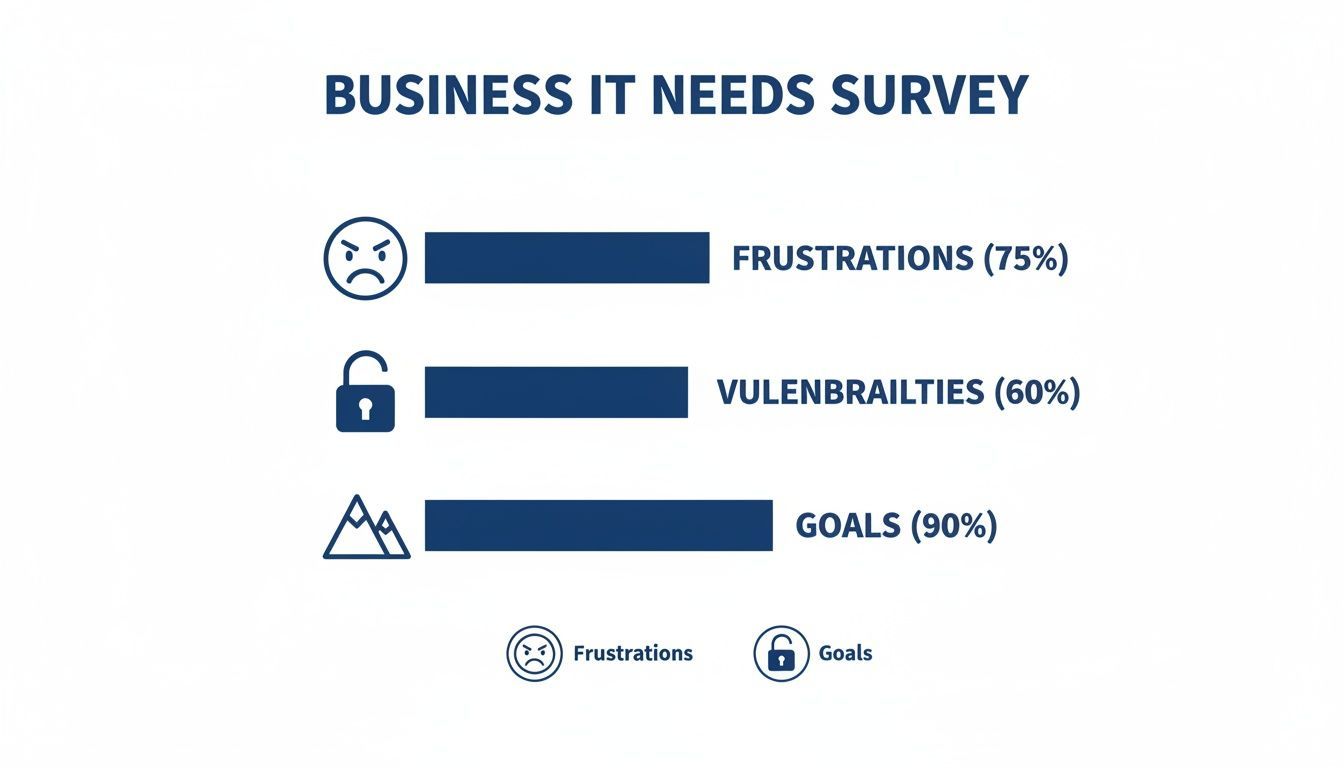
While daily tech frustrations often prompt the initial call, it’s the bigger concerns, like security gaps and achieving growth targets, that drive the search for a true IT partner.
A common conversation with business leaders is about the return on investment. The monthly fee for an MSP can seem high until you compare it against the real cost of hiring an in-house IT professional.
Let’s look at the numbers. In Calgary's competitive market, a good managed IT services in Calgary plan will typically range between $95 and $150 per user per month. For a company with 25 employees, you're looking at a predictable monthly investment.
Now, let's compare that to hiring just one internal IT manager.
| Cost Factor | In-House IT Manager | Managed Service Provider (MSP) |
|---|---|---|
| Annual Salary | $85,000 | Included |
| Benefits & Overhead (EI, CPP, WCB @ ~25%) | $21,250 | Included |
| Training & Certifications | $5,000 | Included |
| Recruitment & Onboarding Costs | $10,000 (First Year) | $0 |
| Tools & Software (Monitoring, Security, Ticketing) | $12,000 | Included |
| MSP Monthly Fee (@ $125/user for 25 users) | N/A | $37,500 (Annually) |
| Total Annual Cost | $133,250 | $37,500 |
The difference is stark. For less than a third of the cost of one IT generalist, you get access to an entire team of specialists, cybersecurity pros, network engineers, and cloud experts. That breadth of expertise is something a single internal hire cannot match.
As you review proposals, you need to know what to watch for to avoid surprise charges down the line. A transparent partner will be upfront about what is and isn't covered in your monthly fee.
Make sure to ask about potential extra costs for things like:
A clear, comprehensive agreement is the bedrock of a good partnership. It protects both parties and sets clear expectations from day one.
Choosing a managed service provider is a major business decision. This isn't just about hiring another vendor; you're bringing on a long-term partner who will have deep access to your most critical systems and data. To get this right, you need to go beyond a simple price comparison. You need to conduct a thorough interview.
Think of the following questions as an interview guide designed to cut through the sales pitch. This will help you probe their technical skills, understand their service philosophy, and gauge their strategic vision. Their answers will reveal whether they are a true partner invested in your growth or just another supplier.

Let's start where it matters most: their technology and security protocols. Vague, general answers are a major red flag. A competent MSP will have no problem being transparent about the tools they use to protect and manage their clients.
Get straight to the point and ask them:
These questions cut through marketing jargon and get to the core of their technical abilities. The goal is simple: confirm they have the real-world infrastructure to keep your business secure and running.
Even the most advanced technology is useless without a great team behind it. The quality of an MSP's support will directly impact your own team's productivity. This is where you find out how responsive and operationally mature they really are.
Dig into their service model with these questions:
A provider's support structure is a direct reflection of how much they value their clients. A well-organized, responsive, and locally-based team is non-negotiable for any business that depends on its technology.
Finally, you need to know if they can be a strategic partner, not just a reactive helpdesk. You need a forward-thinking provider who offers real guidance and helps align your tech with your business goals. To learn more about what separates a basic supplier from a true partner, check out our guide on selecting from different types of managed IT service companies.
These questions will reveal their strategic value:
Asking these tough questions head-on will give you the clarity you need to make an informed decision. It’s how you find an MSP in Calgary that doesn't just fix today's problems but actively helps you build a more resilient and successful business for tomorrow.
Not all managed services are created equal. The term itself is broad, and what one provider calls “all-inclusive” might be another’s basic offering. To find a true partner for your Calgary business, you have to look past marketing claims and get a real sense of their technical capabilities.
This means digging into their core services, identifying their specializations, and seeing if they’re aligned with how modern businesses operate. You need a partner who thinks in terms of proactive security and cloud-first solutions, not just maintaining legacy servers. For any business trying to stay competitive in Alberta’s dynamic economy, that distinction is everything.
Before you consider advanced offerings, you need to confirm the provider has the fundamentals locked down. These are the foundational services that keep your business secure, online, and productive day in and day out.
Any MSP worth considering should deliver the following without hesitation:
These services are the bedrock of any solid IT partnership. If a provider can’t clearly explain and demonstrate their strengths here, they are not equipped to support a modern business.
Once you’ve confirmed the fundamentals are in place, it’s time to look at the skills that will help your business grow and innovate. For most Calgary companies, this means finding an MSP with real, hands-on experience in cloud technology, modern communication tools, and the key business applications you rely on. This is where you separate generalists from true specialists.
The push toward digitization in Canada is significant. Cloud deployments are on track to make up 56.10% of Canada's $136.69 billion ICT market revenue by 2025. This trend is especially strong among small and mid-sized businesses, which makes a potential partner’s cloud and SaaS expertise a critical point to investigate. You can read more about Canada's ICT market growth to get a sense of the scale here.
A forward-thinking MSP doesn't just manage the tech you have now; they give you a clear roadmap to modernize it. Their expertise in cloud migration and platform optimization is what turns your IT from a cost centre into a real strategic asset.
You should be looking for specific, demonstrable experience in the areas that matter most to your day-to-day operations.
Ultimately, vetting a provider's technical expertise is all about alignment. You need to ensure their skills, tools, and strategic vision are perfectly in sync with where your business is today, and where you plan on taking it tomorrow.
Switching IT providers can feel like a daunting, disruptive undertaking, but it doesn't have to be. A professional MSP in Calgary makes the transition smooth and strategic, turning a potential headache into a well-managed project.
A great onboarding process is more than just flipping a switch. It’s a carefully managed project designed to minimize downtime, prevent data loss, and set a strong foundation for a long-term partnership. The entire process should feel transparent and collaborative from the very first meeting, ensuring your operations continue without a hitch while your new IT partner becomes deeply acquainted with your environment.
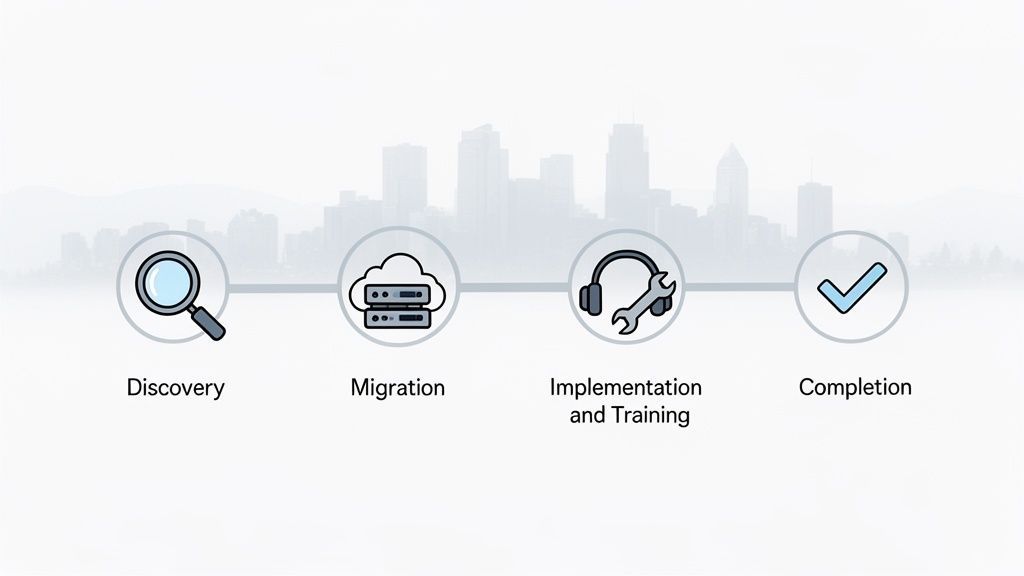
The real work begins long before any technical changes are made. This first phase is all about deep-dive discovery, where the MSP’s team works to understand every corner of your IT infrastructure. Think of it as a full-system diagnostic.
It involves a thorough network and security assessment to identify vulnerabilities, outdated hardware, and opportunities for improvement. This initial audit is critical. It allows the MSP to build a detailed and customized migration plan that addresses your specific needs and business goals. They should work directly with you to establish clear timelines, define key milestones, and outline exactly what to expect at each stage, ensuring no surprises.
With a solid plan in place, the technical migration can begin. This is where a top-tier MSP truly shines, executing the plan with precision to avoid disrupting your team. They’ll handle all the heavy lifting, from deploying monitoring agents and setting up security tools to migrating your critical data.
A structured migration plan typically includes:
A seamless onboarding experience is a direct reflection of an MSP's technical skill and operational maturity. It should feel like a well-rehearsed performance, not a chaotic scramble, giving you confidence from day one.
The final, crucial step is empowering your team. Your new MSP partner should provide crystal-clear instructions on how to submit a support ticket, who to contact for help, and what new tools or processes are in place.
This often includes a brief training session to ensure everyone feels comfortable and confident with the new support system. A great onboarding process concludes with a formal handover, where both teams agree that the transition is complete and the new support model is fully active. This structured approach is what separates a true partner from a simple vendor, ensuring your business is supported effectively from the moment you sign the agreement.
Engaging in a partnership with a managed service provider is a significant step, and it’s natural to have questions. To provide clarity, we’ve put together answers to the most common queries we hear from Calgary business leaders as they weigh their IT support options.
A well-managed switch to a new MSP usually takes between 30 and 90 days. The exact timeline depends on the complexity of your current IT setup.
A professional provider won't rush this process. Instead, they’ll guide you through a structured onboarding plan that starts with a deep dive into your systems, followed by careful planning and a phased implementation. The goal is always a smooth cutover that causes minimal disruption to your team's workday, a seamless transition, not a stressful one.
Absolutely. In fact, this is a common and effective setup we call a co-managed IT model.
In this scenario, the MSP typically handles foundational, time-consuming tasks like 24/7 network monitoring, cybersecurity defence, and daily helpdesk tickets. This frees up your internal IT experts to stop firefighting and start focusing on high-value, strategic projects that move the business forward. It's a hybrid approach that gives you the best of both worlds: specialized external expertise combined with dedicated internal knowledge.
Scalability is one of the biggest reasons businesses partner with an MSP in Calgary. Instead of going through the slow and expensive process of hiring new IT staff every time you grow, you can simply adjust your service plan.
Whether you're bringing on five new employees, opening another office, or adopting new cloud technology, your MSP can scale your support, licences, and security up or down almost instantly. This agility ensures your technology is always an asset to your growth, never a roadblock.
At CloudOrbis Inc., we provide the strategic IT partnership that Calgary businesses need to thrive. If you're ready to move beyond reactive IT support and build a secure, efficient, and scalable technology foundation, we’re here to help. Get in touch with us today to start the conversation.
Book a 30-minute call with a senior engineer. No sales script, just straight answers about your environment.


