Finding the Right IT Support Calgary Businesses Rely On
Discover how to choose the right IT support Calgary businesses trust. This guide covers service models, key services, and how to vet the perfect IT partner.

Discover how to choose the right IT support Calgary businesses trust. This guide covers service models, key services, and how to vet the perfect IT partner.

For any Calgary business serious about growth, relying on yesterday's IT support model is no longer a viable strategy. It’s time to move past the reactive, break-fix cycle and embrace a proactive, strategic partnership. This means finding a provider who doesn't just put out fires but actively prevents them, ensuring your technology is an engine for growth, not a source of constant headaches.
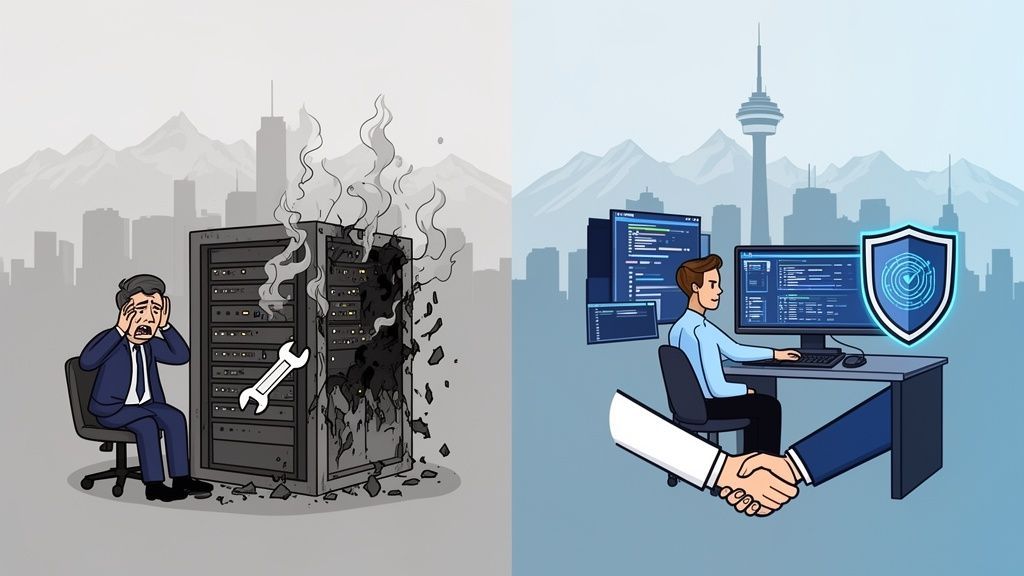
In Calgary's fast-paced business landscape, the traditional "break-fix" IT model is a recipe for disruption. This approach means you only call for help after a critical system has failed, leading to expensive downtime, lost productivity, and significant stress for your team. It’s the equivalent of waiting for a fire alarm before considering fire safety.
Modern businesses require a more forward-thinking approach. Strategic IT support is about partnership and prevention. Instead of reacting to emergencies, a dedicated IT partner continuously monitors your systems, identifies potential weaknesses, and addresses issues before they can disrupt your operations.
The fundamental difference lies in the mindset. A break-fix provider profits from your problems. A strategic partner, however, is invested in your stability and success. This shift is critical in a city that is rapidly cementing its place on the economic map.
Calgary's tech sector has experienced remarkable growth, becoming one of North America's fastest-growing tech hubs. Between 2021 and 2024, the city’s tech workforce expanded by an impressive 61.1 per cent, creating 24,500 new jobs. This level of growth demands a robust IT infrastructure that can scale effectively.
With this economic boom comes fierce competition. Calgary businesses can no longer afford the chaos caused by an unexpected server crash or a security breach. A proactive approach ensures your technology provides a competitive edge, not a handicap.
Consider a mid-sized manufacturing firm in Calgary operating on tight production schedules. Under a break-fix model, a server failure could bring their entire assembly line to a halt for hours, or even days. The financial consequences would be severe, including:
Now, imagine that same scenario with a strategic IT partner. This provider would have implemented 24/7 monitoring, detecting early warning signs of a failing server weeks in advance. They would schedule maintenance during off-hours, replace the faulty hardware before it fails, and ensure all backup systems are operational.
By preventing the failure from ever happening, the strategic partner transforms IT from a chaotic, unpredictable expense into a reliable operational asset. That’s the core value of moving beyond just fixing what’s broken.
This preventive philosophy is at the heart of modern IT management. For a closer look at how this works in practice, our guide on proactive IT maintenance in Calgary offers valuable insights. Ultimately, the right IT support in Calgary doesn't just solve problems, it anticipates them, giving your business the stability and security it needs to thrive.
Finding the right IT partnership begins with understanding the available options. Not every business requires the same level of support, and the best model for your Calgary company depends on your internal resources, business goals, and budget.
Making the wrong choice can lead to significant frustration and unexpected costs. The right fit, however, becomes a solid foundation for growth. Let's examine the most common service models to determine where your organization fits.
This is the most hands-off approach for your business and the most hands-on for your provider. With a fully managed model, you are essentially outsourcing your entire IT department. Your provider assumes full responsibility for everything, from daily helpdesk tickets and data backups to long-term strategic planning and network security.
A small Calgary-based law firm with no in-house tech expert is a perfect candidate. They require secure, compliant, and consistently operational systems, but lack the staff or expertise to manage them internally. A fully managed provider delivers enterprise-grade support for a predictable monthly fee.
This model is ideal for organizations that want to focus completely on their core business without being distracted by technology management. It transforms IT into a simple, predictable operational expense.
The co-managed or "co-MITs" model is a hybrid approach, creating a powerful partnership between your internal IT team and an external provider. It is not about replacing your employees; it’s about augmenting their capabilities.
Your IT staff can continue to handle the day-to-day tasks they know best, while the provider fills in the gaps with specialized expertise, advanced tools, and additional resources when needed.
Consider a mid-sized logistics company in Calgary with a small, two-person IT team. They are proficient at resolving immediate user issues but may lack the specialized skills for advanced cybersecurity or a complex cloud migration. A co-managed partner can provide 24/7 network monitoring and security expertise, freeing up the internal team to focus on strategic, business-specific projects.
If you are weighing your options, this guide on staff augmentation vs. managed services offers valuable insights. This approach allows you to scale your IT capabilities without the high cost of hiring more full-time specialists.
As the name suggests, the break-fix model is purely reactive. You request assistance only when something breaks and pay for the service on an hourly or per-incident basis.
While it may seem like the most affordable option initially, it often becomes the most expensive in the long run. Unpredictable costs and the high price of downtime can accumulate quickly. This model might be suitable for a micro-business with minimal IT needs, but it is a risky strategy for any company that relies on technology to operate.
Every minute of downtime is a minute of lost productivity and revenue. With break-fix, you are always one failure away from a major disruption.
To clarify the decision-making process, here is a straightforward comparison of how each model performs.
| Feature | Fully Managed IT Support | Co-Managed IT Support | Break-Fix (On-Demand) |
|---|---|---|---|
| Cost Structure | Predictable monthly fee (proactive) | Predictable monthly fee + in-house salary | Unpredictable, hourly billing (reactive) |
| Ideal For | Businesses with no internal IT staff | Businesses with an existing IT team needing support | Micro-businesses with very simple IT needs |
| Service Scope | Comprehensive: strategy, security, support | Collaborative: specialized projects, 24/7 monitoring | Reactive: repairs and troubleshooting only |
| Strategic Planning | Included; provider acts as a virtual CIO | Collaborative; augments internal team's strategy | None; focused only on immediate problems |
| Response Time | Governed by an SLA; typically very fast | Governed by an SLA; coordinated with internal team | Best-effort; no guaranteed response time |
| Cybersecurity | Proactive, multi-layered security management | Advanced security services to supplement internal team | None, unless specifically requested per incident |
Choosing the right model is a critical first step. An outsourced partnership, for example, can completely transform your approach to technology, turning it from a constant challenge into a strategic asset.
To learn more about how a fully outsourced model can benefit your organization, explore our overview of managed IT services in Calgary. Making the right choice now sets the stage for a stable, secure, and successful future.
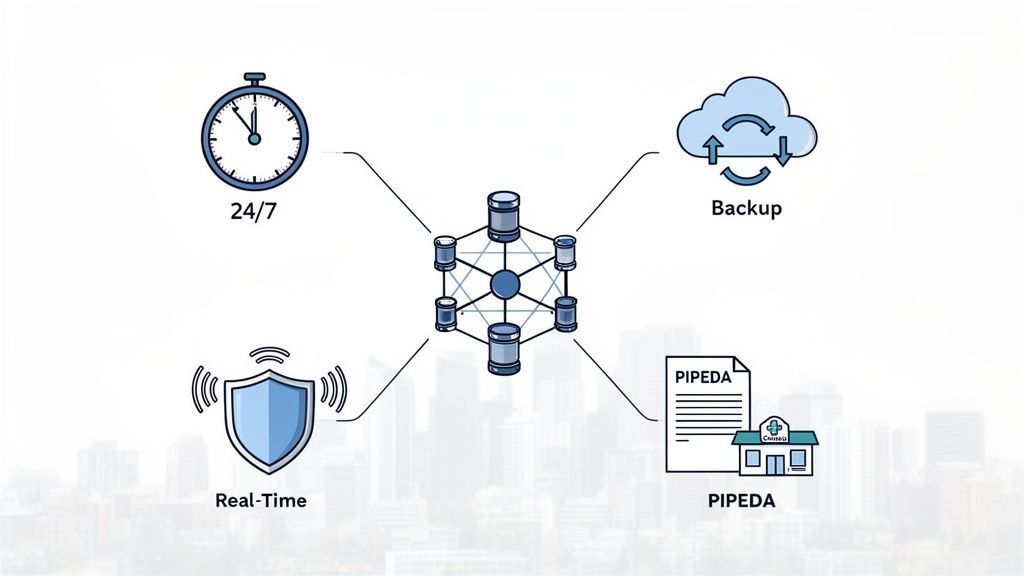
What distinguishes an adequate IT technician from a great IT partner? It is not just about fixing computers. The best IT support Calgary businesses depend on extends far beyond the helpdesk, delivering a suite of services that protect your operations, secure your data, and actively drive your business forward.
When you engage a top-tier provider, you are not just hiring technicians, you are gaining a strategic ally. They provide the essential foundations that keep your business running smoothly and securely, regardless of the challenges.
Exceptional IT support does not wait for you to report a problem. A premier provider uses sophisticated tools to monitor your entire network, 24/7. This constant vigilance allows them to identify potential issues, such as a server running out of space or unusual network traffic, long before they cause a significant disruption.
This proactive approach allows small issues to be resolved quietly in the background, often before you or your team are aware of them. The direct result is improved productivity and fewer operational interruptions.
In today’s environment, cybersecurity is not an optional add-on; it is the absolute bedrock of any competent IT service. A strong IT partner implements a multi-layered security strategy that actively identifies and defends against threats.
This involves much more than basic antivirus software. A truly robust security posture includes:
A provider's commitment to security is a direct reflection of their commitment to your business's survival. Without these advanced measures, your most critical assets are left dangerously exposed.
What would happen if your data disappeared overnight? Whether due to hardware failure, a natural disaster, or a ransomware attack, data loss can be catastrophic. A top-tier IT provider ensures this scenario is a minor inconvenience, not a business-ending disaster.
They implement a comprehensive backup and disaster recovery (BDR) plan. This means your data is regularly backed up to multiple secure locations, both on-site and in the cloud. Crucially, they also test these backups to guarantee they can be restored quickly and reliably when needed.
A solid BDR plan is your ultimate safety net. It ensures you can continue operating, even when the unexpected happens.
Imagine a local healthcare clinic in Calgary that handles sensitive patient records, making it a prime target for a ransomware attack. One morning, they discover all their files are encrypted, with a ransom demand on the screen.
Because they partnered with a proactive IT provider, the situation is stressful but contained. Here is how it unfolds:
This clinic survived a potentially devastating attack not by luck, but because their IT partner had already implemented the core services required for modern business resilience. To see a full list of what a partnership can include, explore our detailed breakdown of Calgary IT services.
For many Calgary businesses, particularly in sectors like healthcare, finance, or law, adhering to strict data privacy regulations is mandatory. A knowledgeable IT partner understands the specific, complex requirements of laws like PIPEDA (Personal Information Protection and Electronic Documents Act).
They ensure your entire IT infrastructure is designed and managed to meet these standards, from data encryption and access controls to audit logging. This expertise helps you avoid significant fines and reputational damage, providing peace of mind that your operations are fully compliant. These core services form the foundation of any reliable and secure IT environment, freeing you to focus on growing your business.
Choosing an IT provider is a major decision, and it is one you cannot afford to get wrong. The right partner will feel like a genuine extension of your team, proactively protecting your operations and supporting your growth. The wrong one can become a constant source of frustration, risk, and unexpected costs.
This vetting process is your opportunity to look beyond the sales pitch. It’s about finding a company that truly understands your business, shares your vision, and has the expertise to deliver. Let's review what to look for, the right questions to ask, and the red flags you cannot ignore.
First, you need evidence that they understand your business environment. Look for a provider with experience serving businesses of a similar size and, ideally, within your specific industry. An IT partner familiar with the manufacturing sector, for example, will already understand the critical importance of uptime on your production floor.
Do not just take their word for it. You need to see the proof.
This is all about confirming their track record. A provider with deep experience in your field will not be learning on your time.
The interview stage is where you can delve into their processes, service philosophy, and technical skills. Generic questions will only yield generic answers. You need to ask pointed, insightful questions that reveal how they truly operate.
The quality of your questions will directly influence the quality of the partnership you secure. This is your chance to distinguish a proactive mindset from a reactive one.
Here are a few powerful questions to start with:
These questions shift the conversation beyond a list of features to the practical reality of working with them day-to-day. For more guidance on this process, you may find it helpful to read our detailed guide on choosing an IT outsourcing company.
Knowing what to look for is only half the battle; knowing what to avoid is equally important. During your conversations and research, watch for warning signs that could indicate a poor fit.
Some common red flags include:
By combining diligent research, insightful questions, and a keen eye for red flags, you can confidently choose an IT partner who will not just solve your tech problems, but actively contribute to your long-term success.
Let's discuss costs. When searching for an IT partner, pricing models and contracts can seem intentionally confusing. However, cutting through that complexity is the only way to find a provider who offers genuine value, not just a low starting price. Your goal should be to secure predictable costs and guaranteed service levels that align with your business operations.
Many Calgary businesses have been burned by the break-fix model. One month, your IT bill is zero; the next, a server failure results in a large invoice for emergency repairs. This is why modern managed IT services have shifted to flat-rate fees. This approach provides budget stability and encourages your provider to be proactive. Before signing anything, it's wise to research the different IT support pricing models available.
As you gather quotes, you will likely encounter a few recurring pricing models. Each is suited to different types of companies, so it's about finding the one that aligns with your specific needs.
Here are the most common structures:
Imagine a local construction company in Calgary with 40 employees on a reactive break-fix plan. They might go a month without any IT expenses. But then a critical server fails. Suddenly, they face a $15,000 bill for emergency repairs, not to mention the cost of lost productivity while their team is idle. Budgeting becomes unpredictable.
Now, suppose that same company switches to a managed IT provider with a flat, per-user monthly fee. That predictable cost covers everything: 24/7 monitoring, proactive maintenance, and all the support they need. When the provider’s monitoring software flags a failing server part, they schedule a replacement after hours. The result? No downtime, no surprise bill.
The flat-fee model fundamentally changes the dynamic. It makes your IT provider invested in keeping your systems operational. Their profit is directly tied to your stability, which creates a true partnership where everyone’s goals are aligned.
If you read only one part of your contract, make it the Service Level Agreement (SLA). This is the legally binding document that specifies exactly what your provider promises to deliver. Understanding its key terms is essential.
Here's what to look for:
To help you get a clearer picture of how these models compare, we've created a simple table.
This table breaks down the common pricing structures, helping you see at a glance which might be the best fit for your Calgary business.
| Pricing Model | Best For | Cost Structure | Key Advantage |
|---|---|---|---|
| Per-User | Businesses with a clear headcount and employees using multiple devices. | Flat monthly fee per employee. | Simple, predictable, and scales easily as your team grows or shrinks. |
| Per-Device | Companies with shared workstations or more hardware than people (e.g., manufacturing). | Flat monthly fee per managed device (server, workstation, etc.). | Cost-effective if device count is stable and lower than user count. |
| Tiered Packages | Organizations that want to choose a pre-defined service level (basic, standard, premium). | Fixed monthly fee for a bundle of specified services. | Offers clear choices, but requires careful review to ensure it meets all needs. |
| Break-Fix | Very small businesses with non-critical IT needs and a high tolerance for risk. | Billed hourly or per project only when an issue occurs. | No recurring cost, but leads to unpredictable expenses and downtime. |
Understanding these options is the first step. By combining this knowledge with a thorough review of the SLA, you can ensure you're entering a fair and transparent partnership.
Drilling down into these details ensures you know exactly what you are paying for. For more tips, check out our guide on evaluating managed IT service companies. A crystal-clear SLA paired with a predictable pricing model is the foundation of any healthy, long-term IT relationship.
Switching to a new IT provider can seem like a daunting task, but with the right partner, it is a structured and calm process. A professional managed IT team will have a clear, transparent plan to guide you, ensuring the entire process is smooth and causes minimal disruption to your team and daily operations.
The journey always begins with a thorough assessment of your current IT setup. A good provider will not make any changes until they fully understand your existing environment. This involves a comprehensive review of your network, servers, software, and security protocols. This methodical approach ensures nothing is left to chance.
Once the initial audit is complete, the implementation begins. Your new provider will start deploying their monitoring agents and security tools quietly in the background. The goal is to avoid interrupting your workflow. They will get their security and management systems running in parallel with your old ones before the final switch.
This parallel approach is critical. It allows for a seamless handover with no gap in coverage. One system is simply deactivated as the other is fully engaged, preventing any window of vulnerability for your business.
A well-managed transition is a hallmark of a top-tier IT support provider. The process should feel organized and proactive, giving you confidence from day one instead of adding to your workload.
What does this look like for a Calgary business? Let's map out a typical transition for a 50-person company to see how a skilled provider manages the process over several weeks.
This infographic provides a high-level view of how different IT support models function over time, which often dictates the type of partnership you will have.
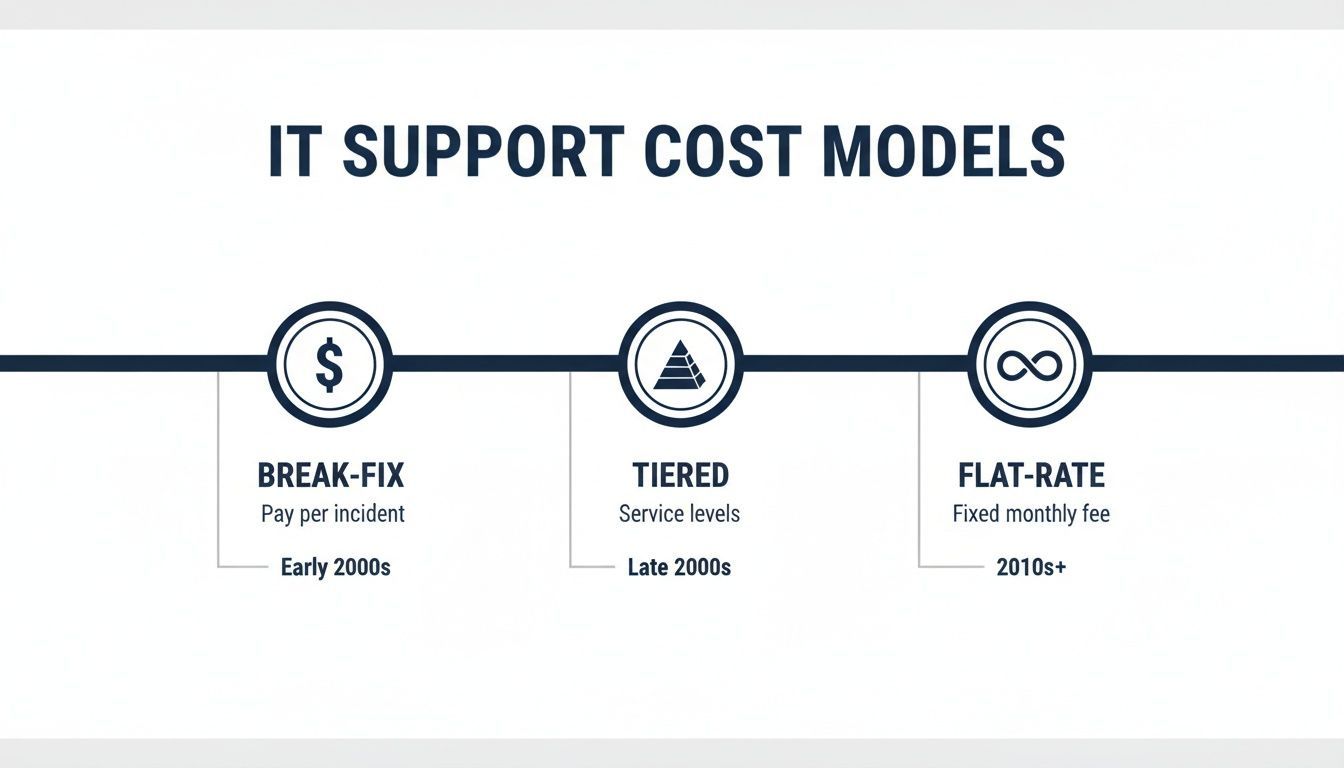
As shown, a Flat-Rate model, common in managed services, is designed for this type of planned, multi-week transition, unlike the reactive nature of Break-Fix.
Do not overlook the human element. Preparing your employees for the switch is just as important as the technical work. Your new IT partner should help you communicate the change clearly and effectively to your entire team.
This includes providing simple instructions on how to contact the helpdesk, explaining any new security policies, and introducing them to their new point of contact. When your team feels informed and supported, the transition is not just a technical success, it's a win for the whole organization.
It is natural to have questions before making such an important decision. We are often asked similar questions by Calgary businesses, so let's address the most common ones.
The benefit extends beyond being in the same city. A local team understands the Calgary business environment, the industries, the unique challenges, and local compliance requirements. Most importantly, when a critical issue requires on-site assistance, nothing is more valuable than having an expert who can arrive at your office quickly.
This local presence fosters a true partnership. You are not just another ticket number; you are a fellow Calgary business, and that accountability makes a significant difference.
Pricing for IT support in Calgary generally depends on three factors: the size of your team, the complexity of your IT setup, and the specific services you require. Most providers have adopted a predictable, flat-rate monthly fee, which typically ranges from $100 to $250 per user.
This model simplifies budgeting because it covers everything from helpdesk support to proactive security monitoring. You receive comprehensive coverage without the worry of unexpected bills.
A fixed fee means your IT provider is financially motivated to prevent problems. Their success is directly tied to your stability, creating a genuine partnership where everyone is working toward the same goal.
A well-executed onboarding process should be smooth and non-disruptive. The goal is a seamless handover that typically takes 30 to 90 days from start to finish.
It is a carefully managed project with several key phases:
This methodical approach ensures that from day one, your business is fully supported and protected without missing a beat.
Ready to build a technology foundation that drives your business forward? CloudOrbis Inc. delivers proactive, reliable, and secure managed IT services designed for Calgary’s ambitious businesses. Let's have a conversation about how we can help you achieve your goals.
Book a 30-minute call with a senior engineer. No sales script, just straight answers about your environment.


