

September 27, 2026
How to Recover from a Ransomware Attack: An SMB PlaybookLearn how to recover from a ransomware attack with a step-by-step SMB playbook covering containment, backup restore, compliance, and post-incident hardening.
Read Full Post%20(1).webp)
Usman Malik
Chief Executive Officer
February 13, 2026
Making the decision to move your business operations to the cloud is significant, and for many Edmonton organizations, Microsoft Azure is the leading choice. An Azure migration in Edmonton is more than just a technology upgrade; it is a strategic move to build a more resilient, scalable, and secure foundation for your business. It addresses common local challenges, from managing aging on-premise hardware to needing greater flexibility in a competitive market.

The conversation around cloud adoption has shifted from "if" to "how." For organizations across Edmonton—from oil and gas services to healthcare clinics and logistics firms—the reasons for selecting Azure are directly linked to local business realities. Outdated on-premise servers, increasing maintenance costs, and the constant risk of downtime are no longer acceptable trade-offs.
A common scenario involves a medium-sized Edmonton manufacturing company whose on-site servers are nearing the end of their life cycle, struggling to keep up with fluctuating production demands and posing a significant security risk. A single hardware failure could halt operations for days. By migrating to Azure, they not only avoid a costly hardware refresh but also gain the ability to scale resources up or down instantly, paying only for what they use.
This need for agility and resilience is a common theme. The cyclical nature of Alberta's economy requires businesses to be prepared to pivot quickly. Azure provides the infrastructure to do just that, offering a stable yet flexible platform that supports growth without requiring a massive upfront capital investment.
This transition is receiving a substantial boost from Microsoft's commitment to the region. Microsoft's planned $19 billion CAD investment in Canadian cloud infrastructure between 2023 and 2027 is a significant development. With over $7.5 billion allocated for the next two years alone, this funding is expanding Azure's Canada Central and Canada East datacentre regions. This ensures Edmonton firms can migrate with the confidence that their data will remain within Canadian borders. You can read more about Microsoft's Canadian cloud expansion here.
Key Takeaway: Migrating to Azure is not just about modernizing IT. It's about future-proofing your business with scalable infrastructure, predictable costs, and robust security that aligns with Canadian data residency laws.
The benefits extend far beyond simply replacing old servers. An Azure migration offers tangible business advantages that are particularly relevant in Edmonton's economic landscape:
Ultimately, a well-planned Azure migration Edmonton project frees up your organization to focus on its core objectives. It transforms IT from a cost centre into a strategic enabler for growth and innovation. As you consider your own journey to the cloud, remember that the right partner can make all the difference, providing expert IT services in Edmonton to guide your transition.
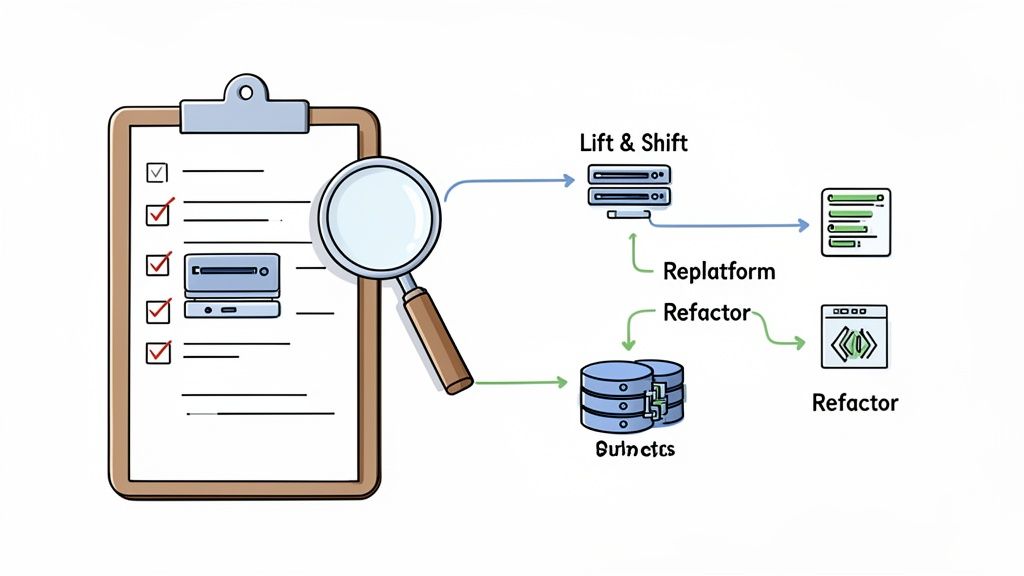
Before moving a single file, a successful Azure migration in Edmonton must begin with a thorough assessment of your current IT infrastructure. This initial discovery phase is the bedrock of your entire project. Bypassing this step can lead to unexpected costs, downtime, and a final cloud environment that does not meet your business objectives.
The process begins with a complete inventory of every server (both physical and virtual), application, database, and network component. More than just a list, this involves understanding the intricate web of interdependencies. Which applications communicate with each other? Which databases are critical for your ERP system? When are the peak performance times for your key workloads?
This detailed assessment provides the data needed to make informed decisions and prevent unforeseen issues. It becomes the blueprint for a migration that aligns with your specific operational needs, not just technical preferences.
Once the inventory is complete, the next step is to map all dependencies. Understanding how your systems interact is non-negotiable for avoiding disruptions to critical processes during the migration. For instance, your customer relationship management (CRM) software might pull data from three different databases to generate reports. Migrating one component without the others would cause the entire system to fail.
Simultaneously, you must establish performance baselines. This involves measuring key metrics like CPU usage, memory consumption, and network traffic over a typical business cycle, such as month-end processing or payroll runs. These metrics determine the resources each application needs to run smoothly, which is vital for accurately sizing your new Azure environment and avoiding unnecessary expenses.
As you develop this plan, it is wise to consider broader data center migration best practices to ensure all aspects are covered.
With a clear understanding of your current environment, you can select the most appropriate migration strategy. There is no one-size-fits-all solution; the best path depends on your specific goals, budget, and timeline.
Selecting the right approach is a critical decision. The table below outlines the three main strategies to help you determine which one is most suitable for your Edmonton-based business.
Each path has its place. Your decision will ultimately shape the timeline, budget, and long-term benefits of your move to Azure.
The growth in this area is undeniable. Edmonton's cloud journey is accelerating as Canada's cloud migration services market is projected to grow from USD 2,056.4 million in 2024 to USD 8,377.5 million by 2030. For local industries like manufacturing that face scalability challenges, Azure VMware Solution assessments now support Canada East regions. This helps create precise cost estimates that can lead to 33% savings through programs like the Azure Hybrid Benefit.
Choosing the right migration path is about balancing speed with long-term value. A lift-and-shift gets you to the cloud quickly, but replatforming or refactoring can unlock significant cost savings and performance improvements over time. For more information, explore our detailed guide on the benefits of professional cloud migration services.
Ultimately, a detailed pre-migration assessment ensures your Azure migration Edmonton project is built for success from day one, aligning the technical work with real, tangible business outcomes.
With your migration strategy mapped out, the next phase is designing the framework that will support and protect your operations in Azure. This involves more than just lifting servers into the cloud; it requires architecting a robust network for reliable connectivity and layering it with security to protect your most valuable asset—your data.
For many Edmonton businesses, this is where the value of cloud becomes clear. You shift from managing physical firewalls and network switches to orchestrating a software-defined environment. The result is a setup that is more flexible, resilient, and secure than what most medium-sized organizations could build on-premise.
Reliable connectivity is essential for your team's productivity. Dropped connections or sluggish performance can bring operations to a halt. Azure provides powerful tools to ensure a seamless experience, whether your team is in the Edmonton office or working remotely.
There are two primary enterprise-grade options:
The right choice depends on your daily operational needs. The goal is always to create a network that is fast, dependable, and transparent to your users.
Migrating to the cloud presents an opportunity to significantly enhance your security posture. Azure provides enterprise-grade security tools that can be configured to protect your business from an evolving threat landscape. A robust Azure security framework is built on a few key pillars.
It starts with Identity and Access Management (IAM). Using Azure Active Directory, we can control precisely who can access what. Simple yet powerful practices like multi-factor authentication (MFA) and the principle of least privilege—granting staff access only to what they need to perform their jobs—dramatically reduce your risk exposure.
Next is data protection. All data stored in Azure should be encrypted, both "at rest" (on a server) and "in transit" (moving across the network). This ensures that even if unauthorized access occurs, the data remains unreadable.
Key Insight: A well-planned Azure migration does not just replicate your on-premise security; it fundamentally strengthens it. By using cloud-native tools for threat detection, identity management, and compliance, you build a more proactive and resilient defence against cyber threats.
Finally, proactive threat detection is crucial. Services like Microsoft Defender for Cloud continuously scan your environment for suspicious activity, helping you identify and mitigate potential threats before they cause damage. To learn more about building a robust defence, read our guide on comprehensive cybersecurity services in Edmonton.
For any business in Edmonton, compliance is non-negotiable. Azure is designed to help organizations meet a wide range of regulatory requirements and provides the controls and documentation to prove it.
The primary regulation for any Canadian business is PIPEDA (Personal Information Protection and Electronic Documents Act). By architecting your Azure environment to keep all data within Canadian datacentres, you take a significant step toward satisfying its data residency rules.
The federal government also trusts Azure's compliance capabilities. Microsoft Canada secured over $214,000 in federal contracts by late 2023, a vote of confidence that carries weight for provincial sectors in Edmonton, including oil and gas, healthcare, and construction. You can discover more insights about these government contracts.
For specific industries, the regulations are even stricter. A local healthcare clinic must ensure its Azure setup meets the privacy rules of HIPAA. A law firm in the city has its own data sovereignty obligations. A properly designed Azure framework addresses these needs from the start, ensuring your migration is not only a technical success but also fully compliant.
This is where strategic planning translates into focused action. A successful migration is carefully orchestrated with a detailed script known as a migration runbook. This document serves as the master blueprint for the execution phase, mapping out every task, assigning clear responsibilities, and setting firm timelines.
The runbook becomes your single source of truth, ensuring everyone, from the technical team to business stakeholders, knows what is happening, when it is happening, and their role in the process. This document transforms a complex project into a series of clear, manageable steps, dramatically reducing the risk of errors.
Before migrating your entire operation, it is essential to conduct a pilot migration. This involves moving a small, non-critical workload to your new Azure environment. A pilot test allows you to validate the process, test your tools, and resolve any unexpected issues in a low-risk setting.
For an Edmonton-based logistics company, this could mean migrating a single development server or an internal reporting tool. The lessons learned are invaluable, allowing you to refine your runbook and approach the main migration with greater confidence. It is also the perfect opportunity to test the data synchronization techniques that will be critical for minimizing downtime.
This process highlights the core principles of a secure and compliant migration, focusing on connecting your systems, securing them, and ensuring they meet all regulations.
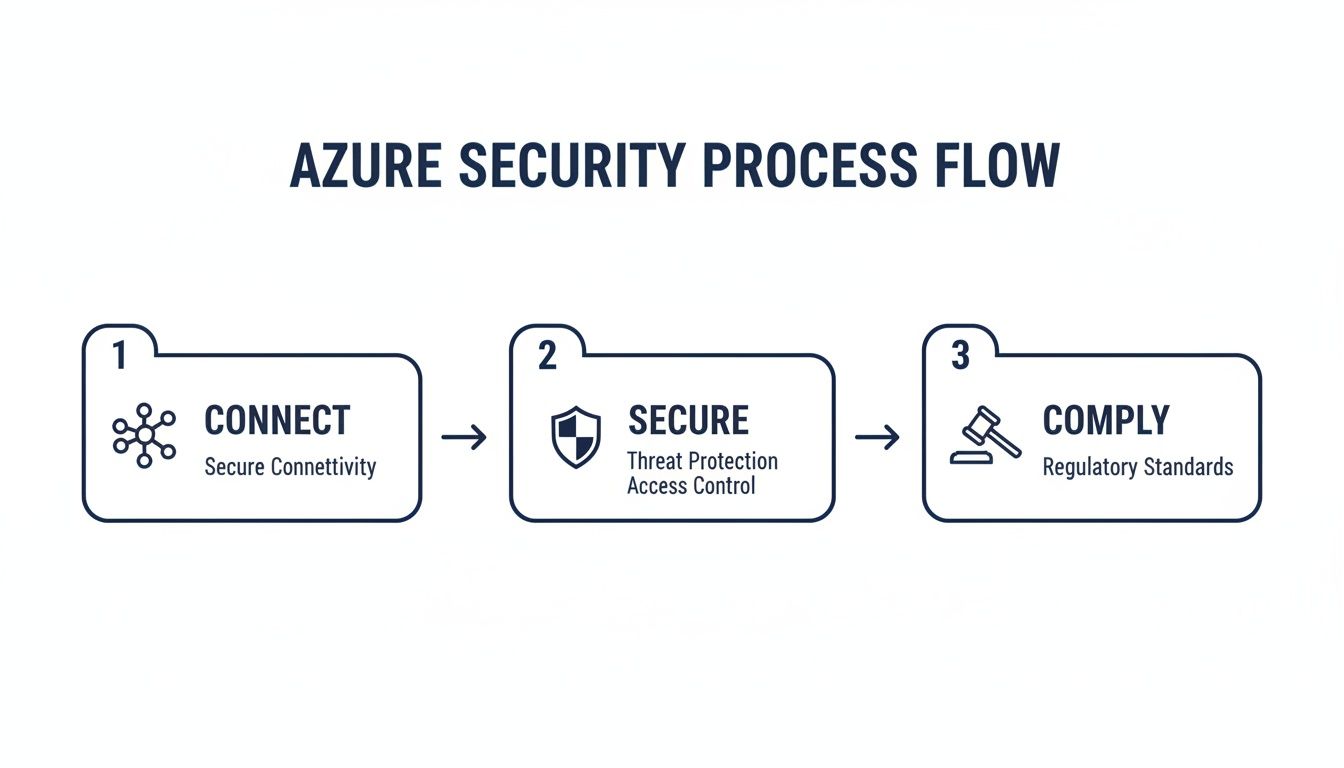
This flowchart breaks down the security journey into three logical stages, demonstrating how a structured approach ensures no critical step is missed.
The cutover is the final switch from your on-premise systems to your new, live Azure environment. This is arguably the most critical phase of the entire Azure migration Edmonton project, and it requires meticulous planning to execute flawlessly. The goal is simple: zero data loss and minimal disruption to your business.
To achieve this, we rely on proven experience and best practices:
A successful cutover is defined not just by what happens during the migration, but by what doesn't happen. With a detailed runbook and a rehearsed plan, you avoid the frantic, last-minute troubleshooting that can derail a project.
Even with the most detailed plan, you must be prepared for the unexpected. A comprehensive rollback plan is your safety net. It is a documented, step-by-step procedure to revert to your original on-premise environment if a critical, unresolvable issue arises during or immediately after the cutover.
Having this plan ready means you can make the decision to roll back quickly and confidently, preventing prolonged downtime. While it's a plan you hope never to use, its existence provides the peace of mind needed to move forward decisively. This level of preparation is a hallmark of professional server migration execution, turning potential chaos into a controlled process.
Completing your Azure migration in Edmonton is not the end of the journey; it is the beginning of unlocking real value. Migrating to the cloud opens up new capabilities, but the long-term success comes from continuous optimization after the cutover. This is how you turn a successful migration into a lasting competitive advantage.
This phase focuses on fine-tuning your new cloud environment. You will monitor performance, enhance security, and manage costs to ensure your Azure investment is delivering returns. Neglecting this part can lead to rising cloud bills and performance that deviates from your business needs.
The journey starts the day after you go live. Your focus shifts from simply moving your resources to truly mastering them, ensuring your cloud setup evolves with your business.
Once your workloads are live in Azure, the first task is to establish a new performance baseline. A cloud environment behaves differently from an on-premise setup, and it requires a different management approach. Tools like Azure Monitor become invaluable, providing real-time data on your applications' performance.
Are your virtual machines correctly sized? Are there unforeseen bottlenecks? Answering these questions early allows you to make data-driven adjustments. For instance, a database server that required extensive resources on-premise might be over-provisioned in Azure. This is an immediate opportunity to scale it down and reduce costs without impacting performance.
Security also requires ongoing attention. The migration was an opportunity to upgrade your security posture, and now you must maintain it. This includes:
The cloud is not a "set it and forget it" solution. Think of it as a high-performance engine that needs regular tuning to maintain peak efficiency and security. Neglecting this can lead to slow performance and unnecessary risks.
One of Azure's main attractions is its pay-as-you-go model, but this flexibility requires active management of your usage. Without careful oversight, cloud spending can easily escalate. A tool like Azure Cost Management + Billing is essential.
This service provides a clear, granular view of your expenditures. You can set up budgets, create alerts for spending spikes, and receive recommendations for cost reduction. For example, the tool might identify idle resources that can be shut down or suggest purchasing Azure Reserved Instances for steady workloads, which can offer significant savings compared to pay-as-you-go pricing.
Consider an Edmonton-based construction company. They could shut down powerful virtual machines used for project rendering over the weekend, saving hundreds of dollars monthly. It is about building a culture of cost-awareness, where every resource must justify its value.
Technology is only one part of the equation. To fully leverage Azure, your team must be comfortable with the new tools and workflows. Investing in training is non-negotiable for achieving a positive return on your investment. When employees know how to use Azure's features, they can innovate faster and work more efficiently.
However, managing a sophisticated cloud environment can become a full-time job, diverting your internal IT team from strategic projects that drive business growth. This is where an expert managed IT partner demonstrates its value. A partner shoulders the burden of day-to-day management, ensuring your environment is always secure, optimized, and aligned with your business goals.
A reliable partner provides services that include:
By working with a dedicated partner, you gain the peace of mind that your Azure environment is not just being maintained, but constantly improved. To see how this works in practice, learn more about our approach to managed IT services in Edmonton. This strategic support allows your team to focus on growth, confident that your cloud foundation is in expert hands.
Even the most detailed migration plan can raise questions. Business leaders in Edmonton want to understand what the process truly entails. Let's address some of the most common questions we hear as local companies prepare for their cloud transition.
This is often one of the first questions, and the answer depends on the complexity of the project.
For a small Edmonton office with only a few servers, a straightforward migration might take just a few weeks. In these cases, the process often involves a direct move of virtual machines and data without requiring major changes.
However, for a medium-sized manufacturing or logistics firm with custom applications and large, interconnected datasets, the project is more involved. These migrations typically span from three to nine months. This timeline covers everything from the initial discovery and assessment to the final cutover and post-migration support.
The key to a predictable timeline is not speed, but structure. A well-phased project with clear milestones for assessment, pilot testing, and execution ensures the migration proceeds smoothly with minimal disruption to your daily operations.
With a properly designed migration, the answer is an emphatic no. This is a non-negotiable aspect of our process.
One of the main advantages of using Azure for Canadian businesses is Microsoft's commitment to in-country datacentres. Major hubs in both Canada Central (Toronto) and Canada East (Quebec City) are critical for compliance.
When you work with an experienced local partner on your Azure migration in Edmonton, a core part of the design phase is to configure your entire environment to remain within Canada. We ensure that everything—from production databases to backups and disaster recovery sites—is set up to keep all your data within Canadian borders.
This directly addresses the data residency requirements of federal regulations like the Personal Information Protection and Electronic Documents Act (PIPEDA) and satisfies stricter rules in sectors like healthcare and finance. Microsoft's ongoing multi-billion dollar investment in its Canadian infrastructure reinforces this guarantee, giving Edmonton businesses complete confidence in their data sovereignty.
Nearly every unexpected cost can be traced back to a rushed or incomplete assessment phase. Without a clear picture of your current environment and your future needs in the cloud, it is easy to encounter budget surprises.
Based on our experience, the most common culprits are:
A thorough pre-migration assessment and cost modelling exercise is designed to identify these potential costs upfront. The goal is always a transparent, predictable budget with no surprises.
For businesses in Edmonton's regulated sectors—such as healthcare, legal, or finance—compliance must be a foundational element of the migration strategy from the very beginning.
We address this by building the necessary compliance controls directly into the Azure architecture. This is a multi-layered strategy that involves implementing specific security controls, setting up granular access policies using Azure Active Directory, and enabling comprehensive audit logging to meet strict regulatory frameworks, such as those mandated by HIPAA for healthcare organizations.
Compliance is not a one-time setup; it is an ongoing commitment. Post-migration, our managed services often include continuous security monitoring and regular vulnerability assessments. This ensures your cloud environment not only starts compliant but stays that way as your business and the regulations themselves evolve.
Ready to start your journey to the cloud with confidence? CloudOrbis Inc. provides expert guidance and end-to-end support for your Azure migration, ensuring a smooth, secure, and cost-effective transition. Let us handle the technical complexities so you can focus on growing your business.
September 27, 2026
How to Recover from a Ransomware Attack: An SMB PlaybookLearn how to recover from a ransomware attack with a step-by-step SMB playbook covering containment, backup restore, compliance, and post-incident hardening.
Read Full Post
September 26, 2026
On-Premise to Cloud Migration Checklist: 10 StepsUse this on-premise to cloud migration checklist to plan assessment, compliance, backups, sequencing, testing, cutover, and optimization for SMBs.
Read Full Post
September 25, 2026
Is VoIP Good for Small Business in Canada? a 2026 GuideIs VoIP good for small business in Canada? Explore costs, benefits, reliability, security, and migration tips for SMBs considering VoIP in 2026.
Read Full Post
