Finding the Right Alberta MSP for Your Business
Choosing an Alberta MSP is critical. Our guide offers real-world advice on compliance, security, and finding a partner who understands the local landscape.

Choosing an Alberta MSP is critical. Our guide offers real-world advice on compliance, security, and finding a partner who understands the local landscape.

When business leaders think of an "Alberta MSP," they often picture a simple IT support company. It's time to reframe that thinking. A true Alberta Managed Service Provider (MSP) is a strategic IT partner who understands the unique demands of our local industries, from oil and gas and healthcare to logistics and manufacturing.
This guide is not just about outsourcing your helpdesk. It’s about forming a strategic alliance with a team that offers localized expertise, ensures compliance with provincial laws, and can provide on-the-ground support when you need it most.
In Alberta's fast-moving economy, a generic, one-size-fits-all IT provider can quickly become a liability. Businesses in Calgary, Edmonton, Red Deer, and across the province face challenges that demand a partner with deep local roots. It's not just about having someone nearby to fix a server; it’s about having a team that instinctively understands the provincial business climate.
From ensuring a stable internet connection for a remote oil and gas site to navigating Alberta’s specific data privacy laws like the Personal Information Protection Act (PIPA), local knowledge is a significant competitive advantage. A true Alberta MSP understands the nuances of our market and the industries that drive it.

The value of a local provider extends far beyond a quick drive for an on-site visit. It’s about receiving a proactive strategy built on years of regional experience.
Consider these real-world examples:
The right local MSP doesn't just react to problems, they anticipate them. Their understanding of regional infrastructure, industry regulations, and economic trends allows them to provide guidance that a national provider simply cannot match.
Ultimately, choosing an Alberta MSP is an investment in a strategic asset, not just a line item for an outsourced function. This partner becomes a genuine extension of your team, dedicated to your success within our local ecosystem.
They can connect you with other regional vendors, offer insights into provincial business trends, and help you scale your technology in a way that aligns with Alberta's economic trajectory. You can explore a deeper dive into managed IT services in Alberta to see the full scope of benefits.
This localized approach turns IT from a cost centre into a driver for resilience and growth. It ensures your technology not only supports daily operations but also positions you to seize future opportunities right here in our province.
When evaluating a potential IT partner, it's easy to get lost in marketing jargon. The real value of an Alberta MSP lies in their technical skillset, the capabilities that keep your operations running, your data secure, and your business moving forward. A glossy brochure is one thing; a battle-tested, multi-layered technical strategy is something else entirely.
It all starts with moving past the idea that basic antivirus software is sufficient. Modern threats require a much more active defence. You need to scrutinize an MSP’s cybersecurity stack to see if it includes crucial tools like Endpoint Detection and Response (EDR), which actively contains threats, not just blocks them. You should also look for proactive threat hunting, where experts actively search for hidden vulnerabilities before cybercriminals can exploit them.
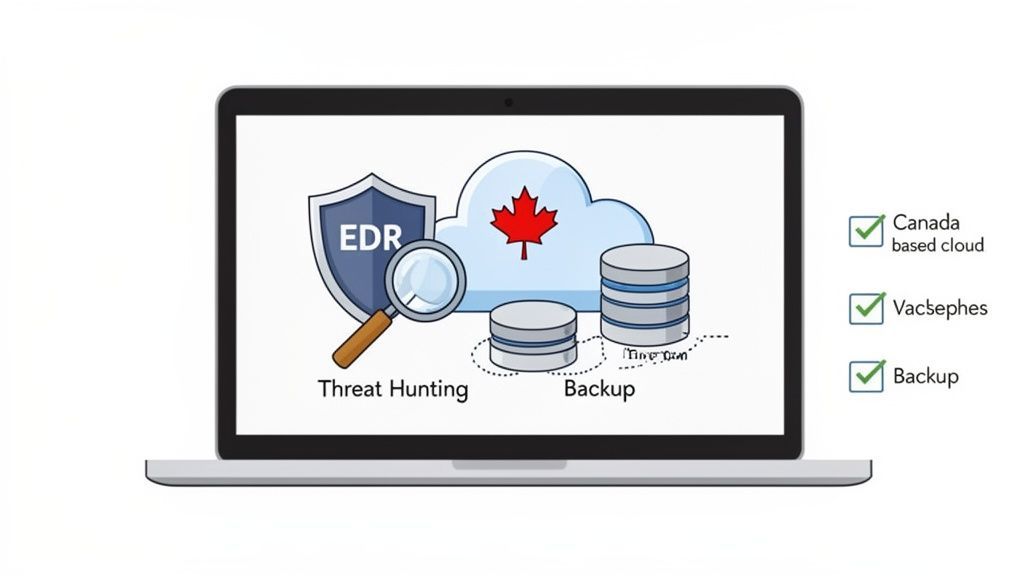
A top-tier MSP doesn’t just sell cloud services; they use the cloud as a strategic tool to solve business problems. For Alberta businesses, this is about more than just storing data off-site. It’s about fine-tuning platforms like Microsoft 365 for maximum performance and security, all while ensuring your sensitive data remains in Canada to comply with data sovereignty laws.
When hiring a new employee, you must find the right talent and properly assess technical skills. You should apply that same critical eye to your prospective IT partner's team. Do they have certified experts who can handle complex cloud migrations and optimize configurations?
This expertise is non-negotiable in regulated industries. For example, the Alberta Health Care Insurance Plan (AHCIP) manages massive datasets, including claims information dating back to 1993. A proficient MSP knows how to build HIA-compliant security and backup solutions to protect this data while using Microsoft 365 for secure reporting and collaboration.
A provider's technical depth is revealed not by the services they list, but by how they apply them to solve your specific business challenges, whether it's compliance, operational efficiency, or data protection.
Nearly any MSP can claim they offer data backup and disaster recovery. The real test is how they perform when something goes wrong. You must dig deeper and ask tough, scenario-based questions that reveal the solidity of their plans.
Here are a few practical questions to ask a potential Alberta MSP:
The answers you receive will quickly separate a truly prepared partner from one who just checks a box on their services list. For more insights, you might be interested in our guide on what to look for in a managed IT service. Their ability to detail these critical processes is a sure sign of a mature and reliable operational framework.
When your operations grind to a halt due to a critical IT failure, the last thing you want is to be routed to a call centre halfway around the world.
For any Alberta business, two factors should be non-negotiable when choosing an IT partner: 100% Canada-based support and deep expertise in our local compliance regulations. These aren't just "nice-to-haves"; they are fundamental to your operational security and resilience.
Imagine your logistics hub in Edmonton suffers a complete network outage late on a Friday evening. An outsourced, overseas helpdesk can only follow a script, unable to grasp the urgency or the specifics of your situation. That delay could cost thousands in missed shipments.
A local Alberta MSP, on the other hand, provides a team that understands your business hours, speaks your language, and can dispatch a technician if needed. That’s the difference between a quick resolution and a weekend of costly downtime.
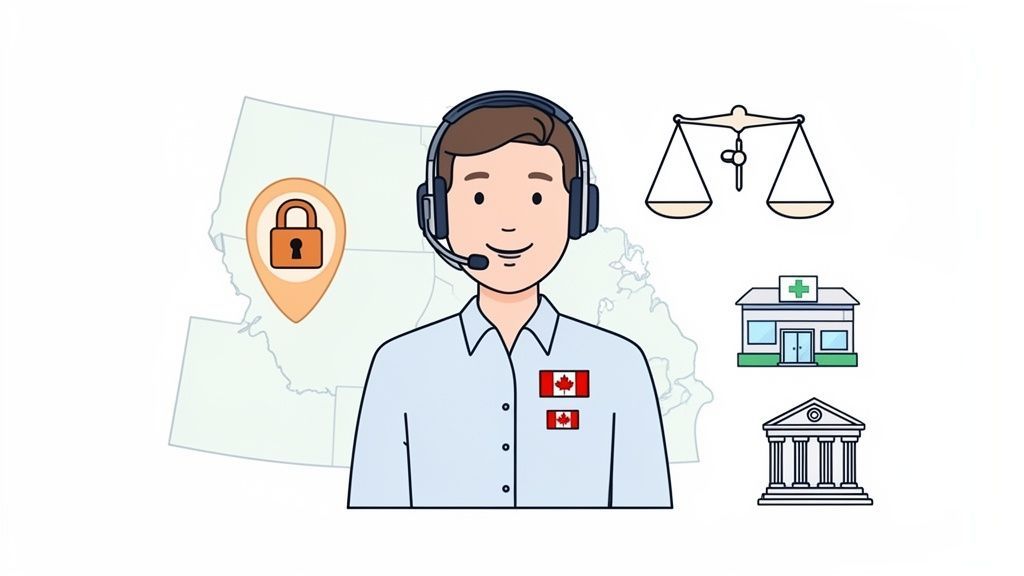
Beyond immediate support, the physical location of your data is a significant security and legal concern that many businesses overlook.
When an MSP stores your business data outside of Canada, it becomes subject to the laws of that foreign country. This can create significant privacy risks and legal challenges, particularly under Alberta's Personal Information Protection Act (PIPA). An Alberta-focused MSP guarantees data sovereignty, ensuring your information stays securely within our borders.
This commitment to local data residency is the foundation for managing industry-specific compliance. Different sectors face unique regulatory pressures that demand specialized knowledge.
Choosing an MSP with proven experience in your specific industry turns compliance from a burden into a strategic advantage. They don't just check boxes; they build a secure, efficient operational framework that protects your business and builds client trust.
To help you vet potential partners, use this checklist to cut through the noise and focus on what truly matters for an Alberta-based business.
| Factor to Evaluate | Why It Matters for Your Alberta Business | Ideal Answer to Look For |
|---|---|---|
| Data Centre Location | Ensures your data is governed by Canadian and Albertan privacy laws, like PIPA, protecting it from foreign jurisdiction. | "All our primary and backup data centres are physically located within Canada." |
| Helpdesk Location & Hours | When an issue hits at 4 PM MST, you need support on your time zone, not from a team overseas that's wrapping up their day. | "Our entire support team is based in Canada and available 24/7/365." |
| Experience with PIPA/HIA | These aren't generic privacy laws. An MSP must have direct experience navigating Alberta's specific compliance landscape. | "Yes, we have multiple clients in your sector and regularly manage PIPA/HIA compliance, including conducting PIAs." |
| On-Site Support Capability | For critical hardware failures or complex network issues, remote support isn't always enough. You need boots on the ground. | "We have technicians based in Alberta who can be on-site within [X] hours as per our SLA." |
| Industry-Specific Expertise | A generalist MSP might not understand the unique tech challenges of a law firm, clinic, or manufacturing plant. | "We specialize in [Your Industry] and understand the specific software and compliance needs you face." |
This table provides a solid starting point to ensure you're asking the right questions from the outset.
Nowhere is this specialized expertise more critical than in Alberta's healthcare sector.
The system's evolution, which began with Primary Care Networks (PCNs) in 2003, now serves over 3.2 million Albertans. This massive shift to integrated care models requires a powerful IT backbone to manage electronic health records and ensure secure data sharing.
For clinics in Calgary, Edmonton, and across the province, partnering with an MSP that understands these intricate systems is essential for maintaining compliance and improving patient care. You can discover the full story of primary care reform in Alberta to see just how complex it has become.
A knowledgeable Alberta MSP can help healthcare providers navigate these challenges, from conducting a required Privacy Impact Assessment to implementing robust cybersecurity measures. This specialized partnership ensures that technology empowers better health outcomes while keeping patient data safe.
Once you’ve narrowed down your list of potential MSPs, the real work begins. This is where you cut through the sales pitch to understand how they actually operate. Asking the right questions is critical, it’s how you’ll determine if they’re a mature, proactive partner or just another reactive “break-fix” shop.
Think of it like hiring a key executive. You would conduct a thorough interview with tough, scenario-based questions to see how they handle pressure. The same logic applies here. Before you proceed, it's a good idea to understand the fundamentals of how to evaluate IT service companies so you can spot the leaders from the laggards.
A truly mature MSP doesn't run on last-minute heroics; they run on documented, repeatable processes. How they answer questions about their internal operations speaks volumes about their reliability. Vague, evasive responses are a major red flag.
Start by digging into their team structure and expertise.
A great MSP won't just tell you they’re proactive; they'll show you through their structured processes and investment in their people. Clear, confident answers are a direct reflection of their operational excellence.
The best MSPs are transparent. Those you need to worry about may hide a reactive mentality behind a slick monthly fee. Your job is to uncover these issues before you’re locked into a multi-year contract.
The Service Level Agreement (SLA) is often where potential issues are revealed. An SLA that’s vague or lacks real, measurable promises isn't worth the paper it's written on. We get into the nitty-gritty of this in our guide on choosing managed IT service companies.
Probe for hard evidence of their security and recovery capabilities.
These questions are designed to get you proof, not just promises. A confident, well-run MSP will welcome this level of scrutiny and have the documentation ready to back up their claims.
Switching your IT provider can feel like a massive undertaking, but a professional Alberta MSP turns it into a controlled, transparent process. A smooth transition isn't about flipping a switch one Friday night and hoping for the best. It’s a structured journey built on clear communication and meticulous planning, designed to integrate new systems with zero disruption to your daily operations.
It all starts with a deep-dive assessment. This isn’t just a quick glance at your servers; it’s a comprehensive analysis of your entire IT environment, including network infrastructure, security protocols, software licenses, and user workflows. This discovery phase is critical. It’s where risks and opportunities are identified, forming the bedrock of a strategic IT roadmap that aligns with your business goals.
Once the assessment is complete, the MSP should walk you through a detailed project plan. This roadmap lays out every step of the transition, complete with timelines, key milestones, and responsibilities. It’s your guide to understanding exactly what will happen and when, ensuring everyone on your team is aligned and prepared.
A key part of this stage is careful coordination. For example, planning for an Azure migration in Edmonton requires precise execution to avoid downtime. The plan should cover everything from deploying new security agents and migrating data to configuring user accounts, all scheduled to minimize the impact on your team’s productivity.
A truly professional onboarding is marked by proactive communication and a clear, documented plan. You should never be left wondering what’s next. Your MSP should be guiding you confidently through each phase, from the initial strategy session to the final handover and team training.
The final piece of the puzzle is the Service Level Agreement (SLA). This document is more than just a contract; it's the official rulebook for your partnership, defining expectations and guaranteeing accountability. A strong SLA doesn't use vague promises. It provides concrete, measurable commitments you can hold your provider to.
This simple flow chart breaks down the key stages of vetting a provider, from the first questions you ask to finalizing the agreement.
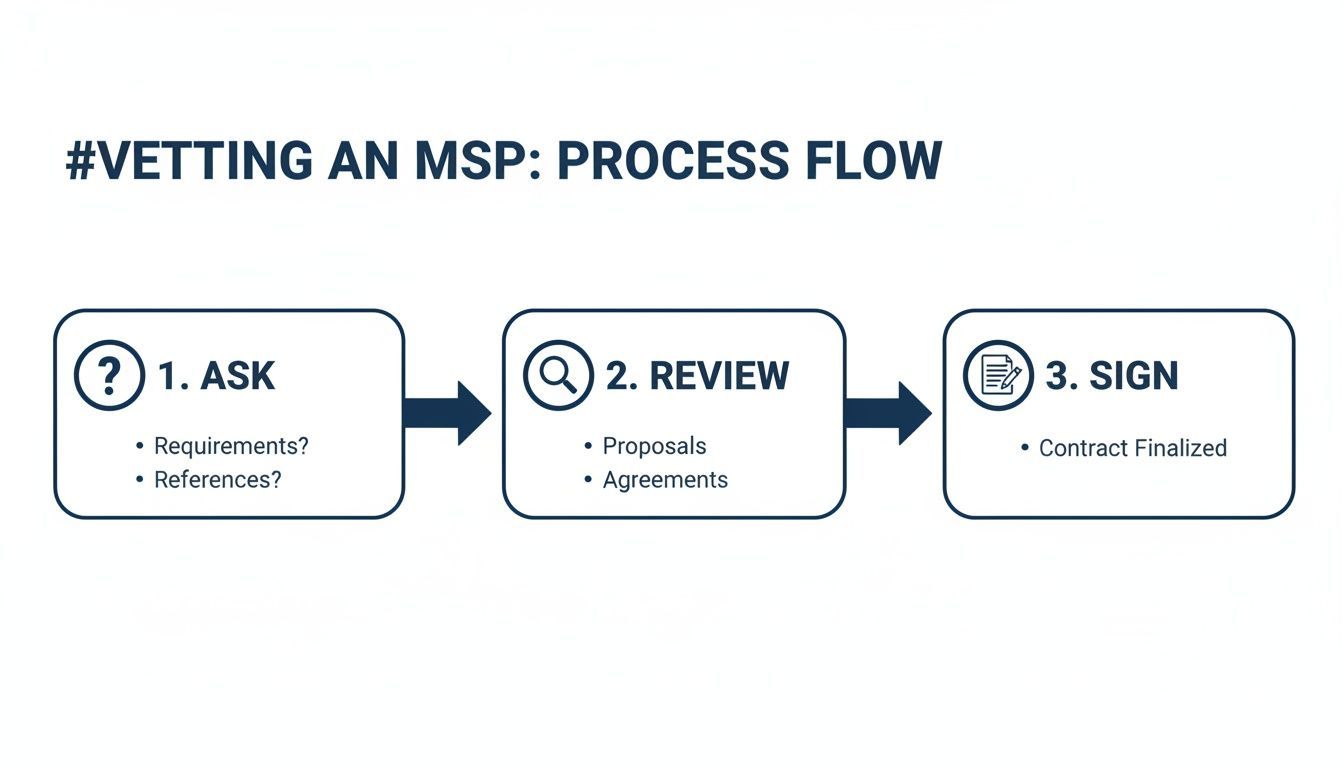
As you can see, signing the agreement is the result of a thorough vetting process, not the beginning of one.
Here’s what a solid SLA should explicitly detail:
For businesses in sectors like legal or finance, this level of accountability is non-negotiable. A top-tier Alberta MSP ensures your data is handled with strict compliance, helping you optimize tools like Microsoft 365 to turn raw data into secure, actionable insights.
When you’re seriously considering an IT partner, the conversation needs to shift from high-level features to practical, real-world questions. Business leaders across Alberta often have the same core concerns at this stage. Here are clear, straightforward answers to the most common questions.
The honest answer is: it depends. The cost is tied directly to your company's size, the complexity of your IT environment, and the depth of support you require.
Most Alberta MSPs use a per-user, per-month model, which generally falls between $100 and $250. A comprehensive plan that includes 24/7 support and advanced cybersecurity measures, which most businesses should consider essential, will be at the higher end of that range.
The key is to look past the monthly fee and evaluate the total value. Weigh it against the immense cost of downtime, the financial and reputational fallout from a security breach, and the daily productivity lost to IT friction. Always demand a detailed proposal that breaks down exactly what's included to ensure there are no surprise fees down the road.
A professionally managed transition to a new provider isn't an overnight event, and you wouldn't want it to be. A smooth, well-planned transition typically takes between 30 and 90 days. Any reputable Alberta MSP will follow a structured onboarding plan that is not rushed.
The process begins with a deep dive into your current systems to understand every component. From there, it moves into strategic planning and a carefully phased implementation. The primary goal is a seamless switchover with zero disruption to your team's workday. A true partner will also handle the handover from your current IT provider professionally, ensuring a complete and drama-free transfer of all necessary credentials and information.
Not at all. In fact, it's quite the opposite. Partnering with a quality MSP means you're gaining a strategic advisor, not surrendering control of your critical assets. You always retain full ownership of your IT infrastructure and data.
Think of an MSP as handling the day-to-day tactical work, the patching, monitoring, and helpdesk tickets, freeing you up to focus on business strategy. Through collaborative services like a virtual CIO (vCIO), you work together to set the IT roadmap and budget. It’s a co-managed partnership where you maintain complete oversight while their experts handle the technical execution.
Yes, absolutely. This is where modern IT support excels. MSPs use powerful remote monitoring and management (RMM) tools that allow them to resolve over 95% of all IT issues from a distance, whether your office is in downtown Calgary or a small town hours away. This technology ensures you get rapid, effective support without having to wait for a technician to drive to your location.
For those rare instances that do require on-site assistance, a prepared MSP will have a clear, pre-defined plan for dispatching technicians. This ensures you’re covered no matter where your operations are based in the province. Make sure your Service Level Agreement (SLA) clearly outlines the response times for this type of hands-on support.
Choosing the right Alberta MSP is one of the most important strategic decisions you can make for your business's security and growth. CloudOrbis Inc. brings the local expertise, technical skill, and proactive support your organization needs to thrive in today's landscape. Start your journey to better IT today.
Book a 30-minute call with a senior engineer. No sales script, just straight answers about your environment.


