Serverless Architecture for Canadian SMBs: Guide 2026
Practical guide to serverless architecture for Canadian SMBs. Learn benefits, costs, security, & migration tips. Migrate with confidence in 2026.

Practical guide to serverless architecture for Canadian SMBs. Learn benefits, costs, security, & migration tips. Migrate with confidence in 2026.
Your team is probably dealing with one of two bad options right now. You either keep paying for servers that sit half-idle most of the month, or you underbuild and get punished when demand jumps. That's the trap many SMBs fall into with traditional infrastructure.
Serverless architecture matters because it changes that cost model. You stop planning around peak capacity first and start paying for execution when work happens. That sounds like hype until you look at how fast the model has moved into the mainstream. Serverless became commercially mainstream with AWS Lambda in 2014, and the global market was estimated at USD 13.09 billion in 2024 with a projection of USD 87.49 billion by 2033 according to Datadog's serverless architecture overview. This isn't an edge pattern anymore. It's a serious operating model.
Most SMBs don't have an infrastructure problem. They have a waste problem.
A customer portal needs to stay responsive. A booking system gets bursts of traffic. An internal workflow runs heavily at month-end and barely at all in between. If you run that on fixed servers, you're paying for capacity you don't use or scrambling when usage spikes. Neither is smart.
Traditional hosting forces you to buy for the worst day, not the normal day. That means idle compute, extra maintenance, patching windows, scaling guesswork, and a constant low-grade fear that one unexpected campaign or seasonal rush will expose a bottleneck.
Serverless architecture flips that. Your application logic runs when triggered. The cloud provider handles the underlying provisioning and scaling. You stop carrying as much dead weight in your environment.
Practical rule: If a workload is intermittent, event-driven, or unpredictable, don't default to an always-on server.
That doesn't mean every server should disappear. It means many jobs shouldn't live on fixed infrastructure in the first place.
The strongest early wins usually come from things like APIs, file processing, scheduled jobs, notifications, and integrations. These are the workloads that often waste money on persistent servers despite doing very little most of the day.
There's a similar mindset in other cloud cost areas. If you're reviewing analytics costs, this guide on how to reduce Athena spend with Server Scheduler is useful because it shows the same principle in action. Don't pay for more cloud activity than the business needs.
If your leadership team is still debating whether cloud economics beat owned infrastructure, start with a broader comparison like CloudOrbis's look at cloud computing vs on-premise. The point isn't that cloud always wins. The point is that fixed-cost infrastructure often hides waste better than it eliminates it.
Serverless doesn't mean there are no servers. It means you're not the one managing them.
A traditional environment is like owning a full restaurant kitchen. You lease the space, buy the equipment, maintain it, staff it, and keep it ready whether you're serving five meals or five hundred. Serverless is closer to ordering delivery from a managed service. You care about the meal arriving properly. You don't manage the kitchen.
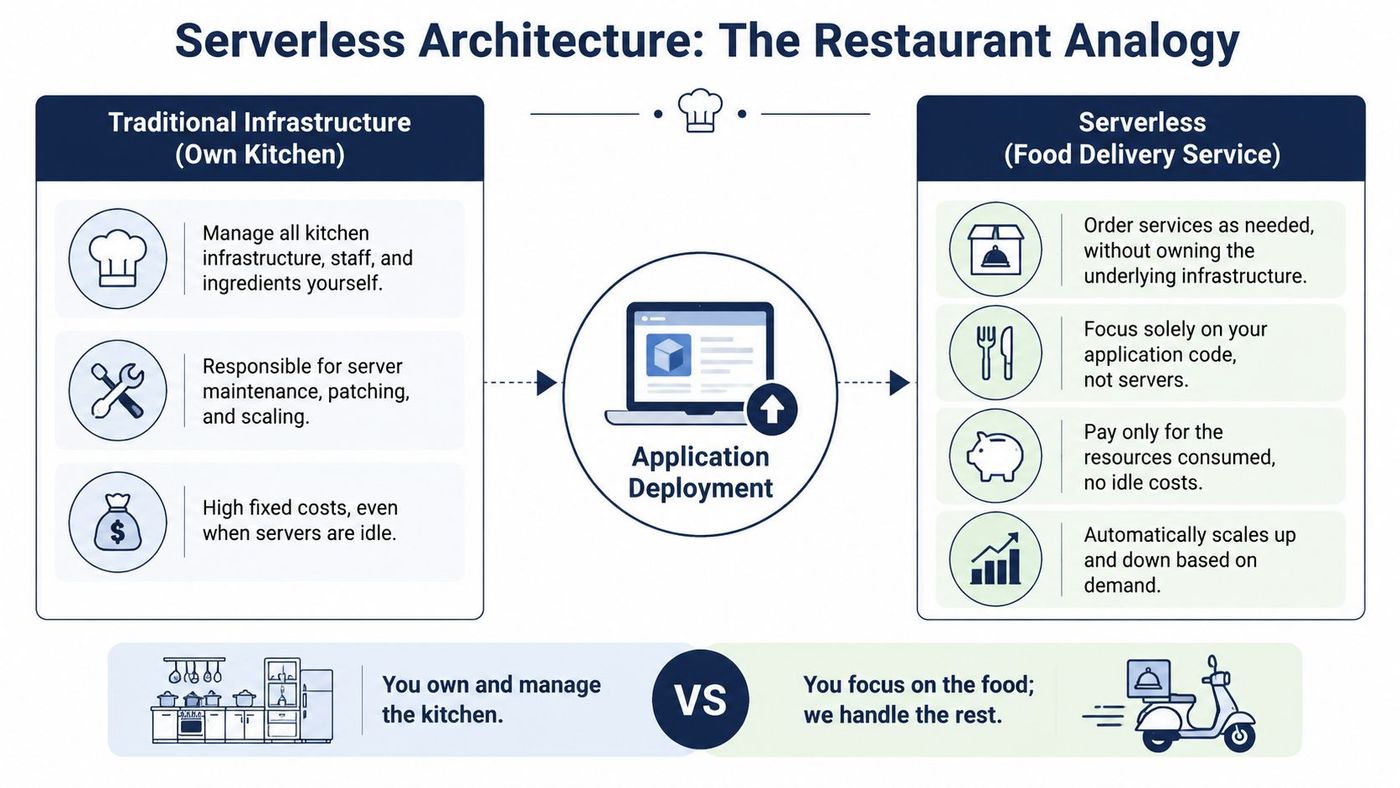
There are two practical patterns most SMBs need to understand:
Used together, these patterns let your team focus more on the application and less on the plumbing.
The core of serverless is its event-driven, pay-per-use model, and that matters in Canada because 62.2% of Canadian businesses used cloud computing in 2023, according to New Relic's overview citing Statistics Canada. That tells me something important. Most Canadian businesses aren't starting from zero. They already understand cloud billing, managed platforms, and elasticity.
Here's the practical translation:
That's why serverless is often a strong fit for service providers managing variable demand and multiple client workloads. This broader view of cloud computing for service providers lines up well with the same operating logic.
The right mental model is simple. Stop buying kitchens for snacks.
Serverless architecture is useful. It isn't magic.
The upside is obvious when you apply it to the right workloads. The downside shows up when teams force-fit it into the wrong ones or ignore the operational trade-offs.
For SMBs, the biggest gain is usually operational focus. Your team spends less time dealing with servers and more time working on customer-facing features, process automation, and integrations.
That benefit often shows up in a few concrete ways:
The weak point isn't usually the compute platform. It's design discipline.
Cold starts can affect latency-sensitive functions. Debugging gets harder when your logic is spread across many event-driven components. Vendor lock-in becomes real when you rely heavily on provider-specific services. Costs can also drift if developers create noisy functions, excessive invocations, or poor logging patterns.
Here's the short version.
| Benefits | Limitations |
|---|---|
| Pay-per-use can reduce waste on bursty workloads | Long-running workloads may fit better elsewhere |
| Auto-scaling handles variable demand well | Cold starts can affect responsiveness |
| Less server management for internal IT teams | Debugging and tracing are more complex |
| Good fit for APIs, automations, and background jobs | Provider-specific services can increase lock-in |
| Faster delivery for small components and integrations | Cost visibility can get messy without governance |
Don't ask, “Should we go serverless?” Ask, “Which workloads deserve serverless?”
That question produces better architecture and fewer regrets.
A managed operating model also helps. If your internal team is small, the benefits of outsourcing routine operational load can extend beyond infrastructure choices. This is why many SMBs pair architecture modernisation with managed IT services benefits.
Serverless architecture is best treated as a scalpel, not a religion.
If you work in healthcare, legal, finance, or any privacy-sensitive environment, security is the key decision point. Not cost. Not speed.
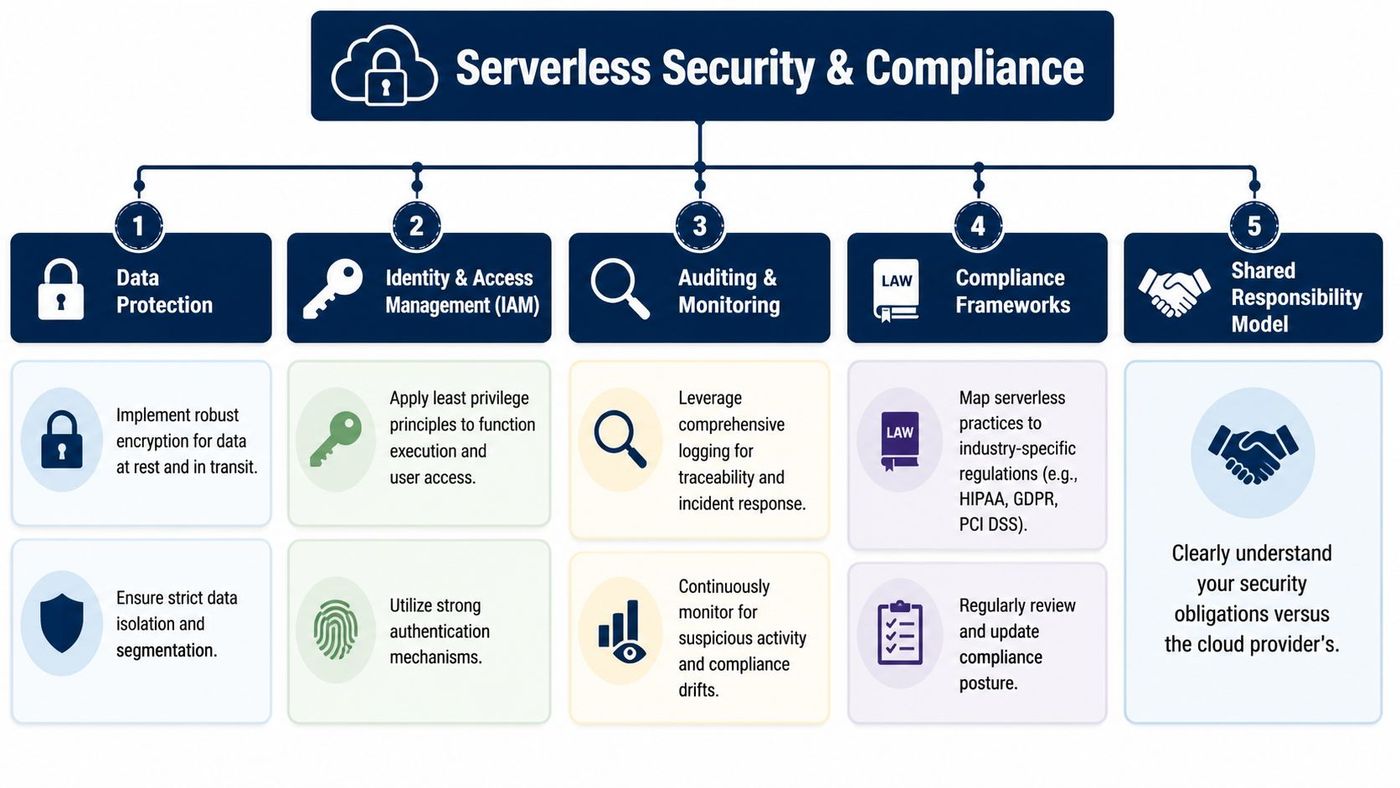
Serverless architecture can improve your operational model, but it doesn't remove your obligations. The provider secures the underlying infrastructure. Your team still owns the application layer, data handling, permissions, integrations, and auditability.
Here, many SMBs get too casual.
Your cloud provider handles the physical data centres, host infrastructure, and managed service platform. You still need to control who can invoke functions, what those functions can access, how secrets are managed, how APIs are protected, and how logs are collected and reviewed.
For regulated Canadian workloads, serverless security requires more than provider-managed infrastructure. It demands least-privilege IAM, robust logging, and API-layer controls, as outlined in SentinelOne's serverless architecture security overview.
If your organisation must align with PIPEDA, Quebec's Law 25, HIPAA, or client-specific contractual controls, focus on design choices that support evidence and control.
Use this checklist as a baseline:
For organisations reviewing these controls more broadly, this guide to data security management is a useful companion.
Security doesn't disappear in serverless. It moves closer to your code, your permissions, and your data flows.
Resilience needs the same level of discipline.
In AWS multi-Region serverless designs, failover planning isn't just about spinning up compute somewhere else. AWS recommends aligning service quotas, API limits, and concurrency settings across Regions, and using idempotent event handling plus cross-Region data replication so failover doesn't create throttling, duplicate processing, or inconsistent data. That guidance comes directly from AWS's multi-Region serverless resilience recommendations.
If you're supporting Canadian users, that matters for both continuity and governance. A failover design that works technically but breaks data handling expectations isn't good enough.
If you can't define your identity model, retention approach, logging design, and data residency requirements up front, you're not ready to move sensitive workloads to serverless.
That's not a knock on the architecture. It's a warning against lazy implementation.
The strongest serverless projects don't start with technology enthusiasm. They start with a bottleneck the business wants gone.

A clinic doesn't need another server just to process appointment reminders, intake form submissions, portal actions, or data from connected devices. Those are event-driven tasks.
Serverless can work well for:
The key is to pair these use cases with strict access controls and logging, especially in HIPAA-aligned environments.
Manufacturing teams usually care less about trendy architecture terms and more about uptime, visibility, and response time.
Good serverless fits include:
For broader sector context, these examples align well with the operational goals in IT solutions for manufacturing companies.
These firms often have predictable pain points. Document intake, client onboarding, periodic checks, approval chains, and secure notifications don't need permanent infrastructure.
A few strong examples:
A lot of office process automation looks small until you add up how much manual effort it consumes. That's where serverless architecture often earns its keep.
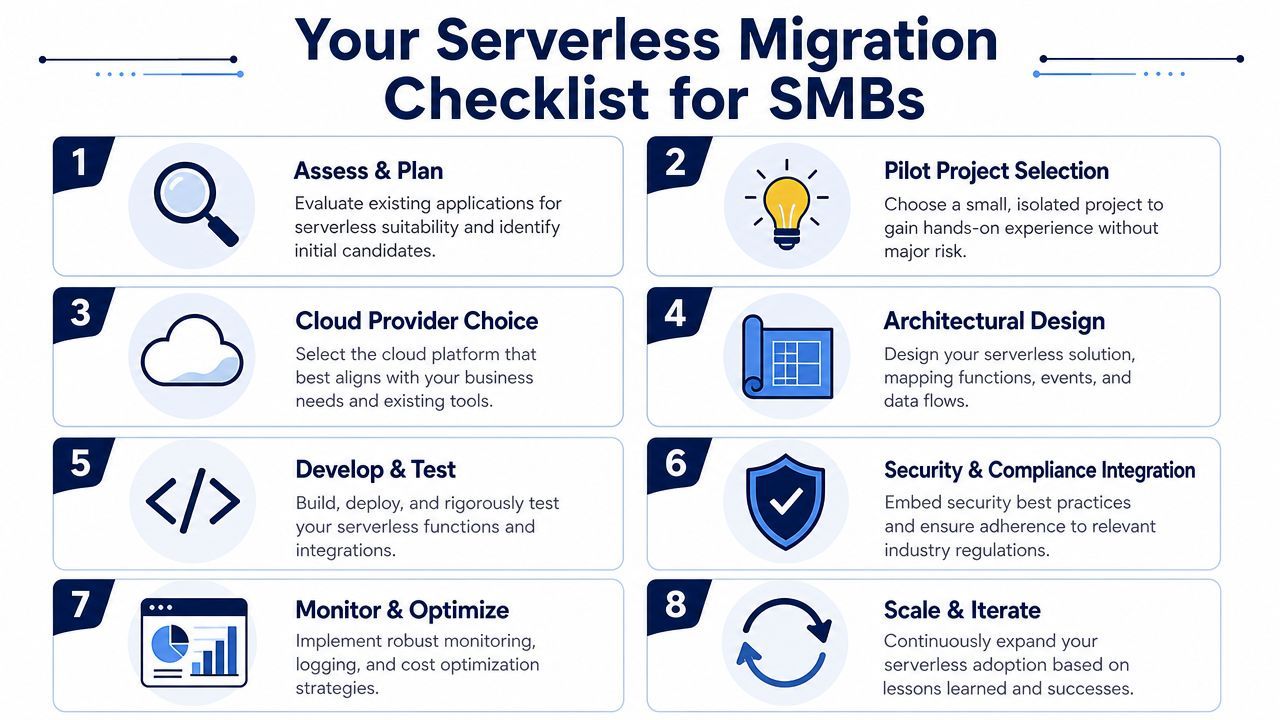
The wrong way to adopt serverless is to rewrite everything because the pricing page looks attractive.
The right way is controlled, phased, and brutally practical. Hidden costs show up when teams ignore observability, governance, and security design until after deployment. That's why total cost matters more than raw compute cost.
According to CodeSignal's discussion of serverless use cases and benefits, businesses need to plan for total cost of ownership, including governance, observability, and security tooling, not just lower server management costs. That's exactly right.
Don't migrate your most complex system first. Start with a contained workload that already behaves like an event-driven service.
Good pilot candidates include:
Avoid large legacy applications with tight coupling, long-running execution, and unclear dependencies as your first move.
Many projects experience difficulties. The compute bill may look lean, but you still need people, process, and tooling.
Expect to invest in:
My advice: If you don't budget for visibility and control, the “cheap” architecture won't stay cheap for long.
A pilot should answer three questions clearly:
If the answer to any of those is no, pause. Fix the operating model before expanding.
Serverless architecture is a strong option for SMBs that need agility, elastic scaling, and less infrastructure administration. It is not the right answer for every application, and pretending otherwise is how companies create expensive complexity.
If your workloads are event-driven, variable, and easy to break into smaller services, serverless is worth serious consideration. If your systems are long-running, tightly coupled, latency-sensitive, or heavily customised around one environment, you need a more selective approach.
The smartest move isn't “go all in.” It's to identify the workloads where serverless architecture gives you a clear business win, then adopt it with proper security, observability, and cost controls in place.
A managed approach usually works better for SMBs because it reduces trial-and-error. You need architecture discipline, not just cloud access.
If you're weighing serverless architecture against your current environment, CloudOrbis Inc. can help you assess fit, identify low-risk pilot workloads, and build a practical migration plan that accounts for security, compliance, resilience, and total cost.
Book a 30-minute call with a senior engineer. No sales script, just straight answers about your environment.


