Security Operations Center Services: Guide for Canadian SMBs
Get a guide to security operations center services for Canadian SMBs. Learn capabilities, deployment, compliance, and how to pick the right provider.

Get a guide to security operations center services for Canadian SMBs. Learn capabilities, deployment, compliance, and how to pick the right provider.
Most business owners don't wake up wanting to buy security operations center services. They wake up to a suspicious Microsoft 365 login alert, a staff member asking whether an email attachment was safe, or an auditor wanting proof that security incidents would be detected and escalated quickly. That's usually the moment the conversation changes from “Do we need better tools?” to “Who is watching our environment when nobody in-house is?”
For Canadian SMBs, that question has become more urgent. Many firms already have endpoint protection, email filtering, firewalls, and backups. What they often don't have is a disciplined, always-on function that ties those signals together, separates noise from real risk, and coordinates a response before a small issue becomes downtime, disclosure, or a compliance problem.
A Security Operations Center, or SOC, is the team and operating model that watches your systems for signs of trouble, investigates suspicious activity, and helps contain incidents. In practice, security operations center services act like a 24/7 digital watch desk for your business. They don't replace your existing tools. They make those tools useful in real time.

A common SMB pattern looks like this. You've bought several security products over the years. One handles endpoints, another filters email, another logs firewall activity. Each one works in its own lane, but nobody is correlating events across the environment after hours, and nobody has a formal process for deciding when an alert is a nuisance versus a real incident.
That's where a SOC matters. It turns scattered alerts into coordinated visibility. If you want a practical primer on identifying exposures before they turn into incidents, Logical Commander's guide is a useful companion read because risk assessment is often the first step before SOC monitoring becomes effective.
Most SMBs aren't losing sleep over SIEM dashboards. They're worried about interrupted operations, privacy obligations, insurance questionnaires, and whether a breach would force them into a chaotic response with no playbook.
Practical rule: Tools generate alerts. A SOC decides what matters and what to do next.
That distinction is important. A firewall can block some traffic. Endpoint software can quarantine some malware. But modern attacks often unfold across email, identity, cloud apps, endpoints, and remote access. Security operations center services help connect those dots and escalate based on business impact, not just technical severity.
Reactive security usually means this: someone notices a problem only after a user reports it, a system slows down, or a customer asks a difficult question. By then, you're no longer preventing damage. You're containing it.
A better operating model is continuous detection and response. If you want a closer look at how that plays out in day-to-day operations, CloudOrbis has a useful overview of threat detection and response. The key idea is simple. Security isn't just about owning tools. It's about having a function that watches, interprets, and acts.
Think of a modern SOC as a digital command centre. It gathers signals from across your environment, prioritizes what deserves attention, and routes action to the right people. The value isn't in one tool. The value is in the combination of monitoring, analysis, response, and discipline.
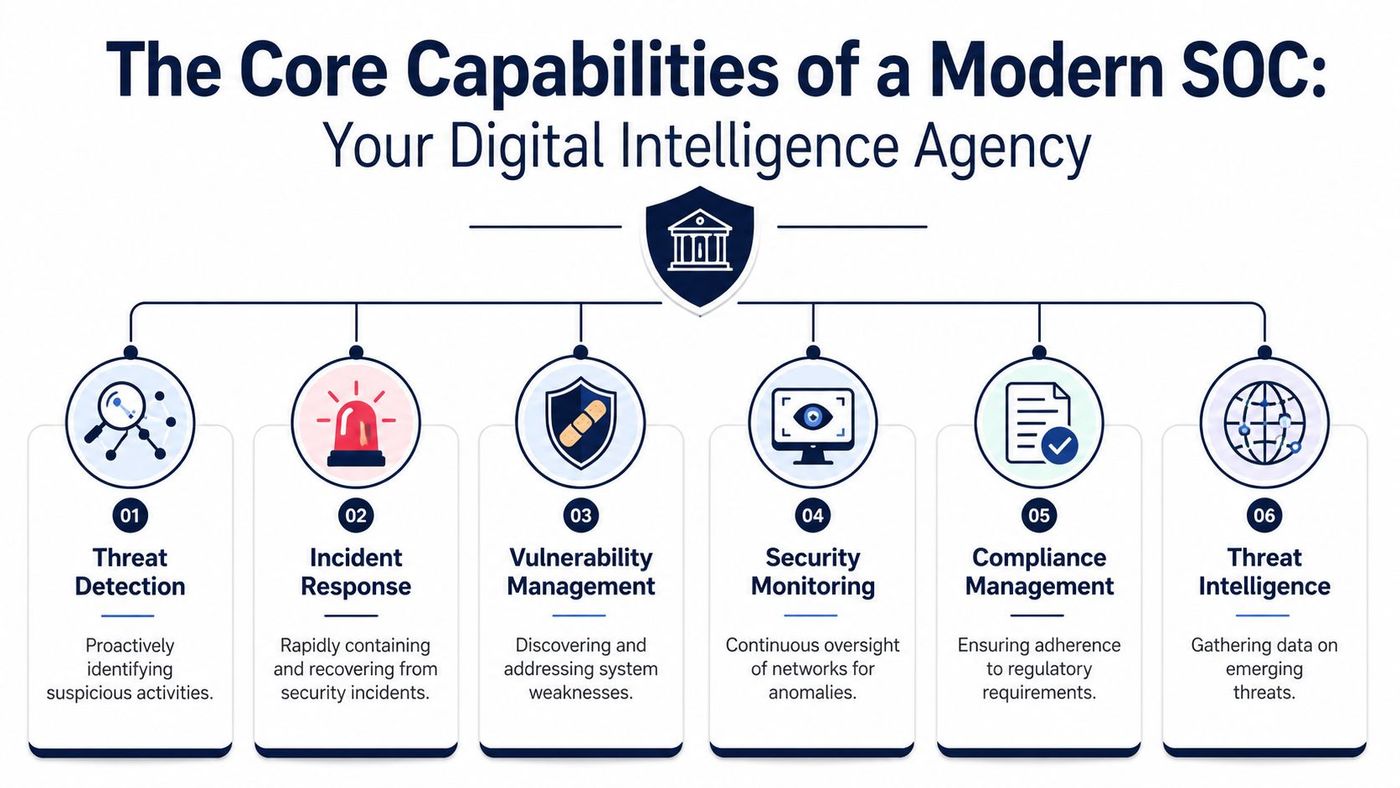
This is the baseline. A SOC watches endpoint, network, cloud, and identity data continuously so suspicious behaviour doesn't sit unnoticed until the next business day. For a business owner, the practical outcome is shorter blind spots and faster awareness when something abnormal starts happening.
In Canada, that expectation is more than a nice-to-have. Cyber Centre guidance for SOC best practices states that Security Information and Event Management, or SIEM, is the foundational component for real-time correlation and analysis of security alerts, helping filter false positives and prioritize threats by severity and business impact in a way that supports lower response times in managed IT environments (Cyber Centre guidance on SOC best practices).
Raw alerts are like smoke alarms wired into every room of a building. Useful, yes. But if every toaster, microwave, and steamy shower triggers a siren, your team stops paying attention.
A SOC's job is to tune that signal. Analysts review patterns, enrich alerts with context, and identify the combinations that suggest credential misuse, malware activity, privilege abuse, or unusual access paths. That's why a mature SOC feels calmer than a pile of disconnected tools. It produces fewer panic moments and better judgement.
When a real issue is confirmed, speed matters. Not dramatic speed for show. Practical speed that isolates a device, disables an account, blocks a connection, preserves evidence, and gets the right people involved.
The best incident response process is boring in the right way. People know their role, alerts are escalated properly, and containment starts before confusion spreads.
For SMB leaders, security operations center services become tangible. A good response process reduces downtime, avoids ad hoc decision-making, and gives management a clear chain of communication.
Good SOC teams don't wait for every threat to announce itself. They look for weak signals, suspicious patterns, and indicators that automated tooling may have missed. They also connect monitoring with vulnerability management, because a known weakness matters more when active behaviour suggests someone is trying to exploit it.
If your team needs a plain-language refresher on what formal reviews should examine, understanding security audits is a helpful read. Audits and SOC work aren't identical, but they intersect where evidence, controls, and risk prioritisation meet.
A modern SOC also supports reporting, log review, and evidence gathering for regulated environments. That matters in healthcare, legal, finance, and any business handling sensitive records. It also uses threat intelligence to adjust detections as attacker techniques change.
For readers weighing where SOC ends and MDR begins, this comparison of MDR vs SOC is useful. In practice, many SMBs consume both through one managed service relationship.
Beyond establishing monitoring's necessity, the strategic choice hinges on how you're going to operate it. For SMBs, the viable options typically include in-house, co-managed, or fully managed models.
The market direction is clear. The global SOC as a Service market reached USD 14.77 billion in 2026 and is forecast to reach USD 26.93 billion by 2031, with a 12.77% CAGR, while Managed Detection and Response held 41.52% of market share in 2025 (Mordor Intelligence SOCaaS market analysis). That doesn't mean every company should outsource everything. It does mean many organisations have decided building from scratch isn't the most practical path.
An in-house SOC makes sense when you want full operational control, you already have mature internal security leadership, and you're prepared to own the hiring, tooling, process design, reporting, and after-hours coverage.
For most medium-sized firms, the hard part isn't buying software. It's maintaining a reliable operation every day, including holidays, vacations, staff turnover, and incident pressure. That's where plans often look better on paper than in real operations.
Co-managed is often a good fit for organisations that have internal IT or security staff but need stronger coverage, specialist investigation support, or better tooling. Your team keeps part of the operational responsibility, and the provider fills the gaps.
This model can work well when internal teams are intimately familiar with the business but don't want to carry all alert triage and escalation themselves. The trade-off is shared accountability. If responsibilities aren't clearly documented, issues can bounce between teams.
A fully managed SOC, often bundled as SOCaaS or through an MSSP, is usually the simplest path for SMBs that need maturity without building a security department. The provider delivers the analysts, tooling, monitoring workflows, and response escalation structure. Your internal team remains involved where business decisions or remediation approvals are needed.
One example in this category is CloudOrbis managed security services, which sits within the broader MSSP model many Canadian firms use when they want monitoring and security operations without standing up a full internal capability.
| Factor | In-House SOC | Co-Managed SOC | Managed SOC (SOCaaS) |
|---|---|---|---|
| Upfront investment | Higher internal build effort, tooling procurement, process design | Moderate, shared between internal team and provider | Lower upfront build burden, more predictable service model |
| Internal staffing need | Highest | Moderate | Lowest |
| Speed to deploy | Slowest | Moderate | Fastest |
| Control over tooling and workflow | Highest | Shared | Lower direct control, higher provider dependence |
| 24/7 coverage | Hard to sustain for SMBs | More achievable | Usually built into the service model |
| Specialist expertise | Depends on hiring success | Shared access | Included through provider team |
| Best fit | Large or highly mature organisations | Firms with an internal IT/security base | SMBs needing fast access to mature operations |
If your team already struggles to cover patching, user support, cloud administration, and compliance work, building an in-house SOC usually adds complexity faster than it reduces risk.
For regulated businesses, security operations center services aren't just about catching threats. They help prove that your business is exercising due diligence. That matters when auditors, insurers, partners, or regulators ask how incidents are detected, escalated, documented, and contained.
In the Canadian context, Cyber Centre procurement guidance says a SOC provider should contractually guarantee 24/7 continuous surveillance with near-real-time incident reporting, with visibility across endpoint, network, and cloud data so indicators of compromise can be detected promptly (Cyber Centre recommended contract clauses for SOC procurement). For SMBs, that's a practical benchmark. If a provider can't define what “continuous” means or how incidents are reported, compliance conversations get shaky quickly.
Healthcare clinics and multi-location practices often need stronger evidence around access monitoring, incident handling, and protection of sensitive information. Legal and finance firms face similar pressure because trust, confidentiality, and record integrity are part of the service they sell.
A SOC supports those obligations by providing:
One of the most common mistakes I see is treating compliance as paperwork and SOC as a separate technical function. That split creates gaps. If your policy says incidents are monitored continuously but your operating model relies on someone checking alerts when they have time, the paperwork won't save you.
For companies preparing for customer assurance reviews, Affordable Pentesting's SOC 2 solutions offer a useful example of how technical validation work can support trust reporting. That complements, rather than replaces, operational monitoring.
If SOC 2 is part of your roadmap, CloudOrbis also has a practical guide to SOC 2 certification in Canada. The key point is that compliance frameworks reward consistency. A SOC helps create it.
The wrong way to evaluate a SOC is to ask only, “What does the subscription cost?” The better question is, “What business losses does this operating model help us avoid, and what internal effort does it replace?”
That shift matters because security operations center services are often less about direct revenue gain and more about reducing interruption, recovery expense, and compliance exposure. The strongest business cases usually combine hard costs, avoided disruption, and management confidence.
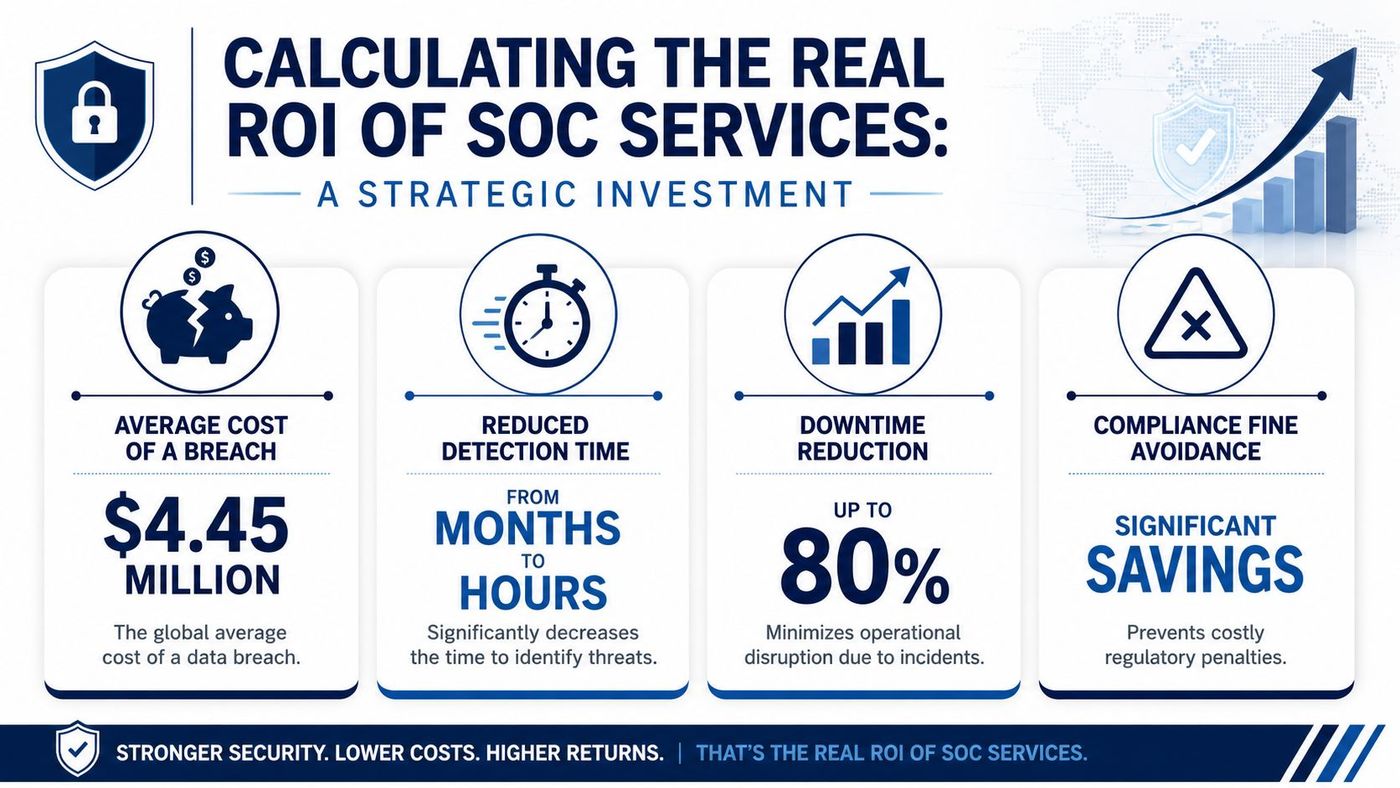
A Bell Total Economic Impact study found that a composite organisation using managed security services in Canada realised C$4.73 million in benefits over three years against C$2.01 million in costs, producing C$2.72 million in net present value and 135% ROI (Bell managed security services TEI report). That won't map perfectly to every SMB, but it gives leaders a credible financial frame for the discussion.
Here's the practical ROI model I recommend using with boards and owners:
A SOC often pays for itself by making one bad day smaller.
Managed SOC pricing models vary. Some are based on users, some on endpoints or log volume, and some are packaged into tiered subscriptions. The pricing structure matters less than the service definition.
Ask whether the provider includes alert triage, after-hours escalation, incident coordination, reporting, vulnerability visibility, cloud coverage, and compliance-oriented evidence. If pricing looks low but the service stops at alert forwarding, you're not buying much relief.
For finance teams that need a structured way to present this internally, this guide to cost-benefit analysis can help turn a technical ask into an investment case.
The Canadian SOC market was valued at USD 4.59 billion in 2024 and is projected to reach USD 93.96 billion by 2033, with projected 10.5% CAGR from 2026 to 2033 (Market Research Future on Canada's SOC market). More providers will enter the market. That gives SMBs more choice, but it also makes selection harder because many offerings sound similar.
Use a checklist that forces operational detail out into the open.
Some providers lean heavily on proprietary platforms. Others build around common tools such as Microsoft security products, SIEM platforms, EDR suites, and vulnerability scanners. Proprietary tooling isn't automatically bad, but it can make visibility and portability harder if you ever switch vendors.
Also ask how they reduce false positives. Too much noise trains internal teams to ignore escalations. Too little sensitivity can create blind spots. Mature providers can explain their tuning process in plain language.
A strong shortlist usually makes the trade-offs obvious:
The best choice is the one that fits your internal capacity, not the one with the flashiest dashboard.
Most SMBs expect onboarding to be disruptive. It doesn't have to be. Good SOC implementation is structured, collaborative, and staged so visibility improves without creating chaos for your internal team.
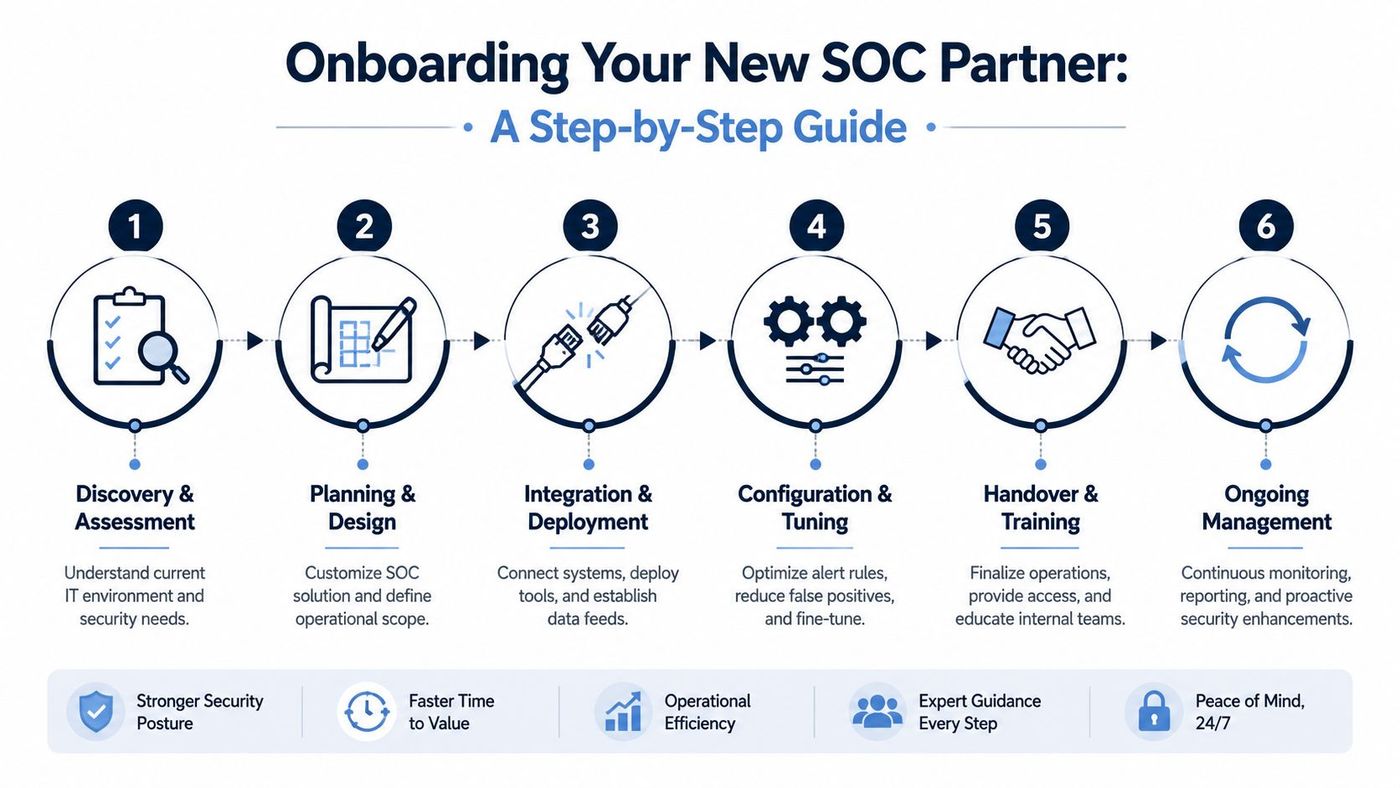
It starts with discovery. The provider reviews your environment, key systems, cloud footprint, security tools, business workflows, and compliance concerns. That step matters because a clinic, law firm, warehouse operation, and construction company don't all define critical systems the same way.
Next comes planning and integration. Monitoring tools are connected, log sources are enabled, endpoint telemetry is validated, and escalation contacts are defined. This is also where roles get clarified. Who gets called first, what actions can be taken immediately, and what needs business approval?
The first version of monitoring is rarely perfect. A good provider will tune detections, suppress obvious noise, and adjust thresholds so the system reflects your environment rather than a generic template.
Then comes handover. Your internal contacts should know how incidents are escalated, where reports live, what to expect after hours, and how the provider communicates during a live issue.
Good onboarding doesn't try to impress you with dashboards. It leaves you with clear contacts, clear playbooks, and fewer unknowns.
If you're weighing security operations center services for a clinic, legal practice, manufacturer, logistics firm, or growing SMB, CloudOrbis Inc. can help you evaluate the right operating model, scope the compliance impact, and build a practical rollout plan that fits your business.
Book a 30-minute call with a senior engineer. No sales script, just straight answers about your environment.


