SOC 2 Certification in Canada: Process & Costs 2026
Achieve SOC 2 Certification in Canada in 2026. Our guide covers costs, timelines, process for SMBs, & a readiness checklist.

Achieve SOC 2 Certification in Canada in 2026. Our guide covers costs, timelines, process for SMBs, & a readiness checklist.
A familiar scenario plays out in Canadian sales calls every week. A promising SaaS firm, clinic technology provider, or managed service business gets through technical validation, pricing, and legal review, then the prospect's procurement team asks one question: can you share your SOC 2 report?
That question changes the conversation. It moves security from a slide deck promise to independent proof. For many small and mid-sized organisations, SOC 2 isn't the first compliance project they planned to tackle. It's the one the market forces onto the roadmap when larger customers, especially enterprise buyers and cross-border clients, need assurance before they sign.
For leaders evaluating SOC 2 certification in Canada, the challenge usually isn't deciding whether security matters. It's figuring out how to approach the process without wasting time, over-scoping the audit, or building a compliance programme that looks good on paper and breaks under real operational pressure.
A Canadian SMB can lose a qualified deal in the final stretch for a simple reason. The buyer's security team asks for a SOC 2 report, and the answer is still, “we're working on it.”
That moment is common now, especially for SaaS companies, managed service providers, health tech firms, and other organisations that handle customer data or support critical workflows. In practice, SOC 2 has shifted from a nice-to-have credential to a buying shortcut for enterprise procurement teams, cross-border customers, and regulated clients that need independent assurance before they sign.
For Canadian businesses, the pressure is not only coming from large U.S. customers. Domestic buyers are asking harder questions too. Boards, insurers, and vendor risk teams want to see that security controls are documented, operating, and reviewed by an external auditor. A policy set and a completed questionnaire may get you through early conversations. They often stop being enough once legal, privacy, and procurement review begins.
SOC 2 is voluntary in Canada, but the commercial pressure around it is very real. Buyers use it to reduce their own vendor risk review, especially when your service touches sensitive data, production systems, or business-critical processes. The distinction is important: buyers do not assess vendors in isolation. They compare how easily each vendor can answer due diligence requests, explain control ownership, and provide independent evidence.
That comparison affects revenue. A current SOC 2 report can shorten security reviews, reduce repeated questionnaire work, and give sales teams a cleaner answer to common objections. Without it, the same deal often turns into weeks of document gathering, exception requests, and internal follow-up. Smaller companies feel that drag more than large firms because the same technical leaders who run operations are usually the ones answering customer audits.
Operationally, the companies that prepare for SOC 2 tend to run better. Access reviews happen on schedule. Change approvals are recorded. Incidents are handled through a defined process instead of inbox threads and memory. Good cloud data protection practices overlap with the day-to-day discipline SOC 2 expects, which is why the work pays off beyond the audit itself.
Buyers are not asking for a promise that controls exist. They are asking for an auditor's opinion on whether those controls are in place and, in a Type 2 report, whether they operated consistently over time.
The demand shows up early in sectors where privacy, uptime, and third-party access are already under scrutiny:
Canadian context changes the conversation here. Many SMB leaders are balancing customer demands for a familiar U.S.-style attestation with local concerns such as data residency, PIPEDA alignment, and whether a Canadian auditor will be easier for customers and counsel to work with. SOC 2 does not replace Canadian privacy obligations, but it gives you a recognised framework for proving that security controls are not ad hoc.
That is why SOC 2 now sits closer to revenue protection than pure compliance. For many Canadian SMBs, it is the control framework that helps them compete for larger accounts, survive procurement review, and show that their security program can stand up to external scrutiny.
SOC 2 gets easier to manage once you separate three decisions: what system is in scope, which criteria apply, and whether you need a Type 1 or Type 2 report. That matters for Canadian SMBs because cost, evidence effort, and auditor scrutiny all change based on those choices.
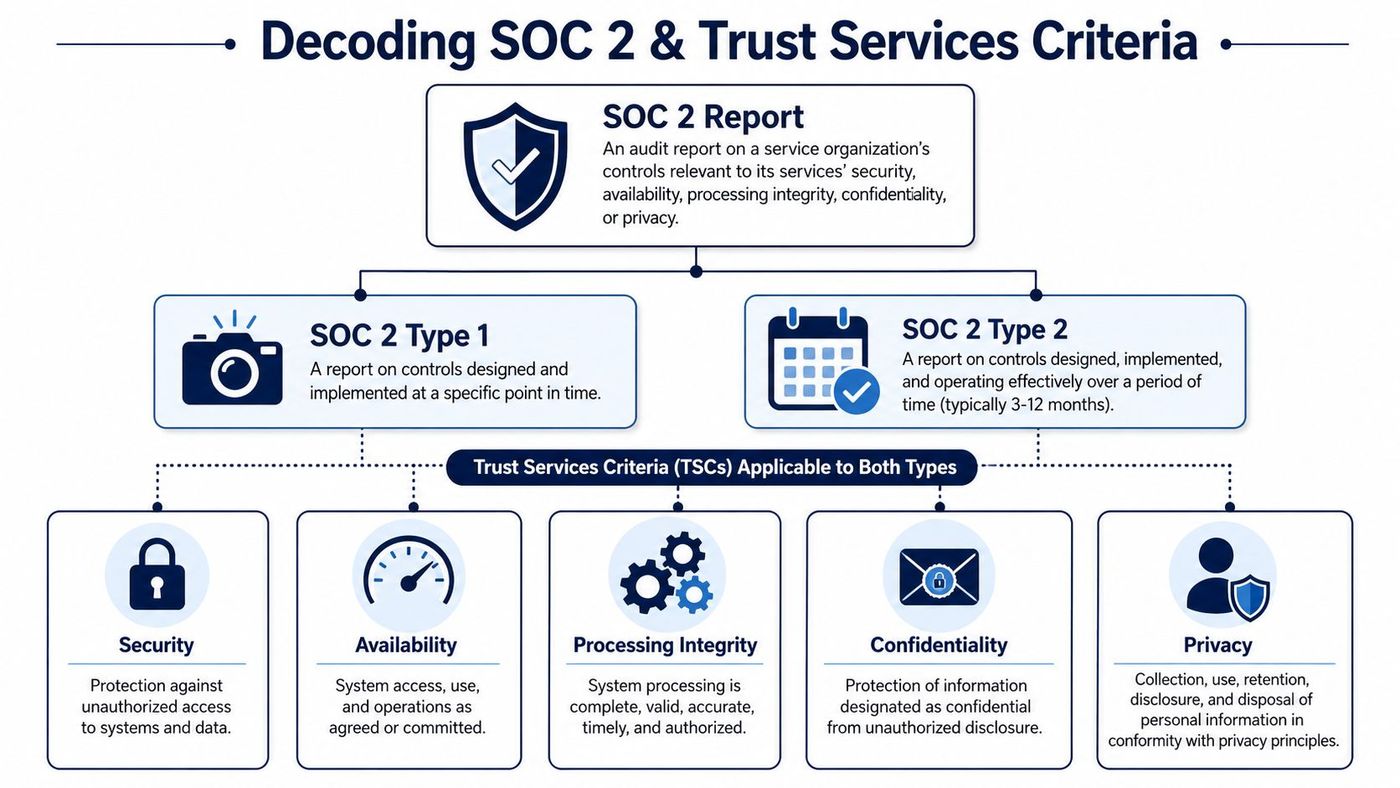
A Type 1 report assesses whether your controls were suitably designed and in place on a specific date. It is often the faster option for a company that needs to answer customer diligence now but is still maturing its control evidence.
A Type 2 report tests whether those controls operated consistently over a review period. In practice, that means your team needs records, approvals, tickets, logs, and review evidence that hold up over time. If user access reviews started late, backups were not being checked, or change approvals were handled informally, the gap will show up in the report.
For Canadian SMBs, the trade-off is practical. Type 1 can help start enterprise sales conversations. Type 2 usually carries more weight with procurement, security teams, and larger customers because it shows operating discipline, not just control design.
SOC 2 uses the Trust Services Criteria, but not every report needs all five. Security is always included. Availability, Processing Integrity, Confidentiality, and Privacy are added based on your service commitments, data handling, and customer expectations.
That flexibility is useful if you are trying to keep scope realistic.
Canadian companies often need to think carefully about the last two. A B2B software firm may need Confidentiality because of customer contract terms, but not Privacy if personal information is limited and outside the scoped system. A healthcare technology provider may need both, especially if client questions are already tied to PIPEDA or provincial privacy expectations.
Good scoping is specific. It defines the service, the people, the infrastructure, the vendors, and the data flows that support the customer-facing system being examined. Over-scoping creates extra testing, more exceptions, and a heavier evidence burden. Under-scoping creates credibility problems if customers can see obvious gaps between your report and the service they buy.
Access control is usually one of the first pressure points. Auditors will ask who can reach production, how access is approved, how privileged roles are reviewed, and whether removals happen quickly when staff or contractors leave. That is why a clear identity and access management program sits near the centre of most SOC 2 efforts.
Practical rule: Scope the criteria around what you actually sell, what data you actually handle, and what your customers are already asking you to prove.
Canadian leaders often compare SOC 2 with ISO 27001 as if one replaces the other. In practice, they answer different questions.
SOC 2 focuses on the controls around a defined system and produces an attestation report used by customers and relying parties. ISO 27001 focuses on the broader information security management system. One is often more useful in customer due diligence. The other is often more useful for internal governance maturity and international standardisation.
| Attribute | SOC 2 | ISO 27001 |
|---|---|---|
| Primary focus | Controls over a defined service system | Information security management system |
| Output | Third-party attestation report | Certification |
| Buyer use case | Vendor assurance and customer due diligence | Broader security governance signal |
| Scope style | Mapped to Trust Services Criteria | Mapped to ISMS requirements |
| Best fit | Service organisations proving control design and operation | Organisations building a formal management system |
For many Canadian SMBs, the choice starts with customer demand. If enterprise prospects are asking for a SOC 2 report, that demand should carry more weight than a general preference for a globally recognised standard.
At the same time, Canadian organisations can't treat SOC 2 as a substitute for privacy law. It's not a legal exemption. It's an attestation framework that can support how you demonstrate control discipline.
The Canadian context matters here. SOC 2 in Canada is voluntary and developed by the AICPA, but it's aligned with other standards and data handling commitments that matter to regulated industries. That makes it useful for organisations balancing customer assurance with obligations under Canadian privacy expectations.
If your business handles personal information, legal duties still come from the law, not the audit report. PIPEDA, provincial privacy obligations, and Quebec's Law 25 create requirements around handling personal data, transparency, safeguards, and accountability.
SOC 2 can help organise the control environment behind those obligations. For example, documented access controls, incident handling, and retention practices strengthen the operational case that privacy commitments are being managed seriously. Privacy assessments also remain important in their own right. A privacy impact assessment in Alberta is a different exercise from SOC 2, but the underlying discipline often overlaps.
SOC 2 tells customers an independent auditor evaluated relevant controls. It does not tell regulators that your legal obligations disappeared.
For healthcare and other sectors with overlapping obligations, the smartest path is often complementary, not either-or. Use SOC 2 to answer customer assurance demands, and map those controls back to the Canadian legal and contractual commitments your organisation carries.
Most SOC 2 delays happen before the audit starts. The controls may exist informally, but the scope is fuzzy, ownership is unclear, and evidence isn't being retained in a way an auditor can test.
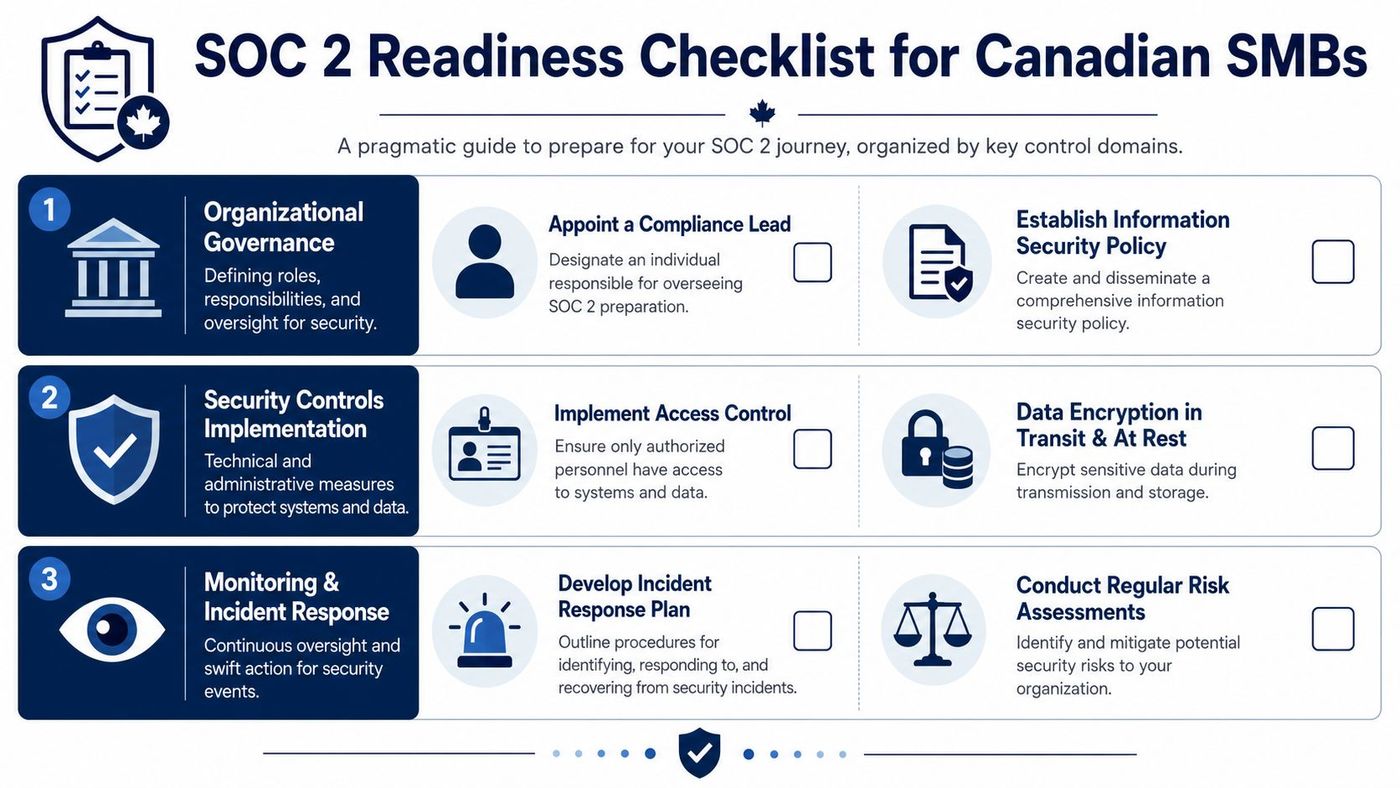
The core requirement is straightforward. The audit scope must explicitly define the system description, including infrastructure, applications, data flows, and services, and align with the specific Trust Services Criteria. Operational evidence like system logs, approval records, access review outputs, change tickets, and incident reports must demonstrate continuous control operation throughout the observation period, according to the BDC glossary on SOC 2.
Start with ownership. If nobody owns the programme, it drifts.
A practical starting point is to map policy and control ownership into an existing risk management framework instead of treating SOC 2 as a separate compliance island.
Auditors often encounter the gap between “we do that” and “we can prove that.”
For teams building their evidence process, checklists can help as long as they don't replace judgement. A useful external reference is this guide to SOC 2 compliance for CEFs, especially for turning broad requirements into auditable tasks.
A thick policy binder won't rescue weak operations. Auditors look for consistency between written controls and lived practice.
If your onboarding process lives in email threads, your access reviews happen ad hoc, and production changes don't leave an approval trail, the problem isn't documentation. It's that the control isn't mature yet.
Good readiness work is usually unglamorous. Tighten workflows in Microsoft 365. Standardise service desk approvals. Make sure security tools retain logs. Reduce exceptions before the observation period begins.
A common Canadian SMB scenario looks like this. Sales has a live deal with an enterprise customer. Procurement asks for a SOC 2 report. Leadership assumes the answer is a quick audit and a fixed invoice. Then the actual work appears. Scope needs to be defined, controls need time to operate, and the budget depends as much on internal discipline as on the auditor's fee.
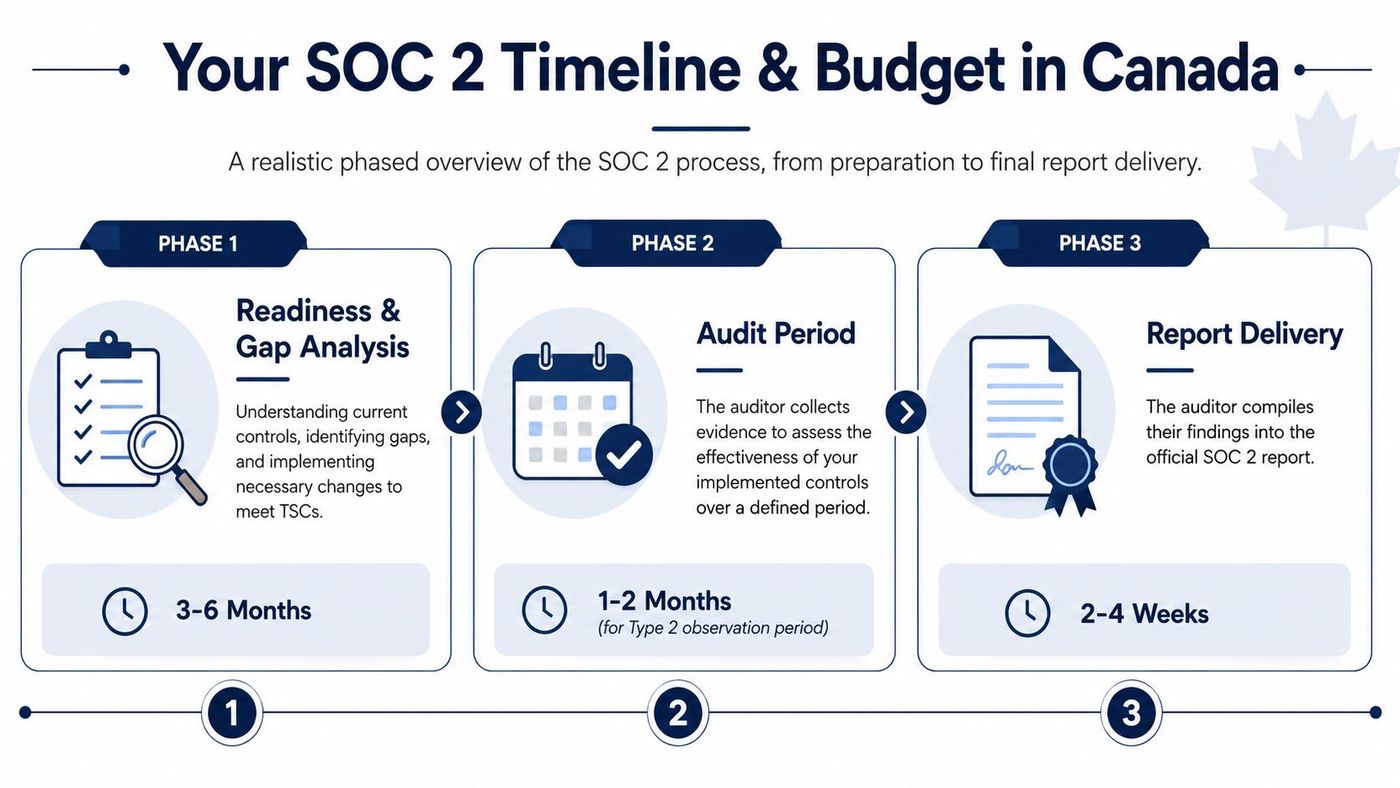
For Canadian companies, the calendar is usually driven by readiness, not by the audit firm's availability. A Type 1 can often be reached faster because the auditor is assessing control design at a point in time. A Type 2 takes longer because those same controls must operate consistently over an observation period.
In practice, the work tends to break into four phases:
This is why early timing decisions matter. If a customer only needs assurance that controls are designed appropriately, Type 1 may support the sales process sooner. If your target market expects proof that controls operate over time, delaying Type 2 planning usually creates rework.
Budget questions are harder because two companies with similar headcount can have very different compliance costs. A 40-person SaaS company with centralised identity, disciplined change management, and clean vendor records will spend differently from a 40-person MSP still relying on shared admin accounts, email approvals, and scattered documentation.
For Canadian SMBs, I usually break the budget into three buckets:
Ask a direct pricing question early. Is the audit quoted as fixed fee or time and materials? Does the fee change if you add Privacy or Availability? What assumptions has the firm made about your control maturity? Those answers affect the actual budget far more than a headline number.
Scope is the first driver. Every added location, production environment, critical vendor, and Trust Services Criterion expands the evidence burden.
Maturity is the second. If your team already uses Microsoft 365, Google Workspace, Jira, or a service desk in a controlled way, you can often build on what exists. If approvals happen in chat threads and reports have to be assembled by hand, preparation hours rise quickly.
Internal ownership is the third. Companies that assign one accountable project lead usually spend less than those that spread tasks across operations, engineering, HR, and finance without clear coordination. The audit fee may be the same, but internal labour and delays push the total cost higher.
Do not budget for a report alone. Budget for a year of operating the controls behind it.
That distinction matters in Canada, where buyers often ask how your security commitments align with privacy expectations, subcontractor oversight, and ongoing governance. A SOC 2 project succeeds when it produces a report and a working control environment that your team can maintain without constant consultant intervention.
A practical budget is usually phased. Fund readiness first. Confirm scope before adding extra criteria. Reserve time for remediation. Then enter the audit with a system your staff can run after the report is issued.
A common Canadian SMB scenario goes like this. The sales team is hearing pressure from enterprise buyers. Leadership approves SOC 2. Then the project stalls because no one chose the audit firm early enough, scope is still fuzzy, and the company is relying on a consultant who cannot carry the work cleanly into attestation.

SOC 2 is not self-certifying in Canada. You need an independent audit from a licensed CPA firm that is qualified to issue SOC 2 reports. That makes auditor selection a business decision, not a late procurement task.
For Canadian companies, fit matters as much as credentials. A firm may be technically strong and still be the wrong choice if it mainly serves large US clients with full-time compliance staff. SMBs usually need an auditor who can keep the bar high, explain evidence expectations clearly, and understand how Canadian privacy obligations shape vendor oversight, access decisions, and data handling.
Good audit interviews get specific fast. Ask how the firm scopes multi-entity environments, how it handles exceptions, and what evidence it will accept from the systems you already use.
Useful questions include:
Ask one more question that leaders often miss. What does the firm see go wrong for companies your size? The answer usually tells you whether the auditor understands SMB constraints or applies an enterprise model directly to smaller teams.
If your team also relies on outside support for security operations, clarify that early. Auditors will want to understand who monitors alerts, who approves changes, and who owns incident response. That conversation is easier when responsibilities are already defined through a provider relationship such as managed security services for Canadian SMBs.
Timelines usually slip because of ordinary execution errors, not because the technical environment is unusually complex.
The first problem is choosing an auditor after readiness work is already underway. That often leads to avoidable rework. One advisor may interpret scope one way, then the CPA firm asks for a different system description, different evidence, or a longer observation period.
The second is over-scoping. Canadian SMBs often try to satisfy every future customer request in the first report. They add extra entities, products, or Trust Services Criteria before the core controls are stable. That raises cost and creates more opportunities for exceptions without adding much sales value.
A third mistake is treating SOC 2 as an IT exercise. HR owns onboarding and offboarding evidence. Leadership approves policies and risk decisions. Operations and service owners often control the records that prove a process happened. If those groups are not engaged early, fieldwork turns into a document chase.
One practical warning deserves attention.
Watch for this: if no one on your team can explain, in plain language, which customer service, systems, vendors, and data flows are in scope, the audit will slow down before testing starts.
The last trap is starting the Type 2 observation period before controls are working consistently. I see this often with access reviews, vendor due diligence, and change approval records. Teams want to move quickly, but a rushed start usually produces exceptions that could have been prevented with a short readiness pause.
Strong SOC 2 projects in Canada are usually quieter than expected. Clear scope. The right CPA firm. A realistic understanding of how privacy, outsourcing, and limited internal bandwidth affect evidence collection. That combination saves time, reduces rework, and produces a report buyers will trust.
A familiar pattern plays out after the first clean SOC 2 report. Sales uses it in customer reviews, leadership breathes easier, and the internal team shifts back to product and operations. Six months later, evidence is scattered, access reviews slipped, a key vendor changed, and renewal suddenly feels harder than the original project.
SOC 2 reports have a shelf life. If you want continuous coverage for customers, procurement teams, and security reviews, you need to plan for a new audit cycle every year. Canadian SMBs do better when they treat SOC 2 as an operating discipline, not a project that ends once the report is issued.
The companies that renew without drama build control work into existing team habits. Quarterly access reviews need named owners and calendar dates. Change approvals should sit inside the engineering workflow already in use. Incident response testing needs management attention before the auditor asks for it.
This matters even more in growing Canadian businesses, where systems, vendors, and customer commitments often change faster than documentation does. A control that matched your environment last year can become inaccurate after a cloud migration, a new MSP relationship, or a change in how personal information is collected and stored. That gap creates audit exceptions, but it also creates customer trust issues.
A practical maintenance cadence usually includes:
For Canadian SMBs, the trade-off is straightforward. Keeping this work in-house gives you more direct control, but it can strain a small IT or security team. Outside support can reduce that burden if it is operational, not just advisory. Teams that need help with monitoring, endpoint coverage, identity controls, and response processes should review how security managed services support ongoing control operations.
Renewals go better when the next audit is mostly evidence collection. If your team has to rebuild ownership, rewrite procedures, and chase missing records each year, the problem is not the auditor. The problem is that the controls never became part of how the business runs.
Yes. A Canadian organisation can engage a licensed CPA firm directly for a SOC 2 attestation. A U.S. parent company is not required.
This comes up often because many SOC 2 resources assume a U.S. startup structure. For Canadian SMBs, that creates confusion that slows down decisions for no good reason. If a customer asks for a SOC 2 report, the core question is whether your controls are defined, operating, and supported by evidence. Corporate geography is rarely the issue.
Canadian companies can obtain SOC 2 even if data is stored or processed outside Canada. The harder question is whether your actual hosting model, privacy commitments, and customer contracts line up.
For Canadian SMBs, PIPEDA and customer expectations warrant a practical review. SOC 2 assesses control design and operation. It does not certify that your data stays in Canada, and it does not fix a privacy notice that says one thing while your cloud stack does another.
Ask these questions early:
A lot of audit friction starts here. The controls may be acceptable, but the legal and operational story is inconsistent. Canadian buyers, especially in regulated sectors or public-sector-adjacent environments, usually want a clear answer on both security and residency.
Sometimes. Fixed-fee pricing works best when scope is stable and both sides agree on what is being audited.
If your in-scope system is still changing, your control owners are not assigned, or your auditor has to help define the boundaries of the engagement, a fixed fee can become misleading. The proposal may look predictable at first, then expand through change requests, added testing, or extra remediation support.
Ask for clarity on four items:
Also ask what happens if you add a product line, bring another entity into scope, or include more Trust Services Criteria later. That is where many Canadian SMBs lose budget control.
Start by defining scope. Identify the service being audited, the systems that support it, the data involved, and the commitments you make to customers.
Then test whether your current controls produce evidence in a repeatable way. That step matters more than polished policy language. A small team with clear ownership, working access controls, and usable logs is in a better position than a company with a large policy set and weak execution.
If your organisation is planning for SOC 2 certification in Canada and needs help turning security expectations into an operational roadmap, CloudOrbis Inc. can support the journey from readiness and control design through ongoing security operations. The goal is to get a report that stands up to customer review and a compliance model your team can maintain as the business grows.
Book a 30-minute call with a senior engineer. No sales script, just straight answers about your environment.


