

September 19, 2026
Database Migration Services Explained for Canadian SMBsLearn how database migration services move data to the cloud securely with minimal downtime. Types, risks, costs and a Canadian provider checklist.
Read Full Post%20(1).webp)
Usman Malik
Chief Executive Officer
June 21, 2026
A lot of Canadian business owners are already living inside digital transformation without calling it that. Your team still relies on spreadsheets passed by email. Staff enter the same customer data into two or three systems. Someone in accounting chases approvals manually. Your office tools work, but they don't connect. Meanwhile, competitors respond faster, onboard clients more smoothly, and seem to make better decisions with less effort.
That pressure feels technical, but it's really operational. The issue isn't only old hardware or one outdated application. It's the accumulation of disconnected processes, inconsistent data, and workarounds that slow the business down.
This is why the question what is digital transformation matters. It's not a buzzword for enterprise IT departments. It's a practical business question for any small or mid-sized company that wants to improve efficiency, protect data, and grow without adding friction at every step.
For Canadian firms, this shift is already mainstream. Statistics Canada reported that 88.7% of Canadian businesses were using cloud computing in 2023, while worldwide spending on digital transformation reached US$1.85 trillion in 2022, according to Statista's digital transformation coverage. That tells you something important. Modernising is no longer an optional side project. It's becoming part of how businesses operate.
Most SMBs don't start with a grand transformation plan. They start with frustration.
A clinic struggles with patient communication because booking, records, and billing live in separate tools. A manufacturer can't get reliable reporting because production data sits in one system and purchasing data sits in another. A legal firm wants better collaboration, but every improvement raises questions about confidentiality, access control, and document retention.
These businesses usually ask for a software fix. What they often need is a better operating model.
Digital friction rarely comes from a single system. It comes from the gap between how the business works and how the technology supports that work. If staff have to rekey information, hunt for files, wait for approvals, or bypass security controls just to get work done, the business is already paying the price.
That's where digital transformation becomes useful as a concept. It gives leaders a way to think beyond replacing one platform with another.
Digital transformation starts when a business stops asking, “What software should we buy?” and starts asking, “How should this process work from end to end?”
The phrase gets overused, but the underlying issue is real. Businesses are under pressure to move faster, support hybrid work, manage risk, and turn operational data into decisions. You can't do that reliably with disconnected systems and informal processes.
For Canadian SMBs, the practical question isn't whether to modernise. It's how to do it in a way that improves day-to-day operations without creating compliance problems, security gaps, or expensive rework later.
If digitisation is repainting a house, digital transformation is renovating the foundation, wiring, and plumbing so the building works for modern life.
A lot of companies digitise. They move paper forms into PDFs, replace filing cabinets with SharePoint, or shift a server workload into Microsoft Azure. Those can be useful improvements. But by themselves, they don't answer what digital transformation is in a meaningful business sense.
True transformation changes how work gets done.
True digital transformation is the rewiring of processes, operating models, and technology architecture. It's not just moving to the cloud. It's redesigning workflows, governance, and KPIs together so technology upgrades produce measurable business value rather than remaining isolated, as described in McKinsey's explanation of digital transformation.
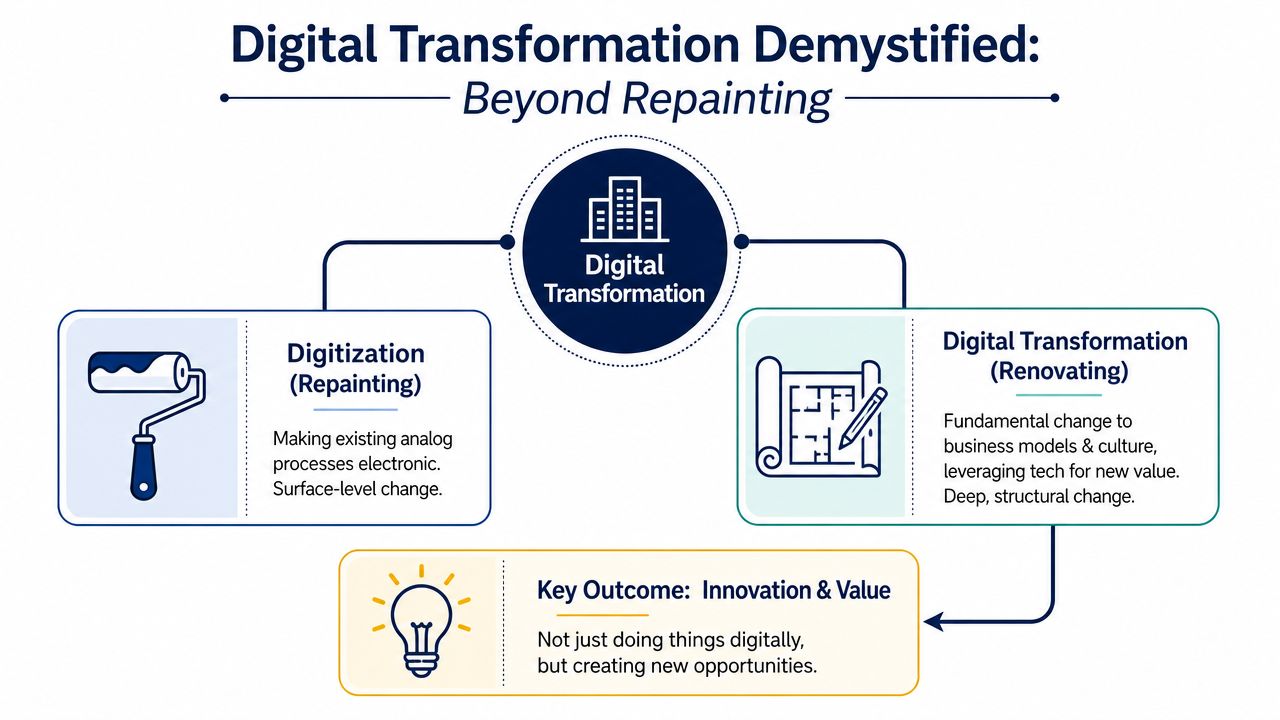
That definition matters because it separates real progress from surface-level upgrades. A business can buy new software and still keep the same bottlenecks. It can migrate email to Microsoft 365 and still have poor document control, unclear ownership, and inconsistent approval paths.
Technology only creates value when the surrounding process changes with it.
In practical terms, digital transformation usually shows up in three areas:
A useful test is this. If you removed the new software tomorrow, would the process fall back into manual workarounds because nothing else changed? If the answer is yes, the business digitised a task but didn't transform the operation.
Some patterns fail repeatedly:
| Approach | Why it falls short |
|---|---|
| Buying tools before defining outcomes | Teams adopt features, not business improvements |
| Migrating to cloud without governance | Files move, but access, retention, and ownership stay messy |
| Launching automation on bad data | Errors happen faster and become harder to trace |
| Treating transformation as an IT project only | Department leaders don't change process ownership or accountability |
If your focus is process efficiency, a good starting point is to map how work moves through the business. Through this, business process optimization becomes tightly connected to digital transformation. You can't improve what no one has documented clearly.
Practical rule: Don't automate confusion. Fix the workflow first, then apply the tool.
The case for digital transformation in Canada isn't abstract. It shows up in payroll delays, missed follow-ups, fragmented reporting, and rising cyber risk. SMBs feel it more acutely because they often have less margin for downtime and less room for technology mistakes.
Modernisation matters because it helps businesses operate with more control. Not just more speed.
Most owners first notice the operational benefits. Teams save time when systems integrate cleanly. Staff collaborate better when files, messages, and tasks live in a managed environment instead of scattered across inboxes and personal devices. Managers can track work more easily when approvals and records leave an audit trail.
Those are tangible improvements. But in Canada, they're only half the picture.
For Canadian businesses, transformation must address operational realities like data residency, cyber risk, and compliance in regulated sectors such as healthcare, finance, and legal. Modernising requires new governance for cloud and data-sharing to ensure security and auditability, as discussed in this Canadian middle-market analysis on digital transformation and growth.
That point often gets missed in generic advice. A cloud app may improve convenience, but if no one has defined where data lives, who can access it, how it's retained, or how activity is reviewed, the business has traded one risk for another.
For a Canadian SMB, a transformation decision often includes questions like these:
Those aren't niche concerns. They're part of basic operating discipline, especially for firms handling personal information, financial records, legal documents, or confidential project data.
A lot of SMB leaders also need a more realistic view of support. Transformation creates ongoing responsibilities around identity management, endpoint protection, backup, device standards, and user training. That's one reason many growing firms look at the benefits of managed IT services as part of the broader modernisation effort, not as a separate conversation.
A well-run transformation programme usually delivers benefits that leaders can feel quickly:
The best reason to act isn't novelty. It's control. When your systems, workflows, and governance line up, the business becomes easier to run.
The cleanest way to approach digital transformation is to treat it as a sequence of business decisions, not a shopping list of tools. SMBs get into trouble when they try to modernise everything at once or chase automation before their data and processes are ready.
A better approach is phased, disciplined, and tied to operational outcomes.
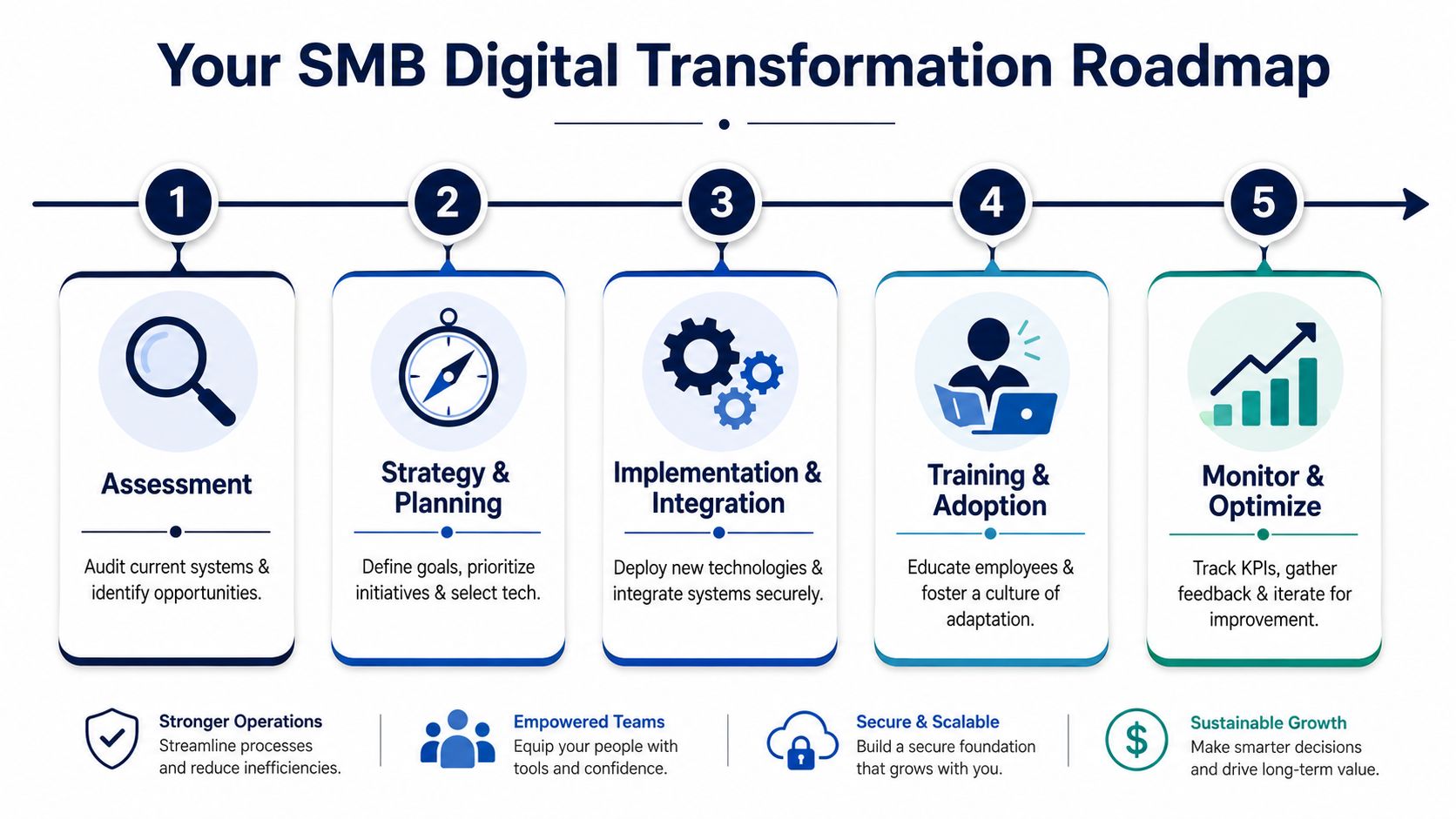
Before choosing platforms or planning migrations, inspect the current environment. Look at where work breaks down, where staff rely on manual fixes, and where data gets duplicated or lost.
Review at least these areas:
This step often reveals that the main problem isn't lack of technology. It's lack of standardisation.
A useful roadmap doesn't begin with “move to cloud” or “use AI.” It begins with priorities such as reducing turnaround time, securing remote access, improving reporting, or standardising collaboration across teams.
From there, you can decide what belongs in phase one and what should wait. Some businesses need identity and device management first. Others need file structure cleanup, network upgrades, or a Microsoft 365 tenant review before anything more advanced makes sense.
If the roadmap doesn't name process owners, data owners, and success measures, it isn't ready.
Strategic guidance is essential. Some firms use an internal IT lead. Others use an external advisor or vCIO to align technology decisions with budget, operations, and risk tolerance. CloudOrbis, for example, provides strategy, cloud migration, cybersecurity, and managed IT support for Canadian SMBs that need that kind of structured guidance.
This is the part many organisations skip, and it's one of the biggest reasons transformation efforts stall.
Successful transformation depends on a data governance first approach. Experts stress that harmonising data and defining integration roadmaps must happen before advanced applications like AI and automation can deliver reliable benefits. Without this foundation, technology investments often fail to improve decisions or operations, according to Splunk's guidance on digital transformation.
In practice, that means:
If you want a more detailed planning framework, this kind of phased thinking is central to a strong digital transformation roadmap.
The rollout should be boring in the best way. Low drama. Clear ownership. Predictable change windows. Training built into the schedule.
A practical sequence often looks like this:
| Phase | Focus |
|---|---|
| First | Secure the foundation, identity, devices, backup, and access controls |
| Next | Clean up collaboration, file management, and workflow bottlenecks |
| Then | Integrate systems and improve reporting |
| Later | Add automation, analytics, or AI where the data is reliable |
That order prevents a common mistake. Businesses often want advanced tools first because they're visible and exciting. Foundational work is usually less glamorous. Access policies, data structure, endpoint standards, retention settings, and process redesign create the conditions that make the advanced tools worthwhile.
Digital transformation becomes much easier to understand when you see it in operating terms. Not “a company bought software,” but “a company changed how work happens.”

A clinic often starts with a familiar problem. Staff juggle appointment requests, patient communications, scanned documents, and internal approvals across separate systems. Information is available, but not organised in a way that supports fast, secure action.
After transformation, the goal isn't just “paperless.” It's a more controlled workflow. Secure cloud access, better Microsoft 365 configuration, clearer document permissions, and standardised communication processes help staff serve patients without exposing sensitive data unnecessarily.
Manufacturers often struggle with visibility. Production, purchasing, maintenance, and sales may all have useful data, but it sits in different places and arrives too late to support quick decisions.
The shift happens when those systems connect more cleanly and reporting becomes operational instead of reactive. Teams can work from a shared view of inventory, orders, vendor updates, and internal requests. For firms planning that kind of change, sector-specific examples in CloudOrbis manufacturing IT services show how infrastructure, connectivity, and support shape the outcome.
Legal practices don't just need convenience. They need control. Before transformation, documents may be spread across desktops, shared drives, and inboxes, with inconsistent naming and access practices.
After a proper redesign, the firm uses structured collaboration, stronger identity controls, secure remote access, and clearer retention practices. The benefit isn't only speed. It's the ability to work efficiently without weakening confidentiality obligations.
Construction teams often face a field-versus-office disconnect. Drawings, project updates, vendor documents, and site communications don't always reach the right people at the right time.
A transformed environment gives project managers and field staff secure mobile access to current files, standard communication channels, and clearer version control. That reduces confusion on site and cuts down on delays caused by outdated information.
The strongest industry examples all share one trait. The technology supports a better process, instead of forcing people to invent workarounds around the technology.
The hard part of digital transformation usually isn't deciding that change is needed. It's managing the risk while the change happens. Most SMBs run into the same three obstacles. Security concerns, legacy complexity, and organisational resistance.
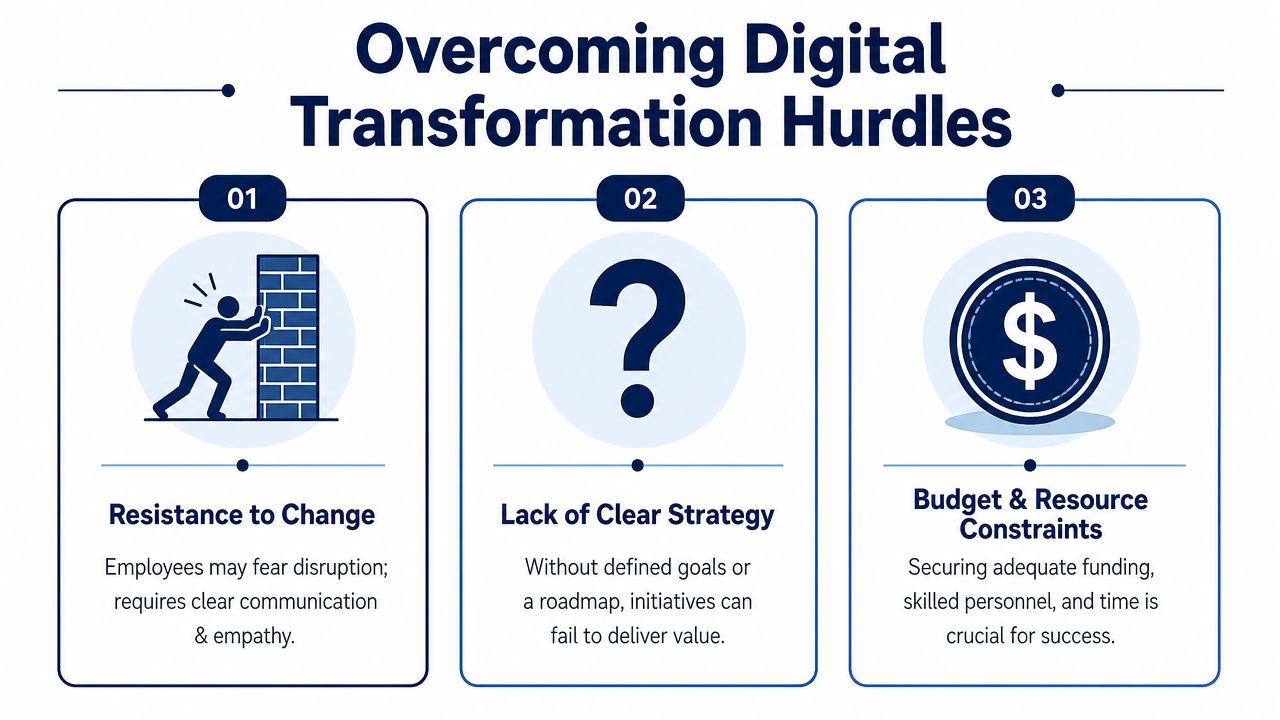
As businesses adopt cloud platforms, mobile access, and integrated systems, the attack surface changes. More identities, more endpoints, and more shared data create more opportunities for error or compromise.
The solution isn't to avoid modernisation. It's to modernise with controls built in. Use multi-factor authentication, conditional access, endpoint protection, backup discipline, role-based permissions, and documented response procedures from the beginning.
Many SMBs still depend on older line-of-business systems that can't be replaced overnight. That creates friction when newer tools need data from systems that were never designed to integrate cleanly.
A phased approach works better than a hard cutover in most cases. Keep the legacy platform where it's still needed, reduce the number of manual touchpoints around it, and plan integration or replacement in stages. That lowers disruption and gives staff time to adapt.
Even strong technical projects fail when staff don't understand why a change is happening or how to work in the new model. Resistance often looks like a technology problem, but it usually starts as a communication problem.
Good change management is practical:
For many SMBs, formalising that human side of the work is where a clear change management process becomes valuable.
| Challenge | Practical response |
|---|---|
| Security worries | Build access, backup, monitoring, and policy controls into the project |
| Legacy integration issues | Modernise in phases and reduce manual dependencies step by step |
| Staff resistance | Communicate early, train by role, and support users after rollout |
Most transformation problems aren't caused by too much ambition. They're caused by weak sequencing, unclear ownership, and poor follow-through.
Digital transformation is easier to manage once you strip away the hype. It means redesigning how the business operates so technology, process, and governance work together. For Canadian SMBs, that includes efficiency and growth, but it also includes data control, security, auditability, and compliance discipline.
The businesses that get value from transformation usually do a few things well. They start with a real operational problem. They fix data and process foundations before chasing automation. They roll changes out in phases. And they treat cybersecurity and change management as core parts of the plan, not side tasks.
That's also why many firms need more than ad hoc support. They need strategic direction, cloud planning, security controls, Microsoft 365 optimisation, and ongoing IT operations that can support the new environment after launch. A vCIO function, structured cloud migration, managed cybersecurity, and proactive support all play a role when transformation moves from idea to execution.
The important point is this. You don't need to modernise everything at once. You need a clear starting point, a realistic roadmap, and the discipline to improve one business-critical area at a time.
If you're planning a digital transformation initiative and want a practical assessment of your current systems, risks, and next steps, CloudOrbis Inc. can help you map a secure, Canadian-focused path forward with strategy, cloud, cybersecurity, and managed IT support aligned to your business goals.
September 19, 2026
Database Migration Services Explained for Canadian SMBsLearn how database migration services move data to the cloud securely with minimal downtime. Types, risks, costs and a Canadian provider checklist.
Read Full Post
September 18, 2026
Business VoIP Telephone Systems Explained for SMBsLearn how business VoIP telephone systems work, what they cost and how to choose a secure, resilient option for your Canadian SMB.
Read Full Post
September 17, 2026
Cloud Migration Roadmap Template That Prevents Costly ReworkGet a practical cloud migration roadmap template plus steps to customize it for assessment, waves, testing and cutover without budget surprises.
Read Full Post
