Support Tier 1 Explained: Roles, Tools, and SLAs for SMBs
Learn how support tier 1 works for SMBs. Discover responsibilities, tools, escalation paths, SLAs, KPIs, and a practical playbook for managed IT services.

Learn how support tier 1 works for SMBs. Discover responsibilities, tools, escalation paths, SLAs, KPIs, and a practical playbook for managed IT services.

Tier 1 support is where most IT value is won or lost. In North America, it absorbs about 60% to 75% of all tickets, and the cost gap is stark, roughly $4 to $8 per ticket at Tier 1 versus $15 to $30 at Tier 2 and $80 to $200 at Tier 3 once engineering time is included (support tier glossary). For Canadian SMBs, that makes support Tier 1 the budget control point, not a back-office convenience.
The practical lesson is simple. If password resets, routine troubleshooting, account changes, and common access issues are handled cleanly at the first line, queues shrink, specialist time stays protected, and the service desk stops acting like a funnel to your most expensive people. A solid Tier 1 operation also gives leaders something concrete to manage, because it turns support from a vague cost centre into a measurable system with clear containment, speed, and escalation targets.
Tier 1 is the first economic decision point in your support stack. Enterprise support data shows a Tier 1 average first response time of 1 hour 8 minutes, an average resolution time of 8 hours 45 minutes, an average handling time of 26 minutes, and a ticket age average of 2.66 days (enterprise support dataset). Those numbers show what Tier 1 is meant to do, handle volume quickly, keep work moving, and stop unnecessary escalation before it reaches more expensive teams.
A Tier 1 function that resolves routine issues well is not just cheaper support. It protects the rest of the operating model. Industry guidance places Tier 1 around 60% to 70% of incoming tickets, and also notes that agents commonly handle 30 to 50 tickets per day. That volume is why the line between “minor request” and “escalate now” has to be disciplined, especially when you are trying to keep service desk spend under control in a Canadian SMB.
Practical rule: if a request can be solved with a known workflow, it should stay at Tier 1 until proven otherwise.
For Canadian SMBs, the economics become clearer when you look at the full cost of ownership. The support stack only works when leaders understand what each layer costs, which is why a TCO lens matters before you expand headcount or hand more work to specialist teams. A useful reference point is CloudOrbis's breakdown of total cost of ownership, because Tier 1 decisions ripple through staffing, tools, after-hours coverage, and escalation load.
Tier 1 also affects compliance in a very practical way. When your service desk handles routine account access, user requests, and ticket routing correctly, you reduce the chance that sensitive data spills into the wrong queue or that regulated work lands with the wrong person. That matters for Canadian businesses supporting healthcare or other regulated clients, where PIPEDA controls and HIPAA-related process expectations often shape how access is granted, logged, and escalated.
The savings do not come from one heroic agent. They come from standardising the repetitive work that clogs the queue. Password resets, routine access requests, basic software issues, and straightforward hardware questions belong at the first line because every successful containment avoids a more expensive touch later.
If you need external recruiting support for service desk growth, an SDR can help source capacity, but staffing alone will not fix weak Tier 1 design. The bigger win is process discipline, clear ticket boundaries, and a knowledge base that lets agents close work without hunting through tribal knowledge. That is where operating costs start to fall in a way finance teams can see, and where a managed services model can keep the first line predictable without pushing avoidable work into higher-cost tiers.
Tier 1 agents should be your frontline triage layer. They log tickets, reset passwords, restore access to accounts, route known issues, answer basic software and hardware questions, and guide users through standard access problems with scripts and a documented knowledge base (frontline support guide). In practical terms, Tier 1 turns user complaints into clean, standardised records before anything becomes a more expensive investigation.

In a Canadian SMB environment, the recurring Tier 1 workload is easy to recognise:
That boundary matters because Tier 1 agents usually work in ticketing systems, live chat, email, and other low-privilege tools rather than admin dashboards or log-level diagnostics (Canadian access control guidance). The point is not to limit skill. The point is to prevent over-privileged support from becoming a security and cost problem.
Anything that needs deep system configuration, patching, log correlation, or root-cause analysis should move upward with complete context. If the agent can't close the issue with a documented workflow, the ticket needs a clean handoff, not a second round of guesswork. That is how mean time to acknowledge stays low and Tier 2 stops drowning in avoidable repeats.
Good Tier 1 work is boring on purpose. The faster agents convert chaos into standard tickets, the less time senior engineers spend chasing the same symptom in different forms.
I've seen weak helpdesks fail for one simple reason, they let Tier 1 become a loose catch-all. When that happens, the team loses speed at the front, the specialists get interrupted all day, and nobody has a clear record of what happened first. A managed help desk works best when the first line stays narrow, documented, and relentlessly consistent, which is why CloudOrbis's managed help desk approach matters to SMBs that need predictable service.
Tier 1 should work with limited tools and limited privilege. In practice, that usually means the ticketing platform, a knowledge base, live chat, email, basic remote-support tools, and selected identity tools, while Tier 2 and Tier 3 handle deeper diagnostics, admin-level changes, and infrastructure work (privileged access overview). That separation keeps expensive access from being handed out casually, and it protects the environment when a small team is trying to move fast.
| Support Tier Tools and Access Comparison | Typical Tools | Access Level | Common Tasks |
|---|---|---|---|
| Tier 1 | Ticketing system, live chat, email, knowledge base, basic remote desktop, identity portal | Low-privilege, tightly scripted | Logging issues, password resets, account setup, basic troubleshooting |
| Tier 2 | Admin consoles, deeper monitoring tools, remote diagnostics, system reports | Controlled, restricted | Log review, application faults, patch-related issues, multi-step fixes |
| Tier 3 | Engineering tools, infrastructure consoles, code or configuration access | Highest privilege | Root-cause analysis, major changes, complex system recovery |
A first-line agent does not need broad admin rights to solve a printer issue, a VPN login failure, or a Microsoft 365 access problem. The job is to verify the ticket, confirm the known fix, and pass the rest upward with clean notes when the issue sits outside Tier 1 scope.
The access model also shapes how 24/7 support behaves. Around-the-clock service breaks down when teams depend on informal tribal knowledge and broad permissions, because both slow audits and create avoidable risk. Canadian organisations that want fast first response without loose control usually pair Tier 1 with identity management portals, ticketing workflows, and tightly defined remote tools, while keeping deeper controls locked down for specialists.
If you are setting this up for a regulated environment, privileged access management should be part of the design from the start. CloudOrbis's privileged access management overview is useful here because it frames the access question around control, review, and separation of duties rather than convenience alone.
More access can make a ticket disappear faster in the moment. It also weakens auditability and raises the chance that the wrong person changes the wrong setting. Less access can feel slower at first, but it usually produces better records, safer escalation, and less rework.
A strong provider should be able to explain exactly which tools Tier 1 uses, what those tools cannot do, and how the handoff works when a ticket leaves the first line. If that answer is vague, the operating model probably is too. That matters for Canadian SMBs trying to keep managed service costs under control while still supporting HIPAA and PIPEDA obligations. For teams that want sharper first-contact performance, first contact resolution tips are only useful if the access model behind them is tight enough to support consistent execution.
Tier 1 succeeds when the SLA matches the work it is given. If you set response targets that ignore queue volume, access limits, and the kind of tickets your helpdesk sees, the desk will miss the mark or hide the miss with weak routing. Enterprise support data shows an average first response time of 1 hour 8 minutes, an average resolution time of 8 hours 45 minutes, and an average handling time of 26 minutes in a practical enterprise support dataset. Another industry guide says straightforward requests can be resolved in 5 to 15 minutes, which is the right expectation for simple first-line work, not every issue that lands in the queue. That kind of benchmark matters for Canadian SMBs that want to control managed services spend without setting impossible promises.
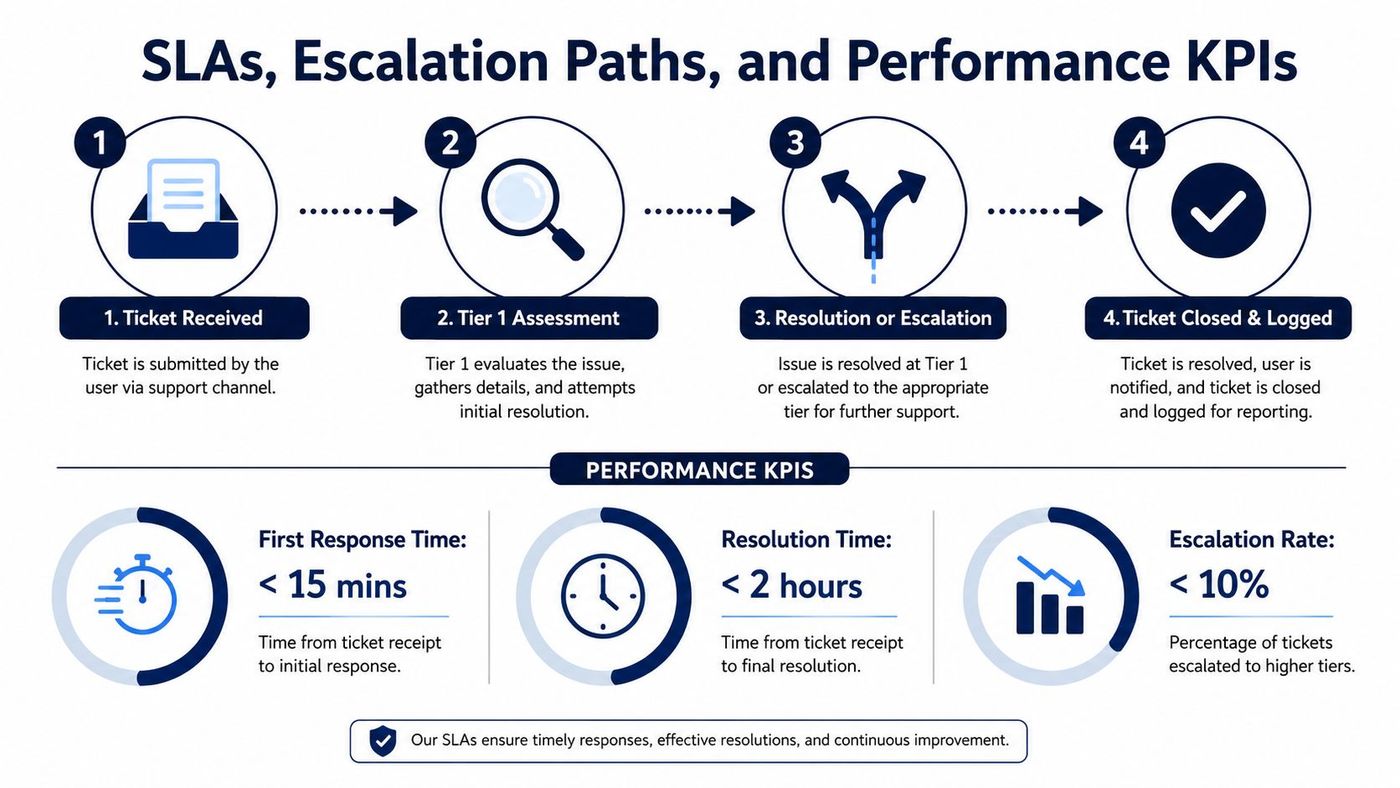
A ticket should move in a straight line. It arrives, Tier 1 assesses it, the agent either resolves it or escalates it with full context, and the record closes only after the outcome is logged. If the issue needs log correlation, patching, or system-level investigation, it should move upward immediately with the original symptoms, what was tried, and what the user reported.
That handoff only works when the first line knows its boundaries. Weak escalation paths create repeat calls, poor ownership, and more time spent by senior staff cleaning up the intake problem instead of fixing the underlying issue. A provider should be able to show how tickets are tagged, when they move, and which notes must travel with them.
For teams that want sharper first-contact performance, first contact resolution tips are useful as a process lens, especially when they reinforce documentation quality and triage discipline rather than just speed.
Tier 1 should be judged on four things:
Useful test: if tickets are escalating with missing context, Tier 1 is not supporting Tier 2. It is feeding it noise.
The point of an SLA is not to make the team look busy. It is to define how quickly the desk acknowledges work, how fast it resolves routine problems, and what “good enough to escalate” means. CloudOrbis's support management services fit naturally into that model because structured support only works when metrics, handoffs, and ownership are visible.
At a clinic, Tier 1 is a privacy boundary, not just a service desk. A receptionist, nurse, or billing coordinator may need quick support, but the agent handling the ticket still has to respect the controls around protected health information, privacy-sensitive records, and access logging. For organisations subject to HIPAA and Canadian privacy rules such as PIPEDA, the support workflow has to reflect that reality.
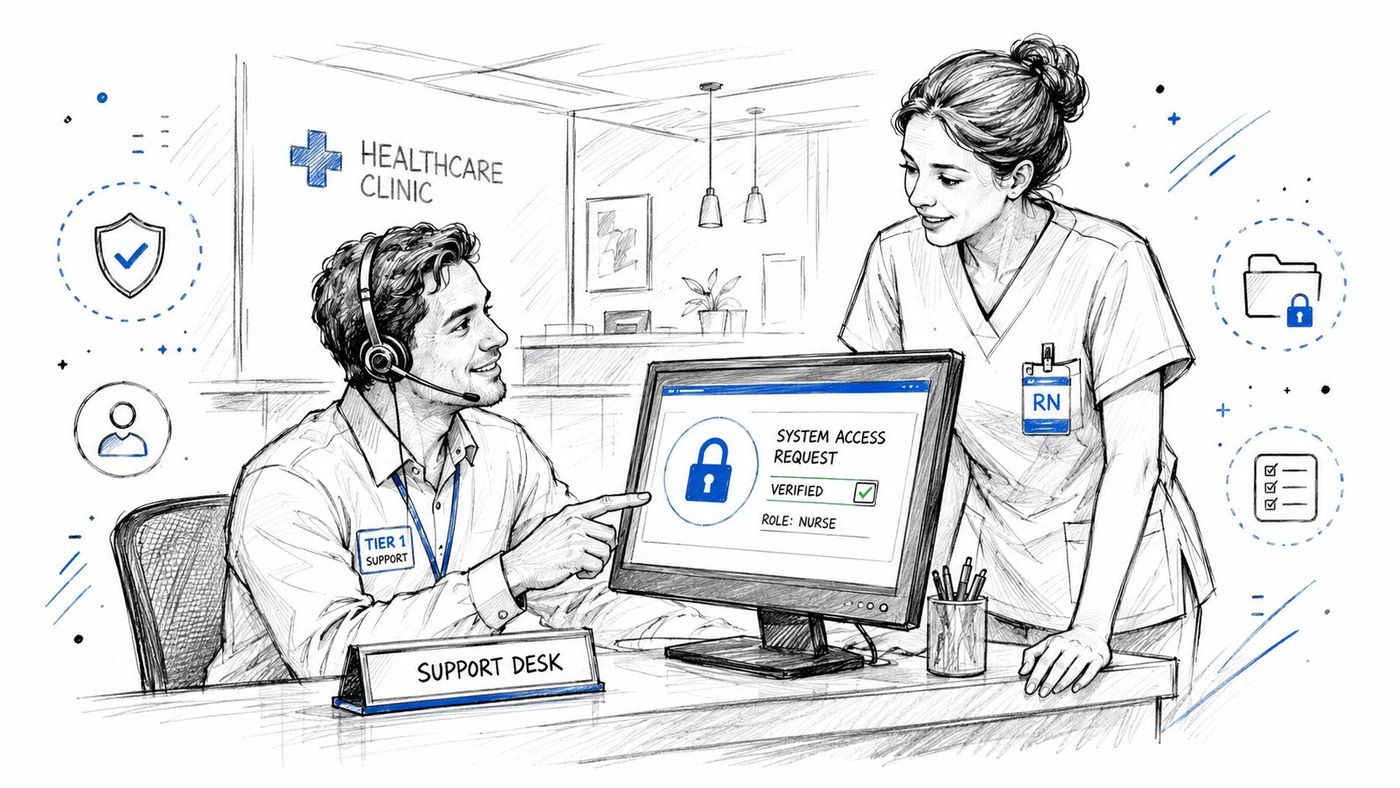
In a healthcare setting, Tier 1 staff need training on what they can record, what they should avoid recording, and when the issue must be escalated to someone with the right authority. The ticket history itself becomes part of the compliance story, so note-taking, identity verification, and access changes all need to be documented carefully.
A good managed services provider should also think about where the support team sits. Canada-based agents are easier to align with provincial privacy expectations, and they usually understand that compliance is operational, not just legal. That matters when tickets involve access to patient systems, account recovery, or emergency workflow interruptions.
A clinic manager should ask direct questions about audit trails, access controls, and escalation logs. If the provider cannot explain how a Tier 1 ticket is handled without exposing unnecessary information, that is a red flag. CloudOrbis's healthcare IT compliance guidance is relevant here because regulated support has to match both the workflow and the recordkeeping standard.
Compliance rule of thumb: if the agent does not need the data to solve the issue, the agent should not collect it.
The same logic applies beyond healthcare. Law, finance, and other regulated SMBs need Tier 1 to be fast, but not careless. The best support desks use narrow access, strict documentation, and clean escalation paths so privacy and service quality move together instead of competing.
The best Tier 1 teams do not grow by accident. They start with the ticket history, because the last 6 to 12 months of incidents usually reveal the boundaries between first-line work and specialist work (Canadian Tier 1 ticket review guidance). That review tells you what users ask for, where escalations pile up, and which requests should never leave the service desk.
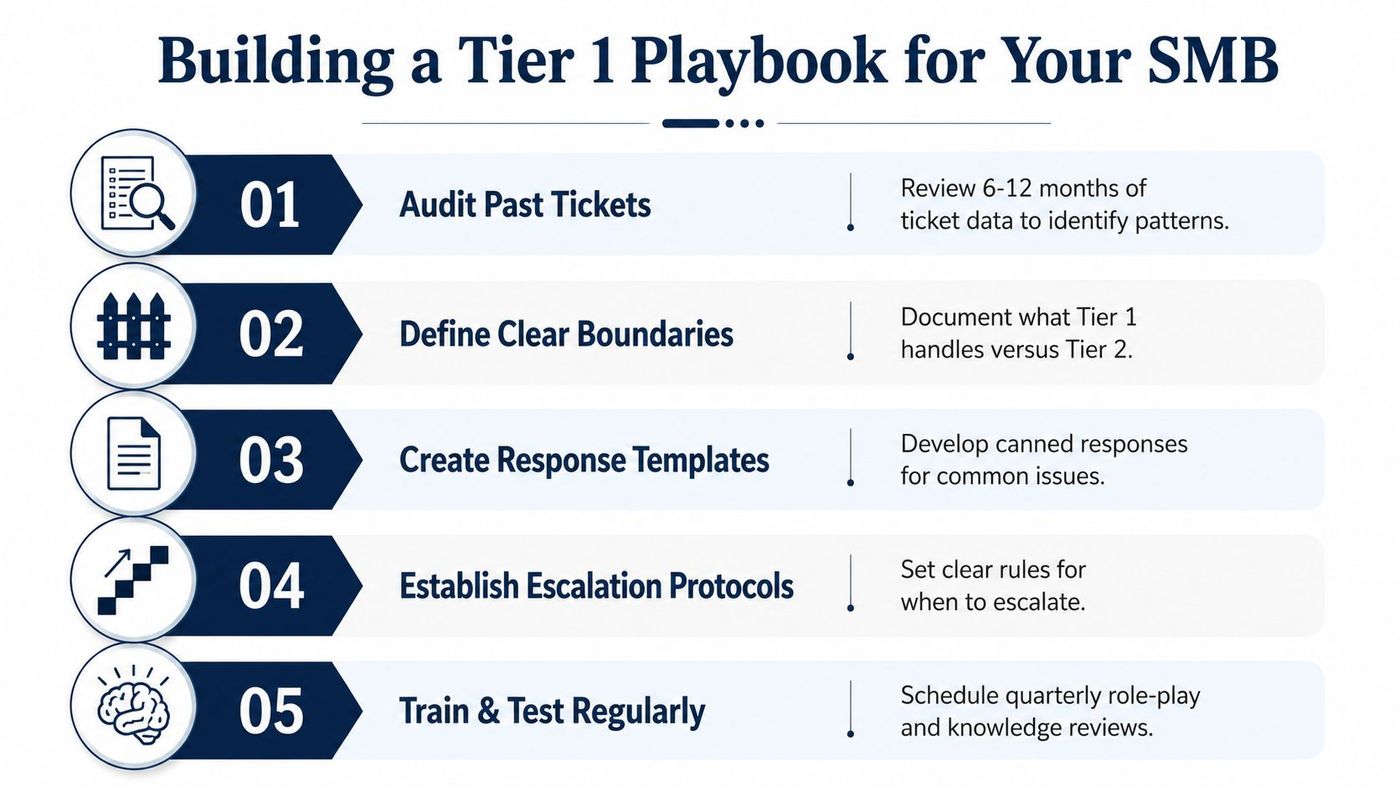
Hire for consistency, judgement, and calm communication. Tier 1 agents need enough technical fluency to follow scripts and enough discipline to avoid freelancing when the issue is outside scope. They also need strong documentation habits, because sloppy notes create friction for everyone downstream.
If you're evaluating a managed IT provider, focus on the same discipline. Ask about 24/7 coverage, Canada-based agents, documented escalation paths, and how KPI reporting is shared. CloudOrbis is one provider that offers first-line support as part of a broader managed IT service model, which is useful when you want the desk, monitoring, and compliance posture to work together rather than in silos.
Tier 1 is the highest-ROI support layer because it controls volume before cost compounds. When the first line is tight, the rest of the stack gets cleaner, faster, and less expensive to run. When it is loose, specialist staff spend their day re-triaging what should never have reached them, and users feel the delay in every queue.
The warning signs are usually obvious. First-contact resolution drops, handling times creep up, tickets arrive with poor notes, and escalations start looking like unfinished first-line work. That is the moment to tighten boundaries, refresh scripts, and review whether the service desk has enough structure to absorb demand without widening privilege.
For Canadian SMBs, the decision is whether Tier 1 is treated as a budget sink or a control point. The better model is to treat it as the place where cost, service quality, and compliance all intersect. If you get that layer right, everything above it gets easier to manage.
CloudOrbis Inc. helps Canadian SMBs build that kind of support model with 24/7, 100% Canada-based helpdesk coverage, proactive monitoring, and managed IT workflows designed for regulated environments. If you want to tighten your Tier 1 containment, improve escalation quality, and support your team with compliant first-line service, visit CloudOrbis Inc. to see how their managed IT services fit your operation.
Book a 30-minute call with a senior engineer. No sales script, just straight answers about your environment.


