
September 23, 2026
DDoS Protection for Canadian SMBs: What Works in 2026Learn what DDoS protection really does, the latest Canada-specific threats, and a practical playbook for small and mid-sized businesses
Read Full Post%20(1).webp)
Usman Malik
Chief Executive Officer
December 26, 2025
Imagine every sensitive system in your business—your financials, client data, and core infrastructure—is locked behind a high-security door. Privileged Access Management (PAM) is the master system that controls who gets the keys, when they can use them, and what they do while inside. It’s a foundational piece of any modern security program.
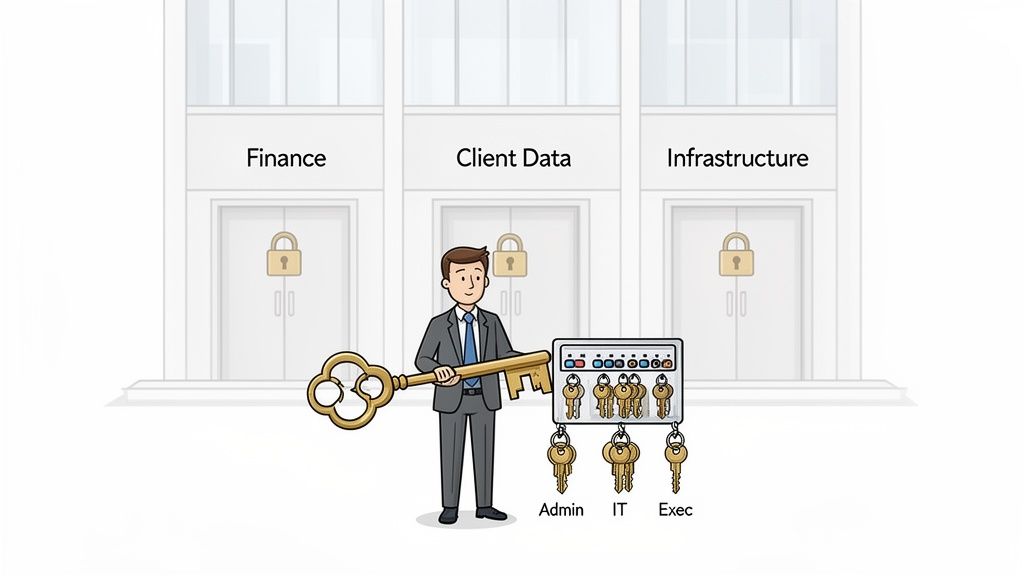
Privileged Access Management is a critical cybersecurity strategy that focuses on securing, controlling, and monitoring the special accounts held by system administrators, IT staff, and key executives. These aren't your everyday user accounts; think of them as the "master keys" to your entire digital kingdom.
Let's put it another way. While every employee might have a keycard to enter the office building, only a select few have the keys to the server room, the vault, or the CEO's office. PAM is the security protocol that manages those powerful keys, ensuring they don’t fall into the wrong hands or get misused.
These powerful accounts are prime targets for cyberattacks precisely because they offer almost unlimited access. If a hacker gains control of an administrator account, they can shut down security systems, steal sensitive data, and bring your operations to a grinding halt. Managing these "master keys" is a non-negotiable security layer for any modern business.
The importance of a solid PAM strategy can't be overstated, especially for medium-sized organizations that handle sensitive information. It's not just an IT function; it's a core business safeguard. Here in Canada, the demand for PAM has shot up as more businesses realize its value in preventing disaster.
For instance, Canadian manufacturing and logistics firms have suffered numerous breaches where privileged credentials were misused, leading to massive financial losses. Protecting these accounts isn't an expense—it's a direct investment in your business continuity and reputation.
A well-implemented PAM system delivers several crucial benefits:
Privileged access is the gateway to an organization's most critical assets. Securing it isn't just about preventing external attacks; it's about establishing trust and accountability for all internal users with elevated permissions.
Ultimately, PAM is a central pillar of an effective security posture. It ensures that only the right people have the right level of access, for the right amount of time, protecting your most valuable digital assets. To see how PAM fits into a bigger picture, check out our guide on what is cybersecurity.
To truly grasp why privileged access management is so critical, you need to think like a cybercriminal. For an attacker, breaking into a standard user’s account is like finding a single office key—it gets them into one room, but that's about it.
Compromising a privileged account, on the other hand, is like being handed the master key to the entire corporate skyscraper.
Once they have that key, they can go anywhere. They can waltz into the server room, rifle through financial records, copy client databases, and access your most valuable intellectual property. This unrestricted access is precisely why these accounts are the ultimate prize for any attacker. A single set of compromised administrator credentials can grant them total control over your network, letting them disable security systems, steal data without a trace, and cause maximum chaos.
The fallout from a breach like this is devastating. A manufacturing plant could be forced into a complete shutdown. A financial services firm could suffer a catastrophic data leak. A healthcare clinic could face crippling compliance violations and see its reputation shattered overnight. The risk of leaving these digital master keys unguarded is simply too high for any business to ignore.
Cybercriminals have a well-established playbook for getting their hands on these powerful credentials. They typically blend technical attacks with clever psychological manipulation, making their efforts incredibly hard to spot without the right defences.
These aren’t random, spray-and-pray attacks. They are carefully planned campaigns aimed squarely at individuals with known administrative rights. The end goal is always the same: trick, coerce, or force someone into giving up their login details.
Some of their most-used attack methods include:
These methods are alarmingly effective. In fact, a huge number of the top cybersecurity threats for SMBs begin with a simple set of compromised credentials. You can learn more about these risks by reading our in-depth guide on the top cybersecurity threats SMBs face today.
When an attacker gains privileged access, they don’t just grab some data and leave. They systematically dismantle your operations from the inside out. Their first move is often to create hidden backdoors, giving them persistent access so they can get back in even if you change the original password.
With privileged credentials, an attacker is no longer an outsider trying to get in—they are an insider with the authority to do whatever they want. They can move laterally across your network, escalating their control until your entire infrastructure is at their mercy.
From that point, the damage spirals. They can deploy ransomware, locking up your critical files and demanding a huge payout. They might start altering or deleting crucial data, quietly sabotaging your business from within. Or, they could just sit back and slowly exfiltrate sensitive information over weeks or months, leading to a massive data breach that destroys customer trust and brings on heavy regulatory fines. This is the high-stakes reality that makes securing privileged accounts an absolute necessity.
Now that you understand why privileged access is a huge deal, let’s look at how a modern PAM solution actually works. It's not just one piece of software; it's a suite of interconnected tools that work together to guard your most sensitive digital keys.
Think of it like securing a physical vault. You wouldn't just use a strong door. You'd have multiple locks, security cameras, and a detailed logbook tracking everyone who comes and goes. A PAM solution brings that same multi-layered security mindset to your digital world, giving you complete control over your "keys to the kingdom."
The diagram below shows exactly what attackers are after—credentials. It's the most direct path to taking over your systems, which is why every component of a PAM solution is built to stop them right there.
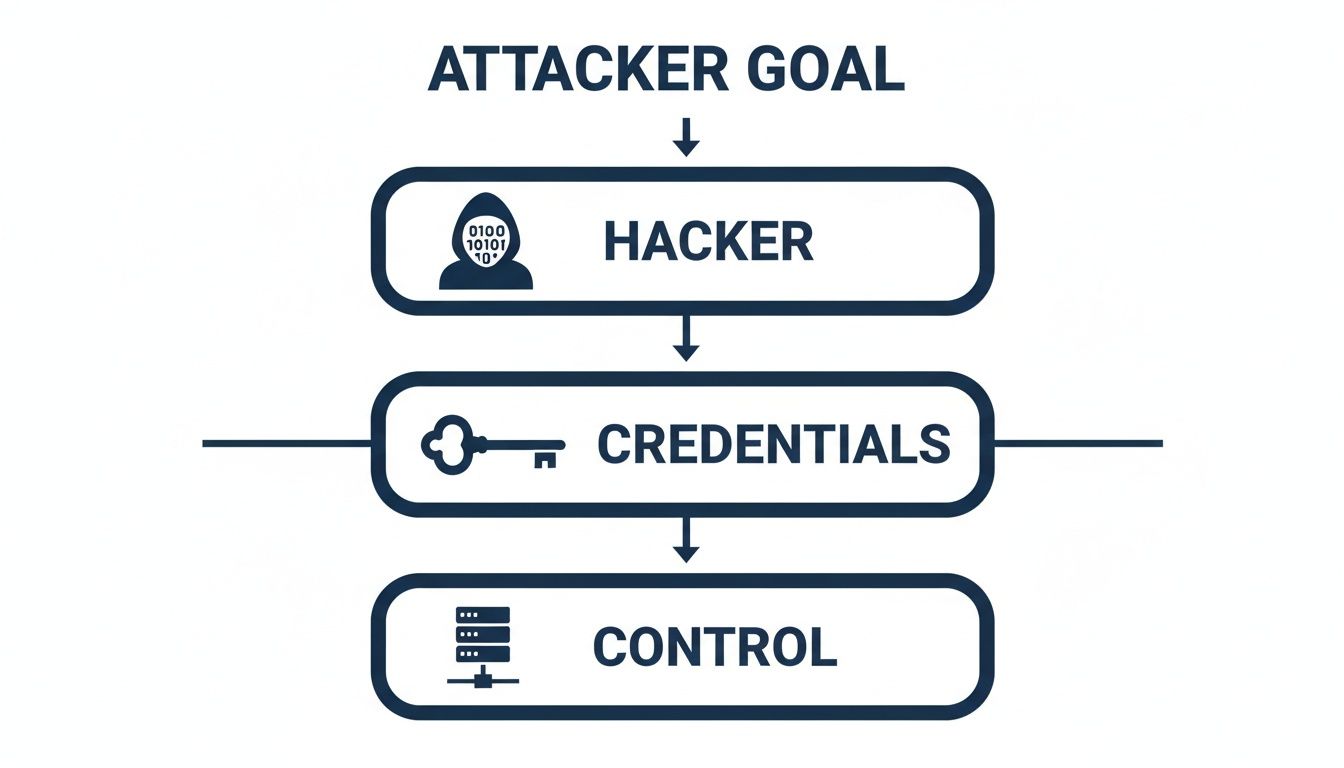
This hierarchy is simple but powerful: protect the credentials, and you block the attacker’s path to their end goal.
At the very core of any PAM system is a secure credential vault. This is a heavily encrypted, central safe where all your privileged credentials live—passwords, SSH keys, API tokens, and any other secrets that unlock your critical infrastructure.
Instead of admins jotting down powerful passwords on spreadsheets or sticky notes (a massive security risk), everything is locked away. The vault handles password rotation automatically, enforces strong complexity rules, and acts as the single, secure gateway for authorized users. By centralizing these secrets, you eliminate password sprawl and drastically lower the chances of them being lost, stolen, or shared.
A credential vault turns password security from a messy, manual chore into an automated, auditable, and incredibly secure process. It's the foundation for everything else in PAM.
Getting these credentials locked down is the bedrock of good security. For a closer look at password hygiene, check out our guide on what’s the best way to manage your passwords.
A classic mistake is giving people "standing privileges," meaning they have powerful, always-on access. A system admin with 24/7 superuser rights is a walking security target. This is where Privileged Elevation and Delegation Management (PEDM) comes in, enforcing the Principle of Least Privilege (PoLP).
Simply put, this component makes sure users work with standard, low-privilege accounts for their day-to-day work. When they need to perform a task that requires more power, they are granted temporary, "just-in-time" access for that specific task, and for only as long as they need it.
It's like giving a maintenance worker a keycard that only opens the server room door and only works for the one hour they're scheduled to be there. PEDM does this for your digital environment. It lets you:
This level of granular control is absolutely critical for stopping both insider threats and external attacks that exploit over-privileged accounts.
The final piece of the puzzle is privileged session monitoring. This is your digital security camera, recording and auditing everything that happens during a privileged session. When an admin or any other privileged user connects to a critical system through the PAM solution, their entire session is captured.
This gives you a tamper-proof audit trail of every single action. You can see which commands were typed, what files were opened, and what settings were changed. This visibility is priceless for a few reasons.
First, it’s a huge deterrent against malicious insiders. Second, if a security incident does happen, these recordings provide the forensic evidence you need to figure out exactly what went wrong and how to fix it. Finally, it’s a non-negotiable requirement for many compliance standards that demand strict auditing of who accesses sensitive data.
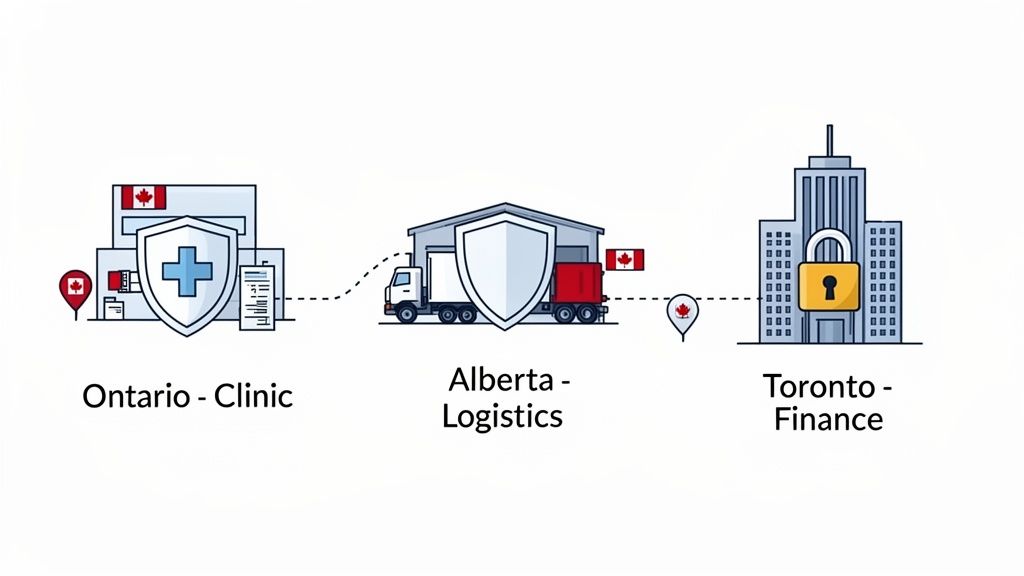
Understanding the technical side of Privileged Access Management is one thing, but seeing how it solves real-world problems is where its value truly shines. PAM isn't just an abstract security theory; it’s a practical tool that protects Canadian businesses in every sector from very real threats.
By looking at specific scenarios, you can see how a solid PAM strategy directly tackles familiar challenges, from navigating compliance rules to stopping a costly insider breach. These examples show how PAM goes from being just another line on an IT budget to a core driver of business resilience and trust.
Let’s walk through three distinct use cases that highlight the power of PAM in action.
Imagine a mid-sized healthcare clinic in Ontario trying to manage who can access its Electronic Health Records (EHR) system. With doctors, nurses, and admin staff all needing different levels of access, staying compliant with Canada's Personal Information Protection and Electronic Documents Act (PIPEDA) was a constant headache.
The clinic’s biggest worry was unauthorized access to sensitive patient data. A single slip-up could lead to massive regulatory fines and completely shatter their reputation. They needed a foolproof way to control access and create indisputable audit trails for compliance checks.
By implementing a PAM solution, the clinic gained fine-grained control over who could see patient records.
A financial services firm in Toronto often brings in third-party contractors for specialized IT projects, including work on their client portfolio management software. Granting these outsiders access to critical systems was a major security vulnerability waiting to be exploited.
The firm had to give contractors the temporary, elevated permissions they needed to do their jobs, but without exposing sensitive client financial data or leaving a permanent backdoor open.
The answer was just-in-time (JIT) access, a core feature of PAM. Instead of giving contractors a permanent privileged account, the PAM system granted them temporary, task-specific access that automatically vanished once the project was done.
This single change completely transformed their security posture. Contractors got exactly the access they needed, for only as long as they needed it. The risk of forgotten accounts or stolen credentials became a non-issue. For firms in this sector, you can learn more about our dedicated solutions for finance and accounting IT services.
A logistics company based in Alberta depends entirely on its supply chain management software and Microsoft 365 environment to coordinate shipments across the country. An internal user with too many admin privileges was a huge insider threat—whether their actions were malicious or just a simple mistake.
The company knew that a single compromised admin account could bring their entire operation to a screeching halt, leading to expensive delays and angry clients.
To head off this disaster, the company used PAM to enforce the Principle of Least Privilege (PoLP) across its entire infrastructure. They stripped all unnecessary permissions from standard user accounts. Now, privileged access is only granted on an as-needed basis through a formal request and approval workflow. This simple change drastically reduced their attack surface, ensuring one employee's mistake couldn't cause a company-wide shutdown.
Putting a Privileged Access Management solution in place can feel like a massive undertaking, but it’s entirely manageable when you break it down into a strategic, step-by-step process. A successful rollout is about more than just installing new software; it's about fundamentally improving your internal processes and building better security habits for your team.
This practical roadmap lays out the proven best practices that turn a complex project into a clear path forward. Follow these steps, and you’ll find your PAM implementation is smooth, effective, and starts delivering security value right away.
You can't protect what you don't know exists. The absolute first step is a thorough discovery process to map out every single privileged account across your entire IT environment. This means digging into on-premises servers, cloud platforms like Microsoft 365, databases, network devices, and even third-party applications.
Many organizations are shocked to find dozens of forgotten or unmanaged "ghost" accounts still holding high-level permissions. These dormant accounts are ticking time bombs. A complete inventory is the non-negotiable foundation of your entire PAM strategy.
Once you have a map of all your privileged accounts, the next goal is to strictly enforce the Principle of Least Privilege (PoLP). This is a core security concept that states users should only have the absolute minimum permissions needed to do their specific job—and nothing more.
Adopting PoLP means shifting away from "standing privileges," where access is always on, to a "just-in-time" model. Access is granted temporarily for a specific task and then automatically revoked when the task is done. This move drastically shrinks your attack surface.
Shared administrative accounts, like a generic "admin" login passed around the team, are a security nightmare. They make it impossible to track who did what, creating a massive accountability gap. Your implementation needs to focus on eliminating these shared accounts completely.
At the same time, you need to hunt down and remove any hardcoded credentials you find embedded in scripts or configuration files. Each one should be replaced with a secure call to your new PAM vault, ensuring passwords are never left exposed in plain text.
Requiring multi-factor authentication (MFA) for all privileged access isn't optional; it's essential. A password by itself is simply not enough to defend against modern cyber threats. MFA adds a critical layer of verification, ensuring that even if a credential is stolen, an attacker can't get in without that second factor.
This single practice is one of the most powerful ways to block unauthorized access to your most critical systems. It needs to be applied universally to every single account that has elevated permissions.
Finally, a successful PAM implementation gives you constant visibility. Your solution must monitor and record all privileged sessions, creating a detailed and unchangeable audit trail of every single action taken. This is crucial for a few key reasons:
The PAM market is projected for substantial growth, driven by the urgent need to secure critical infrastructure. This is especially true for Canadian businesses, as sectors like financial services work to curb payment platform risks, where a high percentage of incidents stem from privileged account misuse. You can find more insights on the growing PAM market from Precedence Research.
Navigating these best practices can be complex, but you don't have to tackle it alone. Partnering with experts can simplify the process significantly. For guidance on building a robust security strategy, consider exploring the benefits of cyber security consulting.
Picking the right Privileged Access Management solution is a big decision, one that will directly shape your company's security and day-to-day operations. With so many options out there, it’s easy to get distracted by flashy features. The real goal is to focus on the core capabilities that fit what your business needs—not just today, but for the long haul.
A great PAM solution should be a partner in your growth. It needs to be more than just a security gatekeeper; it has to fit smoothly into your existing workflows and technical environment without causing friction.
When you start comparing PAM tools, it’s best to have a plan. A simple checklist can help you cut through the marketing noise and pinpoint a solution that truly fits your organization. You're looking for that sweet spot: a platform that delivers robust security but is also straightforward for your team to use and manage.
Here are the non-negotiables to consider:
Before making a final decision, it’s helpful to lay out your options side-by-side. This checklist provides a structured way to compare different PAM solutions or managed service providers, ensuring you cover all the critical bases.
Using a checklist like this helps you move beyond the sales pitch and focus on what truly matters for your organization’s security and operational health.
For many medium-sized businesses, trying to manage a sophisticated PAM solution in-house can be a real challenge. It demands specialized cybersecurity skills, around-the-clock monitoring, and constant updates—resources that are often already stretched thin. This is exactly where a managed PAM service becomes a game-changer.
Partnering with a managed service provider like CloudOrbis hands over the complex task of PAM management to a team of dedicated experts. This approach ensures your system is configured correctly, monitored constantly, and always kept up to date.
Choosing a managed service takes the heavy lifting off your internal IT team. It guarantees your PAM system is rolled out following best practices and watched over 24/7 by security professionals who live and breathe this work. This model is often more cost-effective than hiring and training specialized staff, giving you enterprise-grade security without the enterprise-level price tag.
Ultimately, this lets your team get back to focusing on strategic projects that move the business forward, all while having peace of mind that your most critical digital assets are protected. It’s a smart, efficient way to lock down your privileged accounts.
As you start to wrap your head around Privileged Access Management and what it could mean for your business, it’s completely normal for questions to pop up. Let's tackle some of the most common ones to give you a clearer picture of how PAM works in the real world.
This is a great question, and an analogy helps make it clear.
Think of your standard Identity and Access Management (IAM) as the system that hands out key cards to every employee. It’s in charge of making sure people can get through the front door and access common areas like the kitchen or their own office. IAM basically answers the question, "Who are you and what general areas can you access?"
Privileged Access Management (PAM), on the other hand, is like the specialized security team that guards the master keys—the ones that open the server room, the finance vault, or the CEO's office. While IAM manages everyday access for everyone, PAM applies much stricter controls specifically for those high-risk 'privileged' accounts that could cause massive damage if they fell into the wrong hands. It’s about securing the keys to the kingdom.
It's a common fear that more security means more headaches for your team. But when it's done right, a modern PAM solution actually makes things smoother and more secure. You can finally get rid of those risky shared password spreadsheets and give your team streamlined, secure access to the systems they need to do their jobs.
A well-designed PAM strategy removes the frustrating hurdles that often come with older security methods. Features like just-in-time (JIT) access grant temporary privileges only when needed, which cuts down on risk without blocking your technical teams from doing their work.
Sure, there’s a small adjustment period with any new system. The long-term payoff, however, is a workflow that's both more efficient and fundamentally more secure. Working with an expert ensures this transition is tailored to your team, keeping any disruption to a bare minimum.
Absolutely. In fact, securing cloud environments is one of the most important jobs for any modern PAM solution. As more businesses lean on platforms like Azure, AWS, and SaaS tools like Microsoft 365, the number of admin accounts with powerful access explodes.
Each one of those cloud admin accounts is a potential doorway for an attacker. A solid PAM solution plugs directly into these services to:
This gives your cloud infrastructure the robust protection it needs—often making it even more secure than your old on-premise systems. It's a non-negotiable layer of defence for any company running in the cloud.
At CloudOrbis, we demystify cybersecurity and provide managed IT services that protect your business and empower your growth. Our experts can help you implement a Privileged Access Management strategy that secures your most critical assets without disrupting your workflow. Discover how our proactive, Canada-based team can strengthen your security posture.
September 23, 2026
DDoS Protection for Canadian SMBs: What Works in 2026Learn what DDoS protection really does, the latest Canada-specific threats, and a practical playbook for small and mid-sized businesses
Read Full Post
September 22, 2026
Security Audit Services Guide for SMBs in CanadaDiscover why security audit services are vital for Canadian SMBs. Explore typical scope, deliverables, timelines, and tips to choose the right provider.
Read Full Post
September 21, 2026
Secure File Sharing Guide for Canadian BusinessesLearn secure file sharing essentials for Canadian SMBs — encryption, compliance, protocols and best practices to protect data and stay compliant.
Read Full Post
