
September 14, 2026
Vulnerability Management vs Vulnerability AssessmentVulnerability management vs vulnerability assessment explained for Canadian SMBs. Compare scope, process, tools, and how to choose the right approach.
Read Full Post%20(1).webp)
Usman Malik
Chief Executive Officer
June 16, 2026
A lot of business owners are in the same spot right now. You hear about another ransomware incident, another phishing email that slipped through, another company dealing with days of disruption, and then you look at your own environment and ask a blunt question: are we protected, or have we just bought a few tools and hoped for the best?
That's where the EDR vs MDR decision gets real. On paper, it sounds like a product comparison. In practice, it's an operating model decision. You're not just choosing software. You're choosing who's responsible for watching for threats, investigating alerts, and taking action when something goes wrong outside business hours.
For most mid-sized Canadian businesses, that's the part that gets missed. The issue isn't whether endpoint detection matters. It does. The issue is whether your team can run it properly every day, every night, and every weekend.
A familiar scenario plays out in boardrooms and owner meetings every week. A leader reads about a cyberattack on a peer company, asks the IT team whether the business is covered, and gets an answer that sounds reassuring but vague. “We have antivirus.” “We have Microsoft 365.” “We have endpoint protection.” None of that answers the question that matters most. Who is actively detecting and responding when a real threat gets through?
That question matters due to the significant financial and security risks. In Canada, the average total cost of a data breach reached CAD 6.32 million in 2024, and the same Canadian analysis reports that 9% of breaches were caused by phishing and 97% of surveyed Canadian organizations experienced at least one security incident in the preceding 12 months, as cited in this Huntress breakdown of EDR vs managed EDR.
Those numbers turn cybersecurity from an IT discussion into a business risk discussion. Revenue disruption, reputational damage, client trust, operational downtime, legal exposure, and leadership distraction all sit downstream of a missed alert.
Five years ago, many organizations could get by with basic endpoint protection plus a capable IT generalist. That's no longer enough. Modern attacks don't politely arrive during office hours, and they rarely stop at a single device.
What you need now is detection and response that matches how your business operates. If your team works evenings, supports remote staff, accesses cloud apps, and relies on email and endpoint devices all day, your security model has to account for that reality.
A good starting point is understanding the difference between prevention and active response. CloudOrbis covered that broader issue in its guide to threat detection and response, and that's exactly where the EDR vs MDR decision sits.
Most articles frame this as “tool versus service.” That's true, but it's incomplete.
The better question is this: when something suspicious happens at 2 a.m. on Sunday, who is reviewing the alert, deciding whether it's real, and taking action before the issue spreads?
If your answer is “our internal team, probably on Monday morning,” you're already leaning toward MDR whether you realise it or not.
EDR, or Endpoint Detection and Response, is a serious security technology. It isn't snake oil, and it isn't optional for mature endpoint protection. But it is still a tool. That distinction matters.
Think of EDR like a high-end workshop full of professional power tools. If you know how to use them, they're highly effective. If you don't have the skill, time, or staff to use them properly, they mostly remind you how much work is sitting there undone.
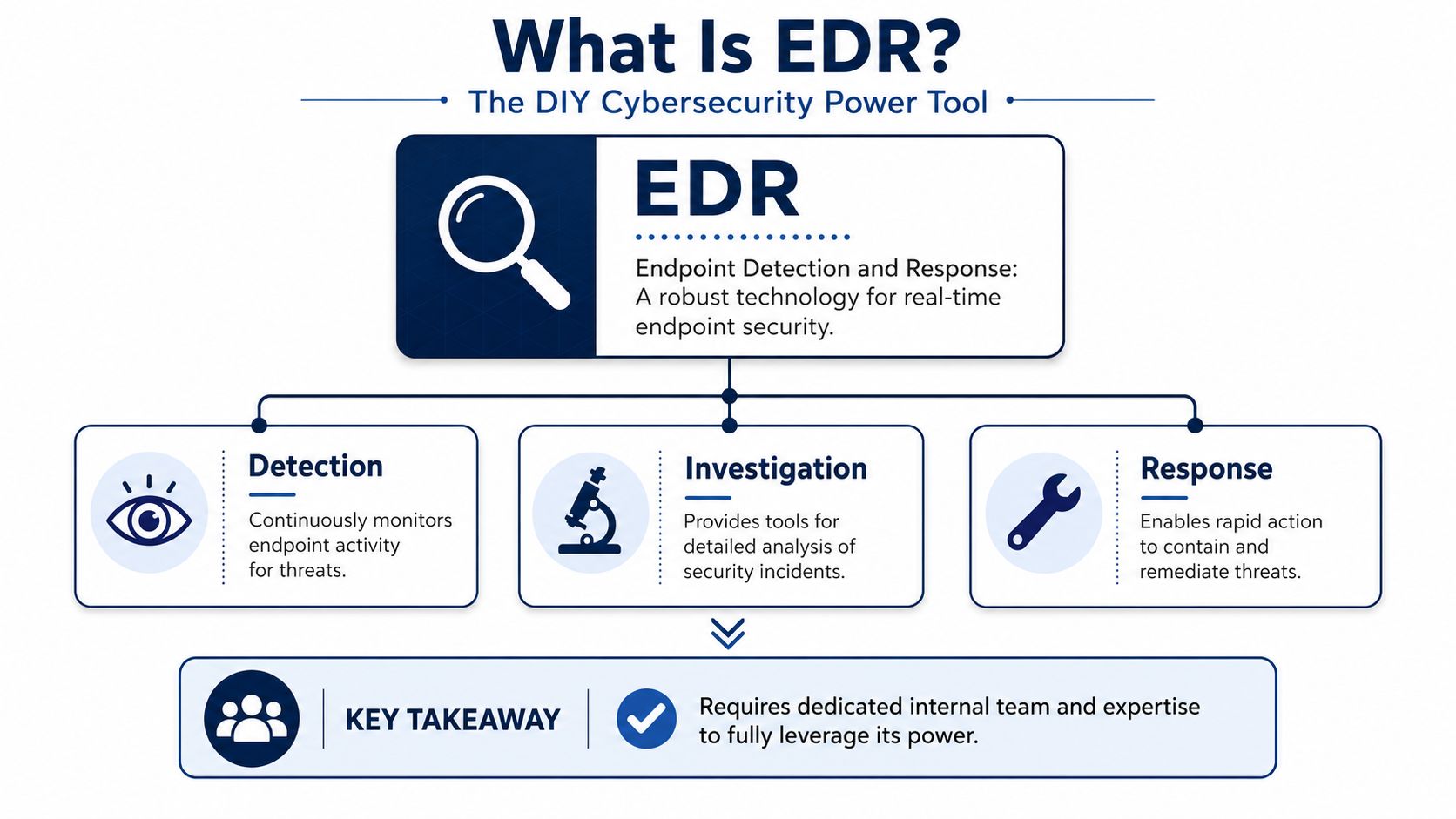
EDR works by placing software agents or sensors on endpoint devices and continuously collecting telemetry. That telemetry supports event recording, suspicious-activity detection, alert triage, forensic search, and remediation. It's strongest at device-level containment and root-cause analysis on laptops, servers, and workstations, as explained in CrowdStrike's overview of EDR vs MDR vs XDR.
That means EDR is especially valuable when you need to answer questions like these:
If your priority is deep endpoint visibility and fast isolation of a compromised device, EDR is exactly the right technology.
Here's the part vendors often gloss over. EDR gives you telemetry, alerts, and response capability. It does not magically provide skilled analysts, a tuned monitoring process, or an overnight queue.
Practical rule: EDR is valuable only if someone is consistently reviewing, tuning, investigating, and acting on what it produces.
That means your team has to do the following:
For a stronger primer on the technology itself, CloudOrbis has a separate article on what endpoint detection and response is.
EDR is the right fit when you already have a capable internal security function, or at least a team that can treat security operations as a daily discipline instead of an occasional side task.
If your internal IT group is already stretched handling users, devices, vendors, Microsoft 365, backups, and projects, adding self-managed EDR often creates a false sense of security. You bought the tool, but no one has enough time to operate it properly.
MDR, or Managed Detection and Response, is the service layer that many businesses assume they're getting when they buy EDR. They're not the same thing.
If EDR is buying the power tools, MDR is hiring the skilled team that brings tools, monitors the job site, spots problems early, and handles the messy work without waiting for your office to open.
MDR adds the human layer that self-managed security often lacks. The service is built around 24/7 human monitoring, threat hunting, and incident response across the environment. That matters because threats don't wait for your internal team to become available.
In a practical sense, MDR providers handle the security operations work that many mid-sized businesses struggle to staff internally:
That's why MDR is usually the better answer for businesses that want an outcome, not just a console.
A lot of owners assume their IT team can “just watch the dashboard.” That sounds efficient until the dashboard starts generating alerts after hours, during a vacation week, or in the middle of a major internal project.
The difference between having a tool and having coverage becomes obvious the moment an incident requires immediate judgement. Someone has to decide whether an alert is harmless, suspicious, or urgent. Someone has to investigate context. Someone has to act.
A response plan is only useful if people can execute it under pressure and outside normal business hours.
That's also why process matters as much as tooling. If you're reviewing your readiness, this guide to an incident response plan for modern apps is useful because it forces the right question: if an incident starts now, who does what first?
You're buying consistency. You're buying expertise on demand. You're buying fewer blind spots caused by staff bandwidth, turnover, or alert fatigue.
MDR doesn't remove your responsibility for security decisions, but it does remove the fantasy that a busy internal IT team can run a round-the-clock detection and response function without help.
If you want a fuller look at the managed model, CloudOrbis has a useful article on managed detection and response.
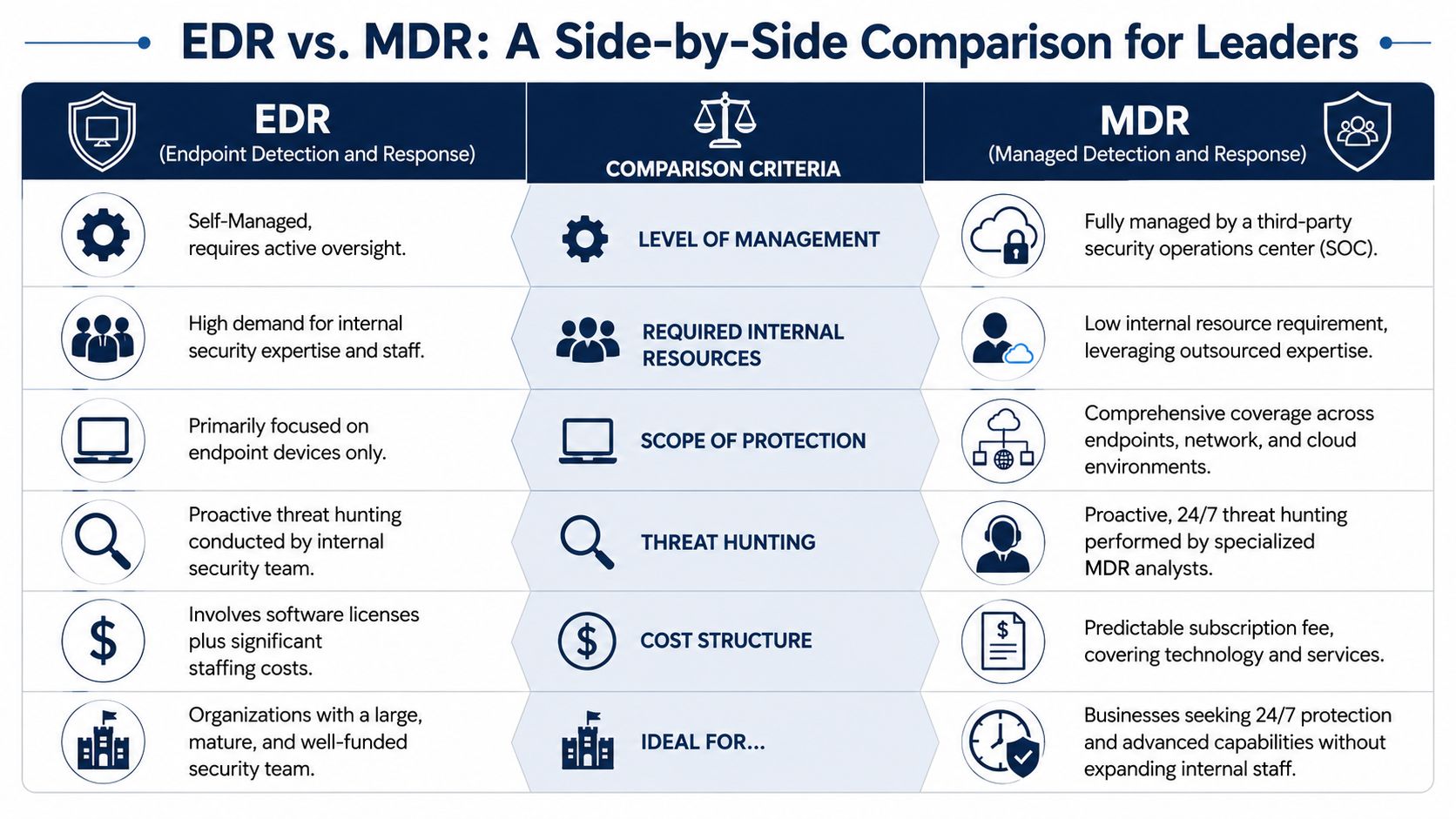
Most EDR vs MDR articles stop at a shallow distinction. EDR is software. MDR is a service. True, but not enough. A meaningful comparison should focus on what changes inside your business once you choose one path or the other.
Here's the short version.
| Business factor | EDR | MDR |
|---|---|---|
| Who watches alerts | Your internal team | Provider analysts around the clock |
| Who tunes detections | Your team | Usually handled as part of the service |
| Who investigates overnight | Whoever is on call, if anyone | Dedicated monitoring and response team |
| Primary strength | Endpoint visibility and device containment | Ongoing monitoring, investigation, and response coverage |
| Operational burden | High | Lower internal burden |
| Best fit | Businesses with mature security staffing | Businesses that need capability without building a SOC |
This is the most overlooked part of the decision. A frequently missed angle in EDR vs MDR coverage is the staffing and operating model problem. As summarised in Kaseya's discussion of MDR vs EDR, many Canadian SMBs face basic security and resilience constraints that make 24/7 in-house monitoring difficult.
That lines up with what vCIOs and operations leaders see every day. Mid-sized businesses rarely fail because they chose a weak product. They fail because nobody owned the operational work required to get value from it.
If you can't answer “who investigates this tonight?” your issue isn't tooling. It's operating capacity.
An EDR platform can generate useful alerts, isolate devices, and support forensics. But those capabilities only help if your organisation has a repeatable process for:
MDR is often stronger here because the service exists to run that process continuously, not as a side duty.
A lot of buyers compare EDR and MDR as if the only question is software price versus service subscription. That's the wrong math.
With EDR, the visible purchase is the platform. The hidden cost is the labour required to run it well. You may need internal analyst time, on-call coverage, alert tuning, documentation, incident handling discipline, and management oversight.
With MDR, the cost is more straightforward. You're paying for a bundled outcome. Technology plus people plus process.
That doesn't mean MDR is automatically cheaper in every case. It means the total cost is usually easier to understand because it already includes the operating layer.
EDR is endpoint-centric. That's a strength when the issue lives on a laptop, workstation, or server. MDR usually matters more when the business needs continuous monitoring and broader visibility across how attacks unfold in live environments.
If your leadership team is weighing outsourced monitoring against building internal capability, this CloudOrbis comparison of MDR vs SOC differences is worth reading because it addresses the same practical issue from an operating model perspective.
Abstract comparisons don't help much when you're trying to make a budget decision. Real businesses buy security based on operational pressure, compliance obligations, and the cost of downtime.
A clinic handles sensitive patient information, relies on appointment systems, and can't afford confusion during a security incident. Even if the clinic has a competent IT provider, it usually doesn't have an internal security team available around the clock.
EDR helps isolate a compromised workstation at the endpoint level. That's useful. But clinics don't just need tools. They need confidence that suspicious activity gets reviewed immediately, especially outside reception hours or over a weekend.
For most clinics, MDR is the stronger fit because the service model supports continuous oversight without forcing a lean internal team to become a de facto security operations centre.
Law firms sit on client files, privileged communications, and deal data. The business risk isn't only downtime. It's also confidentiality.
A legal firm can buy EDR and gain visibility on laptops and servers, but that still leaves the operational question unanswered. Who is reviewing alerts when partners are travelling, users are working remotely, and the office manager assumes IT already has it covered?
For a firm without dedicated security analysts, MDR is usually the smarter choice. It gives the firm access to investigative capacity without turning every suspicious event into a scramble among already busy staff.
Manufacturing environments have a different pressure point. Downtime hurts fast. When systems slow, lines stop, or staff lose access to critical tools, the impact reaches operations quickly.
In that environment, EDR still has value because endpoint containment can stop a compromised device from causing wider trouble. But manufacturing leaders also need fast triage and reliable escalation, especially after hours.
In manufacturing, the right security decision is often the one that reduces operational delay during an incident, not the one with the flashiest console.
That's why MDR often wins here as well. The service model aligns better with businesses where speed of response matters as much as depth of telemetry.
This is the most common mid-market scenario. The business has grown. Devices, users, cloud tools, and compliance expectations have all increased. The IT team is capable, but small. They're already supporting users, projects, vendors, and infrastructure.
That business is the classic candidate for buying EDR and then underusing it.
A lean team may absolutely need endpoint telemetry and response capability. But if nobody can monitor alerts consistently, tune detections, and respond after hours, self-managed EDR becomes a half-built security programme.
In that case, MDR is usually the practical choice. It lets the internal team stay focused on business IT while specialists handle continuous threat monitoring. Businesses in exactly this position often start with a broader managed cyber security service model because it matches their staffing reality better than a tool-first approach.
The fastest way to make this decision is to stop thinking like a buyer of software and start thinking like the person accountable for business continuity.
If you answer these questions candidly, the right path usually becomes obvious.
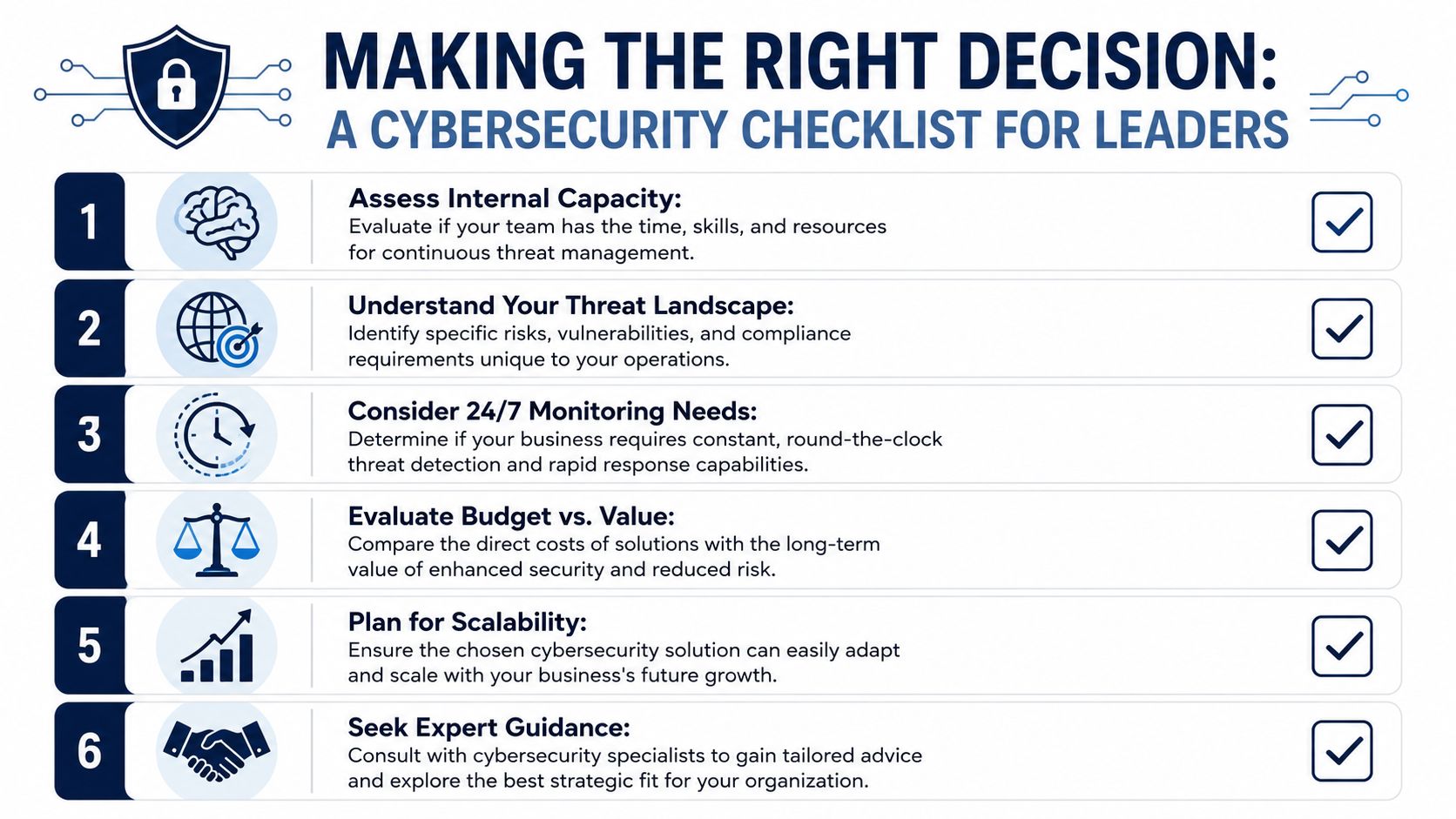
Choose EDR if you have the in-house maturity to run it properly and you want direct operational control over endpoint detection and response.
Choose MDR if you need reliable detection and response outcomes without building your own round-the-clock analyst function.
That's the blunt answer. For most mid-sized businesses, especially those without a dedicated security team, MDR is the safer and more cost-effective decision because it addresses the labour problem, not just the technology gap.
They assume the existing IT team can absorb security operations on top of everything else. Sometimes they can for a while. Usually they can't for long.
Security tools don't fail because the technology is weak. They fail because no one had enough time, expertise, or authority to use them consistently when it mattered.
The EDR vs MDR decision isn't really about which acronym sounds more advanced. It's about whether you want to buy a tool and build the operating model around it, or buy a service built to produce a security outcome.
For most Canadian mid-sized businesses, the answer should be clear. If you don't already have the staff, processes, and after-hours coverage to run EDR properly, MDR is the better decision. It closes the operational gap that leaves too many organisations exposed.
CloudOrbis helps businesses address that gap with managed cybersecurity services designed for real operating environments, not idealised ones. That matters if your team needs strong protection without taking on the complexity and cost of building an in-house security operations function.
A Canadian-based service model also matters. When you're dealing with security events, support quality, communication speed, and accountability aren't side issues. They are part of the service.
Here's where to start the conversation.
If your business is trying to choose between self-managed tools and fully managed protection, don't make the decision based on product features alone. Make it based on who will do the work when the alert comes in.
If you want a practical recommendation based on your team size, risk profile, and operating hours, talk to CloudOrbis Inc.. A no-obligation conversation can quickly show whether EDR is enough for your environment or whether MDR is the smarter investment.
September 14, 2026
Vulnerability Management vs Vulnerability AssessmentVulnerability management vs vulnerability assessment explained for Canadian SMBs. Compare scope, process, tools, and how to choose the right approach.
Read Full PostSeptember 13, 2026
Third-Party Risk Management for Canadian SMBsMaster third-party risk management for your Canadian SMB. Learn OSFI compliance, vendor monitoring frameworks, and how to secure your supply chain.
Read Full Post
September 12, 2026
Managed Services Cost: A Practical Guide for Canadian SMBsUnderstand managed services cost for Canadian SMBs. Learn pricing models, industry factors, ROI, and how to choose the right provider for your business.
Read Full Post
