

September 27, 2026
How to Recover from a Ransomware Attack: An SMB PlaybookLearn how to recover from a ransomware attack with a step-by-step SMB playbook covering containment, backup restore, compliance, and post-incident hardening.
Read Full Post%20(1).webp)
Usman Malik
Chief Executive Officer
September 28, 2026

A growing Canadian business often reaches the same frustrating point: the phone system still works, but it no longer fits the way people work. New employees need extensions quickly, remote staff need to answer the main number, and customers shouldn't be sent through a maze of outdated menus. Meanwhile, the legacy PBX remains tied to one office, requires specialist maintenance, and makes every change feel more expensive than it should.
VoIP in business addresses that problem by carrying voice as digital traffic over an internet connection. In a hosted model, the provider manages the phone platform while your organisation uses desk phones, computers, and mobile devices as endpoints. The result isn't just a cheaper dial tone. Properly deployed, VoIP becomes part of unified communications, connecting voice with messaging, video meetings, call routing, analytics, and business applications.
A mid-sized company with offices in Toronto and Calgary may have once needed separate phone systems, separate contracts, and separate rules for handling calls. Adding a user meant installing hardware. Moving a department meant rewiring desks. Supporting remote employees often meant forwarding calls manually or asking them to use personal mobiles.
VoIP changes the operating model. The phone system becomes a service that can follow users, departments, and customer workflows rather than remaining fixed to a cupboard in one building. Auto-attendants can direct callers, employees can use softphones away from the office, and administrators can adjust routing through a management portal instead of replacing the PBX.
Canada's VoIP market has a clear historical milestone. In January 2004, Primus Canada became the first company to offer VoIP service in Canada, and competitors including Vonage Canada and Navigata had entered by spring of that year, according to the CBC backgrounder on VoIP in Canada. Navigata launched in eight Alberta and British Columbia cities, including Vancouver and Calgary, showing that western Canada was an early proving ground for business-grade deployments.
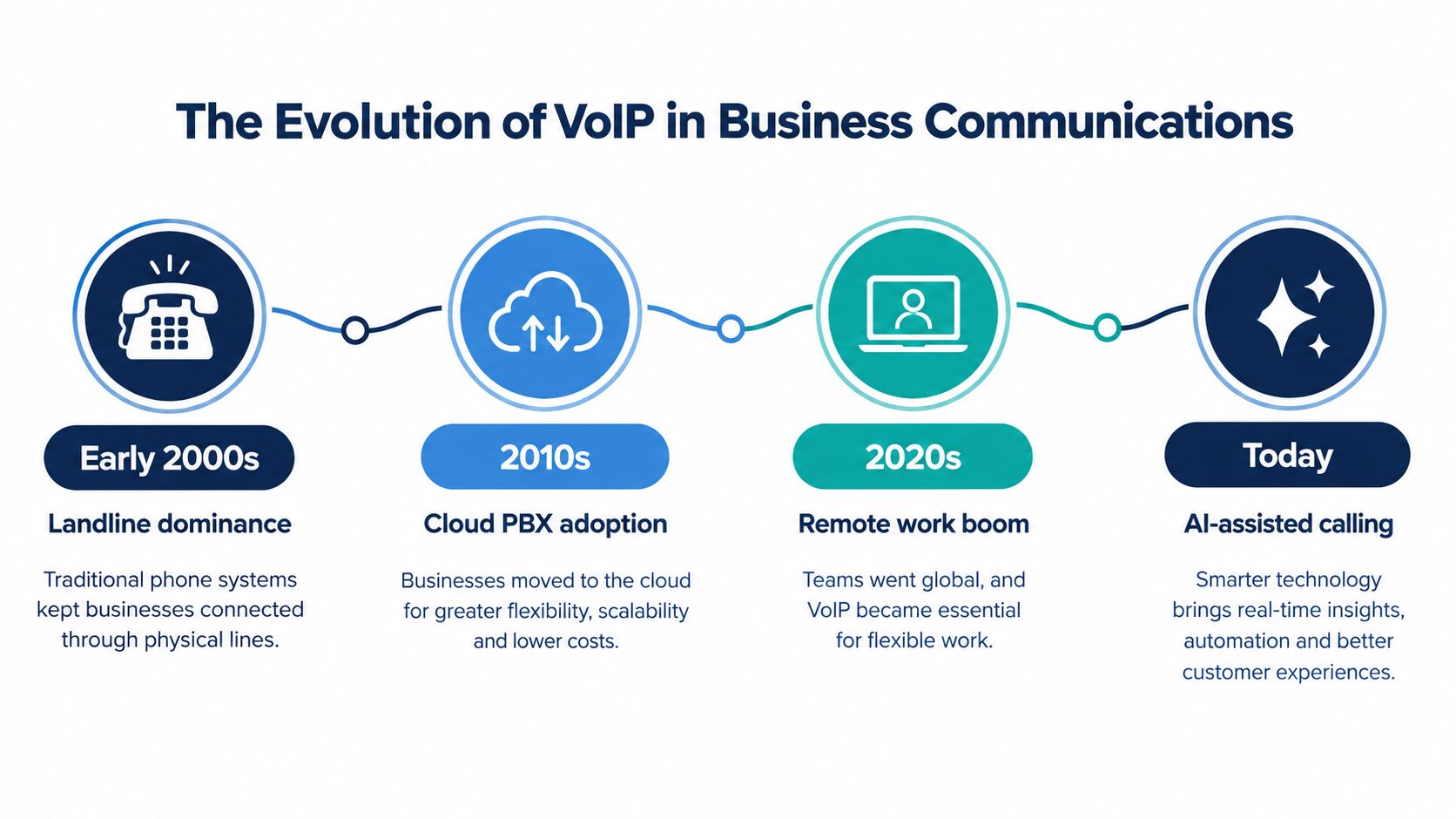
A 2014 Primus anniversary release described VoIP as having moved from “on the fringe” to a key alternative to conventional landlines in Canada within 10 years. Broadband expansion and cost effectiveness helped drive that change. The important lesson for today's leaders is that Canadian VoIP adoption didn't appear suddenly with remote work. It grew alongside national connectivity and intercity coverage.
That history also explains why businesses shouldn't treat hosted telephony as an isolated application. Microsoft's retirement of Skype for Business Online, discussed in this CloudOrbis guide to the transition, reflects a wider shift toward integrated communication platforms. Businesses now expect calling to work with the tools employees already use, not sit apart from their collaboration and customer systems.
A business VoIP proposal should connect features to operating outcomes. The question isn't whether a platform includes an auto-attendant. The question is whether callers reach the right person faster, whether staff can work from different locations, and whether administrators can make changes without a telecoms project.
Canada's connected environment supports that shift. One 2026 Canadian market summary estimates internet usage at 95.5% in 2024 and smartphone penetration above 91% of adults, while another estimate places business VoIP at about 65% of Canadian VoIP revenue. These figures come from market research rather than government statistics, but they point to a mature category shaped by business use cases and widespread connectivity. The Canadian market summary also estimates a 2024 VoIP telephony market of USD 93.16 billion and projects USD 126.43 billion by 2033, with a 4.3% CAGR from 2026 to 2033. Treat those estimates as directional, not as audited national accounts.
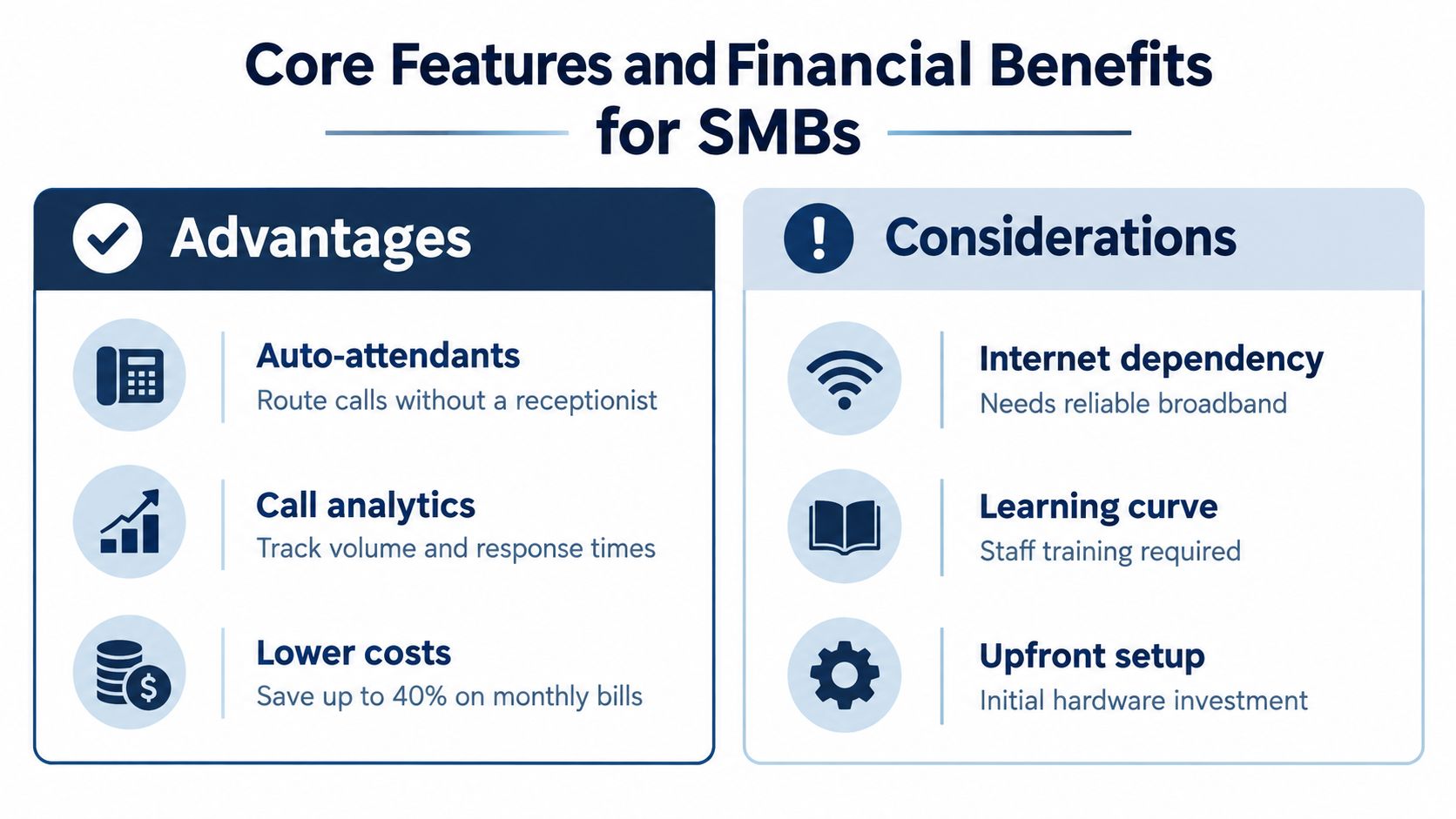
Cloud VoIP usually shifts spending from a large on-premises PBX purchase toward recurring operating expenditure. That can make costs easier to forecast, but it doesn't make every deployment inexpensive. Handsets, network improvements, licensing, implementation, training, support, and failover connectivity all belong in the business case.
The strongest financial argument is often scalability. A company expanding in Edmonton or adding a remote team can provision users without extending a proprietary phone system across every site. The weakest argument is a promised saving disconnected from network and support requirements. For a structured way to compare total ownership costs, use CloudOrbis's cost-benefit analysis guidance.
Leaders assessing the wider platform should also review this practical IT leaders unified communications guide, particularly when deciding whether voice, messaging, meetings, and business applications belong in one coordinated environment.
VoIP quality depends on the network's behaviour, not just its advertised download speed. A fast connection can still produce poor calls if voice packets wait behind other traffic, arrive inconsistently, or disappear before reaching the destination.
For Canadian business VoIP, the practical thresholds are:
| Metric | Acceptable Threshold | Impact if Exceeded |
|---|---|---|
| Round-trip latency | Under 100 ms | Delayed conversations and talk-over |
| Jitter | Under 30 ms | Choppy, uneven audio |
| Packet loss | Under 1% | Clipped words, gaps, and dropped audio |
These thresholds come from Canadian VoIP quality guidance for small businesses. In multi-site environments, Canadian QoS guidance also notes that regional call paths can remain below roughly 50 ms and that national round-trip latency under 90 ms is commonly considered acceptable. Benchmark routing between offices rather than assuming the codec is the problem.
VoIP handles communications data and can expose the business to toll fraud, spoofing, SIP credential theft, unauthorised recording access, and compromised endpoints. A defensible design should include:
Canadian privacy obligations still apply when a provider hosts the platform. Businesses handling personal information need to understand their responsibilities under PIPEDA and document how the service, endpoints, administrators, and integrations protect that information. CloudOrbis's overview of Canadian data privacy laws can help leaders frame the wider compliance review.
The CRTC requires local VoIP providers to support applicable 9-1-1 obligations, but a business can't assume that every user has identical emergency-calling capability. The CRTC's VoIP 9-1-1 guidance distinguishes services associated with a physical location from services that may move with the user.
That distinction matters for hybrid teams. Maintain current service addresses, define what happens when an employee works from home or changes offices, train users on limitations, and document a fallback procedure for internet or power failure. The CRTC's Canadian 9-1-1 requirements also state that all VoIP providers must provide access to 9-1-1, while local VoIP services must provide 9-1-1 or E9-1-1 where it is available from the incumbent local exchange carrier.
VoIP is regulated telecommunications in Canada, not merely generic software. The CRTC registration list explicitly includes Voice over IP services, including 9-1-1, as shown in its telecommunications registration information.
A successful migration begins before anyone plugs in a handset. Start by documenting how the current system works, including main numbers, direct numbers, hunt groups, voicemail, reception rules, emergency addresses, call recording, fax dependencies, door-entry systems, and any analogue devices. Ask staff which workflows matter most, because undocumented workarounds often surface only after cutover.
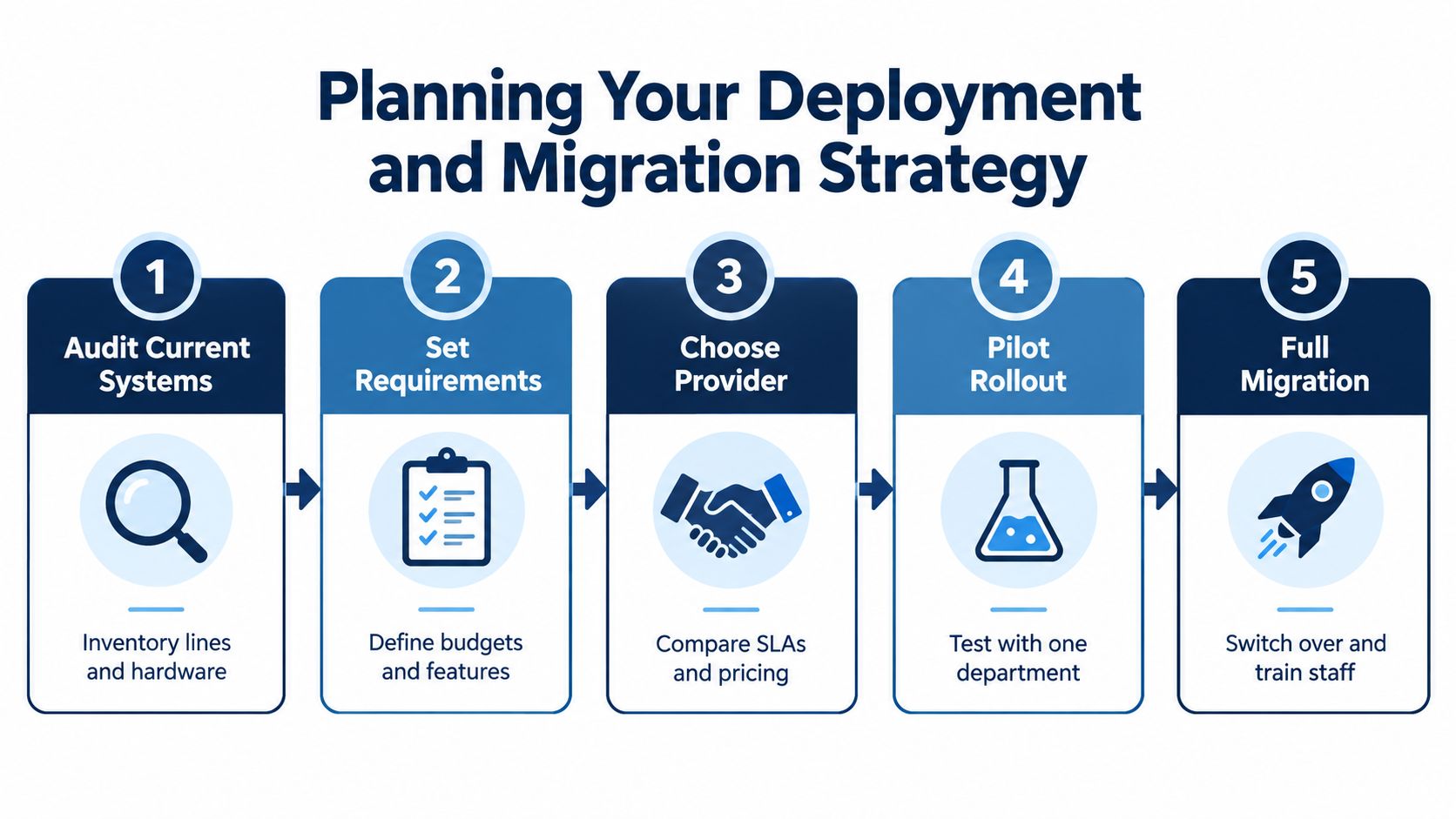
Number portability reduces switching friction. In Telecom Decision CRTC 2008-11, the Commission determined that VoIP providers must continue to port telephone numbers to other VoIP and telecommunications providers, including local exchange carriers and wireless providers. That doesn't remove the need for careful coordination, but it gives medium-sized organisations a practical path to preserve customer-facing numbers during a migration.
Multi-site companies should test interoffice routing and ISP peering rather than relying on a single speed-test result. The CloudOrbis cloud migration roadmap template offers a useful planning mindset, inventory first, define dependencies, pilot deliberately, and maintain a controlled transition plan.
The same VoIP feature can solve one operational problem and create another if the organisation ignores its regulatory context. A clinic, a manufacturer, and a law firm may all want mobile calling, but they need different controls around identity, records, availability, and access.

A clinic can use call queues to direct appointments, a secure softphone for authorised staff, and controlled voicemail to reduce missed patient communications. Integration with scheduling or patient-management workflows may reduce duplicate entry, but only if the integration exposes the minimum information needed and administrators control access carefully.
Patient communications require more than an encrypted connection. The organisation needs policies for recordings, voicemail, transcripts, shared devices, remote work, user departures, and incident response. Healthcare leaders can use CloudOrbis's healthcare IT compliance resource as a starting point for connecting communication systems with broader IT governance.
Warehouse supervisors, dispatchers, drivers, and plant-floor staff often need to stay reachable without publishing personal mobile numbers. Business mobile applications, call groups, presence indicators, and escalation rules can connect those roles to office teams while keeping identity and billing under organisational control.
The trade-off is dependency on coverage, devices, and network resilience. A warehouse with weak wireless coverage shouldn't assume a softphone will replace every physical endpoint. Map the site, test the busiest areas, keep appropriate alternatives for critical operations, and make sure staff know what happens when the primary service is unavailable.
Law firms and financial organisations may value call recording, searchable histories, controlled transfers, and integration with client workflows. Those features can improve accountability, but they also create more sensitive records. Access should be role-based, retention should be deliberate, and administrators should be able to investigate unusual access or calling activity.
The correct design may involve different policies for reception, partners, assistants, and mobile users. Recording everything by default can create unnecessary exposure. A better approach matches recording and retention to documented business and legal requirements, then reviews those settings as the organisation, clients, and regulations change.
The most expensive VoIP mistake is treating the service as a replacement for a phone bill rather than a business-critical workload. A consumer internet plan may look attractive, but unmanaged congestion, weak wireless coverage, and limited support can turn every busy period into a call-quality incident.
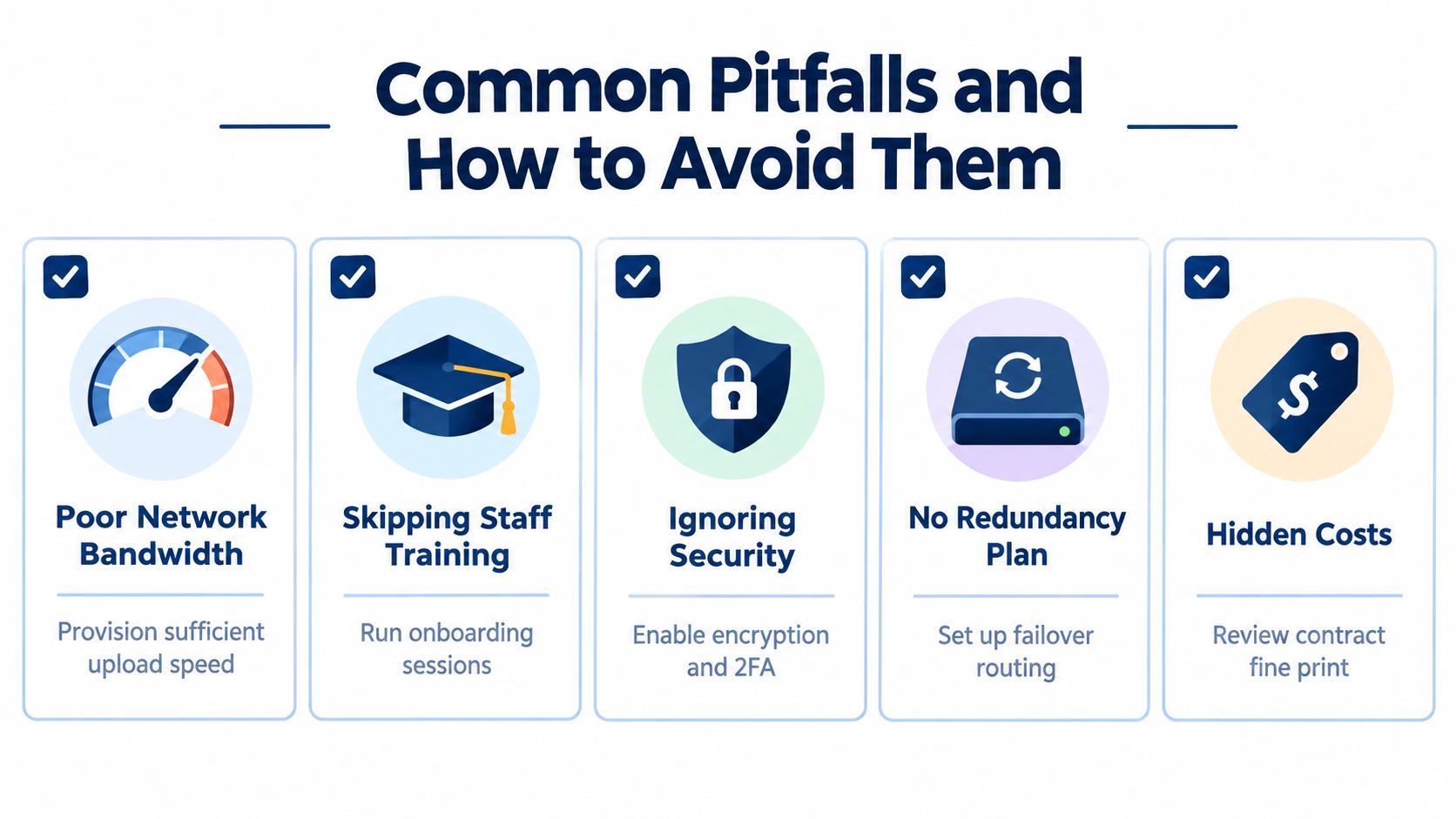
Security also needs ongoing attention. A provider can secure its platform, but the business still controls user permissions, endpoint hygiene, administrator access, and monitoring. The CRTC registration framework reinforces that VoIP belongs in the organisation's telecoms and compliance inventory, not in an unmanaged software category.
Practical rule: If nobody owns address management, fraud monitoring, and failover testing, those controls don't exist in practice.
VoIP is valuable because it connects communications with the way a business operates. It can support distributed teams, centralise call handling, integrate with customer workflows, and reduce dependence on ageing hardware. Those benefits only hold when leaders design for network performance, security, privacy, emergency calling, and user adoption from the beginning.
A resilient deployment also leaves room for change. The provider, handset strategy, integrations, call policies, and support model should be reviewed as the organisation adds sites, changes work patterns, or enters regulated markets. Number portability gives businesses more freedom to change providers, but a smooth transition still depends on accurate records and disciplined planning.
For Canadian SMB leaders, the right decision isn't only whether to buy a hosted phone system. It is whether the communications layer can remain reliable, secure, and manageable as the business grows across Toronto, Calgary, Edmonton, and remote locations.
CloudOrbis Inc. helps Canadian small and mid-sized businesses assess network readiness, plan number porting, configure business VoIP, strengthen endpoint and privacy controls, and support staff through migration. Visit CloudOrbis Inc. to discuss a practical VoIP deployment aligned with your operations, compliance obligations, and growth plans.
September 27, 2026
How to Recover from a Ransomware Attack: An SMB PlaybookLearn how to recover from a ransomware attack with a step-by-step SMB playbook covering containment, backup restore, compliance, and post-incident hardening.
Read Full Post
September 26, 2026
On-Premise to Cloud Migration Checklist: 10 StepsUse this on-premise to cloud migration checklist to plan assessment, compliance, backups, sequencing, testing, cutover, and optimization for SMBs.
Read Full Post
September 25, 2026
Is VoIP Good for Small Business in Canada? a 2026 GuideIs VoIP good for small business in Canada? Explore costs, benefits, reliability, security, and migration tips for SMBs considering VoIP in 2026.
Read Full Post
