

September 16, 2026
How to Send Secure Email in Outlook Made SimpleLearn how to send secure email in Outlook with encryption, S/MIME and compliance tips for Canadian businesses. Step-by-step guide inside.
Read Full Post%20(1).webp)
Usman Malik
Chief Executive Officer
September 17, 2026

A migration project can look healthy on paper while the business keeps paying for the old data centre, the new cloud environment, duplicated security controls, and unresolved application work. A finance team asks why the forecast moved, users report inconsistent performance, and nobody is certain who can approve a rollback. That situation is common when a roadmap is treated as a calendar rather than an operating control.
A useful cloud migration roadmap template connects workload decisions to owners, dependencies, budget checkpoints, testing evidence, and a clear definition of done. For Canadian organizations, it also needs to account for data-centre exit planning, Enterprise Data Centre decisions, public cloud modernization, regional connectivity, and the period when both environments run together.
A mid-sized organization often starts with a reasonable objective, move selected workloads out of an aging data centre and reduce operational pressure. The first technical stream migrates successfully, but the next wave stalls because the application owner wasn't identified, a database dependency was missed, or the security team hasn't approved the target design. The timeline slips, the legacy environment remains open, and the programme starts paying twice.
That isn't primarily a tooling failure. It's a planning failure. Migration tools can copy servers and data, but they can't decide whether an application should be retained, modernized, replaced, or retired. They also won't determine who owns a go/no-go decision when a production-like test exposes an undocumented dependency.
Practical rule: Treat the roadmap as a control system. Every workload needs an owner, a migration path, an exit criterion, and a rollback decision.
A Canadian roadmap also needs to reflect public-sector and enterprise modernization realities. The Government of Canada Cloud Adoption Strategy formalized a cloud-first approach in 2016, making cloud the preferred option for IT services and public cloud the preferred deployment choice. Its 2023 update stated that departments had expanded cloud use and that, as legacy data centres close, applications should move either to Enterprise Data Centres or be modernized with public cloud services.
That policy direction reinforces an important design choice. Cloud migration isn't always a hosting swap. A roadmap may need to sequence application rationalization, data-centre exit activities, and modernization decisions so the team doesn't move obsolete or unsuitable workloads because they're running on existing infrastructure.
Use the template before selecting migration tooling, finalizing procurement, or promising a cutover date. It gives leadership a defensible view of what must happen first and gives delivery teams a practical way to pause a risky wave without losing programme control.
Legacy code deserves particular attention. Before assigning a workload to rehost, review the useful Faberwork LLC legacy code insights alongside your own application assessment. For a broader view of approaches and sequencing, compare the roadmap with CloudOrbis's cloud migration strategies.

Success means more than “the workload is in the cloud.” It means the business can operate normally, security controls are evidenced, recovery objectives are validated, the old environment has a defined retirement path, and the team knows when to proceed, pause, or reverse the change.
The template should make the migration flow visible from discovery through optimization. A practical structure uses linked workstreams rather than one oversized task list.
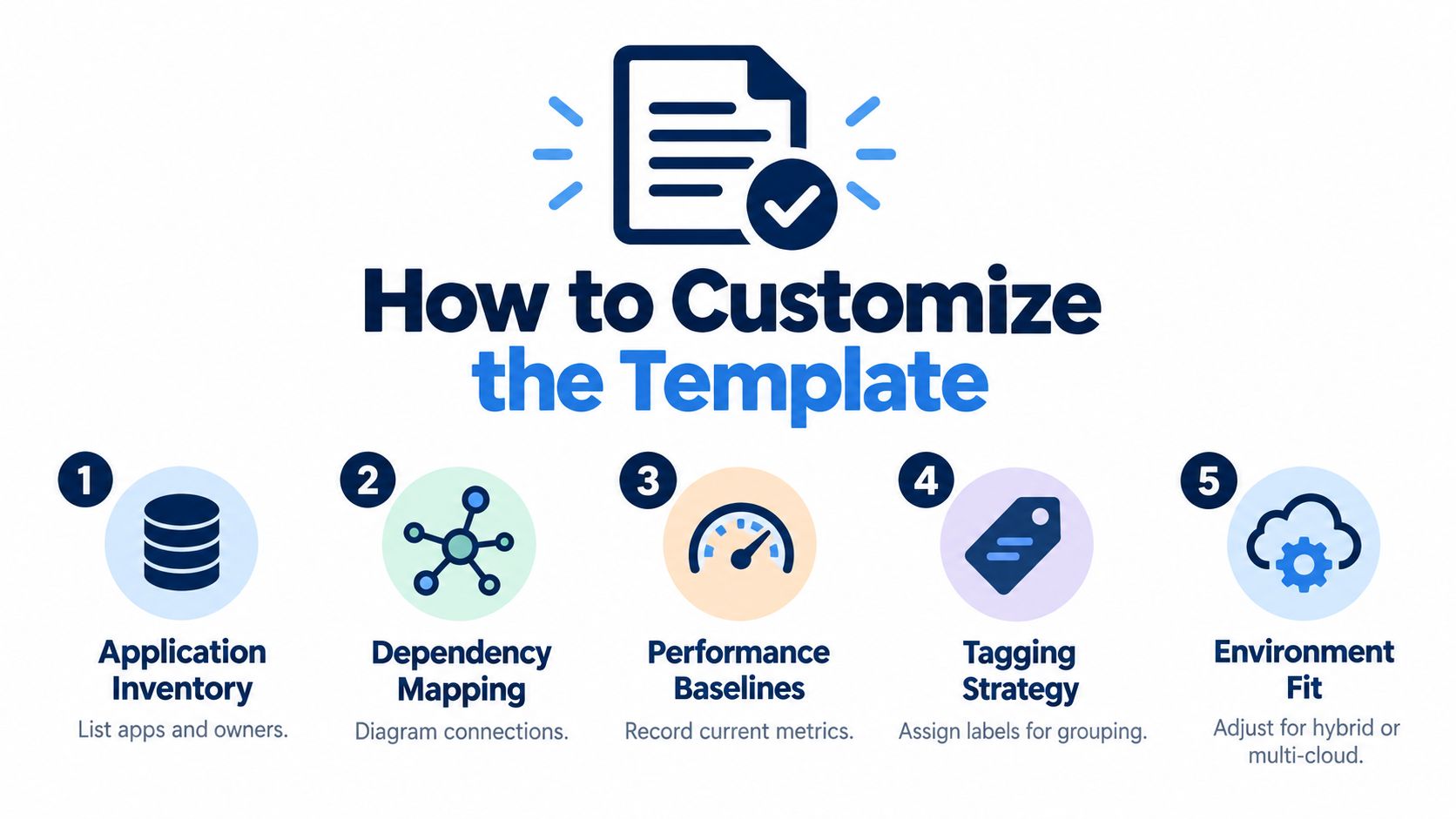
Start with the application and data register. Record each workload, business owner, technical owner, environment, data classification, support dependency, licence constraint, and current operating pattern. The register should link to a dependency map, not sit as a standalone spreadsheet.
The assessment block turns inventory data into a decision. Assign each workload to one of six paths:
The choice should include rationale, risk, expected effort, compliance considerations, and the decision owner. A high-risk application may require a separate architecture review even if its technical move appears simple.
The wave tab groups workloads around dependencies, business calendars, support capacity, and rollback feasibility. Each wave needs a start condition, build tasks, test evidence, cutover window, hypercare owner, and stop/go checkpoint.
Build and migrate activities should remain separate from validation. A completed deployment isn't proof that users can work successfully. Testing needs its own tasks for performance, access, integrations, backup, recovery, monitoring, and operational handover.
The final block records the change sequence, final synchronization, communications, approval chain, monitoring plan, incident route, and rollback trigger. Hypercare should have an end date or explicit exit condition, otherwise temporary support arrangements become permanent operating debt.
The Government of Canada's cloud-first policy provides useful context for Canadian planning, particularly when a roadmap must distinguish public cloud modernization from Enterprise Data Centre placement. For teams moving Microsoft workloads, CloudOrbis also provides a focused overview of Azure migration services.
Keep the timeline, risk register, and checklist connected. If a risk changes the wave order, the timeline should reflect it. If a checklist item fails, the relevant milestone should remain blocked rather than showing a misleading green status.
Populate the template from evidence, not assumptions. A discovery workshop can identify known systems, but application owners, infrastructure specialists, security staff, finance, and business operations each hold different parts of the truth.
A Canada-focused roadmap should begin with a complete application-and-data inventory, dependency mapping, and baseline documentation before any cutover. Canadian cloud migration guidance specifically emphasizes cataloguing workloads, mapping interdependencies, recording performance baselines, and tagging compliance and security requirements so each workload can receive an appropriate 6R decision.
For every application, capture:
Avoid vague labels such as “mission critical” without a reason. A clinic's scheduling platform, a manufacturer's production planning system, and a professional services firm's document management platform may all be important, but their outage tolerance, integration profile, and data controls differ.
A stable commodity application may be suitable for rehosting when speed and low change risk matter most. A database that would benefit from a managed service may justify replatforming, while a heavily customized application with a long operating life may warrant refactoring. A duplicate reporting tool might be retired, and a dated line-of-business product could be replaced with a supported service.
Retain is also a valid decision. It can protect the migration from becoming blocked by a workload with unresolved regulatory, technical, or commercial constraints. Record the condition that would trigger a later review, rather than allowing “retain” to become an unowned permanent exception.
Score each workload qualitatively against business impact, technical complexity, dependency density, data sensitivity, testability, and rollback practicality. Start with a workload that teaches the team about the target environment without putting core operations at unnecessary risk.
Each wave should have one accountable approver, named technical leads, business sign-off, and a written rollback owner. CloudOrbis's approach can be aligned with its 10-step engagement, from assessment and strategy through implementation, training, and ongoing optimization. Teams working through older platforms can also use the legacy system modernization guidance to separate migration work from deeper application transformation.
The output should be a prioritized backlog with decisions that someone can challenge. If an owner can't explain why a workload belongs in a particular wave, it isn't ready for scheduling.
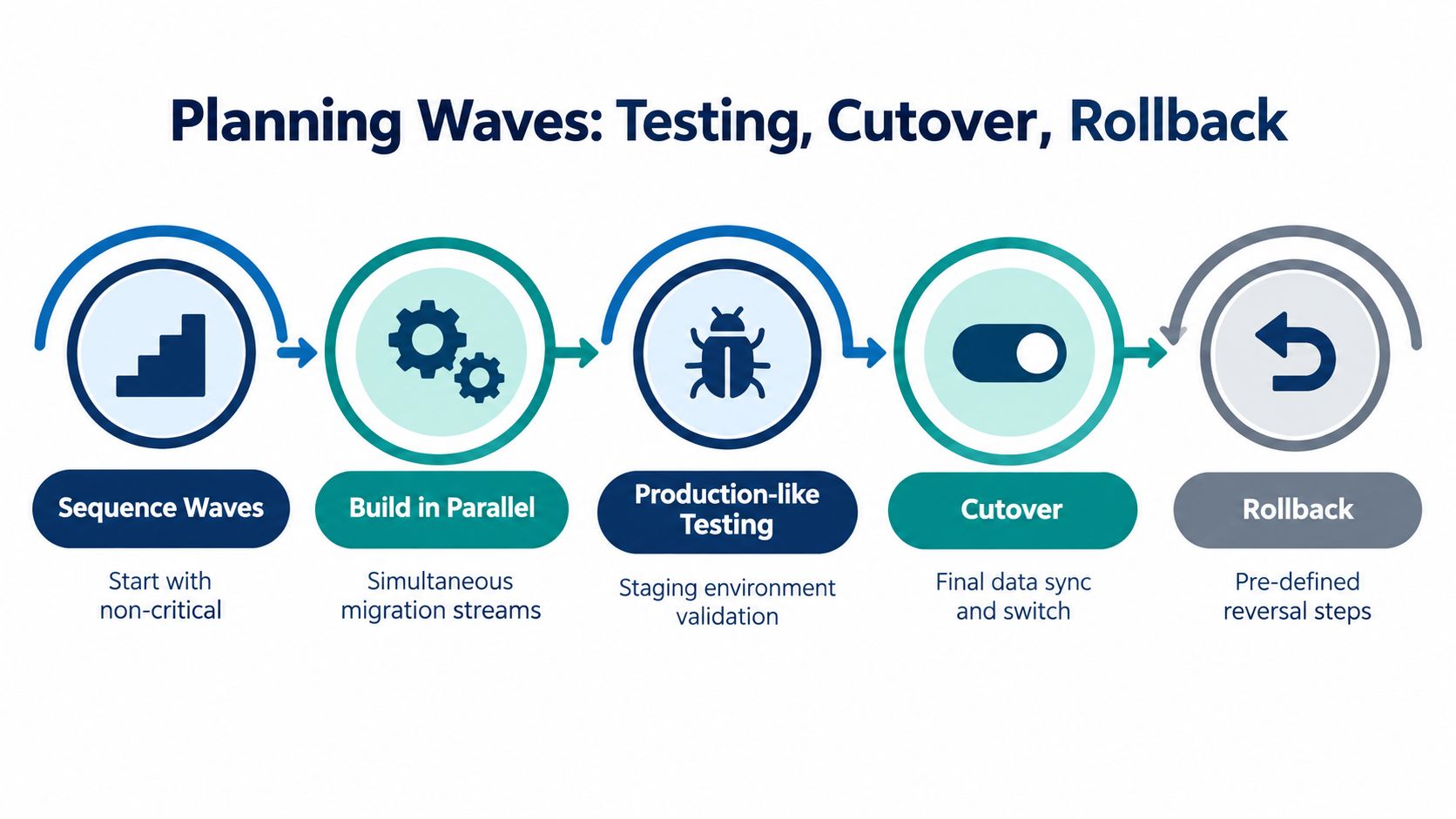
A migration wave should behave like a controlled release, not a one-time leap. The safest sequence starts with a non-critical workload, builds the target environment in parallel, tests against production-like conditions, and moves forward only when evidence satisfies the agreed exit criteria.
| Workload Example | Risk and Complexity | Recommended Wave |
|---|---|---|
| Internal reporting tool with limited dependencies | Lower operational impact and straightforward validation | Early learning wave |
| Departmental collaboration or file service | Moderate identity, access, and user adoption considerations | Controlled business wave |
| Customer-facing application with several integrations | Higher availability, network, and data consistency risk | Later production wave |
| Clinical, financial, or production-control platform | High business impact, strict controls, and complex rollback | Carefully governed final wave |
The matrix isn't a substitute for judgement. It creates a consistent conversation about why one workload moves before another and what evidence the team needs before increasing risk.
For the build phase, verify identity integration, network paths, firewall policy, logging, backup, monitoring, and administrative access. During testing, compare the target environment with the documented baseline. Check user journeys, batch processing, integrations, data consistency, performance under representative load, and support procedures.
Recovery objectives need operational proof, not just values in a design document. Validate that the team can restore, fail over, communicate, and resume work within the organization's agreed tolerance. CloudOrbis's guidance on recovery time objectives can help teams connect recovery planning to application priority.
A rollback checkpoint should state:
Canadian IT leaders should take execution risk seriously. A Canadian IT checklist reports 32% of cloud spending is wasted, cloud projects average 13% over budget, and 27% of organizations have experienced a public-cloud security breach, with misconfiguration driving most incidents. The same guidance recommends phased migrations, parallel builds, production-like testing, recovery-objective validation, and rollback checkpoints. Canadian cloud migration checklist guidance supports using those controls as standard roadmap fields.
The go/no-go meeting should review evidence, not optimism. If identity cleanup, network capacity, VoIP quality, or rollback testing remains unresolved, delaying the wave is usually cheaper than forcing a cutover that creates a business incident.
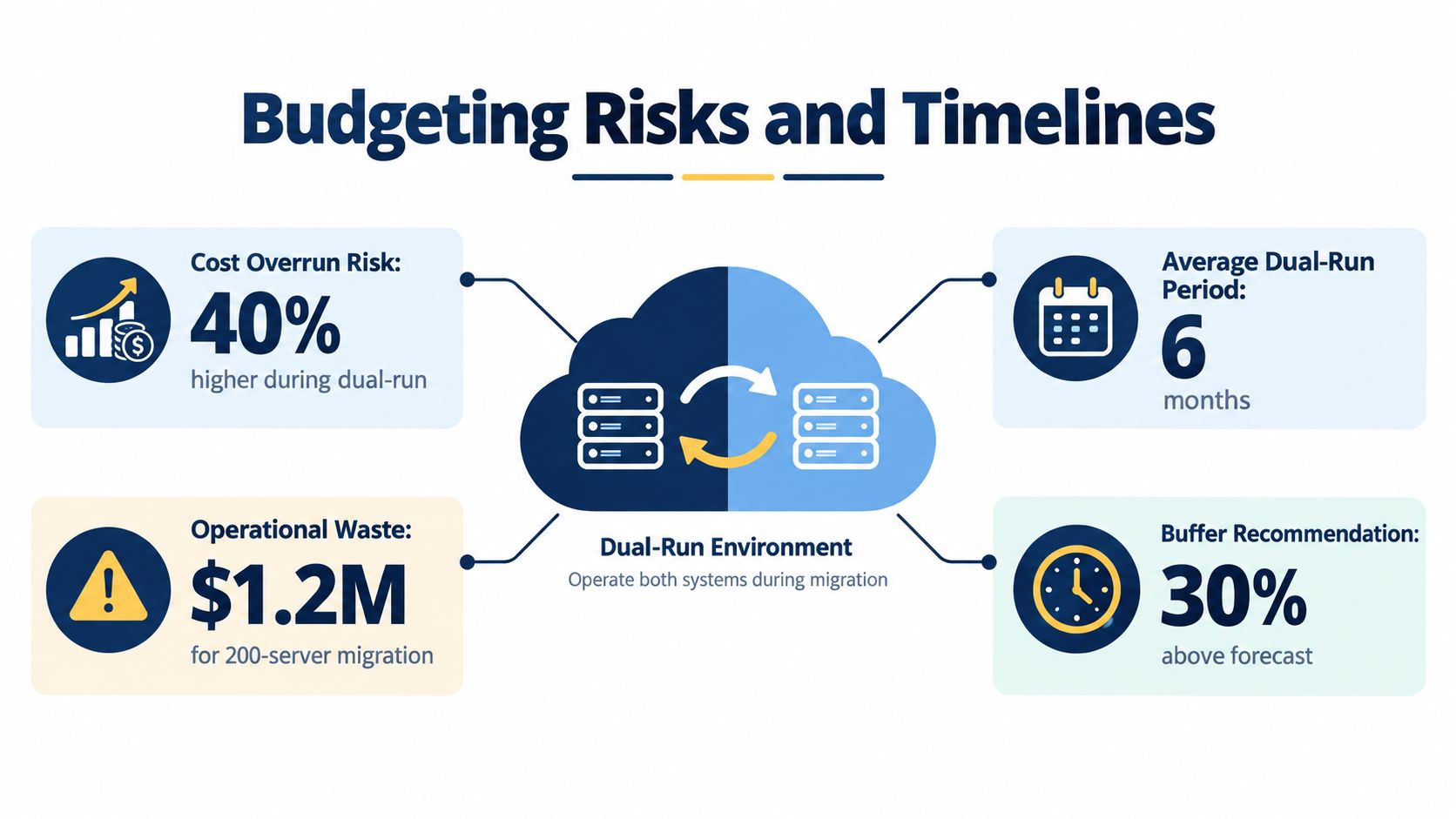
The most misleading migration budget is the one that covers only the destination environment. During dual run, the organization may continue paying for legacy hosting while funding cloud consumption, data movement, security tooling, network changes, identity remediation, refactoring, training, and additional support.
Independent Canadian guidance warns that bills can run 30% to 60% above forecast when egress, support tiers, and refactoring aren't modelled in advance. Canadian cloud migration cost guidance identifies data transfer fees, increased infrastructure demands, underutilized resources, and missing rollback planning as common sources of overruns.
Add a dual-run cost baseline to the roadmap rather than hiding it in contingency. Include:
Give every cost a forecast owner and a review cadence. Consumption tracking should compare forecast with actual usage and explain variance in plain language. A resource that remains underused after migration may need resizing, scheduling, redesign, or retirement.
Government data shows how quickly cloud operations can scale in Canada. Shared Services Canada cloud-services consumption rose from $1.4 million in fiscal 2019-20 to $103.8 million in fiscal 2021-22, then to $156.9 million by fiscal 2022-23, roughly a 74x increase in three fiscal years. The Government of Canada spending record makes the governance lesson clear: a roadmap needs budgeting milestones, phased procurement, and consumption tracking.
A pilot should have a stop/go decision that covers technical readiness and financial reality. Ask whether actual consumption matches the operating model, whether the support tier is appropriate, whether egress assumptions remain valid, and whether the expected legacy exit date is still achievable.
For Canadian businesses with distributed offices, don't treat connectivity as a minor implementation detail. Regional latency, remote access, office-circuit upgrades, and VoIP performance can affect user experience while old and new environments coexist. Put those tests on the timeline before leadership commits to a data-centre closure date.
A completed template becomes useful when it governs the next meeting. Validate the pilot wave, confirm the workload owner, lock the RACI, publish the test evidence required for approval, and assign someone to maintain the risk register. Schedule internal review for tone, accuracy, and alignment before publishing roadmap material for employees or stakeholders.
After cutover, keep monitoring active. Review performance, access, security events, backup results, consumption, support volume, and unresolved defects. Close hypercare only when the operational team can support the workload without relying on project specialists.
Cost control must remain visible after migration. Canadian guidance notes that bills can run 30% to 60% above forecast when egress, support tiers, and refactoring aren't modelled up front, so the roadmap should retain cost ownership beyond the initial deployment. The IT staffing cloud transformation results offer useful context for leaders evaluating the people and operating-model side of transformation.
CloudOrbis Inc. supports assessment, migration strategy, implementation, training, security, backup, disaster recovery, and ongoing optimization for Canadian small and mid-sized organizations. Its 24/7 Canada-based helpdesk and structured engagement can support teams that need practical delivery capacity alongside internal IT ownership. Explore the CloudOrbis cloud migration services when you're ready to turn the roadmap into a controlled pilot.
CloudOrbis Inc. can help you inventory workloads, select the right 6R path, model dual-run costs, test recovery, and manage a low-disruption migration for your Canadian business. Download the cloud migration roadmap template, then visit CloudOrbis Inc. to discuss your pilot wave and build an execution plan your leadership team can defend.
September 16, 2026
How to Send Secure Email in Outlook Made SimpleLearn how to send secure email in Outlook with encryption, S/MIME and compliance tips for Canadian businesses. Step-by-step guide inside.
Read Full Post
September 15, 2026
Why Managed IT Services Matter for Canadian SMBsDiscover why managed IT services are a smart move for Canadian SMBs. Learn the benefits, real ROI, and how to choose the right provider.
Read Full Post
September 14, 2026
Vulnerability Management vs Vulnerability AssessmentVulnerability management vs vulnerability assessment explained for Canadian SMBs. Compare scope, process, tools, and how to choose the right approach.
Read Full Post
