

September 21, 2026
Secure File Sharing Guide for Canadian BusinessesLearn secure file sharing essentials for Canadian SMBs — encryption, compliance, protocols and best practices to protect data and stay compliant.
Read Full Post%20(1).webp)
Usman Malik
Chief Executive Officer
March 25, 2026
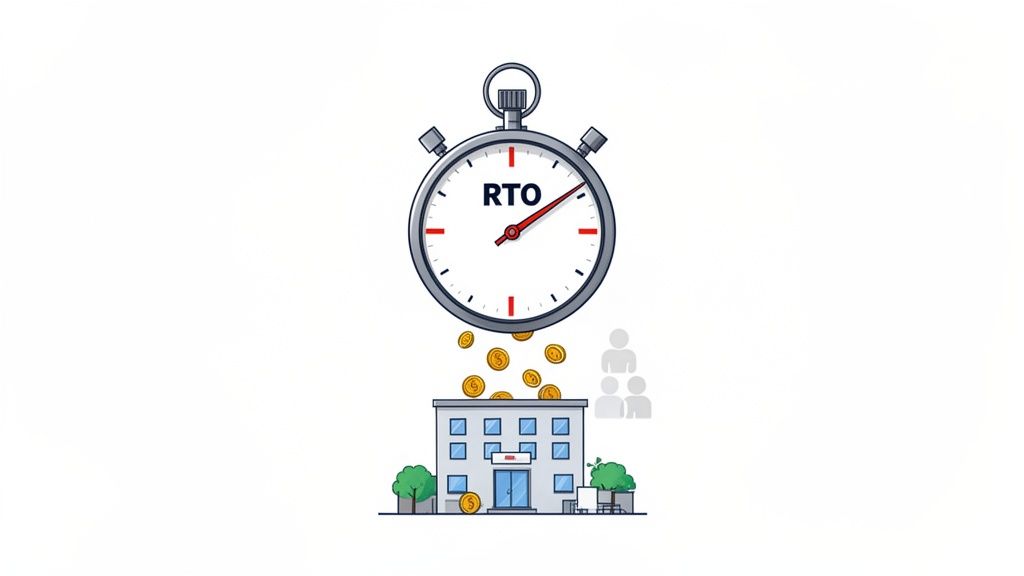
When disaster strikes your IT, the clock starts ticking. Every moment your systems are down, you're losing money, productivity, and customer trust. But how long is too long? That's the question your Recovery Time Objective (RTO) answers.
Think of it as the absolute maximum amount of time your business can tolerate a specific system being offline before the damage becomes unacceptable. It’s your line in the sand—the deadline for getting back on your feet.
A Recovery Time Objective isn't just IT jargon; it’s a core business decision that shapes your entire disaster recovery strategy. It forces you to answer a critical question for each part of your operation: “How quickly do we absolutely need to get this service back online to avoid a major business disaster?”
The answer will be different across your organization. For instance, if your e-commerce website goes down, every minute of downtime directly translates into lost sales. Its RTO might be just a few minutes. However, the internal HR portal used for booking vacation time could likely wait 24 hours or more without causing a serious problem. You're defining your tolerance for pain.
Setting clear RTOs turns your recovery plan from a hopeful idea into an actionable, time-bound commitment. It’s the difference between guessing and knowing. Without these targets, you're essentially flying blind during a crisis, gambling with your company's future.
In today's connected economy, understanding why zero downtime isn't optional is a crucial first step, as any interruption can have a massive business impact.
A solid RTO framework delivers powerful benefits:
A Recovery Time Objective is the bridge between a business continuity plan on paper and a resilient organization in practice. It transforms recovery from an abstract goal into an actionable, time-bound commitment.
Ultimately, setting your RTOs is a strategic business decision, not just a technical one. It forces you to identify what truly matters to your operations and aligns your IT investments with those priorities. This is a foundational step in building a truly effective disaster recovery plan. As you'll see, a clear RTO is a critical piece of a much larger puzzle; you can learn more about this by reading our guide on what is business continuity and its importance.
In any disaster recovery plan, you'll constantly hear two terms: Recovery Time Objective (RTO) and Recovery Point Objective (RPO). Business leaders often use them interchangeably, but that's a dangerous mistake. Confusing them can leave massive gaps in your business continuity strategy, leading to a false sense of security.
Getting them right is everything. They each answer a completely different, yet equally critical, question about what happens when disaster strikes.
Recovery Time Objective (RTO) is all about time. It forces you to answer the question: “How quickly must this system be back online to prevent unacceptable damage to the business?”
Think of RTO as a stopwatch that starts ticking the moment an outage occurs. It sets the maximum acceptable downtime for any specific service or application. For a mission-critical e-commerce site, the RTO might be just 15 minutes. That aggressive target demands a fast, highly automated recovery process.
On the other hand, Recovery Point Objective (RPO) is all about data. It makes you answer the question: “How much data can we realistically afford to lose?”
RPO looks backward from the moment of an incident, defining the maximum tolerable age of the files you recover. In practice, your RPO dictates how often you need to back up your data. If you set an RPO of one hour for your accounting system, you must perform backups at least every 60 minutes. This ensures you never lose more than an hour's worth of transactions.
A simple way to remember the difference is to think of a video game. Your RPO is your last save point—it determines how much progress you’ll lose. Your RTO is how quickly you can reboot the console and get back to playing after it crashes.
Both metrics are vital, but they shape different parts of your recovery strategy. Your RTO drives the kind of infrastructure and procedures you need for a fast recovery, while your RPO determines your data backup and replication schedule. To explore this further, our comprehensive data backup and recovery guide offers deeper insights into building a solid protection plan.
To make this distinction crystal clear, let's put them side-by-side.
This table breaks down the two most critical metrics in disaster recovery, showing how they focus on different outcomes and impact your business in unique ways.
| Metric | Focus | Question It Answers | Example | Business Impact |
|---|---|---|---|---|
| Recovery Time Objective (RTO) | Downtime | "How quickly must we be back online?" | An RTO of 1 hour means the service must be fully restored within 60 minutes of an outage. | Determines the speed of recovery and the investment needed in failover systems and recovery procedures. |
| Recovery Point Objective (RPO) | Data Loss | "How much data can we afford to lose?" | An RPO of 15 minutes means backups must occur at least every 15 minutes. | Dictates backup frequency and storage requirements, directly impacting the potential for lost transactions or information. |
As you can see, getting these two mixed up can lead to a disastrous gap between expectation and reality. You might have a system that can be restored in under an hour (meeting your RTO), but if your last backup was from the previous day, you’ve still lost nearly 24 hours of critical data (completely missing your RPO). A truly effective disaster recovery plan requires setting, planning for, and testing both RTO and RPO for every critical business function.
Figuring out your company’s Recovery Time Objective isn't about pulling a number out of thin air. It’s a strategic process, one that’s firmly rooted in the realities of your business. To set the right RTO, you need to take a clear-eyed look at what keeps your organisation running and what happens when those functions grind to a halt.
This calculation is all about balancing risk, cost, and operational necessity.
The best tool for this job is a Business Impact Analysis (BIA). A BIA is a methodical exercise where you pinpoint your most critical business functions and then quantify the impact of their disruption over time. It provides the data-driven framework that turns your RTO from a guess into a strategic target.
The first step in any BIA is to identify your mission-critical functions. These are the processes that directly generate revenue, deliver services to your customers, or are absolutely essential for legal and regulatory compliance. You need to think less about individual servers and more about business outcomes.
For example, a logistics company's most critical function might be its dispatch and routing system. For a healthcare clinic, it would almost certainly be its Electronic Health Record (EHR) platform. Once you have this list, you can start to analyse the true cost of downtime for each one.
To get a better picture of how RTO fits into the broader disaster recovery timeline, take a look at the infographic below. It clearly shows the relationship between the point of data loss (your RPO) and the time it takes to get back online (your RTO).
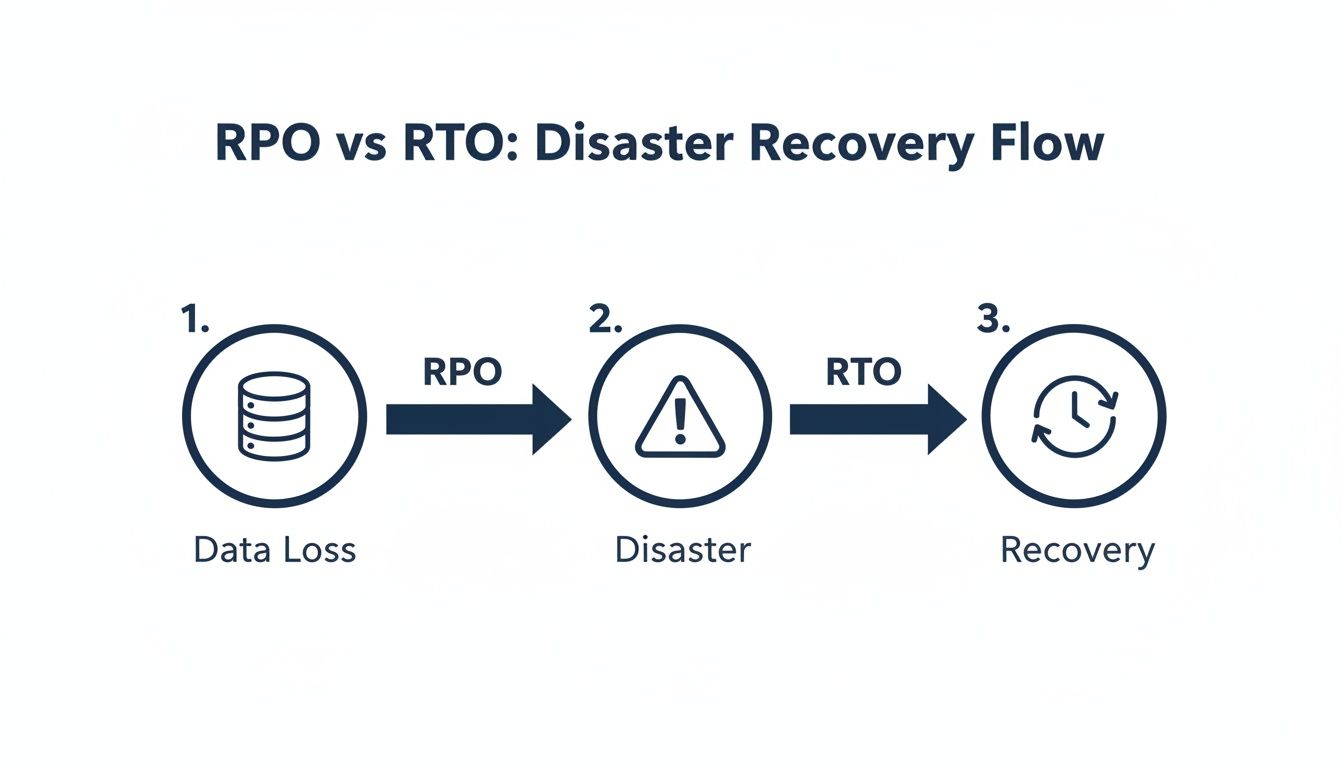
This flow highlights that RPO measures the data you lose before the disaster hits, while RTO measures the downtime after it happens. Both are crucial for a complete and effective recovery strategy.
The next step is to attach real numbers to an outage. This isn’t just about lost sales; the costs are often complex and can escalate frighteningly fast.
You should consider:
With this financial data, you can build a timeline showing how the cost of an outage grows. You might find that the first hour of downtime costs $10,000, but that cost jumps to $100,000 by hour four. That inflection point is a powerful indicator of your maximum tolerable downtime.
A well-structured BIA is a core component of any robust resilience strategy. You can find guidance on building one in a comprehensive IT disaster recovery plan template.
Not all systems are created equal. Trying to achieve a near-zero RTO for every single application is incredibly expensive and, frankly, unnecessary. A much smarter approach is to use the data from your BIA to group your applications into recovery tiers.
By tiering your applications, you align your technology investments directly with business priorities. This ensures you spend resources protecting what truly matters, rather than treating all systems with the same level of urgency.
This tiered approach allows you to set realistic, achievable RTOs across your entire organisation.
Here’s a practical example of what this could look like:
This framework transforms the abstract concept of a recovery time objective into a concrete, actionable plan. It gives your IT team clear, prioritized targets that are directly aligned with your business's most important goals, ensuring your resilience strategy is both effective and cost-efficient.
A recovery time objective is just a number until you see it in the context of a real-world business. The targets you set have to be grounded in the pressures, regulations, and daily realities of your industry. What’s a minor inconvenience for a marketing agency could be a full-blown catastrophe for a hospital or a factory.
Looking at industry benchmarks gives you a much clearer picture of where your own RTO goals should land. It ensures your recovery plan isn't just a technical document, but a strategic tool that keeps you competitive and compliant.
For an Ontario healthcare clinic, business continuity isn't about profit—it's about patient safety and legal compliance. Under the strict rules of the Personal Health Information Protection Act (PHIPA), consistent access to Electronic Health Records (EHR) is non-negotiable. An outage doesn't just stop billing; it can delay a diagnosis, postpone a critical treatment, and put patient care in jeopardy.
Because of this, the recovery time objective for critical EHR systems is incredibly tight. While many clinics aim for an RTO of under four hours, the real goal is to get back online almost instantly. A 2023 Statistics Canada report on IT disruptions in Ontario healthcare found that 62% of small clinics suffered outages longer than six hours from ransomware alone. These incidents cost an average of $12,500 per incident and delayed care for over 1,200 patients annually at each affected facility.
According to guidance from the Canadian Centre for Cyber Security, healthcare organizations must define RTOs as the planned time to meet minimum service expectations, with a strong focus on restoring critical systems rapidly to avoid disruptions in patient care. You can review the complete guidelines on the Canadian Centre for Cyber Security's website.
This data underscores the immense pressure on healthcare providers. Missing an RTO target doesn’t just hurt the bottom line; it has a serious human cost and can trigger major compliance penalties.
In the fast-paced world of manufacturing, an idle production line creates an instant and expensive domino effect. Think of a Toronto-based firm using a just-in-time inventory model. Every minute their control systems or Enterprise Resource Planning (ERP) platform is down, output stops, machinery sits idle, and the supply chain grinds to a halt.
The financial stakes are enormous, forcing manufacturers to have very little tolerance for disruption.
The entire goal is to restart the most critical functions first to stop the financial bleeding. A single delayed shipment in Calgary's logistics sector or a missed production window at an auto parts plant can lead to broken contracts and reputational damage that lasts for years.
The RTO targets for logistics and professional services are just as specialized, mirroring their distinct business models. A Calgary-based logistics company’s dispatch system is its lifeline, demanding an RTO of less than an hour to keep a fleet of drivers from sitting idle.
On the other hand, a law firm in Edmonton might prioritize its document management system with an RTO of two hours, but could easily tolerate a 24-hour RTO for its internal accounting software, since billing can wait a day if needed.
By looking at these industry-specific examples, you can start to frame your own business needs. Your recovery time objective should be a direct reflection of what your organization can—and absolutely cannot—afford to lose when the inevitable outage occurs.
Knowing your recovery time objective is the first step, but the real challenge is hitting that target when a crisis unfolds. An RTO on paper doesn't mean much if your recovery plan can't deliver under pressure. The key is to move from a reactive "what if" mindset to a proactive, prepared one.
This means putting the right technology, processes, and testing in place to make sure you can consistently meet your goals. It’s all about turning your disaster recovery plan from a theoretical document into a reliable, battle-tested system.
Think of your disaster recovery (DR) plan as the master playbook for a crisis. It needs to be a detailed, step-by-step guide that leaves absolutely no room for guesswork when things go wrong. A solid plan clearly lays out roles, responsibilities, and how everyone will communicate.
Most importantly, it has to prioritize the order of restoration based on the application tiers you identified during your business impact analysis. This ensures your most critical systems—like customer-facing platforms or production line controls—are brought back online first to minimize financial fallout and reputational damage.
Manual recovery processes are slow, full of potential for human error, and a major risk to meeting an aggressive recovery time objective. Thankfully, modern technology gives us powerful tools to speed up recovery and take human error out of the equation.
Key technologies to consider include:
A proactive disaster recovery posture means using constant monitoring and modern solutions to identify and neutralize threats before they can cause an outage, making even the most aggressive RTOs achievable.
For manufacturing and logistics firms in Canada, this is especially vital. A 2024 report found that 55% of mid-sized Ontario manufacturers faced outages averaging 8.7 hours from IT failures, leading to significant financial losses. Another analysis for Canadian businesses showed that after a simulated disaster, server shortages could extend recovery times by 48%. This really highlights the need for guaranteed access to resources, which is something DRaaS is built to provide. You can discover more insights about disaster recovery for Canadian businesses at consolidated-it.com.
A disaster recovery plan that has never been tested is just a document filled with hope. The only way to know if your plan actually works is through regular drills and simulations. This is how you uncover hidden weaknesses and make sure your team is truly prepared.
Regular testing confirms that your technology works as expected and that your people can execute the plan under pressure. These drills help you find gaps—like outdated contact lists, incorrect system dependencies, or restoration speeds that are slower than you thought. Every test gives you valuable data to refine your plan and builds confidence that when a real crisis hits, you will meet your recovery time objective.
Trying to hit an ambitious recovery time objective with a small, in-house team can feel like an impossible task, especially when resources are already stretched thin. This is exactly where a partnership with CloudOrbis can make all the difference, turning disaster recovery from a dusty plan on a shelf into a reliable, battle-tested system.
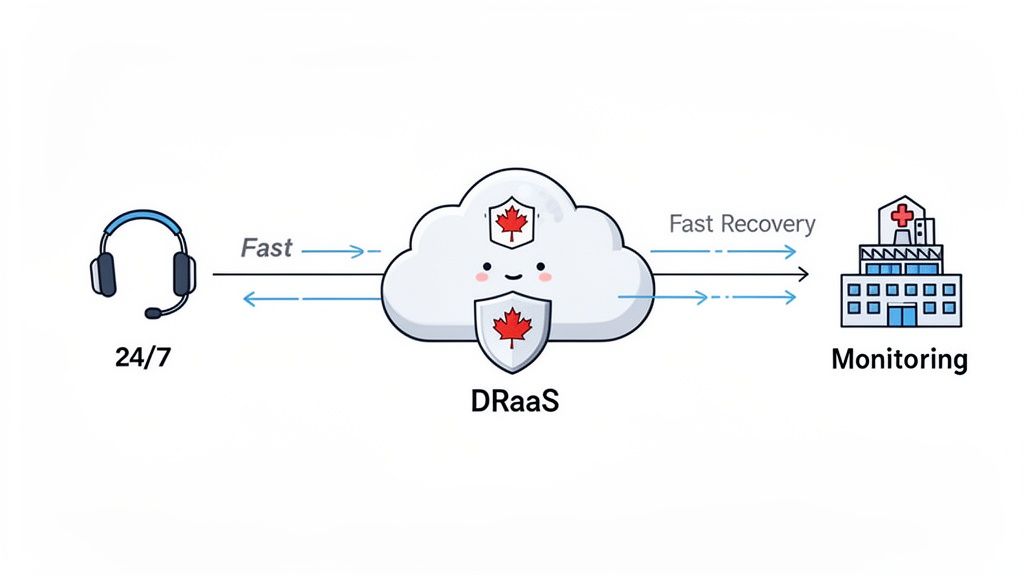
Our approach is built on a simple philosophy: prevention is the best cure. With 24/7 monitoring and advanced cybersecurity measures, we work tirelessly to spot and stop threats long before they can ever cause an outage.
For businesses in demanding sectors like healthcare, manufacturing, and logistics, a one-size-fits-all plan just doesn’t cut it. We specialize in developing disaster recovery solutions built for the unique challenges and compliance needs of the Canadian business landscape, designing a plan that protects your most critical operations first.
Our proven 10-step engagement process starts with a deep dive into your business. We take the time to understand your operations inside and out, which allows us to build a DR plan that is not just effective but also cost-efficient.
Partnering with a managed services provider like CloudOrbis shifts your disaster recovery from a reactive, high-stress event to a managed, predictable process. This allows you to stop worrying about downtime and focus on growing your business with confidence.
We back up this strategic planning with the right technology. By implementing modern, automated solutions, we ensure that when an incident does happen, recovery is fast and free from the human errors that often cause delays. You can learn more about how we make this happen through our data backup and disaster recovery solutions.
What really makes CloudOrbis different is our unwavering commitment to Canadian businesses. Our helpdesk is 100% Canada-based and operates 24/7, so when you need support, you’re talking to an expert who understands the local context—not a frustrating offshore call centre.
We deliver enterprise-grade capabilities without the enterprise-grade price tag. This includes:
By taking the complexities of disaster recovery off your plate, we fortify your operations against disruption and free up your team to focus on their core responsibilities. With CloudOrbis, achieving your recovery time objective isn’t just a goal—it’s a core part of our service.
Diving into the world of disaster recovery can feel a bit overwhelming, and it's natural to have questions. We’ve put together some straightforward answers to the most common queries we hear from business leaders about the recovery time objective, helping you get a firm grasp on the concept and what it means for your business.
Recovery Time Objective (RTO) and Recovery Point Objective (RPO) are often mentioned together, but they measure two very different things. Getting them straight is the first step in building a solid disaster recovery plan.
RTO is all about time. It answers the question, “How fast do we need to get back up and running?” This is the absolute maximum amount of downtime your business can handle before the damage becomes unacceptable.
RPO is all about data. It answers a different question: “How much data can we realistically afford to lose?” Your RPO determines how frequently you need to back up your systems to avoid losing more work than you can recover from.
Think of it this way: RTO is the stopwatch counting down your outage, while RPO is the line in the sand for how much work you’re willing to lose forever.
A classic mistake is getting a great RTO but forgetting about RPO. You might get a server back online in under an hour, meeting your RTO. But if the last backup was from yesterday, you’ve just lost nearly 24 hours of critical data and completely failed your RPO. Both are vital.
Setting your RTO isn't a guessing game. It needs to be a strategic decision, and the process starts with a Business Impact Analysis (BIA). A BIA helps you identify your most critical business functions and actually calculate what an outage costs you over time.
Think about the real-world impact. What are the financial losses, reputational hits, and potential compliance fines for every hour a key system is down? The point where those costs become unbearable is your maximum tolerable downtime, which directly informs your RTO.
From there, you can tier your applications. Mission-critical systems will need a very aggressive RTO, while less important ones can have a longer recovery window. This lets you focus your resources where they truly matter most.
When your recovery time objective is measured in minutes, not hours, you need modern tools built for speed and reliability. Relying on old-school methods just won't cut it.
Key technologies include:
Stop worrying about downtime and start building a more resilient business. CloudOrbis offers tailored disaster recovery solutions that ensure you meet your recovery time objectives with confidence. Schedule your consultation today at https://cloudorbis.com.
September 21, 2026
Secure File Sharing Guide for Canadian BusinessesLearn secure file sharing essentials for Canadian SMBs — encryption, compliance, protocols and best practices to protect data and stay compliant.
Read Full Post
September 20, 2026
Disaster Recovery Plan Business Continuity for SMBsBuild a disaster recovery plan business continuity strategy tailored for Canadian SMBs. Covers risk assessment, RTO/RPO, backup, testing, and ownership.
Read Full Post
September 19, 2026
Database Migration Services Explained for Canadian SMBsLearn how database migration services move data to the cloud securely with minimal downtime. Types, risks, costs and a Canadian provider checklist.
Read Full Post
