
September 19, 2026
Database Migration Services Explained for Canadian SMBsLearn how database migration services move data to the cloud securely with minimal downtime. Types, risks, costs and a Canadian provider checklist.
Read Full Post%20(1).webp)
Usman Malik
Chief Executive Officer
March 21, 2026
Picture this: a professionally managed, off-site digital vault built specifically for your company's most critical asset—its data. That’s the core idea behind Data Backup as a Service (DBaaS). Instead of buying and managing complex backup systems yourself, you subscribe to a service that handles everything from automated backups and secure cloud storage to rapid recovery when a disaster strikes.
At its heart, Data Backup as a Service is a strategic partnership. You are entrusting a specialized provider to protect your digital information from all kinds of threats, whether it's hardware failure, simple human error, or a sophisticated cyberattack. This is not just about making copies of files; it’s about having a concrete plan to ensure your business keeps running, no matter what.
Think of it as an insurance policy for your data. The traditional approach forces you to buy expensive servers, install complicated software, and pull your IT staff away from other priorities to manage and test backups. With DBaaS, you outsource this entire headache to experts who live and breathe data protection. They manage the infrastructure, monitor your backups 24/7, and are on standby to get you back on your feet fast.
For most medium-sized businesses, IT teams are already stretched thin. Managing backups often becomes a reactive, time-consuming chore that gets pushed aside for more immediate problems. This creates a massive, unnecessary risk. A single failed backup could mean losing weeks of irreplaceable business data.
DBaaS turns that vulnerability into a strength. It makes data protection a proactive, predictable, and managed part of your daily operations.
Data is a core business asset, and protecting it is not just an IT function but a foundational element of business continuity. Losing access to customer records, financial data, or operational files—even for a few hours—can cause major financial and reputational damage.
This service-based model gives Canadian businesses looking to stay competitive and secure several immediate advantages:
A truly comprehensive data protection plan also has to consider the entire lifecycle of your information. While backup services safeguard your live data in the cloud, it is just as important to understand what happens to data at the end of its life, like the secure destruction of data on old physical hardware. This is a crucial piece of your business's overall security posture.
Ultimately, adopting data backup as a service is a strategic move to build true resilience. It ensures that when a crisis hits—whether it's a ransomware attack or a server meltdown—your business is prepared to bounce back quickly and effectively. For a deeper look at building a resilient strategy, you might be interested in our complete data backup and recovery guide.
To truly appreciate the value of data backup as a service, it helps to peek behind the curtain and see how the technology actually works. It is not about just copying and pasting your files somewhere else. It’s a sophisticated system built for one single purpose: to protect your business information, no matter what.
At the heart of any professional backup strategy, two metrics matter more than any others: your RPO and your RTO. Think of them as the two most important questions every business leader needs to answer before a disaster strikes.
Recovery Point Objective (RPO): This answers, "How much data can we afford to lose?" It sets the maximum acceptable amount of data loss measured in time. An RPO of one hour means that if the worst happens, you'd lose no more than the last hour of work.
Recovery Time Objective (RTO): This addresses, "How quickly do we need to be back up and running?" It sets the target time for getting your systems and data restored. An RTO of four hours means your entire operation is back online within that window.
A good DBaaS solution is all about finding the perfect balance between these two goals—one that fits your company's real-world needs and budget.
A modern DBaaS setup has several moving parts, all working together to capture, secure, and manage your data. The goal is to create a seamless, hands-off flow of information from your office to the cloud and back again when you need it.
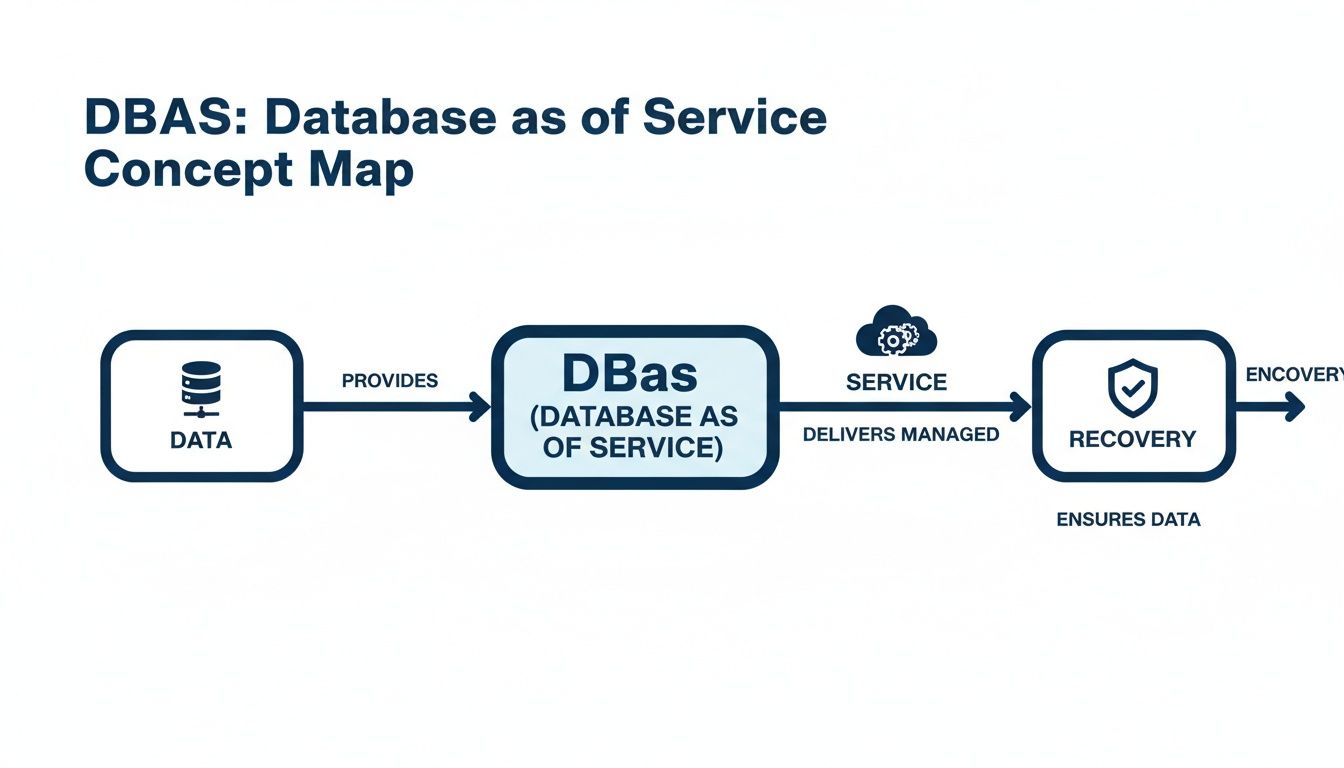
This map gives you a high-level view of that journey. Data moves from your on-site servers, gets processed and secured by a managed cloud service, and is always ready for a quick, reliable recovery. It turns a complex chore into an automated cycle of protection.
Let's break down the most important pieces of the puzzle.
Security is, without a doubt, the single most important part of any data backup as a service solution. Before your data even thinks about leaving your network, it is encrypted. Think of it like sealing your most valuable documents in a digital safe that only you have the key to.
This is what’s known as end-to-end encryption, and it protects your data at every single stage of its journey:
This multi-layered defence makes your backed-up information completely useless to anyone who does not have authorized access. To get a better handle on how this works with different backup types, it is worth understanding the key differences between incremental vs. differential backups and their role in a modern strategy.
Once your data is safely stored in the cloud, the next question is simple: how long do you keep it? This is where data retention policies come into play. A retention policy is just a set of rules that automates the entire lifecycle of your backups.
A data retention policy acts like a smart digital filing cabinet. It automatically keeps records for the exact duration required by industry regulations and then securely disposes of them to minimize risk and storage costs.
For any Canadian business, getting this right is critical for compliance. Regulations like PHIPA in healthcare or FINTRAC in finance have very strict rules about how long you must hold onto sensitive data. A DBaaS provider helps you set up these policies so you automatically meet your legal duties, giving you auditable proof of compliance without any of the manual headaches.
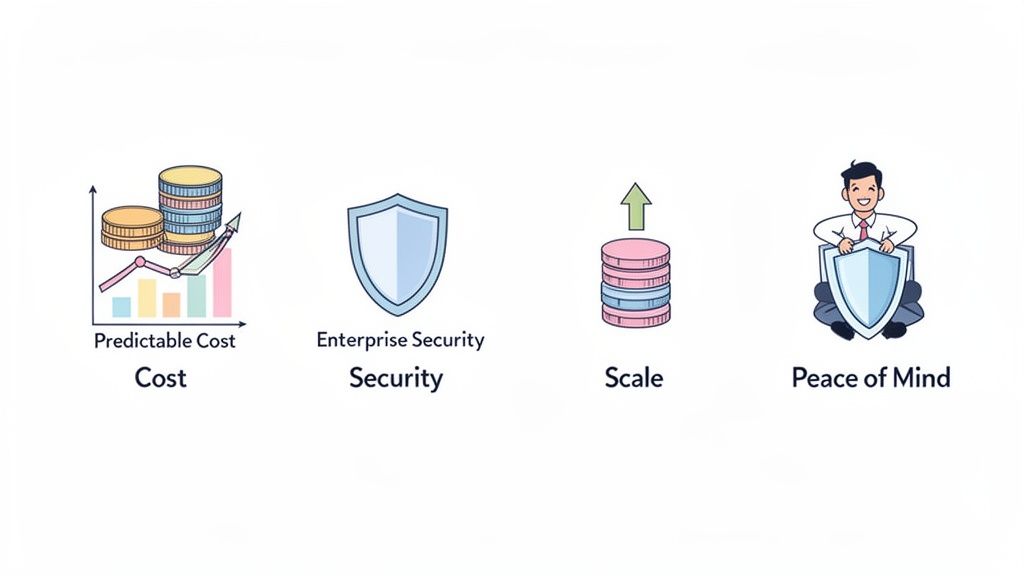
Switching to data backup as a service (DBaaS) is about much more than just making copies of your files. For Canadian businesses, it is a strategic shift in how you protect your operations, control your budget, and prepare for growth. The real value is not just in the tech itself, but in what it allows your business to achieve.
This move is part of a much bigger trend. The Canadian managed services market, which includes DBaaS, has exploded from USD 8.18 billion in 2018 to over USD 17.3 billion in 2024. As more businesses move to the cloud, these services are becoming the standard for getting powerful IT capabilities without the massive price tag. You can check out the full projections and find more insights into the Canadian managed services market to see just how fast things are changing.
The old way of backing up data was a constant drain on capital. You had to shell out for expensive servers and complicated software licences, then brace for a costly replacement cycle every few years. This created huge, unpredictable spikes in your budget and tied up cash that could have been used to grow the business.
DBaaS flips that financial model on its head. By moving to a subscription, your data protection costs become a predictable monthly operational expense (OpEx).
Instead of facing a $50,000 hardware refresh every three to five years, a manufacturing firm can budget a consistent monthly fee. This frees up significant capital for upgrading machinery or hiring new staff, directly contributing to business growth.
This shift delivers immediate financial wins:
For most medium-sized organizations, building and maintaining a truly secure, compliant backup system in-house is incredibly difficult and expensive. It demands dedicated security experts, round-the-clock monitoring, and constant updates to keep up with new threats. This is where data backup as a service really shines.
A specialized provider gives you a level of security that would otherwise be completely out of reach. This includes things like:
For a logistics company handling sensitive shipping manifests or a professional services firm with confidential client files, this built-in security is not just a nice-to-have. It’s essential for keeping client trust and meeting your regulatory obligations.
Your business is always changing, and your data is growing right along with it. A traditional, on-site backup system just cannot keep up. Once you hit your storage limit, you are back to another expensive and time-consuming project to add more capacity.
With DBaaS, scalability is built right into the service. As your data footprint expands, the service automatically adjusts to handle the growth without you having to do a thing.
This agility is critical for businesses in fast-moving industries. Think about a construction firm generating huge project files or a healthcare clinic where patient data grows exponentially. DBaaS ensures their protection strategy grows with them, without needing new hardware or major IT projects. It is a foundational piece of a modern IT framework, and you can learn more about the broader benefits of managed IT services in our other article.
For any Canadian business in a regulated field, compliance is not just a good idea—it’s the law. Failing to protect data according to the rules can lead to crippling fines, a tarnished reputation, and a complete loss of customer trust. This is where data backup as a service stops being just a tech solution and becomes a cornerstone of your governance, risk, and compliance strategy.
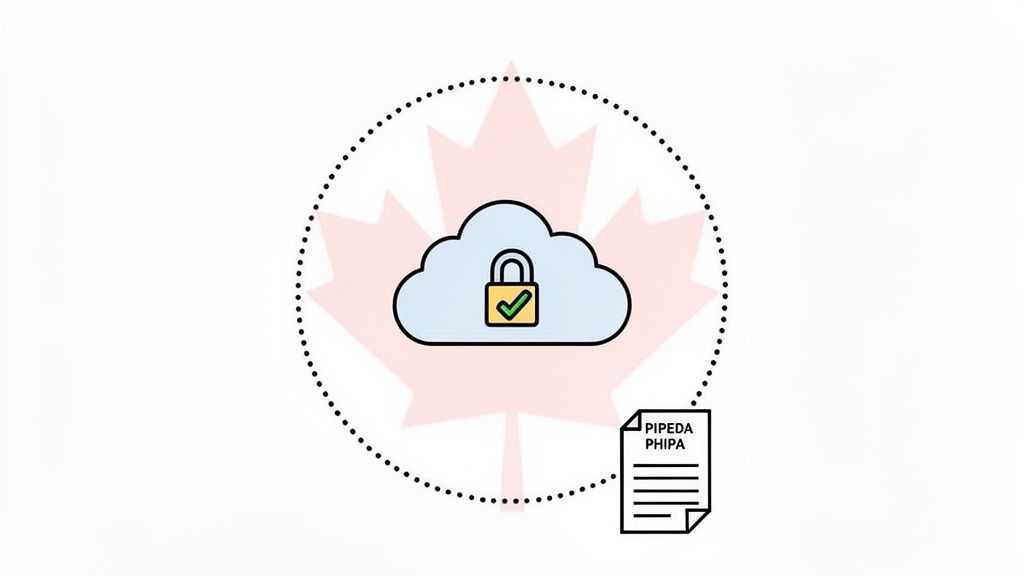
A solid DBaaS solution helps you navigate the complex web of data protection laws by giving you the specific technical tools needed to satisfy them. It is how you prove that you’re taking responsible, proactive steps to guard sensitive information.
Canada's Personal Information Protection and Electronic Documents Act (PIPEDA) dictates how private-sector businesses collect, use, and share personal information. One of its core principles is accountability. You are responsible for the information you control, even when you hand it off to a third party for processing.
A qualified DBaaS provider helps you meet this obligation head-on. When you partner with a provider that offers end-to-end encryption and detailed audit logs, you can clearly demonstrate that all personal data is protected at every single stage. It’s a straightforward way to ensure you’re always on the right side of the rules.
For healthcare organizations in Ontario, the Personal Health Information Protection Act (PHIPA) imposes even stricter standards for patient records. Keeping electronic medical records (EMRs) confidential and available is absolutely non-negotiable.
A PHIPA-compliant DBaaS solution is built with the safeguards needed to protect this highly sensitive data. Key features include:
By using a compliant DBaaS, a clinic can ensure that even after a ransomware attack or system failure, it can restore patient records quickly and securely. This maintains continuity of care and fulfills its legal duties under PHIPA.
For businesses in finance, real estate, and law, the Financial Transactions and Reports Analysis Centre of Canada (FINTRAC) enforces strict record-keeping rules to fight money laundering and terrorist financing. These regulations demand that certain records be kept for a specific time and be ready for an audit at a moment's notice.
This is where specific DBaaS features become essential for compliance.
Immutable Backups: This technology creates write-once, read-many copies of your data. Once a backup is created, it cannot be changed or deleted, even by an administrator. This provides a tamper-proof record that is vital for meeting FINTRAC’s tough data integrity requirements.
Data Residency: This feature ensures your data is physically stored within Canada's borders. Keeping financial and legal records on Canadian soil is often mandatory—or at the very least, a highly recommended practice to simplify legal jurisdiction and meet client expectations for data sovereignty.
This intense focus on data sovereignty is driving huge investments in local infrastructure. In fact, Canada's data centre storage market is projected to hit USD 1.88 billion by 2031, fuelled in part by these strict residency laws. With the healthcare sector's storage needs alone growing at a 14.6% CAGR, the demand for advanced backup services to manage these massive data volumes is clearer than ever.
The following table can help you evaluate DBaaS providers based on the features needed for key Canadian regulations.
| Compliance Feature | PIPEDA | PHIPA (Healthcare) | FINTRAC (Finance/Legal) |
|---|---|---|---|
| Data Residency (Canada) | Recommended | Highly Recommended | Often Mandatory |
| End-to-End Encryption | Required | Required | Required |
| Immutable Backups | Recommended | Recommended | Highly Recommended |
| Detailed Audit Logs | Required | Required | Required |
| Role-Based Access Control | Required | Required | Required |
| Defined Retention Policies | Required | Required | Required |
| Rapid Data Recovery | Recommended | Required | Recommended |
Choosing a DBaaS solution that ticks these boxes gives you a powerful tool to build a compliant and resilient data strategy.
Of course, a complete data management strategy includes more than just your digital files. A truly robust approach, which complements your DBaaS, should also include a complete guide to secure data destruction for physical hardware to maintain compliance from end to end.
Choosing the right data backup as a service provider gives you the tools to build a resilient and future-proof data strategy. To learn more, you can also read our guide on strengthening your overall data security management.
Picking a provider for your data backup as a service is one of the most important technology decisions your business will make. This is not just about finding the cheapest monthly fee; it’s about finding a partner you can trust with your most valuable asset—your data.
The right partner acts as an extension of your own team. They are the experts ensuring your business can weather anything from an accidental file deletion to a full-blown system failure. To find them, you need to look past the flashy marketing and focus on what really matters: verifiable credentials, security, and proven support.
Security is the bedrock of any worthwhile DBaaS solution. A provider’s promise to protect your data is meaningless without independent, third-party validation. Do not just take their word for it; you need to see the proof.
One of the first credentials you should ask for is a SOC 2 Type II certification. This is not a one-and-done certificate; it is a rigorous, ongoing audit that proves the provider consistently upholds strict security controls. It’s your confirmation that they have robust, tested processes for managing and securing client data.
When a provider has a SOC 2 Type II report, it signals that their security practices, from employee access controls to data centre physical security, have been rigorously examined and approved by an independent auditor. It’s the gold standard for validating a service organization’s trustworthiness.
For any Canadian business, another absolute non-negotiable is guaranteed data residency. Your provider must be able to contractually commit that all your data will be stored exclusively within Canadian borders. This is critical for meeting data sovereignty laws and satisfying the rules of regulations like PIPEDA, PHIPA, and FINTRAC.
When a crisis hits, the quality of your provider’s support team is what will make or break your recovery. A vague or weak Service Level Agreement (SLA) is not worth the paper it is printed on. Your SLA must clearly define the provider's commitments, especially around your Recovery Time Objectives (RTOs).
Look for these key support criteria:
The demand for these services is exploding for a reason. The SaaS backup software market in Canada is projected to grow at a 16% compound annual rate, a trend fuelled by rising threats. With ransomware attacks in Canada climbing 25% year-over-year in 2024, a strong backup strategy is no longer optional. For many businesses, the right DBaaS partner can even cut in-house IT costs by up to 40% while guaranteeing critical uptime. You can find more details in the latest research on the SaaS backup market.
Ultimately, choosing a DBaaS partner is a long-term strategic decision. The right one will not just sell you a product; they will help you build a more resilient and secure business. If you are wondering how this model fits into a wider strategy, our guide on selecting an IT outsourcing company offers some valuable related insights.
As Canadian business leaders consider Data Backup as a Service, a few questions almost always come up. Getting clear, practical answers is the first step toward understanding how this service works and deciding if it’s the right move for your company.
This is a critical distinction, and one that trips up many businesses. Think of services like OneDrive or Google Drive as digital filing cabinets. They are fantastic tools for sharing active files and collaborating on documents, but they are not true backup solutions.
A DBaaS platform is an entirely different beast—it’s an enterprise-grade safety net built for business continuity. It does not just sync individual files; it creates versioned, point-in-time copies of your entire IT environment, including servers, complex databases, and applications. If you get hit with ransomware, you can restore your whole system to a specific moment before the attack happened. That’s a capability basic cloud storage simply does not have.
Absolutely, and it is a non-negotiable feature for any modern DBaaS solution. It is a dangerous myth that Microsoft automatically backs up all your data in Microsoft 365.
Microsoft uses what’s called a Shared Responsibility Model. They promise to keep their platform running, but protecting the data you put inside it is your job. They will not save you from an employee accidentally deleting a critical folder, a ransomware attack that encrypts your SharePoint files, or a malicious insider. A proper DBaaS solution closes this gap, making sure your cloud application data is as secure as everything else.
Any reputable provider will tell you that security is their absolute top priority. Your data is shielded by multiple layers of protection that would be incredibly expensive and complex for most SMBs to manage on their own.
These protections typically include:
When you realize you have lost data—whether it’s a single file or a whole server—you simply contact your provider's support team. Their experts will work directly with you to pinpoint the cause of the problem and identify the best version of your data to restore from.
The recovery process is a collaborative effort. The provider’s team helps you quickly and successfully restore your critical systems and data, whether it’s a single file or an entire server, minimizing downtime and business impact according to your agreed-upon RTO.
This guided process turns what could be a business-ending disaster into a manageable, structured task, getting you back to work with confidence.
At CloudOrbis Inc., we provide a secure, compliant, and fully managed Data Backup as a Service solution tailored for Canadian businesses. Our 100% Canada-based team is ready 24/7 to protect your data and ensure your business is resilient against any threat.
Secure your business's future today. Learn more about our Data Backup and Disaster Recovery services.
September 19, 2026
Database Migration Services Explained for Canadian SMBsLearn how database migration services move data to the cloud securely with minimal downtime. Types, risks, costs and a Canadian provider checklist.
Read Full Post
September 18, 2026
Business VoIP Telephone Systems Explained for SMBsLearn how business VoIP telephone systems work, what they cost and how to choose a secure, resilient option for your Canadian SMB.
Read Full Post
September 17, 2026
Cloud Migration Roadmap Template That Prevents Costly ReworkGet a practical cloud migration roadmap template plus steps to customize it for assessment, waves, testing and cutover without budget surprises.
Read Full Post
