Pen Test Cost: A Guide for Canadian Businesses
Demystify pen test cost in Canada. Our guide breaks down pricing for SMBs, factors driving costs, and how to budget for network, web app, and cloud tests.

Demystify pen test cost in Canada. Our guide breaks down pricing for SMBs, factors driving costs, and how to budget for network, web app, and cloud tests.

A standard SMB penetration test often lands around US$10,000 to US$35,000, and genuine manual testing in the U.S. and Canada market commonly falls in the US$5,000 to US$30,000 range for standard scopes. In Canada, though, that's rarely a simple sticker price. Currency conversion, GST or HST, local day-rate billing, scope, and reporting requirements can all move the actual budget higher than many U.S.-based guides suggest.
If you're reading this, there's a good chance someone has just asked your business for a pen test. It may be a client questionnaire, a cyber insurer, a board discussion, or a compliance review tied to privacy obligations such as PIPEDA. The question sounds simple: what does a pen test cost?
The practical answer is that pen testing is less like buying software and more like commissioning a professional assessment. What matters is what is being tested, how thoroughly it will be tested, and what you need the result to prove. A single public-facing website is one thing. A hybrid Microsoft 365 environment, a cloud-hosted application, segmented internal networks, and auditor-ready reporting are another.
For Canadian businesses, that distinction matters more than many articles admit. Most pricing content online is written for a U.S. buyer. That can lead to budget surprises when a finance lead in Toronto or Calgary starts converting quotes and adding tax.
A lot of mid-sized businesses don't seek out a penetration test because they suddenly became fascinated with offensive security. They do it because a customer asked for proof, an insurer tightened underwriting, or an internal risk review uncovered a blind spot.
That's a sensible trigger. A pen test gives leadership something far more useful than a vague sense of security. It gives a tested view of whether an attacker could move through your environment, exploit weaknesses, and reach systems that matter.
Most online guides are U.S.-centric, and that creates confusion for Canadian buyers. A U.S. US$5,000 to US$20,000 benchmark can become meaningfully more expensive after a 30% to 40% currency conversion, with GST or HST pushing the procurement total higher still, as noted in this Canada-focused discussion of penetration testing cost for Canadian buyers.
For budgeting purposes, many businesses start with a low five-figure expectation for a standard engagement. That's a useful planning range, not a quote.
Practical rule: If a stakeholder asks, “What's the pen test cost?” the better answer is, “For which assets, to what depth, and for which business requirement?”
Pen testing used to be treated as a one-off project. It's increasingly becoming part of an annual or recurring security programme, especially where businesses are expected to demonstrate ongoing assurance. That shift is one reason many firms also evaluate broader delivery models such as benefits of CaaS for businesses, where testing sits alongside monitoring, response, and governance rather than as an isolated purchase.
If you're deciding whether the spend is justified, CloudOrbis has a useful primer on the reasons your business can benefit from penetration testing. The business case usually comes down to three things:
A common mistake is assuming a penetration test is just a more expensive vulnerability scan. It isn't.
A scan is helpful. It can identify known weaknesses quickly and at scale. But a real pen test is the step where a human tester tries to validate what matters, chain issues together, escalate access, and determine whether a finding is just theoretical or a genuine path to compromise.
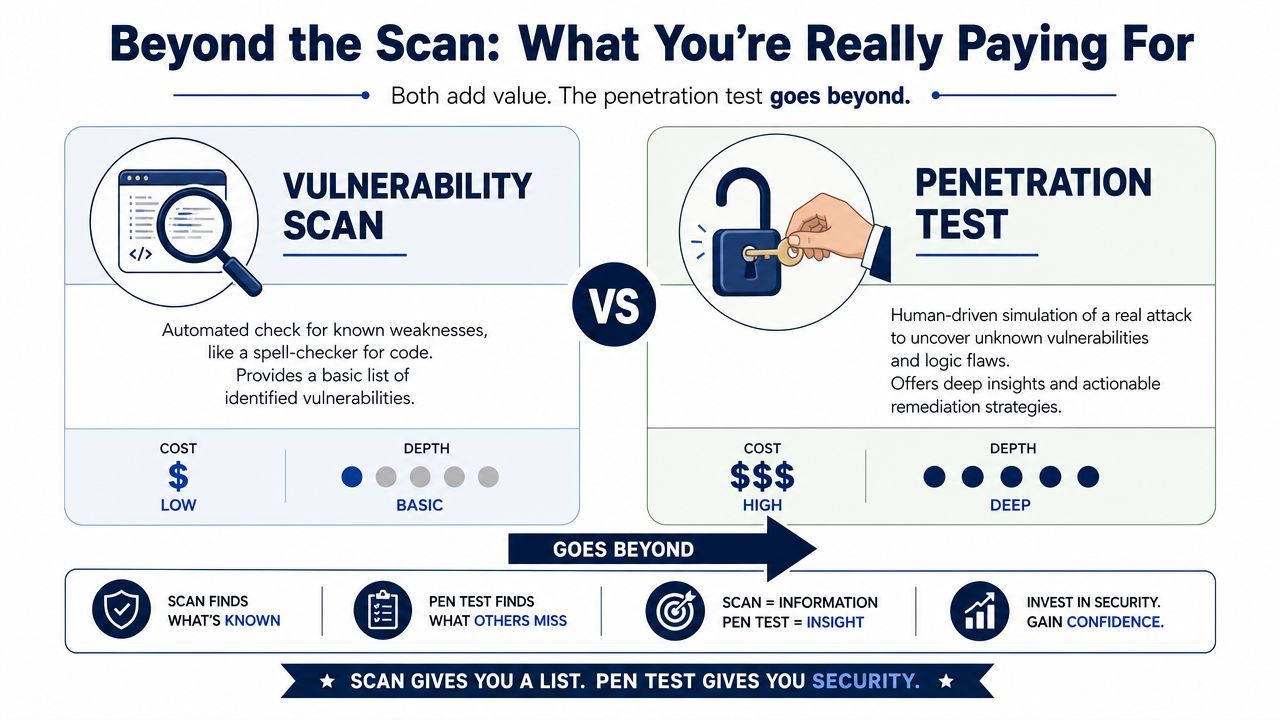
The easiest analogy is this:
That difference is why very cheap offers deserve scrutiny. Offerings below about US$4,000 are often just automated scans, while a genuine manual penetration test that includes human-driven exploit chaining and validation typically costs US$5,000 to US$30,000 for standard scopes, according to VikingCloud's breakdown of penetration testing cost.
A good penetration test doesn't end with a PDF full of red icons and jargon. It should give your team something they can act on. At minimum, expect:
A scanner tells you what might be wrong. A pen test tells you what an attacker could actually do with it.
This is also where many buyers under-scope the engagement. If the goal is client assurance, insurance renewal, or audit support, the report quality matters almost as much as the testing itself. If the report won't stand up in front of an auditor or security-conscious customer, the cheaper quote may not save money.
If you want a broader view of where penetration testing sits beside governance reviews and control validation, this overview of computer security audits is worth reading.
A Toronto company rolls out a new client portal, adds Microsoft 365, moves files into Azure, and assumes it now needs "a pen test." A more pertinent question is narrower and more useful. What are you trying to prove: that internet-facing systems resist opportunistic attacks, that a compromised employee account cannot spread, or that a customer-facing application will stand up to abuse?
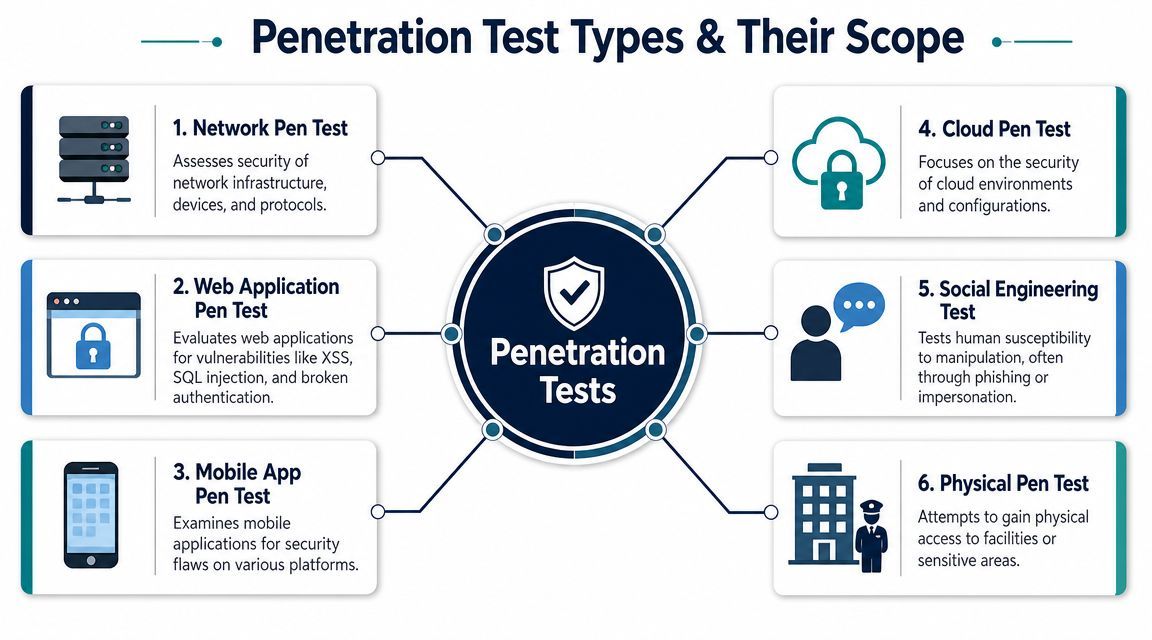
Scope drives cost because each test answers a different business question and requires a different mix of skills.
External network testing checks what an attacker can reach from the public internet. That usually includes firewalls, VPN portals, email gateways, remote desktop exposure, and any public-facing services. For many mid-sized Canadian businesses, this is the first engagement because it gives a quick read on obvious exposure and often supports customer due diligence.
Internal network testing starts from the assumption that someone is already inside. That could be a phished workstation, stolen credentials, or a contractor account with too much access. These tests show whether segmentation, Active Directory controls, privileged access, and monitoring slow an attacker down.
Internal work often takes more effort than buyers expect. Once a tester gets a foothold, the engagement can branch into lateral movement, privilege escalation, and access to finance, HR, or production systems. That added depth is one reason firms such as Coalfire describe internal, cloud, and application testing as more involved than a basic external perimeter review in their penetration testing pricing guide.
For many Canadian SMBs, the highest-risk scope sits in the application layer.
Web application pen tests focus on customer portals, internal line-of-business apps, admin panels, and the APIs behind them. A proper test examines authentication, access control, session handling, business logic, and how different user roles interact. This matters if your company stores personal information, processes payments, or needs to show clients that sensitive data is handled with care under PIPEDA and contractual security terms.
Mobile application tests are relevant if staff or customers use iOS or Android apps to access business systems. The work usually covers the app itself, local data storage, authentication flows, and the backend API. If the mobile app is only a thin front end to a web service, the API may deserve more attention than the interface.
Cloud environment tests look at identity, permissions, storage exposure, network rules, and service configuration in Azure, AWS, or Google Cloud. In practice, many serious cloud findings come from misconfiguration and excessive privileges, not exotic zero-days. That is why a cloud pen test often overlaps with architecture review and identity assessment.
Some scopes are narrower but still worth paying for if they match the risk.
These engagements are not interchangeable. A social engineering exercise will not tell you whether your web app has broken access control, and a network test will not tell you whether a user can pull another customer's records through an API.
If you're trying to map these scopes to resourcing or internal hiring plans, this reference on staffing for penetration tester roles helps explain the skill mix involved.
For buyers, the practical step is to define the scenario before asking for quotes. "Test our security" is too vague. "Test our external perimeter and our customer portal used by Canadian clients" is scoping language a provider can price properly. If you want a clearer view of how providers package these options, CloudOrbis explains common penetration test services in plain terms.
In Canada, pen test cost is often built from tester-days, not just a flat package fee. That changes how you should evaluate quotes.
Canadian providers commonly quote around C$600 to C$3,000+ per day, and total cost scales with the number of days needed for scoping, manual testing, exploit validation, reporting, and retesting, according to this guide to understanding penetration testing costs.
You'll usually see one of three structures.
This is the most transparent model for custom scopes. It works well when the number of systems, user roles, or environments is still being clarified.
The downside is that weak scoping can produce budget creep. If the target list grows halfway through the engagement, the invoice usually grows with it.
This suits a clearly defined test, such as one external perimeter or one web application. Procurement teams like it because the budget is easier to approve.
The risk is hidden assumptions. If the proposal says “one application” but your platform has multiple roles, integrations, and separate environments, the scope may not reflect reality.
Some organisations want recurring testing and retesting across the year. That can make sense when applications change often or when multiple compliance deadlines drive repeated assurance work.
The table below is a planning aid, not a rate card. It uses the verified Canadian day-rate model and duration patterns rather than invented package pricing.
| Test Type | Typical Scope | Estimated Budget (CAD) |
|---|---|---|
| Focused external test | Small internet-facing scope, 1 to 3 days | Approximately C$600 to C$9,000+ |
| Internal network assessment | Multi-system internal scope, more than a week possible | Approximately C$4,200 to C$21,000+ and higher with retesting |
| Web, cloud, or API assessment | Complexity-driven scope, often several tester-days | Commonly lands in the low five-figure range depending on effort |
| Standard commercial engagement | Defined SMB scope with manual testing | Often aligns with US$10,000 to US$35,000 before Canadian conversion and taxes |
A quote can look reasonable until local realities are added. Currency conversion, tax treatment, procurement cycles, and compliance reporting all affect the final number your business approves.
If your company already bundles cybersecurity with broader outsourced operations, it helps to compare pentest spending against your wider IT model. This guide to managed IT services in Canada is useful context when deciding whether testing should remain ad hoc or move into a recurring security budget.
Two firms can both quote for a penetration test, and one comes in at C$7,500 while the other lands above C$20,000. In practice, that usually means they are pricing different levels of effort, different reporting standards, or a different understanding of your environment.
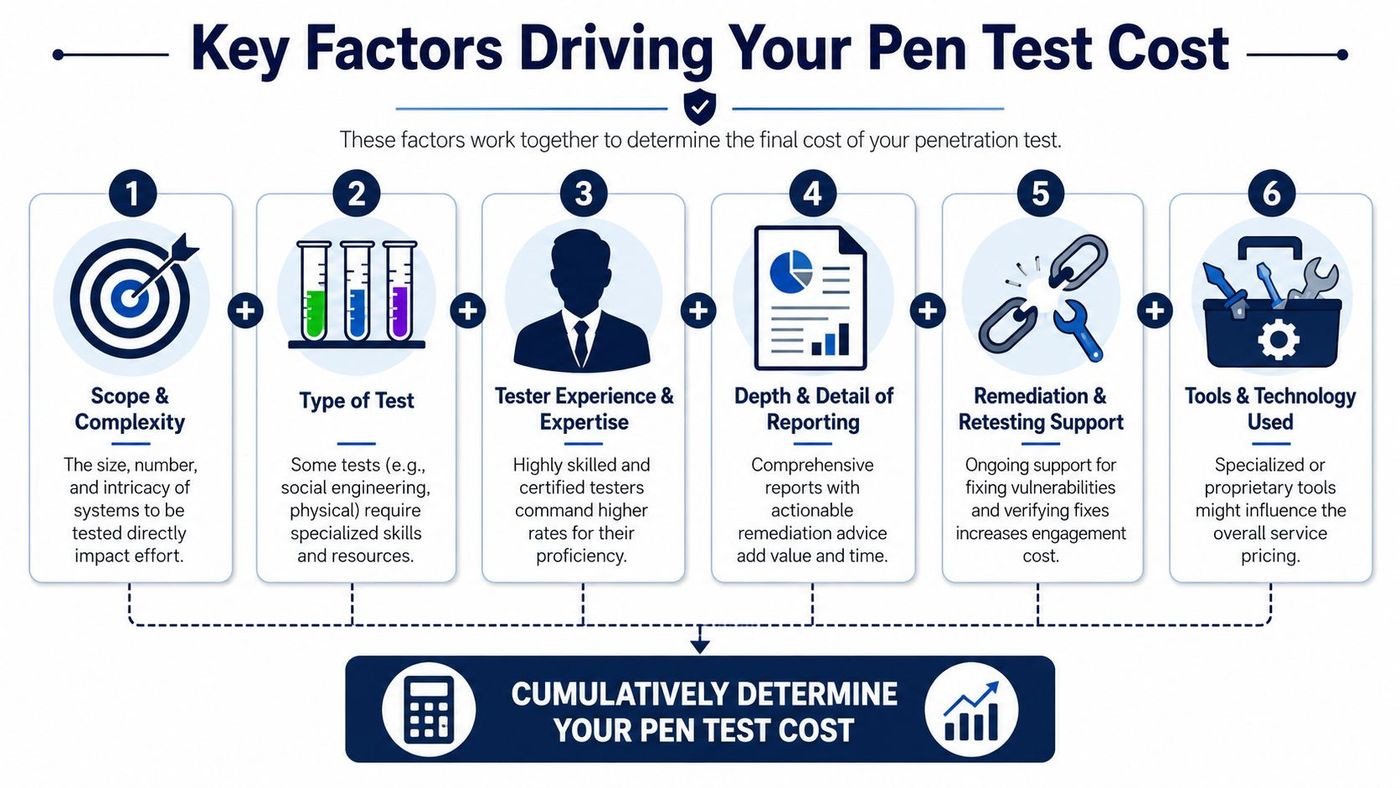
The final number rises or falls based on how much manual work the testers need to do. Automated scanning affects cost, but it rarely explains the quote on its own. The expensive part is the human work: validating findings, chaining weaknesses together, writing a report your IT team can act on, and producing evidence a client, insurer, or auditor will accept. That is the difference between a checkbox exercise and a real security assessment.
For Canadian SMBs, there is another layer. The same scope can price differently depending on whether the provider bills in CAD or USD, whether provincial sales tax applies, and whether your engagement needs reporting that supports PIPEDA, contractual security reviews, or insurer questionnaires. If you are comparing providers, compare the actual deliverable, not just the day count.
More assets mean more testing time. That includes public IPs, web apps, APIs, cloud tenants, user roles, and internal segments.
The detail that matters is not just quantity. It is whether those assets are distinct enough to require separate testing paths. Ten similar marketing microsites are different from one ERP environment, one customer portal, and one Azure estate with multiple privilege levels.
Complexity pushes cost up faster than asset count. A small environment with SSO, hybrid identity, VPN access, conditional access rules, and third-party integrations often takes more tester time than a larger but simpler setup.
Often, buyers are surprised. A provider may price a “small scope” low at first, then revise the quote once they see cloud dependencies, staging environments, or role-based workflows that need manual verification.
Different test types produce different labour profiles. External perimeter work can be fairly contained. Internal network testing often takes longer because privilege escalation, lateral movement, and validation across multiple systems are more time-intensive. Web application, API, cloud, and mobile assessments also tend to cost more because business logic and authentication flows must be examined by hand.
If you are still deciding what kind of engagement fits your risk profile, this overview of cyber security services for Canadian businesses helps frame where penetration testing sits within a broader security program.
Reporting changes the price more than many buyers expect. A short technical summary is cheaper than a report with executive language, reproducible evidence, remediation guidance, risk ranking, and a retest letter.
That matters for mid-sized Canadian businesses dealing with procurement reviews, customer due diligence, or regulated data handling. A weak report creates extra internal work. Your IT lead has to interpret vague findings, your compliance contact has to chase clarification, and your leadership team still lacks a clean record of what was tested and what risk remains.
Low-cost testing often breaks down at the reporting stage. The testing may be acceptable, but the final deliverable is too thin to support audit, remediation tracking, or client assurance.
Some of the biggest price swings come from details buried in the statement of work:
I often see companies compare the fee without comparing the assurance outcome. The same problem shows up in adjacent security projects. This guide to understanding Cyber Essentials expenses is a useful example of how scope, documentation, and validation change the actual cost once requirements are defined properly.
The best way to control pen test cost isn't to negotiate aggressively at the end. It's to buy cleanly at the start.
A well-scoped engagement with the right provider usually costs less in practice than a vague, low-priced proposal that expands once testing begins.
When reviewing quotes, ask direct questions:
Good preparation reduces wasted tester time. In a day-rate model, that matters.
A business should have the following ready before kickoff:
Preparation is one of the few levers you control directly. Better prep usually means less wasted effort, fewer delays, and a cleaner final bill.
If you want a benchmark for what a broader managed security relationship can include around testing, incident support, and ongoing risk reduction, CloudOrbis describes that model on its cyber security service page. CloudOrbis Inc. is one option among MSP and security providers that package penetration testing into a wider operational security programme.
The phrase “pen test cost” sounds like a procurement question. In practice, it's a risk management question.
A penetration test is valuable when it helps your business answer one of three things clearly. Can an attacker get in, can they move where they shouldn't, and can your team prove due diligence to the people who matter. That might be customers, insurers, auditors, or your own leadership team.
The cheapest quote usually wins only when the buyer treats the test as paperwork. That approach often leads to shallow coverage, weak reporting, or a scan being sold as a manual assessment. A better buying standard is this: pay for the scope, methodology, and evidence your business needs.
For Canadian organisations, the budgeting process also needs to reflect reality. U.S. benchmarks are useful reference points, but they don't tell you the full landed cost once conversion, tax, and compliance overhead enter the picture. The right budget is the one tied to your environment, your obligations, and your risk tolerance.
A strong pen test doesn't just identify technical flaws. It gives leaders a basis for action.
If you need help defining scope before you request quotes, CloudOrbis Inc. can help you assess your environment, identify the right type of penetration test, and align the work with your compliance, risk, and budget priorities in Canada.
Book a 30-minute call with a senior engineer. No sales script, just straight answers about your environment.


