Penetration Test Services for Medium-Sized Businesses
Discover how penetration test services uncover critical security risks. This guide explains the process, benefits, and how to choose the right partner.

Discover how penetration test services uncover critical security risks. This guide explains the process, benefits, and how to choose the right partner.

Penetration test services are a proactive method for assessing your cybersecurity by having ethical hackers simulate a real-world cyberattack on your company's systems. The objective is to find and exploit vulnerabilities before a malicious actor does. Think of it as a controlled, authorized attack designed to test your defences and provide a clear, honest picture of your security posture.

Picture your business’s digital infrastructure, your networks, applications, and cloud services, as a high-security facility. You have locks (firewalls), alarm systems (intrusion detection), and security personnel (your IT team). On paper, it all looks solid. But how can you be certain a clever intruder could not find a way past these measures?
This is precisely where penetration test services, often called "pen tests", come into play. Instead of simply trusting that your security measures should work, a pen test subjects them to a real-world trial. Certified security professionals use the same techniques and tools as actual attackers to identify weak spots and demonstrate exactly how they could be exploited.
Automated vulnerability scanners are useful for identifying common issues, such as unpatched software or frequent configuration errors. They are quick and can scan a broad area. However, they lack the creativity, intuition, and adaptive problem-solving of a human attacker.
A key distinction is that automated scans find potential weaknesses, while a penetration test demonstrates actual, exploitable risk. A human tester can chain together multiple low-risk vulnerabilities to create a high-impact breach, something a scanner cannot do.
This human-driven approach is what makes a security assessment truly meaningful. Ethical hackers can:
Ultimately, penetration testing is not just about finding flaws; it is about managing risk. It answers the critical questions that business and IT leaders must ask: How well would we withstand a genuine attack? Where are our most significant security gaps? What is the real-world damage if these vulnerabilities are exploited?
By simulating an attack in a controlled environment, you gain actionable insights that help you prioritize your security investments and strengthen your defences. For Canadian businesses, adopting this proactive approach is a critical first step. To build a stronger security foundation, you can learn more about what cybersecurity entails in our detailed guide. This mindset transforms security from a reactive task into a strategic business advantage that protects your data, reputation, and bottom line.
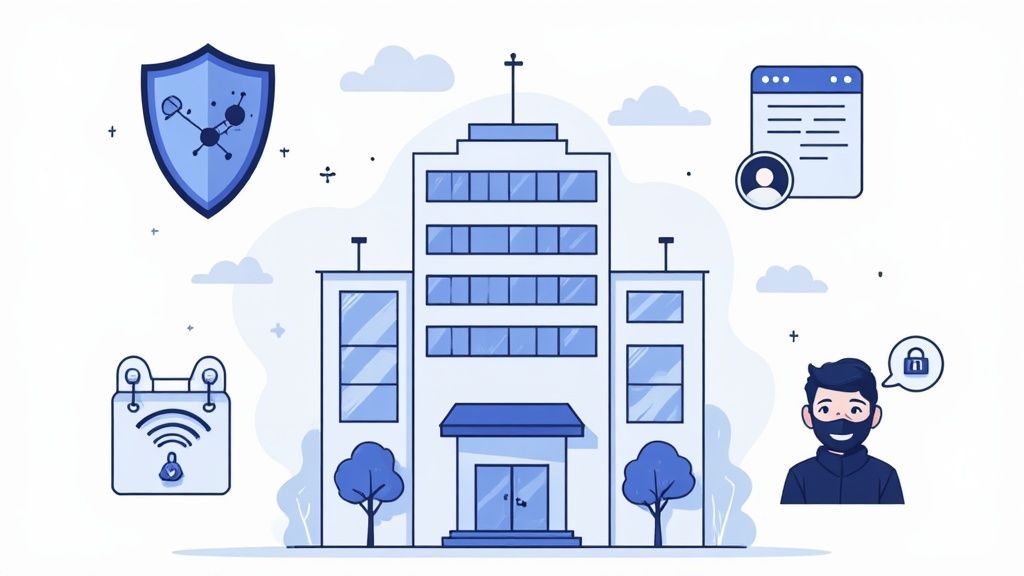
Recognizing the need for a penetration test is the first step. The next, more critical one, is determining which type of test your business requires. Much like a doctor who prescribes specific treatments for different illnesses, security experts use various testing methods to target specific areas of your digital operations, each designed to answer a different question about your security posture.
Choosing the right penetration test services ensures your security budget is allocated where it will have the greatest impact. Let's explore the most common types, using scenarios relevant to any medium-sized Canadian business. This will help you identify where your own organization might be most exposed.
Consider your network the digital backbone of your company, it encompasses all the servers, firewalls, routers, and workstations that keep your operations running. Network penetration tests focus on this IT infrastructure and are typically divided into two types to mimic different kinds of attackers.
If your business has an online presence, whether a simple marketing website, an e-commerce store, or a complex customer portal, your web applications are a prime target for attackers. A web application test delves deep into the code and business logic of these platforms, searching for flaws that could lead to a significant data breach.
This type of testing is vital because standard network scans often miss application-specific weaknesses like SQL injection or cross-site scripting (XSS). With the proliferation of online platforms, web application testing now commands the largest share (around 36%) of the penetration testing market. A thorough test can be the difference between a secure online experience for your customers and a devastating data leak. You can find more details on this trend in a market analysis by Technavio.
Wireless networks offer incredible convenience, but they also introduce unique security vulnerabilities if not configured correctly. A wireless security assessment examines your Wi-Fi environment, looking for weaknesses that could allow an attacker to gain access to your internal corporate network.
Testers will check for weak encryption, poorly secured access points, or "rogue" devices that employees may have connected without IT's knowledge. A successful breach here could give an attacker in your parking lot the same level of network access as an employee at their desk.
Often, the weakest link in any security chain is not a piece of technology, it is a person. Social engineering tests are designed to assess how well your team withstands the manipulation tactics used by real-world attackers.
These campaigns can take several forms:
This type of test provides invaluable, real-world feedback on the effectiveness of your security awareness training.
To help you visualize how these services compare, here is a brief overview.
| Testing Type | Primary Target | Example Vulnerability Found |
|---|---|---|
| External Network | Internet-facing systems (firewalls, servers) | Unpatched software on a public web server |
| Internal Network | Internal IT infrastructure | Weak password policies allowing privilege escalation |
| Web Application | Custom web/mobile apps, APIs | SQL injection flaw allowing database access |
| Wireless Network | Corporate Wi-Fi infrastructure | Weak WPA2 password that can be easily cracked |
| Social Engineering | Employees, staff, and contractors | An employee clicking a link in a phishing email |
By understanding these different attack vectors, you can select the right combination of services to build a defence that is both deep and wide. To see how these tests fit into a broader strategy, review our guide on comprehensive cyber security services.
For many business leaders, cybersecurity can feel like a necessary expense with no obvious return. However, viewing penetration test services this way overlooks the broader picture. Proactive security testing is not just about fixing technical flaws; it is a strategic investment in your business's continuity, reputation, and long-term financial health.
Instead of seeing it as a cost, consider it a form of insurance that actively lowers your risk profile. By identifying and remedying vulnerabilities before an attacker can, you avoid the staggering costs associated with a real data breach. These expenses extend beyond technical fixes to include regulatory fines, legal fees, customer notification costs, and often-irreversible brand damage.
When you weigh the manageable, predictable cost of a penetration test against the chaotic, potentially ruinous expense of a security incident, the return on investment becomes clear. It is the difference between a controlled fire drill and a real five-alarm fire.
A security breach erodes your most valuable asset: customer trust. When customers provide their data, they do so with the expectation that you will protect it. A breach shatters that trust instantly, often driving clients to your competitors and making it incredibly difficult to attract new ones.
Proactive testing is a tangible way to demonstrate your commitment to security. It sends a clear message to your clients, partners, and stakeholders that you take your data protection responsibilities seriously. This commitment not only helps you retain existing customers but also becomes a powerful selling point in a competitive market. In a world where security is a primary concern, proving your resilience is a significant business advantage.
For Canadian businesses, regulatory compliance is not optional. Frameworks like the Personal Information Protection and Electronic Documents Act (PIPEDA) and industry-specific standards such as SOC 2 require organizations to demonstrate they are taking diligent steps to protect sensitive information. Regular security testing is a fundamental component of meeting these obligations.
A penetration test provides auditable proof that your organization is actively assessing and managing its security risks. This documentation is invaluable during audits and can significantly mitigate liability in the event of an incident.
Failure to meet these standards can lead to severe penalties and legal complications. Penetration testing helps you:
This proactive approach turns compliance from a stressful obligation into a streamlined, integrated part of your security strategy.
Ultimately, the business case for penetration testing comes down to a straightforward risk calculation. The proactive investment is minimal compared to the potential reactive costs. The growing demand for these services indicates that businesses are recognizing this. In 2025, the North American penetration testing market is projected to command over a 40% share of the global market, with an estimated size of around USD 689 million. You can find more details on this market growth in a report from Cognitive Market Research.
For those looking to build security into their operations from the ground up, understanding how to go about implementing DevSecOps in your CI/CD pipeline is a crucial next step. By simulating real-world attacks, you gain invaluable insights into where you are truly exposed, allowing you to allocate security resources where they will be most effective. To better understand the threats you face, read our breakdown of the top cybersecurity threats facing SMBs. This knowledge empowers you to make informed, data-driven decisions that strengthen your defences and protect your bottom line.
Knowing you need a penetration test is one thing; understanding what happens when the experts arrive is another. It is not a mysterious, cloak-and-dagger operation where hackers simply start breaking things. A professional pen test is a highly structured, collaborative process designed to provide maximum insight with minimal disruption to your business.
Think of it as a partnership. We work with you to safely uncover risks, not to cause chaos. The entire process is a controlled simulation that delivers clear, actionable intelligence. Let's walk through the typical phases so you know exactly what to expect.
This is the most crucial stage. If done correctly, the rest of the engagement will deliver real value. Before any testing begins, we sit down with you to define the rules of engagement. This is not just a technical conversation; it is a strategic discussion to ensure the test aligns with your business goals.
During this phase, we answer key questions to establish a clear scope:
Consider this phase as drawing a detailed map and agreeing on the rules before the game begins. This clarity ensures there are no surprises and that the final report is directly relevant to your priorities.
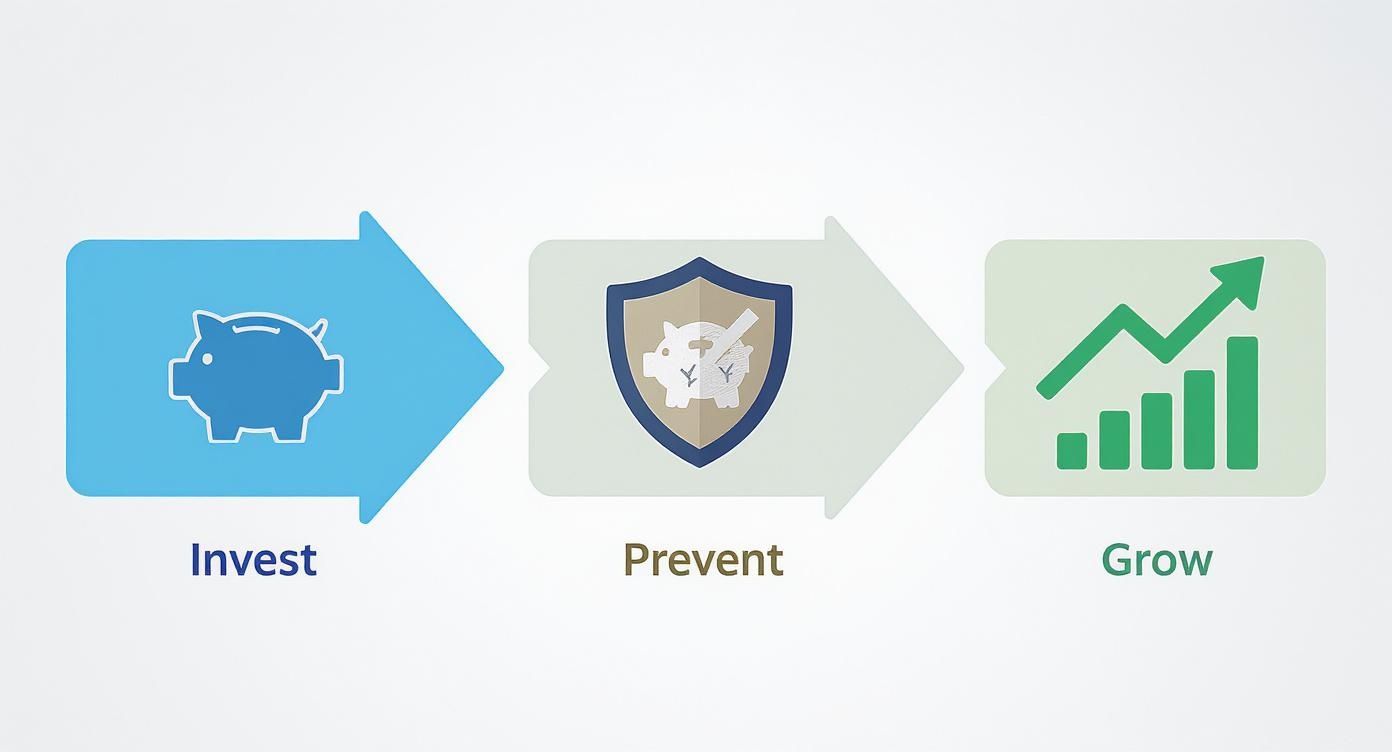
This structured approach is an investment in your company's security. It's a proactive step that prevents costly incidents and, in turn, helps fuel sustainable growth.
With a solid plan in place, our ethical hackers begin their work. The process starts with reconnaissance, where our team gathers as much public information about your organization as possible, just as a real attacker would. This can involve finding employee names from social media, identifying the technologies you use, and mapping your network from the outside to spot potential entry points.
Next is the exploitation phase. This is the active, hands-on testing. Using the intelligence they have gathered, our security experts will carefully attempt to exploit the vulnerabilities they have found. It is a methodical process designed to confirm if a potential weakness is a genuine, exploitable risk to your business.
The goal is not to cause damage; it is to demonstrate impact. A successful exploit proves that a vulnerability is not just a theoretical line in a report. It is a tangible threat that a real attacker could use to steal data or compromise your systems.
Once the testing is complete, the most valuable part of the engagement begins. A good penetration test does not just leave you with a long, confusing document full of technical jargon. It delivers a comprehensive report that translates technical findings into a clear business context. This is the deliverable that empowers you to take action.
A strong report is always broken down into two key sections:
This final report is what transforms the test from a simple security audit into a strategic tool. It gives your leadership the "why" they need to understand the risks and your technical team the "how" they need to strengthen your defences.
Selecting the right security partner is perhaps the most important decision you will make in strengthening your company’s defences. The firm you choose will determine whether you receive a generic, checkbox-style audit or a genuine, in-depth analysis that actually improves your security. A true partner does more than just find vulnerabilities; they provide the context and clear guidance needed to resolve them effectively.
This is a decision an increasing number of Canadian businesses are facing. Market data shows that around 32% of organizations now perform penetration tests at least annually or bi-annually. Furthermore, over half (51%) of them outsource these critical services to specialized third-party providers. This trend is not surprising, it highlights how much businesses rely on expert firms to meet today's demanding security standards. You can find more insights on the penetration testing market on Fortune Business Insights.
The goal is to find a provider that feels like an extension of your own team, a partner genuinely invested in your long-term security, not just a one-time project.
When evaluating potential vendors, start with the fundamentals. A reputable firm should have no trouble demonstrating its expertise through its team's qualifications and a solid track record of successful projects.
Look for industry-recognized certifications among their ethical hackers. Credentials such as the Offensive Security Certified Professional (OSCP) or CREST Registered Penetration Tester are not just acronyms. They represent rigorous, hands-on qualifications that prove a tester has advanced skills and a commitment to a high standard of technical excellence.
Equally important is their experience in your specific industry. A firm that understands the nuances of healthcare compliance in Ontario or the operational technologies in a manufacturing plant will provide far more relevant insights than a generalist. Do not hesitate to ask for case studies or references from businesses similar to yours to ensure they have practical, relevant experience.
A professional penetration testing partner will never treat their process as a trade secret. They should be able to walk you through their entire methodology with clarity and confidence, from the initial scoping call to the final report. This transparency is the mark of a mature, trustworthy provider.
A solid methodology should clearly outline:
If a potential vendor is vague about their process or cannot explain it in terms a business leader can understand, that is a significant red flag. A lack of clarity often indicates an over-reliance on automated tools and a lack of genuine, human-led expertise.
Knowing what to look for is important, but knowing what to avoid is critical. Some firms offer "pen tests" that are little more than a basic automated scan. These services can create a dangerous false sense of security, leaving you exposed while you believe you are protected.
Be cautious of any firm that focuses heavily on speed and low cost over depth and expertise. A quality penetration test is a meticulous, human-driven effort that cannot be replicated by software alone. The value comes from the expert analysis, not the automated output.
To help you identify low-value providers, we have compiled a simple checklist to use during your evaluation.
Choosing a partner requires careful vetting. This table provides a framework to help you compare potential vendors and spot any warning signs before you commit.
| Evaluation Criterion | What to Look For | Potential Red Flag |
|---|---|---|
| Methodology | A clear, multi-phased approach combining manual and automated testing. | Vague or "proprietary" processes that rely entirely on automated scanners. |
| Reporting | Sample reports with an executive summary and detailed, actionable technical findings. | Generic, unprioritized lists of vulnerabilities with no business context. |
| Certifications | Testers hold respected certifications like OSCP, CREST, or CEH. | The company is certified, but individual testers are not. |
| Experience | Proven track record in your industry with relevant case studies. | A one-size-fits-all approach with no specialized industry knowledge. |
Ultimately, this decision comes down to finding a team that truly aligns with your security goals. They should provide a clear roadmap for improvement, not just a list of problems. This strategic approach is central to building a robust defence, a topic we cover more broadly in our guide to choosing a cyber security service.
Knowing you need a penetration test is the first step; taking decisive action is what truly secures your business. In today's threat landscape, a proactive approach to security is not just an option; it is a fundamental business necessity. At CloudOrbis, we do not view penetration testing as a one-off audit. We see it as a cornerstone of an ongoing security partnership.
Our approach is designed for the realities that Canadian medium-sized businesses face. We know you need more than a dense report filled with technical jargon. You need a clear, prioritized plan that fits your team's capacity and your budget. This is why our process goes far beyond simple automated scans to provide you with real, actionable intelligence you can use.
Our goal is simple: to become an extension of your team. We do not just deliver a report and disappear. We remain available to provide the guidance and expertise you need to understand the findings and implement effective, lasting changes. It is this partnership model that ensures your security posture genuinely improves over the long term.
Our certified experts deliver:
At CloudOrbis, we believe effective security is a continuous journey, not a destination. Our partnership-driven penetration test services provide the clarity and support you need to navigate that journey with confidence.
We offer a full suite of cybersecurity services designed to protect your entire organization. Our commitment is to provide the strategic insight that transforms your security from a reactive defence into a proactive business advantage.
Protecting your organization's future starts with understanding your current risks. Let's work together to build a more secure foundation for your business.
Schedule a consultation with our security experts today. We can discuss your unique challenges and show you how CloudOrbis can help safeguard your most critical assets.
When investigating penetration testing services, most business and IT leaders have a few practical questions. Getting clear, straightforward answers is the first step to making an informed decision that genuinely improves your company's security. Here are the most common questions we hear, with answers based on years of experience.
This is arguably the most important distinction to understand. Think of a vulnerability scan as a security guard walking the perimeter and checking if all doors and windows are locked. It is an automated process that quickly flags potential weak spots, like outdated software or simple misconfigurations, by comparing your systems against a vast list of known issues. It is fast and provides a good baseline.
A penetration test, on the other hand, is like hiring a security expert to actually try to break in. A human tester will not just find an unlocked window; they will attempt to climb through it, see what they can access once inside, and determine the real-world damage a skilled intruder could cause.
A scan gives you a list of potential problems. A pen test delivers proof of exploitable risk and shows you exactly how a real attacker could harm your business.
There is no single magic number; the right frequency depends on your business. That said, a good rule of thumb for most organizations is to conduct a professional pen test at least once a year.
You should consider testing more frequently if your organization:
Penetration testing is not an off-the-shelf product, so the cost can vary considerably. The investment is directly tied to the scope and complexity of the engagement. Think of it like hiring a contractor to inspect a building, a small retail shop will cost less to inspect than a massive warehouse.
Key factors that influence the price include the number of applications or IP addresses in scope, the depth of the testing required, and the overall size of your digital footprint. A basic external network test for a small office will naturally cost less than a deep-dive assessment of a complex e-commerce platform that demands intensive manual analysis.
This is precisely why we begin with a consultation. It allows us to properly define the scope and provide you with an accurate quote that aligns perfectly with your security goals and budget.
At CloudOrbis Inc., we believe in building security partnerships, not just delivering reports. Our experts provide the clarity and guidance you need to turn security insights into meaningful action. Protect your business with our tailored cybersecurity solutions.
Book a 30-minute call with a senior engineer. No sales script, just straight answers about your environment.


