RTO Meaning in Work: A Guide for Modern Businesses
Uncover the RTO meaning in work. Our guide clarifies Return to Office and Recovery Time Objective with practical strategies for Canadian business leaders.

Uncover the RTO meaning in work. Our guide clarifies Return to Office and Recovery Time Objective with practical strategies for Canadian business leaders.
When you hear leaders discussing RTO, the conversation can quickly become confusing. That’s because the RTO meaning in work isn’t a single concept. It refers to two completely different, yet equally critical, business priorities.
One focuses on your people; the other focuses on your technology.
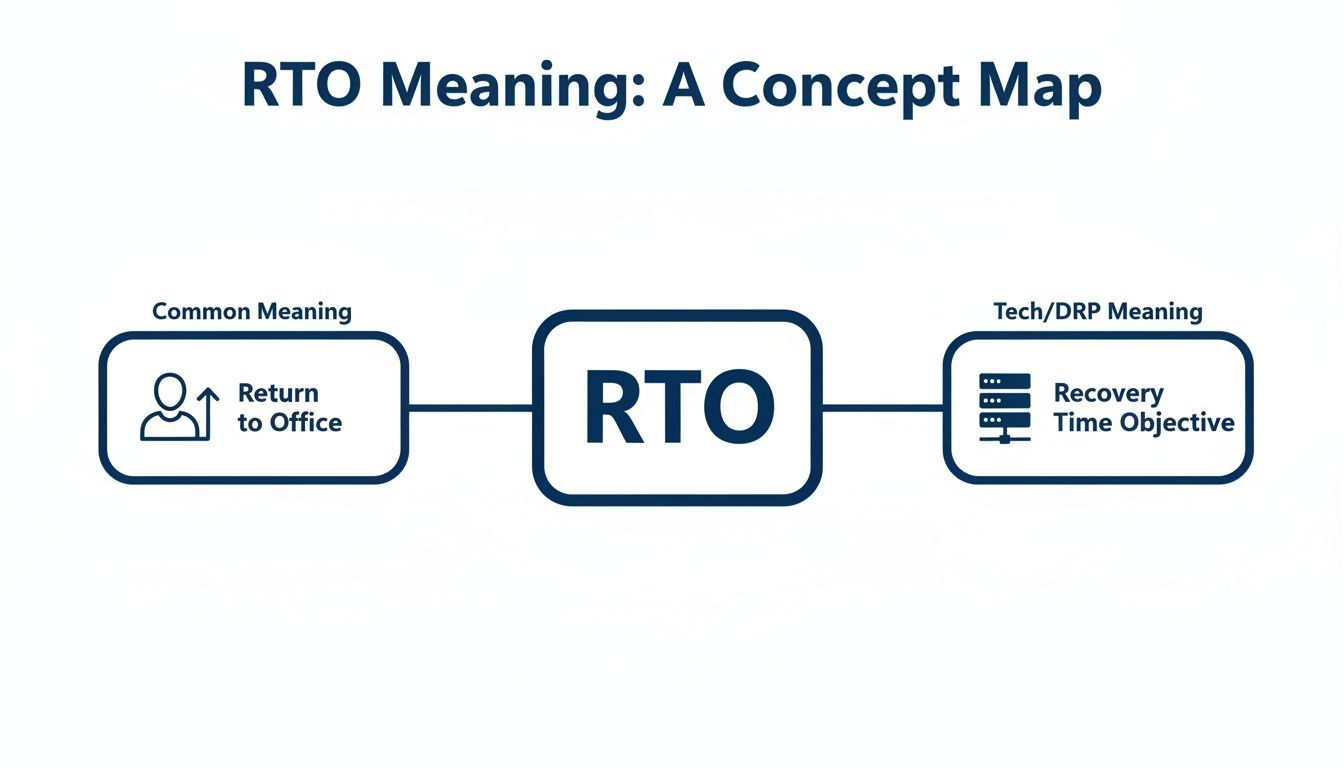
Confusing them can create significant blind spots in your strategy. Let's clarify the distinction so you can ensure your Canadian business is covered on both fronts.
The first meaning, Return to Office, is a strategic workplace policy. It outlines the plan for bringing employees back to a physical office after a period of remote or hybrid work.
This isn’t just about unlocking the doors. It’s a comprehensive plan that affects company culture, collaboration, and how your teams will work together. For instance, some government and corporate entities have mandated a return to the office, showing just how significant this shift is for many organizations.
The second meaning, Recovery Time Objective, is a core metric in your IT strategy. It defines the maximum acceptable time your business can tolerate a system being down after a failure or disaster. Think of it as a deadline for your IT team to restore operations.
This RTO is all about operational resilience and is a fundamental piece of any solid business continuity and disaster recovery plan. If your customer database goes down, is it acceptable for it to be offline for five minutes, or five hours? Your Recovery Time Objective determines that threshold.
To make the distinction crystal clear, here’s a quick side-by-side comparison.
| Aspect | RTO (Return to Office) | RTO (Recovery Time Objective) |
|---|---|---|
| Focus | People, culture, and workplace logistics | Technology, systems, and operational uptime |
| Primary Goal | Enhance collaboration, productivity, and company culture | Minimize business disruption and data loss after an incident |
| Measured In | Days per week in the office, employee attendance rates | Time (minutes, hours) |
| Key Question | "How and when will our employees work from the office?" | "How quickly must our critical systems be restored after a failure?" |
| Owner | HR, Executive Leadership, Operations | IT Department, CTO/CIO |
As you can see, while both use the same acronym, their goals and the business areas they impact are worlds apart. Understanding both is essential for building a truly resilient and well-run organization.
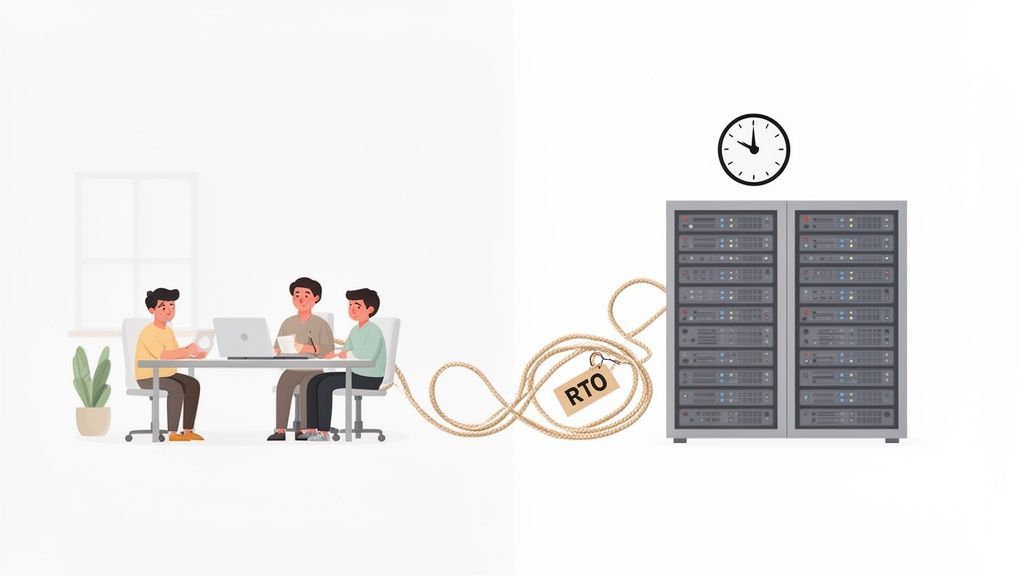
When people discuss the RTO meaning in work, they are often referring to the human side of the equation: Return to Office. This is not just about reopening the office; it is a strategic move to reshape your company's future by bringing your team back together.
For many Canadian businesses, the primary goal is to recapture the spontaneous collaboration and creative energy that flourishes when people share a physical space. Those "water cooler" moments often spark the next big idea.
A well-crafted RTO strategy makes the office a destination for connection and mentorship, not just a place to work. It’s a tool for strengthening your culture.
To get the best of both worlds, companies are exploring hybrid models, like a three-days-in-office week, to balance in-person connection with the flexibility employees have come to value. At the same time, the rise of fully remote-first jobs has completely changed the talent landscape, compelling businesses to define what their workplace truly offers.
Making this shift work requires clear goals and a genuine commitment to supporting your team through the transition. This means having a rock-solid IT framework so everyone can work effectively, whether at home or in the office. This is where a clear Bring Your Own Device (BYOD) policy becomes absolutely critical.

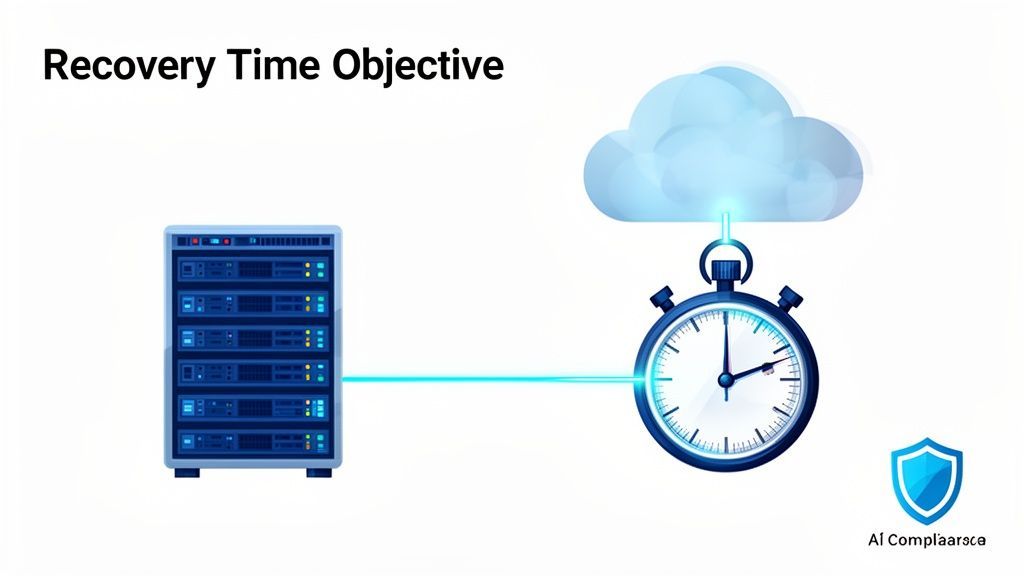
Now, let's switch gears to the other crucial RTO meaning in work: Recovery Time Objective. This is not about office schedules; it is the technical lifeline that keeps your business running when disaster strikes. Think of it as a promise to your customers, partners, and team about how resilient your operations truly are.
Here’s a simple way to look at it: if your e-commerce site goes down, how fast do you need it back online? Is the goal a few minutes, or can you survive a few days? That specific, targeted timeframe is your Recovery Time Objective. You arrive at this number by identifying which systems are essential for survival and balancing recovery speed with your budget.
Your Recovery Time Objective is not about how much data you can stand to lose. It is about how much downtime your business can afford before it causes serious damage.
This metric is a critical piece of the puzzle for any modern business. For those in tightly regulated sectors like healthcare or finance, where uptime can be a legal requirement, it is absolutely non-negotiable. Building a solid strategy around your RTO takes careful planning, which is why our IT disaster recovery plan template is an excellent place to start.
The two faces of RTO manifest very differently depending on your industry. For any Canadian business, juggling the human side (Return to Office) and the technical side (Recovery Time Objective) is a constant balancing act.
What’s a critical priority for one sector might be a minor concern for another. Let’s break it down with a few examples.
As you can see, both kinds of RTO planning are essential. Building a solid plan for business continuity in Alberta or anywhere else in Canada means preparing for disruptions to both your people and your technology.
Let's move from theory to action. Understanding the two meanings of RTO is one thing, but building a solid strategy around them is another. This is where we create a concrete plan, covering both your people and your technology.
As leaders navigate bringing teams back to the office, getting the approach right is essential. A successful transition balances business needs with employee expectations. To achieve this balance, it helps to adopt the Top 8 Best Practices For Hybrid Work, which offer valuable insights for blending in-office and remote work.
Creating a policy that works for everyone is challenging, but achievable with a clear, empathetic process. Start by focusing on what your team needs to thrive.
Now for the other RTO, the one that keeps your business running when disaster strikes. This is about preparing for the worst by knowing exactly how fast you need to get back on your feet.
We know there's a lot to unpack when one acronym has two major meanings. To clarify, here’s a common question we hear from business leaders.
What is a realistic Recovery Time Objective for a small business?
There is no single right answer, it all comes down to the specific system. For less critical tools, like an internal project management board, an RTO of 24 hours might be perfectly acceptable.
However, for your core operations, like your e-commerce platform or payment processing system, every minute of downtime costs you money and customer trust. For those, your RTO should be as low as possible, ideally under four hours. The best approach is to analyze the real-world cost of downtime for each system to set a target that makes sense for your business.
Juggling strategies for both returning to the office and recovering from disaster is a complex balancing act, but you don’t have to figure it out on your own.
CloudOrbis specializes in IT consulting and disaster recovery planning that ensures your business is resilient, protecting both your people and your technology. Let's work together to build a strategy that fits your unique needs.
Book a 30-minute call with a senior engineer. No sales script, just straight answers about your environment.


