A Guide to Business Continuity in Alberta for 2026
Secure your business with our guide to business continuity Alberta. Learn to build a resilient plan against local risks and see how managed IT can protect you.

Secure your business with our guide to business continuity Alberta. Learn to build a resilient plan against local risks and see how managed IT can protect you.
In today's unpredictable world, thinking about business continuity in Alberta is not just a task for the IT department, it's a core survival strategy for any organization. A business continuity plan (BCP) is a proactive strategy that keeps your doors open and your clients served, even when faced with disruptions like supply chain breakdowns or cyberattacks. For medium-sized organizations across Calgary, Edmonton, and beyond, having a solid plan is what separates a resilient business from one forced to close.
Think of a business continuity plan (BCP) as a pilot’s pre-flight checklist, but for your entire organization. Before a plane leaves the ground, the pilot runs through a meticulous check of every critical system. They don’t just glance at the engines; they verify navigation, fuel levels, and communication gear to ensure a safe journey, no matter what turbulence lies ahead. A strong BCP does the same for your business, ensuring every crucial part is ready for disruption.
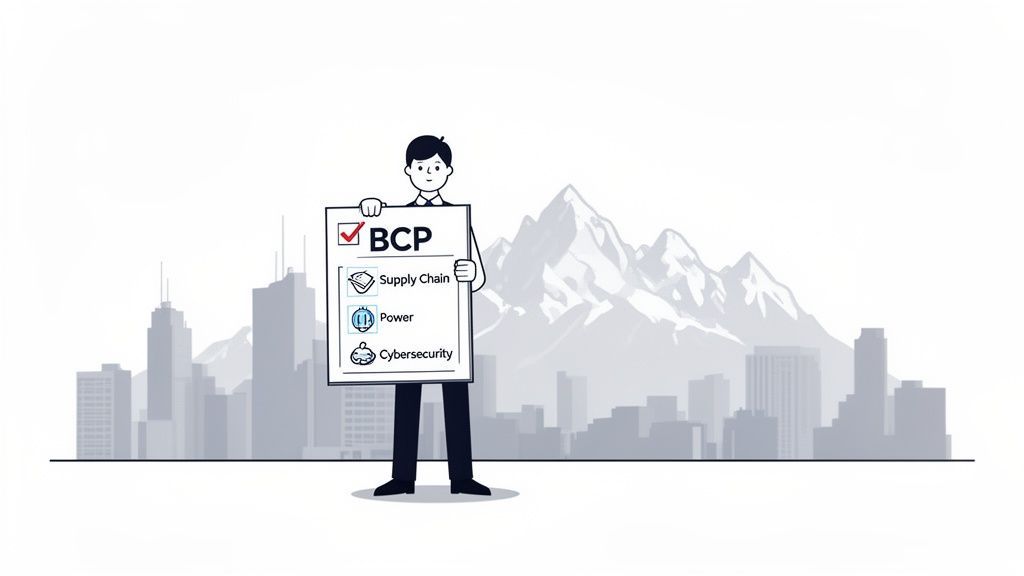
This mindset goes far beyond just your technology. While a disaster recovery (DR) plan is laser-focused on getting your IT systems back online after a failure, business continuity addresses the much bigger question: How do we keep the business running?
This question is particularly vital for organizations in Alberta. Economic swings directly affect our key sectors and all the businesses that support them. For example, during the cooling economy in early 2025, Alberta's manufacturing sector shed roughly 12,000 jobs in the first quarter alone. That kind of market shift sends ripples through logistics, construction, and other dependent industries, making a robust continuity strategy non-negotiable. You can explore the complete economic analysis from the Business Council of Alberta.
A disruption means so much more than lost data. It means lost revenue, a damaged reputation, and broken customer trust. The costs add up quickly, with the national average for a single downtime incident now topping $300,000. And when you realize that 51% of businesses have been hit by a cyberattack, the argument for a proactive defence becomes crystal clear.
A business continuity plan is not about trying to prevent every disaster imaginable. It's about building an organization that can take a hit, whether it’s from an economic downturn, a cyber incident, or a power grid failure, and keep moving forward without catastrophic losses.
Without a plan, your team is left scrambling to find answers in the middle of a crisis:
A BCP answers these tough questions ahead of time, providing a clear roadmap to navigate the chaos. It turns panic into a structured, calm response, protecting your bottom line and the reputation you’ve worked so hard to build.
A generic disaster plan copied from a textbook just won’t work for a business in Alberta. Our province has its own distinct set of interconnected challenges, and building real resilience means understanding the specific threats that define our economic and physical environment. We need to focus on real-world, local risks.
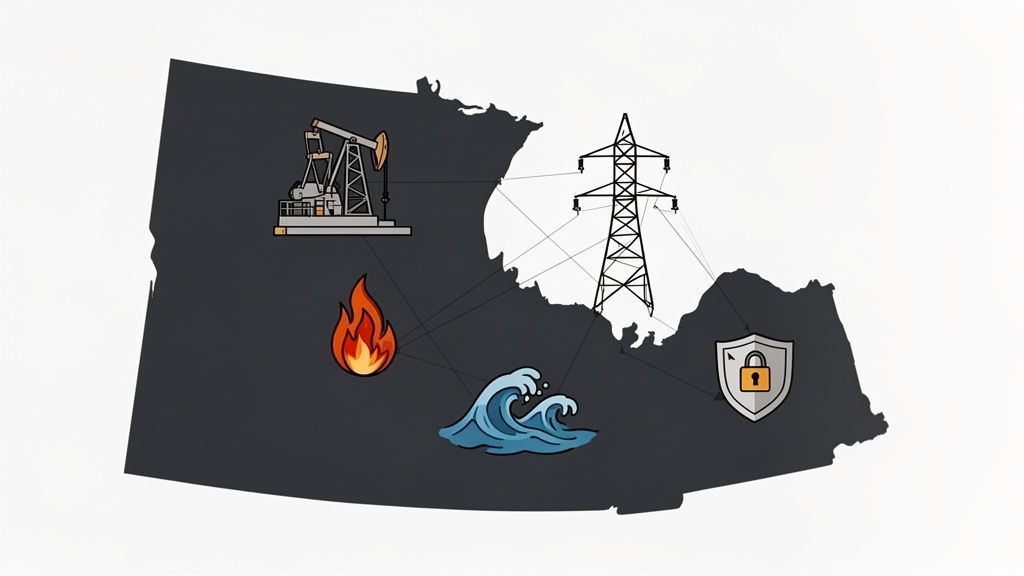
From economic volatility tied to the global energy market to extreme weather events that strain our infrastructure, the risks here are unique. These factors do not exist in a vacuum; they create a domino effect that can disrupt your operations in unexpected ways. A solid business continuity Alberta strategy starts by facing these local realities head-on.
It’s no secret that Alberta's economy is deeply intertwined with the oil and gas industry. When global prices swing, the impact ripples across nearly every sector, from construction and manufacturing to logistics and professional services. This volatility creates a constant undercurrent of uncertainty that can disrupt supply chains, derail project timelines, and change customer demand with almost no warning.
On top of this economic pressure, we must contend with our province's susceptibility to extreme weather. We have all seen firsthand how devastating these events can be.
These environmental disasters are not just one-off incidents. They are becoming more frequent and intense, putting immense strain on the systems we all depend on, especially our electrical grid.
Your business cannot run without power, and Alberta's grid is facing serious challenges. The Alberta Electric System Operator (AESO) has been sounding the alarm on mounting reliability risks. A key problem is declining "system inertia," which is the grid's ability to handle sudden changes in electrical frequency without failing.
This technical issue is a direct threat to your operational uptime. It is a massive concern for energy-hungry sectors like oil and gas, manufacturing, and construction. You can dig into the specifics by reading the AESO's full report on Alberta's 2025 emerging reliability risks.
A sudden power outage is not just an inconvenience; it can halt production lines, corrupt data, and disable security systems. For businesses in Alberta, grid stability is a core component of business continuity that cannot be overlooked.
This fragility creates a perfect storm when mixed with economic pressures and extreme weather. A wildfire could easily damage transmission lines, while an economic downturn might delay desperately needed infrastructure upgrades. These physical and economic threats also open the door to a dangerous digital consequence.
When a community is grappling with a physical crisis like a flood or a widespread blackout, cybercriminals see an opportunity. They exploit the chaos, knowing that your team is distracted and emergency protocols might create security gaps.
This is precisely why a strong business continuity Alberta plan must integrate both physical and digital defences. If you're looking to reinforce your digital resilience, our article on managed cybersecurity services in Alberta may be helpful. Ultimately, understanding this complex web of risks is the first step toward building a plan that will protect your business when it matters most.
Knowing the general risks facing Alberta is one thing, but a truly solid business continuity plan must be specific. After all, the day-to-day realities for a healthcare clinic in Calgary are worlds apart from an oil and gas operation near Fort McMurray. A generic, one-size-fits-all strategy is an expensive document that will fail when you need it most.
Building real resilience means tailoring your plan to protect what matters to your business, in your sector.
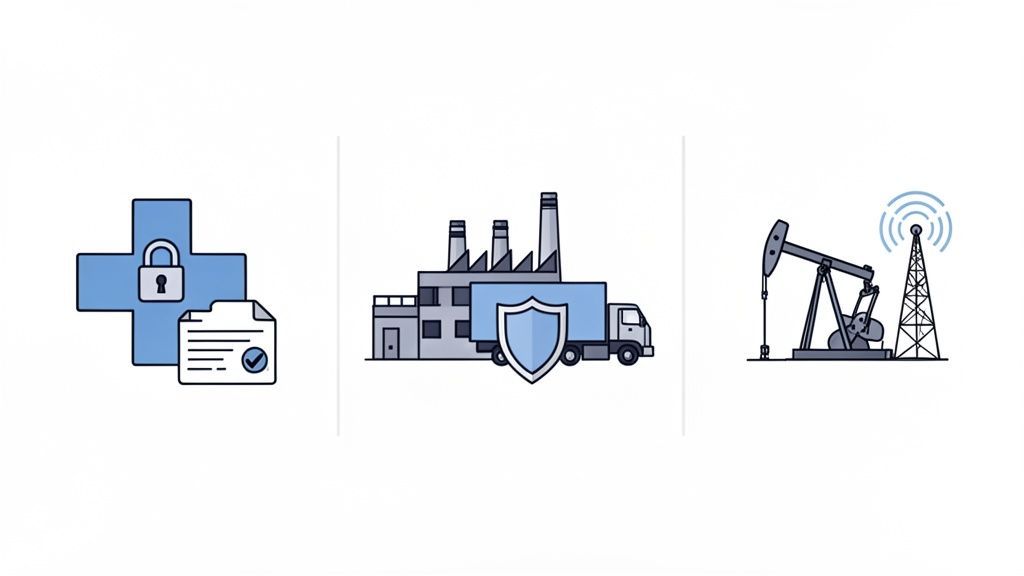
This is where your BCP moves from a theoretical exercise to a genuine strategic tool. By focusing on your industry’s unique weak points, you create a focused, efficient, and far more effective continuity strategy. It’s not just about getting through a disaster; it’s about protecting your clients, your reputation, and your bottom line.
To give you a clearer picture, let's look at how continuity priorities differ across some of Alberta's key sectors. The following table breaks down the primary risks and the most critical actions needed to keep these businesses running.
| Industry | Primary Alberta-Specific Risk | Top Continuity Priority |
|---|---|---|
| Healthcare | Cyberattack on patient records (EHRs) leading to a PIPA breach. | Ensuring immediate, secure access to patient data via isolated backups and having clear manual record-keeping protocols. |
| Manufacturing & Logistics | Supply chain disruption from extreme weather (floods, fires) or economic instability. | Building supply chain resilience by pre-qualifying alternate suppliers/routes and maintaining strategic inventory. |
| Construction | Project delays from worksite shutdowns due to weather, safety incidents, or material shortages. | Maintaining worksite safety and securing access to alternate material suppliers and subcontractors. |
| Finance | System downtime or data breach leading to loss of client trust and regulatory fines. | Guaranteeing transaction integrity and secure, uninterrupted access to financial systems and client data. |
| Oil & Gas | Outage at a remote site (drilling, processing) causing operational, financial, and safety risks. | Maintaining remote site control and operational data integrity through redundant power and communication systems. |
As you can see, "business continuity" means something different for everyone. It's not a single product, but a strategy built around your specific operational DNA.
For any healthcare organization in cities like Edmonton or Lethbridge, patient data is everything. A cyberattack that locks up electronic health records (EHR) is not just an IT headache, it's a direct threat to patient safety and a massive compliance failure under Alberta's Personal Information Protection Act (PIPA).
The absolute top priority here is guaranteeing immediate and secure access to patient data during an outage. This demands robust, completely isolated backups that can be restored in a heartbeat, without considering paying a ransom. Your plan also needs crystal-clear instructions for shifting to manual record-keeping and secure communication channels to coordinate patient care when the main systems are offline.
Alberta’s manufacturing and logistics firms are the engine of our provincial economy, but they are extremely sensitive to supply chain shocks. A single point of failure, whether it’s a flood washing out a major highway or a key supplier going under, can grind an entire production line to a halt.
For these businesses, a business continuity Alberta plan must focus on supply chain resilience. This means doing the work before a crisis hits: identifying alternative suppliers, mapping out secondary transport routes, and even keeping a strategic stock of critical parts. For instance, a parts manufacturer in Red Deer might pre-qualify a backup trucking firm or lease secure storage for raw materials in a different region to buffer against local disasters.
The energy sector is in a class of its own, facing a tough mix of risks. You have volatile commodity prices, the immense challenges of remote sites, and plenty of aging infrastructure. A simple power grid failure or a communications blackout at a distant drilling site can trigger enormous financial losses and serious safety hazards.
For the oil and gas industry, the top continuity priority is maintaining remote site control and ensuring the integrity of operational data. A disruption that corrupts sensor readings or cuts off remote monitoring can create dangerous and costly situations.
This requires layers of redundancy, like satellite backups for communication, uninterruptible power supplies (UPS) for critical equipment, and secure, off-site data replication. Ensuring that operational data is both available and trustworthy during an incident is non-negotiable. As the industry dives deeper into technology, the threats also evolve, a topic we cover in our guide to cybersecurity for Alberta’s oil and gas industry.
By defining these industry-specific priorities, a BCP becomes a powerful, practical tool. It goes beyond generic checklists to give your team clear, actionable steps to take when a crisis hits, cementing your organization's ability to weather any storm in Alberta's dynamic environment.
A solid business continuity program is not a single document you create, file away, and hope you never need. It's a living system of interconnected parts, all working together to shield your entire organization from disruption. For business continuity in Alberta, this means looking at the whole picture, from your strategic playbook down to the technical engines that bring your systems roaring back to life.
Think of it like building a custom vehicle designed to navigate Alberta’s rugged backroads. You would not just focus on the engine. You would need the right chassis, a tough suspension, reliable navigation, and a communication system that works when you're off the grid. A modern continuity plan is built the same way, with each part playing a critical role.
Let’s break down these essential components.
The Business Continuity Plan (BCP) is the high-level strategy that governs your entire response during a crisis. It's your organization's game plan, outlining the people, processes, and procedures needed to keep critical business functions running when things go sideways. It answers questions like:
The BCP is non-technical by design. Its purpose is to guide human decision-making and maintain operational momentum, ensuring your business can continue to serve customers and generate revenue even when your primary resources are offline.
If the BCP is the strategic playbook, the Disaster Recovery (DR) Plan is the technical engine that executes the IT side of that strategy. It’s a highly detailed, step-by-step guide focused exclusively on restoring your IT infrastructure, applications, and data after an incident. While the BCP worries about keeping the business open, the DR plan is what gets the lights back on in your server room or cloud environment.
A common point of confusion is the difference between a BCP and a DR plan. Think of it this way: the BCP ensures your employees can still take customer orders by switching to a manual system, while the DR plan focuses on restoring the automated e-commerce platform.
A strong DR plan allows you to meet your Recovery Time Objectives (RTOs) and Recovery Point Objectives (RPOs). If you want to dive deeper into the technical nuts and bolts, our guide on creating a disaster recovery plan provides a more detailed look.
Data backups are the absolute foundation of any recovery effort, they are your ultimate safety net. In simple terms, backups are copies of your data stored separately from your live systems. Modern backup strategies follow the 3-2-1 rule: keep at least three copies of your data, on two different types of media, with one copy stored off-site.
This off-site copy is non-negotiable, especially for businesses in Alberta where a regional disaster like a flood or wildfire could wipe out both your primary and local backup copies. Cloud backups provide a geographically separate, "air-gapped" copy that is safe from localized events and even ransomware attacks.
During a crisis, silence creates panic. A Crisis Communications Plan dictates how, when, and what you will communicate to all stakeholders, employees, customers, suppliers, and even the media. It ensures your messaging is consistent, transparent, and reassuring, helping to protect your hard-earned reputation.
Finally, your continuity plan must extend beyond your own four walls. Third-party and vendor continuity involves assessing the resilience of your critical suppliers. If your key logistics partner has no BCP, your own plan has a massive hole in it. This means having conversations with your vendors to understand their continuity strategies and protect your entire value chain. A core part of this is ensuring financial stability post-disaster, so knowing how to read your business insurance policy is crucial for an effective recovery.
Knowing the risks and the key parts of a business continuity plan is half the battle. Now, it's time to turn that knowledge into a concrete, actionable roadmap. Building real resilience does not have to be a huge, abstract project; you can break it down into five clear steps that any organization can follow.
This roadmap takes business continuity from a complex theory and turns it into a manageable project. By following these steps, you can methodically build a program that protects your people, processes, and technology, ensuring your business is ready for whatever comes its way.
You cannot protect what you do not understand. The first step is always to figure out exactly what you need to keep safe. This assessment phase boils down to two key activities: a Business Impact Analysis (BIA) and a risk assessment. The BIA pinpoints your most critical business functions, the absolute must-haves that your organization cannot operate without, and tells you how quickly they need to be back online.
A risk assessment, on the other hand, identifies the specific threats most likely to disrupt those functions. For a business in Alberta, that means looking at everything from cyber threats and shaky supply chains to the very real possibility of power grid failures or extreme weather events.
Without this foundational analysis, your entire plan is just guesswork. You could end up pouring resources into protecting non-critical functions while your most vital operations are left completely exposed.
Once you have a clear picture of your priorities and risks, you can start building your strategic playbook. This is where you formally write down your Business Continuity Plan (BCP) and your Disaster Recovery (DR) Plan. The BCP outlines the big-picture strategy for keeping the business running, including who's in charge during a crisis and how everyone will communicate.
The DR plan gets into the technical, step-by-step instructions for getting your IT infrastructure back up. This is also where you will define your Recovery Time Objectives (RTO), how fast you need to recover, and your Recovery Point Objectives (RPO), how much data you can afford to lose. These two metrics are critical, as they will dictate your technology choices in the next step. If you want to see what these plans look like, our article on business continuity plan examples offers some great models.
A strategy without execution is just an idea on paper. This is the step where you deploy the actual technology needed to bring your BCP and DR plans to life. Your investment in technology is what provides the muscle to support your recovery strategy.
Key implementations include:
The right technical controls are what make recovery possible. A plan is useless if you do not have the tools to restore your systems and data when a crisis hits. The process flows from creating the strategic playbook to using technology for recovery and backups.
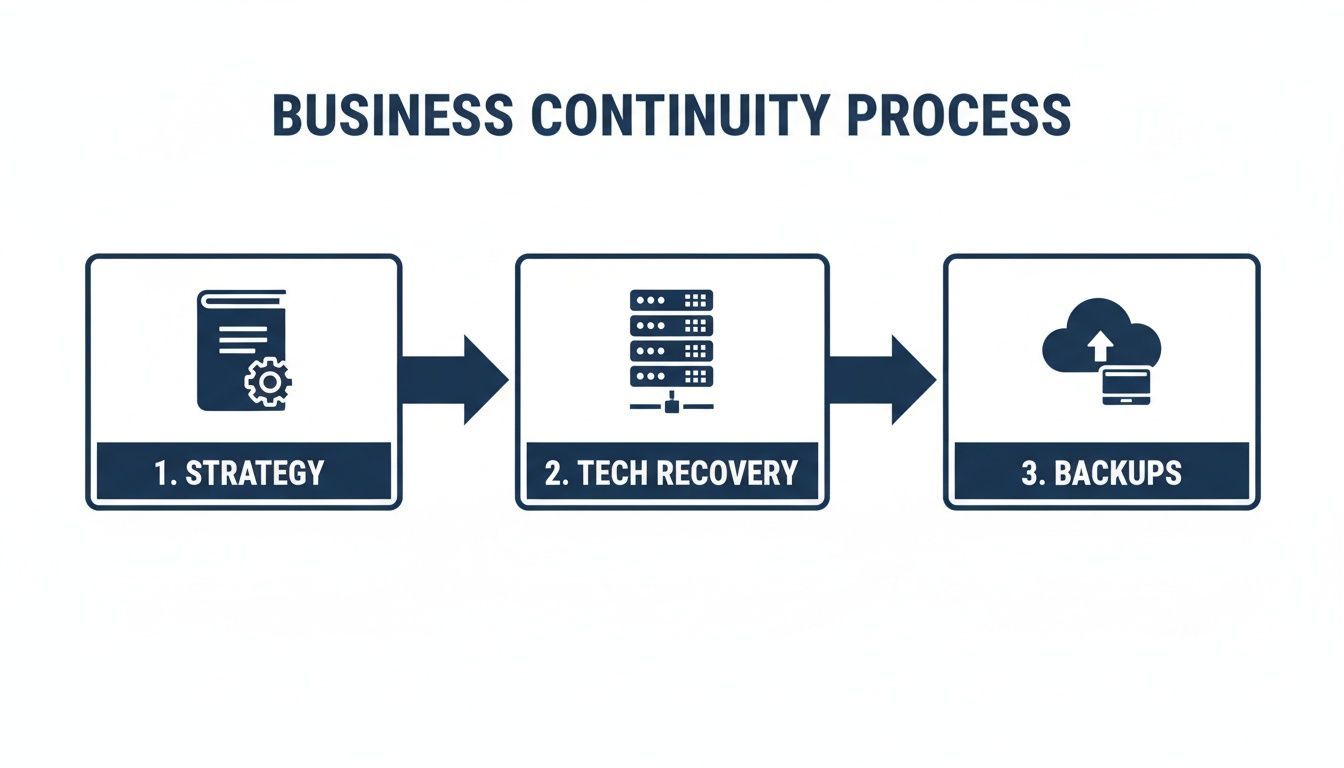
As you can see, a successful business continuity program seamlessly marries high-level strategy with the powerful technical tools needed for recovery.
A plan that has not been tested is a plan that is guaranteed to fail. Regular testing is the only way to find the weak spots, gaps, and hidden dependencies before a real disaster puts you on the spot. This is not a one-time event, but a continuous cycle of drills.
Start with tabletop exercises, where your team walks through the plan on paper to discuss the response. From there, you can graduate to partial and then full failover drills, where you actually switch over to your backup systems to see if they work as intended.
A plan is just a theory until it has been tested. Drills turn your documented strategy into muscle memory, ensuring your team can respond calmly and effectively under pressure.
Testing builds confidence and competence. It proves that your plan works, that your technology performs as expected, and that your team knows exactly what to do when things go wrong.
Finally, business continuity is not a "one-and-done" project. Your business, your technology, and the threats you face are always changing, so your plan must evolve with them. This final step is all about creating a cycle of continuous improvement.
Schedule annual reviews of your BIA and risk assessment to ensure they still reflect your business reality. Update your BCP and DR documents whenever you bring in new systems or change key processes. Ongoing monitoring and strategic reviews ensure your business continuity Alberta plan remains a relevant, effective tool for building long-term resilience.
Understanding the theory behind business continuity is one thing. Turning that knowledge into a living program that works when disaster strikes requires dedicated expertise, the right technology, and hands-on experience. This is where a partner like CloudOrbis comes in, transforming your continuity strategy from a plan on paper into a powerful operational reality.
When you work with us, you are not just buying a service. You are gaining a dedicated team of Canadian IT experts who are genuinely committed to fortifying your Alberta business. Think of us as an extension of your own team, we handle the technical heavy lifting so you can stay focused on serving your customers and growing your company.
True resilience is not just about bouncing back; it’s about preventing disruptions in the first place. A solid strategy stands on two pillars: stopping trouble before it starts and recovering with lightning speed when it cannot be avoided. Our services are built to cover you from every angle.
A strong technical foundation is non-negotiable, but it’s only half the battle. You also need strategic oversight to ensure your plan stays relevant and effective. This is where our virtual Chief Information Officer (vCIO) services deliver incredible value, guiding your entire planning process from the start.
A vCIO does not just look at technology; they focus on tying your IT strategy directly to your core business goals. They work to ensure your business continuity plan is effective, compliant with Alberta’s regulations, and cost-efficient, turning resilience into a real competitive advantage.
Our vCIOs work alongside your leadership team to conduct the initial business impact analysis, pinpoint critical operational risks, and build a BCP that makes sense for your specific operations here in Alberta. They can help you navigate tricky compliance rules, like PIPA for healthcare providers, and ensure your plan evolves right alongside your business.
This strategic partnership is what ensures your continuity program does not just collect dust on a shelf but remains a powerful, relevant asset for years to come. To see how a dedicated partnership can elevate your entire IT framework, check out our guide on managed IT services in Alberta.
When it comes to building a resilient business, many questions come up. It’s a complex topic, but understanding the fundamentals is the first step toward protecting your company. Here are a few of the most common questions we hear from Alberta business leaders, with straightforward answers to give you clarity.
This is a big one, and it’s easy to get them mixed up. The simplest way to think about it is to imagine a medical emergency.
In short, Business Continuity keeps the business running, while Disaster Recovery gets the technology fixed.
A plan you have not tested is just a theory on paper. For it to be effective when you need it, you need to practice. Best practice is to run a comprehensive test at least annually, but supplementing that with smaller, more focused drills throughout the year is even better.
A solid testing schedule usually mixes a few different approaches:
Consistent testing does more than just find holes in your plan; it builds your team’s confidence and muscle memory so they can respond effectively when it counts. That is the key to real business continuity in Alberta.
Absolutely. You might not need a 100-page binder like a massive corporation, but the principles of business continuity are arguably even more important for a medium-sized business.
Large enterprises often have the cash reserves to absorb a major disruption. For a medium-sized business, a single prolonged outage, whether from a flood, cyberattack, or supply chain failure, can be a true make-or-break moment. A simple, focused BCP is your playbook for protecting revenue, keeping your clients happy, and ultimately, ensuring your business survives in Alberta’s dynamic and sometimes unpredictable economy.
Building a resilient business continuity plan does not have to be overwhelming. The expert vCIOs and technical specialists at CloudOrbis Inc. can guide you through every step, from assessment to implementation and testing. Strengthen your defences and secure your future by visiting https://cloudorbis.com today.
Book a 30-minute call with a senior engineer. No sales script, just straight answers about your environment.


