IT Staffing Solutions: A Guide for Canadian SMBs
Find the right IT staffing solutions for your Canadian SMB. This guide compares staffing models vs. managed services, covers risks, and provides a checklist.

Find the right IT staffing solutions for your Canadian SMB. This guide compares staffing models vs. managed services, covers risks, and provides a checklist.
Projects are slipping. Your internal IT lead is juggling Microsoft 365 issues, security alerts, user onboarding, and a cloud migration that nobody has time to finish. Someone in finance wants tighter controls. Someone in operations wants fewer outages. Leadership wants answers, but the team already feels maxed out.
That's where many Canadian SMBs start looking at IT staffing solutions. Not because they suddenly want a bigger org chart, but because the business has outgrown a reactive, one-person-does-everything model. The question usually isn't “How do we hire faster?” It's “How do we get the right capability, at the right time, without creating more risk?”
Canadian SMBs don't hire in isolation. They compete in a North American talent market that is large, specialised, and increasingly flexible. The United States IT staffing market was valued at USD 37.89 billion in 2023 and is projected to reach USD 52.21 billion by 2029, with a 5.4% CAGR, according to Research and Markets on the U.S. IT staffing market. That same analysis notes that temporary and contract engagements made up 63.15% of the market, which tells you something important. Flexible delivery is no longer a workaround. It's a standard operating model.
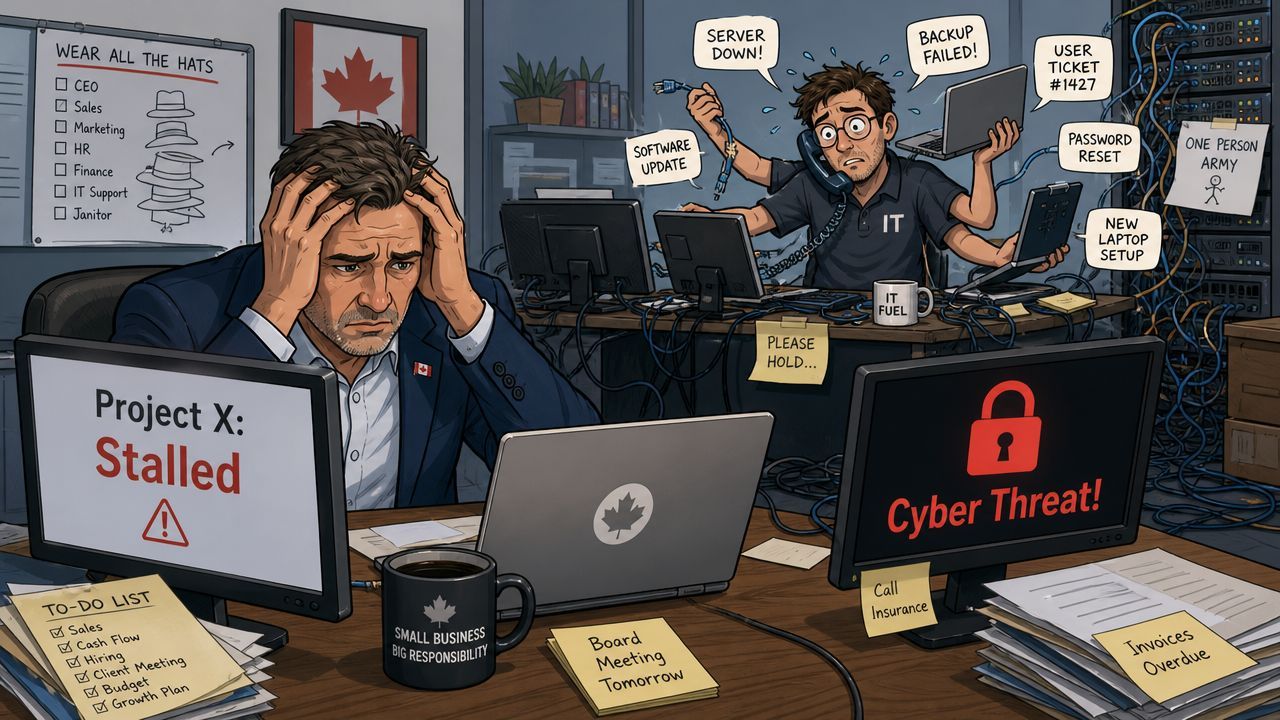
A lot of SMB leaders still approach IT the way they did years ago. Hire a generalist, add another person when tickets pile up, and hope the team can absorb security, cloud, compliance, and support at the same time. That works for a while. Then the environment gets more complex.
Microsoft 365 governance, endpoint protection, backup validation, identity management, vendor coordination, and after-hours response don't sit neatly inside one broad role. The work has become more specialised, and the consequences of getting it wrong are higher.
Practical rule: If your business depends on cloud systems, remote access, and regulated data, your staffing problem isn't just capacity. It's capability.
The strongest businesses don't treat IT staffing as a back-office HR task. They treat it as a growth decision tied to uptime, security, project execution, and internal accountability. Sometimes that means adding a full-time systems administrator. Sometimes it means short-term project talent. Sometimes it means using a fractional IT leadership model to cover planning and governance without building a full executive layer.
What usually doesn't work is defaulting to one model for every problem. A stalled migration, recurring help desk backlog, and weak security controls rarely need the same kind of hire. They need a staffing strategy that matches the work.
Think of IT staffing the way you'd think about building a facility. You can hire individual tradespeople. You can bring in specialists for a defined phase. Or you can hand part of the project to a firm that owns delivery from start to finish. IT works the same way.
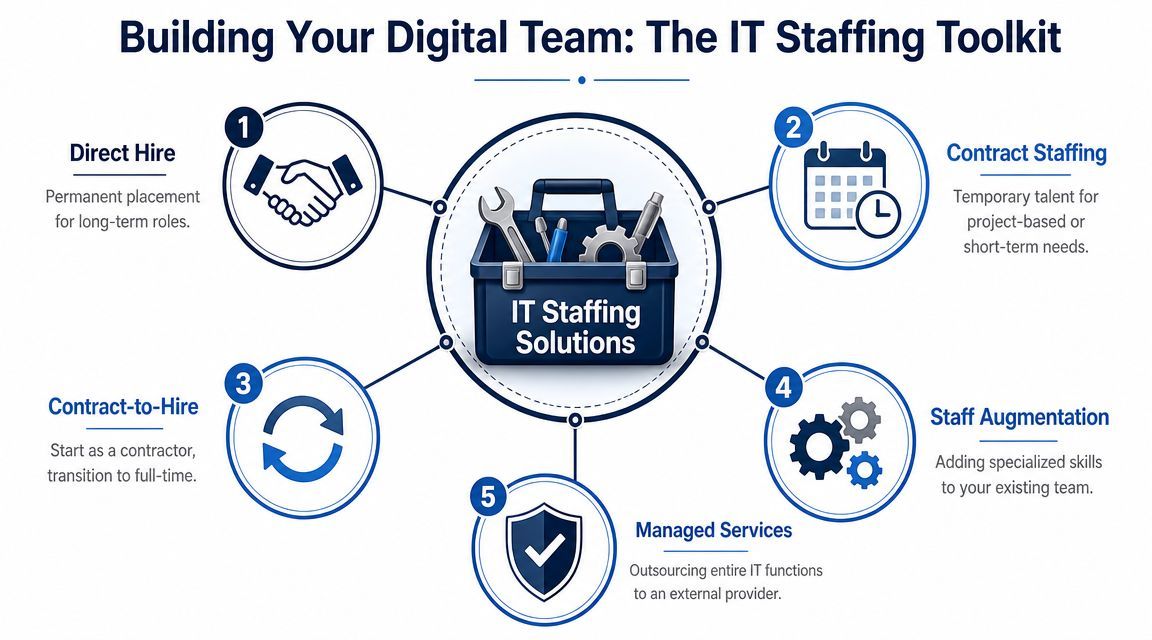
Direct hire fits when the role is ongoing, business-critical, and tied to internal knowledge. A permanent IT manager, systems administrator, or security lead can build process consistency and understand how your people work.
Temporary or contract staffing works best when the need is urgent, specialised, or time-bound. That might include a tenant-to-tenant Microsoft 365 migration, a security hardening project, infrastructure refresh work, or short-term service desk coverage during a transition.
Contract-to-hire gives you a trial period before making a long-term commitment. It's useful when the role is important but the scope isn't fully settled, or when you need someone productive quickly while still evaluating fit.
Staff augmentation adds skill to your existing team without replacing it. This model is common when internal IT can manage the environment but lacks depth in one area, such as Azure, compliance documentation, endpoint security, or automation.
Managed or co-managed IT services shift some or all delivery to an external provider. In a co-managed model, your internal team keeps ownership of certain systems or decisions while the partner handles service desk, monitoring, cybersecurity operations, escalations, or project execution.
The most practical lesson for SMBs is that demand is rising fastest where the skills are narrow. According to Mordor Intelligence on the IT staffing market, healthcare IT staffing is projected to grow at 10.25% CAGR through 2031, while SME demand is projected to grow at 8.85% CAGR. That aligns with what many Canadian firms are seeing on the ground. The pressure is strongest in compliance, cloud migration, security, and systems support.
When a business says it needs “more IT help,” it often needs one scarce skill, not three generalists.
If you're reviewing options, this overview of Top IT staffing services for 2025 is useful because it frames different provider types and where they fit. The key is not finding the broadest menu. It's matching the model to the business problem.
The wrong question is “Which staffing model is best?” The right question is “Which model gives us control, speed, and accountability for this specific need?”
A service desk backlog is an operating issue. A cloud migration is a delivery issue. A privacy-sensitive environment is a governance issue. Once you separate those, the right staffing solution becomes much clearer.
Most SMBs don't need a pure model. They need the right blend. A direct hire may own vendor relationships and internal priorities. A contract specialist may handle a migration. A co-managed partner may cover monitoring, support, and security operations that the internal team can't staff consistently.
That's why the core decision is about resilience and cost control, not ideology. As noted in this workforce and technology perspective, specialised digital roles remain difficult to fill, and a flexible model can be more effective than trying to build every function in-house.
| Criterion | Direct Hire | Contract Staffing | Co-Managed IT Services |
|---|---|---|---|
| Cost structure | Fixed employment cost with ongoing payroll commitments | Variable cost tied to project term or contract period | Recurring service cost, often easier to forecast operationally |
| Scalability | Slower to scale up or down | Fast to add niche capability for a specific period | Easier to expand coverage across support, security, and infrastructure |
| Expertise access | Deep knowledge in one person or small team | Strong for a defined specialty | Broad access across multiple disciplines |
| Management overhead | Highest internal management load | Moderate, because internal leaders still direct work closely | Shared management, with provider handling more day-to-day execution |
| Accountability | Internal accountability, but dependent on your own processes | Accountability can blur if scope is vague | Clearer if the agreement defines ownership, escalation, and outcomes well |
Direct hire is strongest when continuity matters. If you need someone embedded in the business, building internal relationships, and carrying institutional context over time, a permanent role makes sense. This is often the right answer for internal IT leadership, governance ownership, or a systems role with constant operational touchpoints.
Contract staffing is strongest when the problem has edges. If the work has a clear start and finish, contract talent can move quickly without locking you into a permanent structure. The catch is that many SMBs bring in contractors without giving them a clean scope, decision rights, or internal owner. That's when contracts drag on and value gets fuzzy.
Co-managed IT services are strongest when breadth matters. If your business needs help desk, patching, security tooling, escalation support, Microsoft 365 administration, and after-hours coverage, one additional employee usually won't solve the problem. You need layered capability.
A common mistake is hiring a senior person and expecting them to absorb frontline support, infrastructure maintenance, strategic planning, and security oversight alone. Another is outsourcing a major function without keeping internal ownership of priorities and policy.
Good staffing models define who does the work, who approves the work, and who carries the risk if something is missed.
For a broader perspective on how companies weigh these choices, Wonderment Apps on tech team models offers a helpful comparison. It's also worth reviewing what a managed IT service actually includes, because many leaders compare staffing and managed services without comparing the same scope.
Use direct hire when you need ownership.
Use contract staffing when you need speed and a defined skill.
Use co-managed support when the business needs dependable coverage across several operational areas at once.
When leaders get stuck, it's usually because they're trying to solve a governance gap with a headcount decision.
External IT talent can be a smart lever. It can also create avoidable problems if you treat it like simple labour instead of controlled access to systems, data, and business processes.
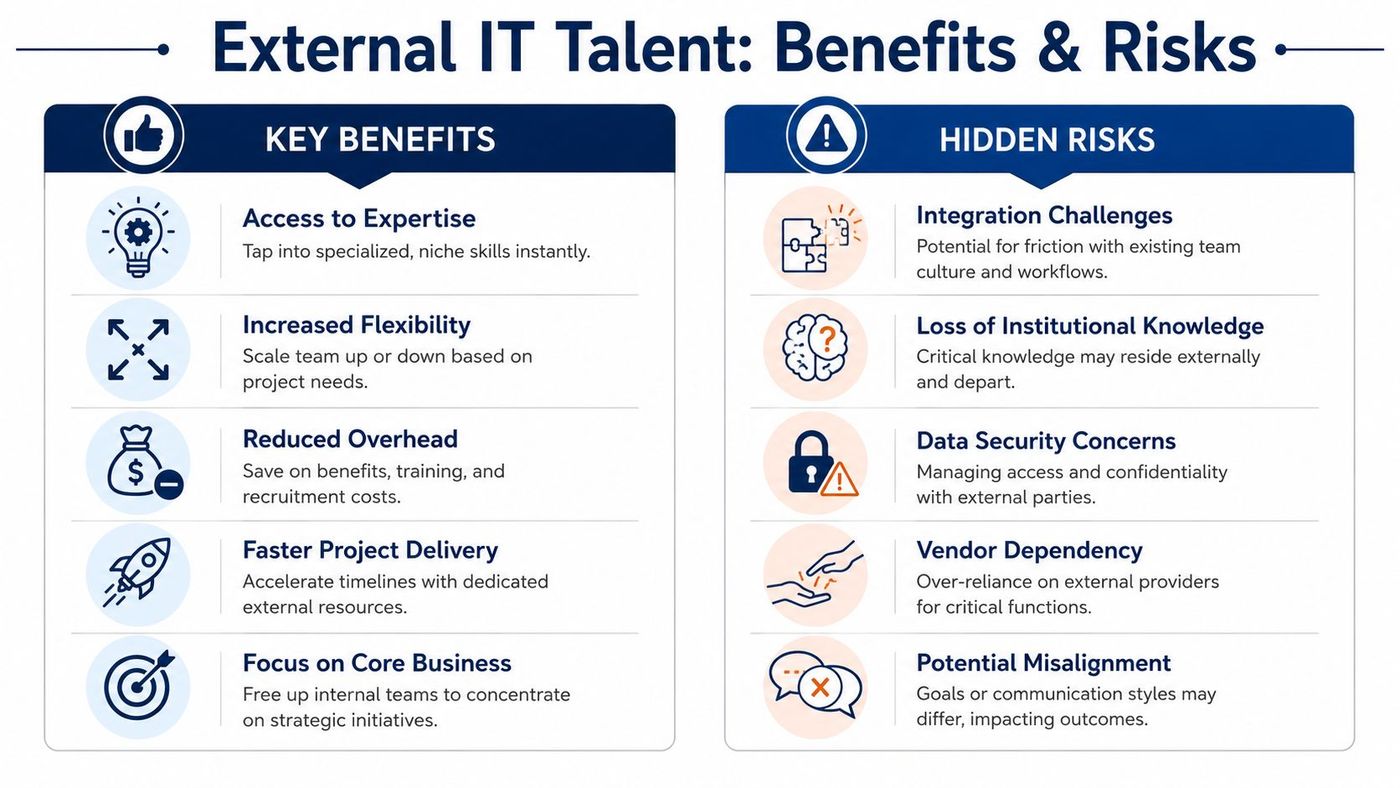
External support gives SMBs room to move faster when internal capacity is tight.
A lot of firms first notice the upside when projects finally move again. The migration gets completed. User onboarding becomes cleaner. Security tasks stop getting deferred.
The hidden risks are almost always governance failures.
External IT support should reduce operational risk. If it adds confusion, the issue is usually the operating model, not the person.
The answer isn't avoiding outside talent. It's putting structure around it.
Start with role-based access. Tie every account to a business need. Require documented approvals for privileged access. Make sure system ownership stays visible internally. Keep runbooks, vendor contacts, and recovery procedures inside your organisation, not just in someone else's ticketing system.
If you're weighing whether broader outsourcing makes sense, this guide on the benefits of managed IT services is a useful reference point. Just make sure any benefit claim in a proposal is matched by operational detail. Ask how onboarding works. Ask who approves access. Ask who maintains documentation.
In healthcare, legal, and many manufacturing environments, staffing decisions are governance decisions. Access to systems means access to regulated information, operational processes, and audit exposure. That changes the standard.
A useful framing comes from Amerit Consulting's discussion of healthcare IT staffing pressures. The central issue isn't only hiring difficulty. It's that governance capacity often becomes the primary bottleneck. If the business hasn't defined access controls, onboarding, logging, and supervision, adding more people can increase risk instead of reducing it.
Clinics, specialty practices, and healthcare groups often need help with endpoint support, Microsoft 365 administration, identity controls, backup oversight, and vendor coordination. But anyone touching systems that contain patient information must operate inside clear rules.
That means the business should define:
Manufacturers and logistics firms often focus on uptime first. Fair enough. Production disruption is painful. But staffing in these environments also touches network segments, plant-floor connectivity, vendor remote access, and supply chain data.
A contractor who can troubleshoot fast but bypasses internal change control can create long-term exposure. In these settings, businesses need staffing partners who respect documented maintenance windows, approval chains, and separation between operational technology and business IT where applicable.
In regulated environments, speed matters. Controlled speed matters more.
Legal practices usually care less about broad technical language and more about confidentiality, chain of custody, document handling, and client trust. That means staffing decisions should account for where work is performed, who can see matter-related data, and how remote access is controlled.
Broader compliance checklists can help leadership align HR and IT expectations. A practical example is this overview of 2025 HR compliance requirements, which is useful for thinking through how hiring, documentation, and policy obligations intersect.
Businesses also need to watch the evolving Canadian privacy regulatory environment. If you're assessing privacy obligations in Alberta or similar environments, a privacy impact assessment perspective is a strong starting point for evaluating staffing and system changes together.
Don't ask only whether a staffing partner can provide talent.
Ask whether they can operate inside your compliance model without improvising it for you.
The easiest way to buy the wrong IT staffing solution is to compare proposals only on rate. A lower hourly number can hide weak coverage, poor escalation design, vague deliverables, or unclear responsibilities.
Most proposals land in one of these buckets:
Each model can work. The difference is whether the contract makes service boundaries obvious.
Before signing, check these points carefully:
One practical benchmark helps cut through vague promises. According to TalentMSH's review of IT staffing ratios, Gartner-referenced guidance places the front-line service-desk benchmark at roughly 1 analyst per 70 users. The same discussion notes broader ratios commonly cited at 1:70 to 1:100 for organisations under 2,500 employees and 1:200 to 1:300 for large enterprises.
That doesn't mean every environment should copy the same ratio. A healthcare clinic, legal office, and warehouse operation generate different ticket patterns. It does mean you should ask any provider how their proposed coverage maps to your user base, locations, systems, and expected support demand.
If a proposal promises rapid response but won't explain staffing depth, escalation paths, or coverage model, keep asking questions.
For leaders comparing providers, this guide to IT support companies can help sharpen your evaluation criteria beyond price alone.
The best IT staffing decisions start with a blunt assessment of what the business needs. Not what the org chart used to look like. Not what a vendor prefers to sell. What the business needs now to operate safely and move forward.
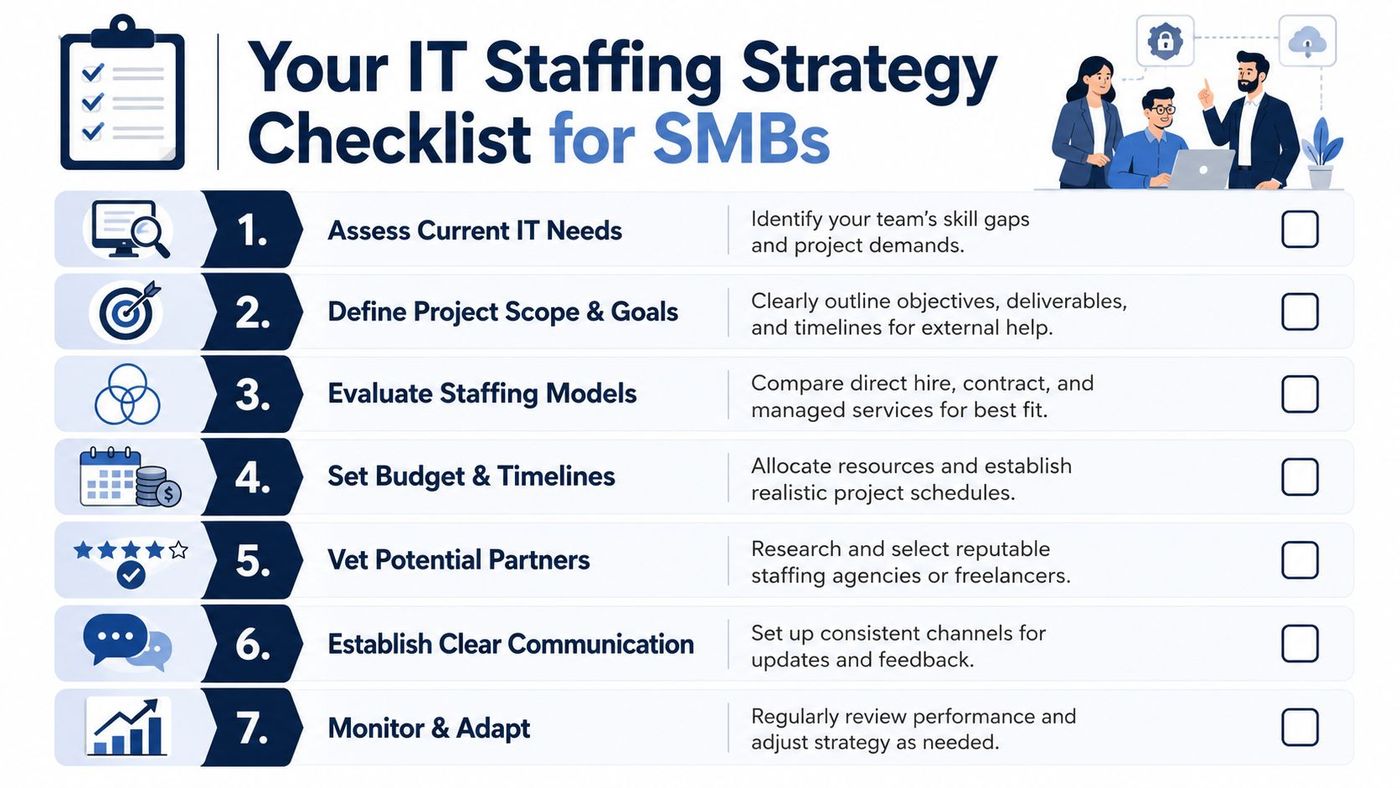
A practical sequence looks like this:
Good IT staffing solutions aren't about buying more hands. They're about building a support model that fits your business, your risk tolerance, and your growth plan.
If you're weighing direct hire, contract support, or a co-managed model, CloudOrbis Inc. can help you assess the trade-offs clearly. Their team works with Canadian SMBs in healthcare, manufacturing, legal, finance, logistics, and other regulated sectors to align IT support, security, and compliance with real business needs. If you want a practical review of your current gaps and a smarter path forward, reach out for a conversation.
Book a 30-minute call with a senior engineer. No sales script, just straight answers about your environment.


