

September 22, 2026
Security Audit Services Guide for SMBs in CanadaDiscover why security audit services are vital for Canadian SMBs. Explore typical scope, deliverables, timelines, and tips to choose the right provider.
Read Full Post%20(1).webp)
Usman Malik
Chief Executive Officer
June 24, 2026
A lot of Canadian business leaders are in the same position right now. Their teams rely on Microsoft 365, cloud apps, VoIP, mobile devices, and a growing mix of office and remote work. The business runs smoothly, until one laptop gets compromised, one weak password is reused, or one phishing email gets through.
That's when an uncomfortable question shows up. If one device is breached, can an attacker move freely across your network and reach finance files, patient records, production systems, or line-of-business apps?
That question sits at the heart of what is network segmentation. It's not a niche networking concept. It's a practical way to reduce risk inside your environment, support compliance, and make your infrastructure easier to manage as your business grows.
Think about your office layout. If your business operated in one giant open room with a single front door, anyone who got past reception could wander into payroll, HR, executive offices, and the records room. That's convenient for movement, but it's terrible for control.
A flat network works in much the same way. Once someone or something gets in, there are very few internal boundaries. A compromised workstation in reception might be able to communicate with a file server, a phone system, or a database that was never meant to be exposed to it.
A segmented network changes that design. Instead of one open floor, you have access-controlled rooms. Finance has its own space. Guest Wi-Fi is isolated. Servers sit behind stricter controls. Sensitive systems require explicit permission before traffic can reach them.
A strong perimeter still matters, but it isn't enough on its own. Modern attacks often succeed by moving sideways after the first compromise.
That's why layered defence matters. If you want a practical non-technical primer on that bigger idea, IT Cloud Global on layered security offers a useful overview of how multiple controls work together.
Inside that broader approach, segmentation is one of the most effective internal controls. It aligns closely with a Zero Trust security model, where access isn't assumed just because a user or device is already “inside” the network.
Many people assume firewalls at the internet edge solve this problem. They don't. Edge firewalls filter traffic coming in and out, but they don't automatically control how systems talk to each other inside your environment.
That's the core value of segmentation. It creates internal boundaries so one mistake doesn't become an organization-wide incident.
Network segmentation means dividing a larger network into smaller, isolated parts called segments. Each segment has rules about what traffic can enter, leave, or communicate with other parts of the business.
A useful analogy is a ship built with watertight compartments. If one area takes on water, the entire vessel doesn't go down. In IT, the same principle limits damage. If malware lands on one device, segmentation helps contain it rather than letting it spread unchecked.
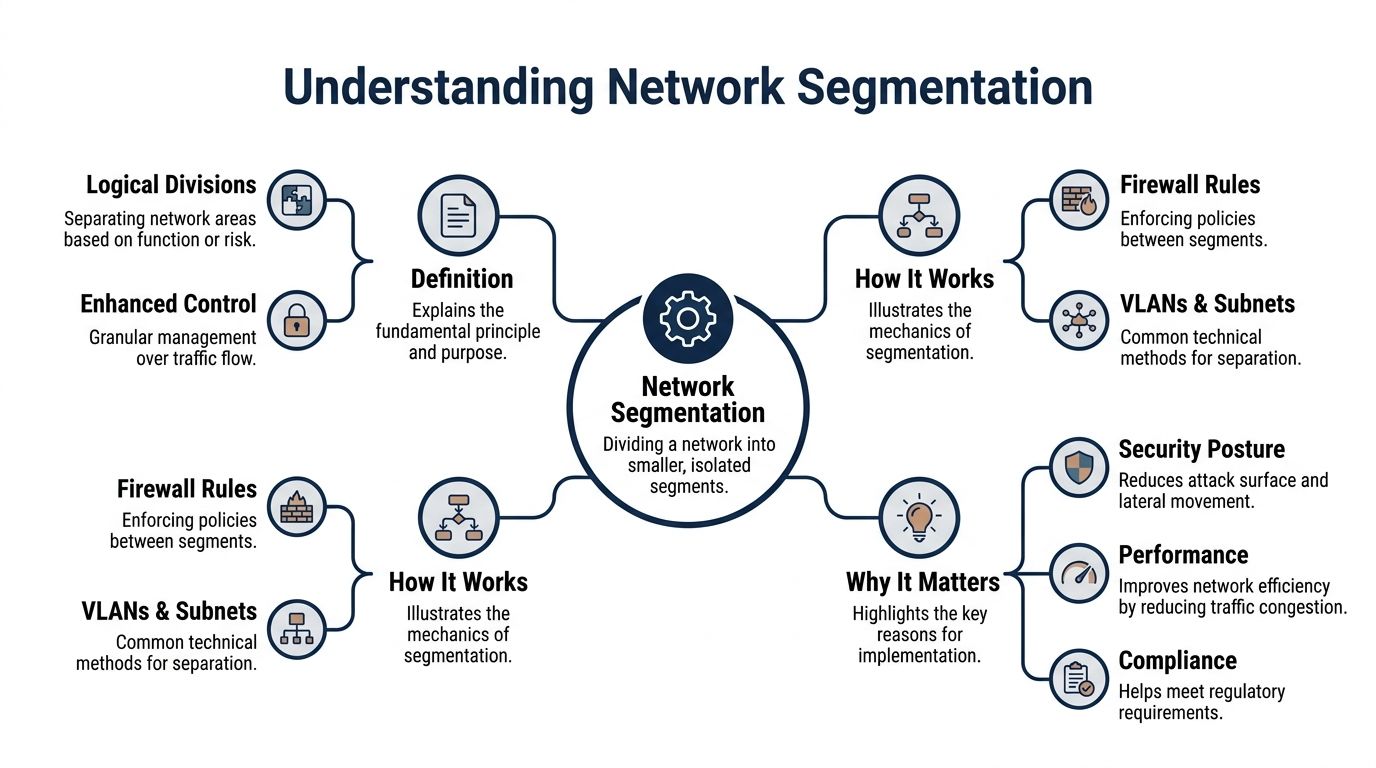
Palo Alto Networks describes the concept clearly in its overview of what network segmentation is. Network segmentation operates by dividing a larger computer network into smaller, isolated subnetworks to restrict lateral movement. That's the technique attackers use to spread from one compromised device to another within the same network.
In practice, that means your business can create rules that:
This isn't only a technical tidy-up. It changes your risk profile.
If your clinic stores patient information, your systems shouldn't all sit on the same unrestricted network. If your manufacturing operation runs legacy equipment, that equipment shouldn't be exposed to every office user and device. If your firm handles trust accounts, tax records, or contracts, broad internal access creates unnecessary risk.
Practical rule: If two systems don't need to talk, they shouldn't be able to talk.
That principle also supports other controls. For example, an intrusion detection system becomes far more useful when traffic flows are intentional and easier to monitor.
For readers who want another external perspective on securing your business network, this guide from Networking2000 adds practical context around the role segmentation plays in reducing internal exposure.
Consider a mid-sized clinic. Staff use desktop PCs, a billing platform, a patient management system, printers, Wi-Fi for guests, and cloud backups. In a flat network, those systems may all have broad reachability. In a segmented network, guest Wi-Fi is isolated, printers sit in a controlled segment, administrative endpoints have limited access, and patient data systems are protected behind tighter rules.
That's why network segmentation matters. It turns “inside the network” from one trust zone into several controlled ones.
Not all segmentation looks the same. The right design depends on your risk, budget, operational complexity, and how modern or legacy your systems are.
Physical segmentation means separate infrastructure. Different switches, different cabling, and sometimes entirely separate environments. It offers strong isolation, which is why it's often used for highly sensitive or operationally critical systems.
Logical segmentation creates separation within shared infrastructure. This is commonly done with VLANs, subnets, firewall rules, and access control lists. It's more flexible and usually more realistic for small and mid-sized businesses.
For many Canadian SMBs, logical segmentation is the practical starting point. It gives you meaningful control without requiring a full rebuild of the network.
After that, leaders usually hear two related terms: macro-segmentation and micro-segmentation.
Macro-segmentation creates larger zones based on department, site, or function. Think finance, HR, guest Wi-Fi, production systems, and server networks.
Micro-segmentation goes deeper. Cisco notes in its explanation of network segmentation approaches that modern strategies increasingly use microsegmentation alongside macrosegmentation to protect east-west traffic, meaning server-to-server and app-to-server communications that traditional perimeter controls often miss. Cisco also highlights technologies such as Software-Defined Networking and identity-based segmentation, where access policies follow the user or device role rather than only an IP-based location.
That distinction matters in hybrid environments. A user may be legitimate, but that doesn't mean every application or workload they touch should communicate broadly behind the scenes.
| Attribute | Macro-segmentation | Micro-segmentation |
|---|---|---|
| Scope | Larger business zones | Individual apps, workloads, or systems |
| Common use | Separate departments, Wi-Fi, server groups | Restrict east-west traffic between workloads |
| Complexity | Lower | Higher |
| Best fit | Foundational network control | Fine-grained Zero Trust enforcement |
| Examples | Finance separate from guest Wi-Fi | Billing app allowed to reach only its database |
Macro-segmentation sets the walls. Micro-segmentation decides which doors can open inside those walls.
A manufacturer might use macro-segmentation to separate office users from plant systems. A legal firm might use it to isolate document management and accounting systems from general staff devices. Then micro-segmentation can tighten communications within those protected areas.
The design work matters here. Good segmentation supports the way your business operates. Poor segmentation creates friction, broken workflows, and exceptions that eventually weaken security. That's why a formal network design exercise usually comes before implementation.
Business leaders rarely ask for segmentation because they love network architecture. They ask for it because they want fewer bad outcomes. Less disruption. Less exposure. Less confusion during audits and incident response.
Segmentation is a core Zero Trust control because it enforces deny-by-default policies at internal boundaries. That reduces the attack surface and limits what a compromised device or user can reach. For Canadian organizations, that matters directly in ransomware scenarios. The Canadian Centre for Cyber Security indicates that organizations lacking granular segmentation experience a 300% higher rate of successful ransomware lateral spread compared to segmented peers, and this supports compliance with PIPEDA.
That's the business case in one sentence. A breach may still begin somewhere, but it doesn't have to become everyone's problem.

For healthcare clinics, segmentation helps isolate systems that handle patient data from routine office traffic. For legal, financial, and accounting firms, it helps restrict access to confidential client records. For any business subject to privacy obligations, segmentation creates clearer boundaries around sensitive information.
That matters for compliance because auditors and regulators care about access control, data handling, and the ability to demonstrate reasonable safeguards. Segmentation supports all three.
A few practical examples:
Flat environments create messy questions. Who can reach what? Why is this workstation able to access that database? Which traffic path should exist, and which one is accidental?
Segmented environments are easier to reason about. They pair well with a broader data security management program because access rules become more intentional and easier to review.
Segmentation doesn't replace endpoint protection, backups, or user training. It makes those controls more effective by limiting how far one failure can travel.
For many organizations, that's the hidden advantage. Segmentation turns security from a vague perimeter concept into a controlled internal architecture.
Most SMBs don't need a grand redesign on day one. They need a clear starting point, a sensible sequence, and enough structure to avoid breaking the business while improving security.
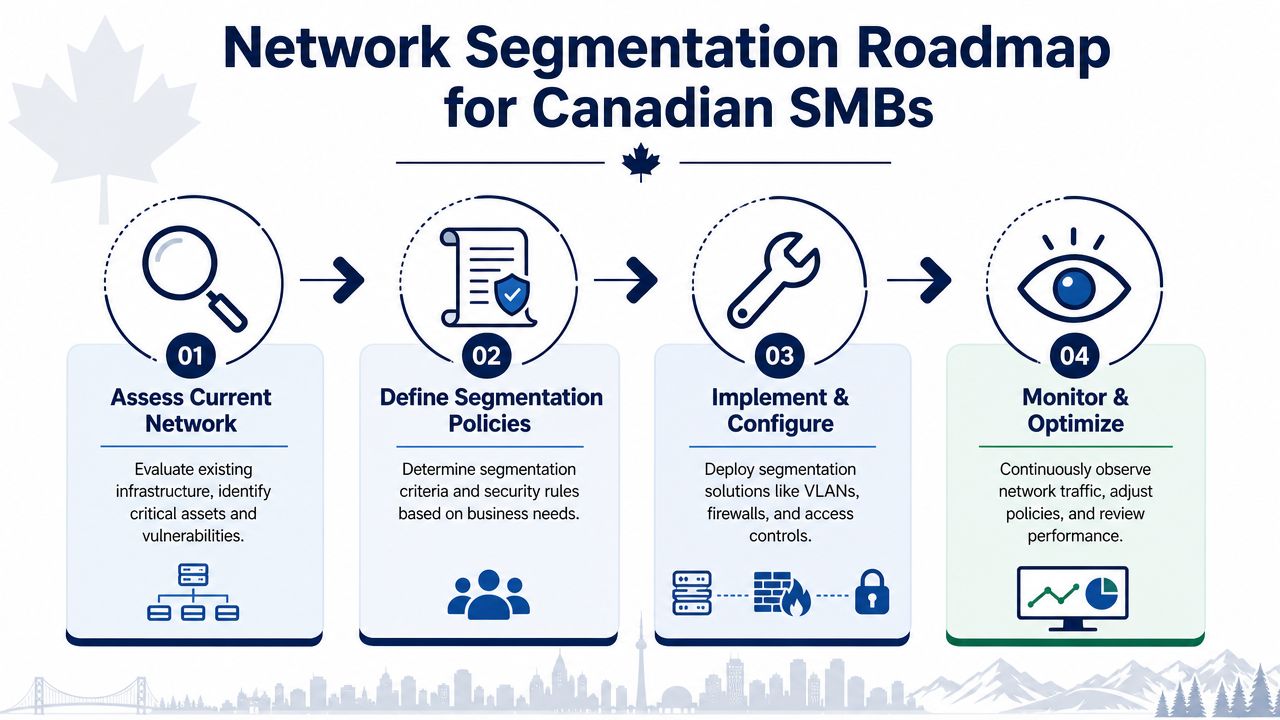
Start by mapping what you have. That includes users, endpoints, servers, business applications, printers, VoIP systems, Wi-Fi, remote access paths, and any OT or IoT devices.
You're looking for three things:
A manufacturing company should pay close attention here. Existing content often overlooks OT isolation, yet the Communications Security Establishment reported that 42% of Canadian industrial cyberattacks in 2024 exploited the lack of segmentation between IT and OT departments, leading to an average downtime of 14 days for affected firms.
Once you know the traffic flows, decide what should be allowed, denied, or tightly restricted.
Business leadership's involvement is essential. Security rules should reflect operational reality, not guesswork. Finance may need access to one set of services. Front-desk staff may need another. Contractors may need almost none.
A useful way to frame policy is by asking:
Start with business functions, not technical gadgets. Segments should reflect how your company works.
This doesn't need to happen all at once. Many SMBs start with high-impact zones such as guest Wi-Fi, servers, finance systems, and remote access.
A Calgary logistics firm, for example, may choose to separate its VoIP environment from general data traffic while isolating line-of-business platforms from staff browsing and guest devices. A manufacturer in Ontario may begin by separating office IT from plant-floor systems before refining controls around production applications.
CloudOrbis includes network segmentation among its managed security and infrastructure services, using traffic analysis to help define secure zones and spot unusual activity. In many environments, the hardest part isn't creating a VLAN. It's understanding what traffic should exist before enforcement begins.
Changes should also follow a structured change management process so testing, rollback planning, and user impact are handled properly.
Segmentation isn't a one-time project. Networks change. Staff roles change. New cloud apps show up. Old equipment hangs around longer than expected.
Monitoring tells you whether policies are working or creating unnecessary friction. It also helps identify strange traffic patterns that may indicate misconfiguration or malicious behaviour.
Look for:
That ongoing tuning is what turns segmentation from a diagram into a durable operating model.
Network segmentation is one of those controls that sounds straightforward until a business tries to implement it in a live environment. The technical pieces are familiar. VLANs, firewall rules, access controls, workload policies. The challenge is designing them around real workflows, legacy constraints, compliance requirements, and uptime expectations.
That's why segmentation works best when it's treated as a business architecture decision, not just a networking task. A clinic needs patient systems isolated without disrupting care. A manufacturer needs IT and OT separated without interrupting production. A legal or finance firm needs tighter internal controls without slowing daily work.
Well-designed segmentation improves both resilience and operations. Benchmark data from the Canadian Centre for Cyber Security shows that segmented networks reduce the time to contain a breach from an average of 28 days to less than 4 days, and proper segmentation can drive a 40-50% improvement in network performance by reducing broadcast congestion.
Those outcomes matter because they touch both risk and productivity. Faster containment means less disruption. Better traffic control means cleaner performance for systems people depend on every day.
A managed partner helps translate goals into a staged plan. Assessment comes first. Then policy design, implementation, testing, documentation, and ongoing monitoring. That approach reduces disruption and helps the business avoid the usual problems, such as over-permissive rules, broken application paths, or segments that exist on paper but not in practice.
For organizations that want to strengthen internal controls without building everything in-house, CloudOrbis cybersecurity services provide a practical path to designing, deploying, and maintaining segmentation as part of a broader security program.
If your business is still operating on a largely flat network, now's the time to rethink that foundation. CloudOrbis Inc. helps Canadian SMBs design secure, compliant, and manageable IT environments that support growth without adding unnecessary complexity.
September 22, 2026
Security Audit Services Guide for SMBs in CanadaDiscover why security audit services are vital for Canadian SMBs. Explore typical scope, deliverables, timelines, and tips to choose the right provider.
Read Full Post
September 21, 2026
Secure File Sharing Guide for Canadian BusinessesLearn secure file sharing essentials for Canadian SMBs — encryption, compliance, protocols and best practices to protect data and stay compliant.
Read Full Post
September 20, 2026
Disaster Recovery Plan Business Continuity for SMBsBuild a disaster recovery plan business continuity strategy tailored for Canadian SMBs. Covers risk assessment, RTO/RPO, backup, testing, and ownership.
Read Full Post
