Edmonton IT Services: Expert SMB IT Solutions & Support
Discover premier edmonton it services for SMBs, covering managed support, cybersecurity, and guidance to choose the right technology partner.

Discover premier edmonton it services for SMBs, covering managed support, cybersecurity, and guidance to choose the right technology partner.

In Edmonton's humming economy, technology is not just a background tool, it is the engine that powers growth. For small and medium-sized businesses, leveraging strategic Edmonton IT services is what transforms that engine into a competitive advantage, preventing expensive problems before they can impact the bottom line.
The way Edmonton companies manage their technology has fundamentally changed. We have moved past the old "break-fix" days, where IT support was only called after a server crashed or the network went down. That reactive approach is a recipe for business disruption, it is unpredictable, costly, and leads to significant downtime that directly affects revenue and productivity.
Consider this: the break-fix model is like calling a tow truck after your delivery van’s engine fails on the QE2 during rush hour. The repair bill is just the beginning of your problems. You are also losing money on the missed delivery, damaging your client relationship, and paying your driver to wait on the side of the road. It is a stressful and inefficient way to operate a business.
Today's organizations need a proactive game plan. A managed IT services provider (MSP) acts as your dedicated pit crew, constantly monitoring your systems and performing preventative maintenance to ensure you never break down in the first place. This strategy is all about optimizing performance and security to address issues before they can disrupt your operations.
This shift in mindset delivers tangible benefits:
A proactive IT partner does not just fix problems, they prevent them. This shift from reactive firefighting to strategic planning allows Edmonton business leaders to focus on innovation and growth, confident that their technology foundation is secure and reliable.
By adopting a forward-thinking IT approach, businesses in key sectors like manufacturing, healthcare, and professional services can transform technology from a recurring headache into a powerful asset. For a detailed guide on what to look for in a provider, our comprehensive IT checklist for businesses in Edmonton is an excellent place to start.
When you partner with a provider for Edmonton IT services, you are not just purchasing a single product. You are investing in a suite of integrated solutions designed to keep your business running smoothly, securely, and strategically. These core components work in concert, forming a protective and productive technology foundation for your entire operation.
Understanding these pillars helps clarify what a comprehensive IT service package truly offers. Think of it less like an à la carte menu and more like a well-balanced, multi-course meal, each element complements the others to deliver a complete experience.
The following infographic illustrates the hierarchy of IT services, placing strategic guidance at the top and separating proactive and reactive support functions.
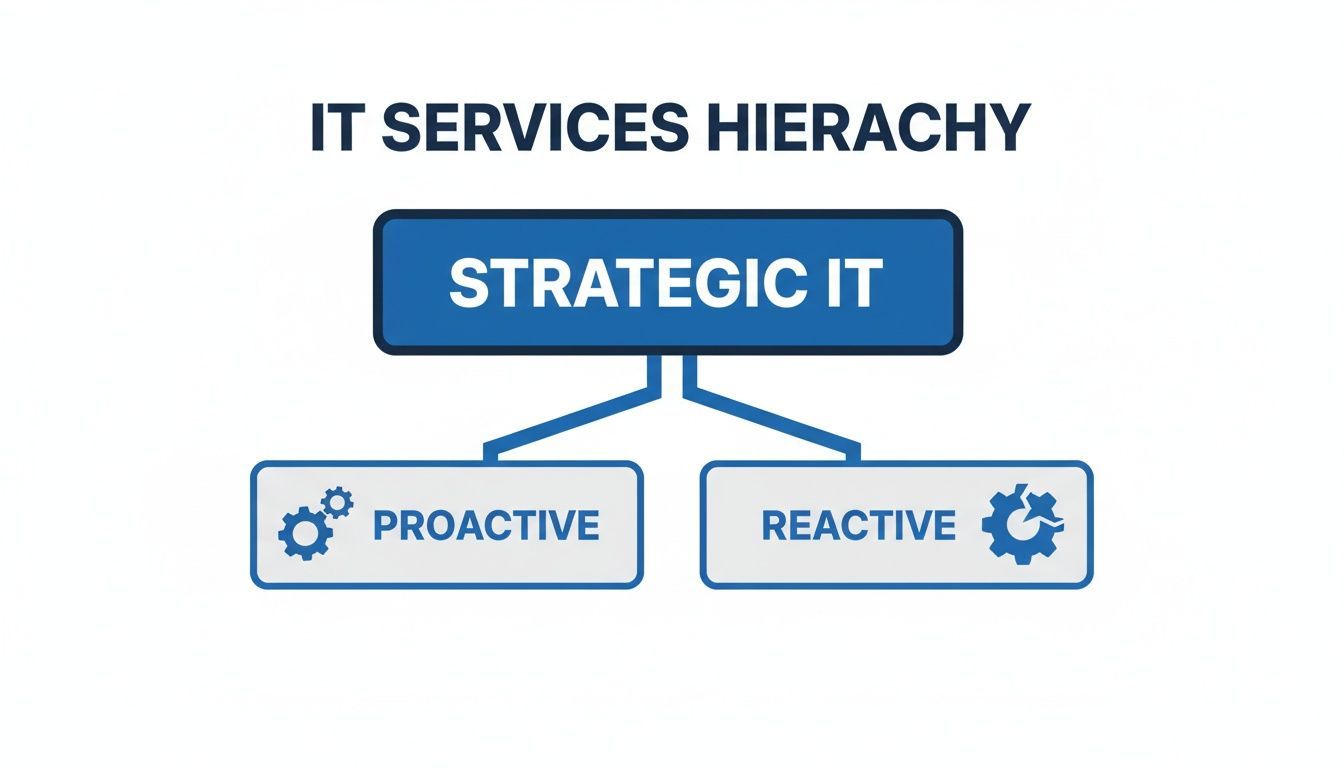
This visual demonstrates how a modern approach prioritizes proactive measures, which prevent problems, over reactive fixes that only address issues after they have already caused damage.
This is the most visible pillar and the one your team will interact with most often. It’s your 24/7 expert helpdesk, but it’s far more than just a reactive helpline. A modern managed IT service focuses on proactive support, which means we monitor your systems around the clock to identify and resolve potential issues before they can disrupt your workday.
Instead of waiting for an employee to report a slow computer or a network outage, our systems flag performance dips and security alerts automatically. This constant vigilance minimizes downtime and keeps your team productive. When support is needed, your staff gets immediate access to a 100% Canada-based team of experts who can troubleshoot and solve problems quickly and effectively.
In an age of constant digital threats, a strong cybersecurity posture is non-negotiable. This pillar acts as your digital fortress, defending your business against a wide array of cyberattacks, from ransomware and phishing to data breaches. It’s a multi-layered defence system that goes far beyond basic antivirus software.
Key components of this defence include:
The cloud is more than just online storage; it is a powerful platform for collaboration, flexibility, and growth. This pillar focuses on ensuring you get the most out of your cloud investments, particularly with tools like Microsoft 365. Many businesses only scratch the surface of what these platforms can do.
A strong cloud strategy involves optimizing your setup for better performance, security, and cost-efficiency. It means configuring tools like SharePoint and Teams for seamless collaboration while ensuring your data is properly secured and compliant with Canadian privacy laws. This strategic management turns your cloud tools from simple applications into a central hub for business productivity.
What would happen if a fire, flood, or major cyberattack wiped out your office and servers? A business continuity and disaster recovery (BCDR) plan is your answer. This pillar is your insurance policy against the unexpected, ensuring your critical data is backed up, secure, and can be restored quickly.
Your data is one of your most valuable business assets. A robust BCDR strategy ensures that even in a worst-case scenario, your operations can be brought back online with minimal data loss and disruption, protecting your revenue and reputation.
This involves creating redundant copies of your data in secure, off-site locations and having a clear, tested plan to restore systems after a disaster. It’s the difference between a minor inconvenience and a catastrophic business failure. You can discover more about the specific elements that form a complete IT solution in our detailed overview of a managed IT service.
Finally, this is the pillar that ties everything together. A virtual Chief Information Officer (vCIO) provides high-level strategic guidance to ensure your technology aligns with your business goals. Think of a vCIO as a fractional CFO, but for technology.
They help you create a technology roadmap, plan your IT budget, and make informed decisions about new investments. This strategic oversight ensures you are not just spending money on technology, but investing it wisely to drive growth, improve efficiency, and secure a competitive advantage in the Edmonton market.
In Edmonton's diverse economy, a one-size-fits-all IT strategy will not suffice. Each of our city's major industries, from healthcare to construction, operates under a unique set of regulations, pressures, and opportunities. This requires specialized technology solutions, not just a generic checklist of services.
For any business leader, the goal is to find an IT partner who already understands your industry. Whether you are navigating complex compliance laws in a clinic or keeping a remote worksite connected, the right Edmonton IT services are designed to solve the real-world problems your business faces every day.

For healthcare providers in Edmonton, IT is not just about running an efficient clinic; it is about patient safety and airtight legal compliance. The confidential nature of electronic health records (EHRs) places enormous pressure on data security.
A single data breach can have devastating consequences, from substantial fines to a complete erosion of patient trust. That is why healthcare providers need an IT partner who is deeply familiar with Alberta's privacy laws, like the Personal Information Protection Act (PIPA).
A specialized IT setup for a medical practice should include:
Consider a busy Edmonton medical clinic. They require their patient booking system and digital records to be completely secure. A tailored IT service would implement multi-factor authentication for all staff, encrypt the entire patient database, and provide ongoing training to identify phishing emails, ensuring PIPA compliance is always met.
In manufacturing and logistics, downtime is the ultimate adversary. Every minute a production line is down or a dispatch system is offline, money is being lost and supply chains are disrupted. The primary IT requirement here is straightforward: unwavering reliability and uptime.
These businesses depend on a complex web of connected systems, from inventory software to automated machinery on the factory floor. A single network outage can bring the entire operation to a standstill.
In manufacturing, technology is the central nervous system of the operation. A disruption in connectivity or data access does not just slow things down; it can halt production entirely, creating a costly ripple effect across the entire supply chain.
IT services built for this sector focus on creating a resilient foundation. This means implementing redundant internet connections to prevent outages, establishing robust data backup systems for quick recovery, and providing 24/7 monitoring to catch issues before they can cause damage. Imagine a logistics warehouse in Nisku Industrial Park where a network failure could delay hundreds of shipments. A proactive IT partner would have a failover system ready to automatically switch to a backup network, keeping operations moving without a single missed deadline.
For law firms and financial institutions across Edmonton, confidentiality is paramount. These sectors handle highly sensitive client information, legal case files, financial records, making them a prime target for cybercriminals. The primary challenge is building an impenetrable fortress around this data while still allowing for secure, efficient collaboration.
A standard, off-the-shelf IT setup is simply not enough. These firms require advanced security protocols to protect client privilege and meet stringent regulatory standards.
This involves solutions such as:
The construction industry presents a unique IT challenge: the need for reliable connectivity in unpredictable and often remote environments. A modern construction site is a digital hub, relying on cloud-based blueprints, project management software, and constant communication between the site and the head office.
Weak or unstable internet can cause serious delays and costly miscommunications. An IT solution that works for a construction company involves rugged, mobile-ready technology that can handle the harsh conditions of a job site.
Consider a firm managing a new development on the outskirts of Edmonton. They need constant, reliable access to architectural plans and daily progress reports. A specialized IT provider would set up a powerful mobile network using cellular bonding technology, creating a stable connection for everyone and every device on-site. This is how projects stay on schedule and on budget. The importance of technology is growing across all sectors; the 2025 Edmonton Business Retention and Expansion Study found that for professional services, over 70% of businesses reported positive impacts from new technology integrations. Learn more by reading the full BRE study findings.
To see how we apply these principles, explore our work with various industries and discover how custom solutions drive success.
Finding the right IT provider in Edmonton is one of the few decisions that can genuinely change the trajectory of your business. This is not just about hiring someone to fix a malfunctioning printer; it is about bringing on a strategic partner who will shape your company's security, efficiency, and capacity for growth.
The right partner feels like an extension of your own team. The wrong one can lead to expensive downtime, frustrated staff, and missed opportunities. To make the right choice, you need to look beyond the sales pitch and delve into their operational processes, ensuring they can support you today and scale with you tomorrow.
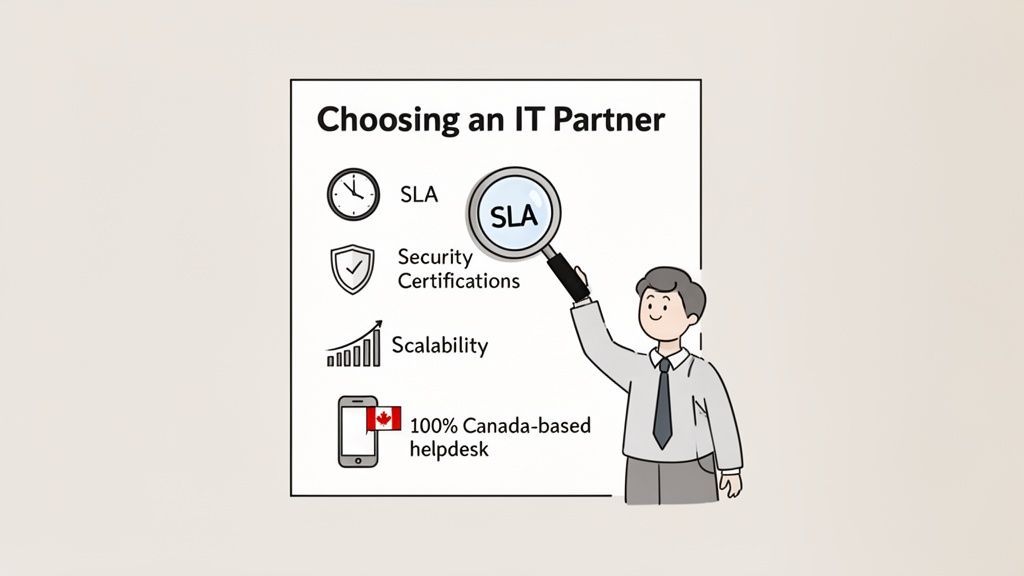
Before you consider signing a contract, there are a few non-negotiables you need to verify. These are the fundamentals that separate a true managed services provider from a simple "break-fix" shop.
Your evaluation comes down to three key areas:
The push for modern IT is significant. The Canadian IT services market is projected to be worth USD 60.08 billion in 2025 and is on track to reach USD 128.46 billion by 2030, largely due to cloud and AI adoption. Here in Alberta, that trend is even stronger, making a future-ready partner essential. You can find more details about Canada's IT services market growth on mordorintelligence.com.
Once you have a shortlist, it is time to dig deeper. The way a provider answers specific, challenging questions will tell you everything you need to know about their real-world capabilities. Do not hesitate to ask for concrete examples.
Here are a few questions that will get straight to the point:
To help you stay organized during your evaluation, we have prepared a simple checklist. Use this to compare providers and ensure you cover all your bases before making a final decision.
| Evaluation Criteria | Key Questions to Ask | Red Flags to Watch For |
|---|---|---|
| Service Level Agreement (SLA) | "Can I see your SLA? What are your guaranteed response and resolution times for critical, high, medium, and low-priority tickets?" | Vague promises of "fast service" with no contractual guarantees. SLAs that only cover response time, not resolution time. |
| Technical Expertise & Certifications | "What certifications do your technicians hold? Can you provide examples of how you have supported businesses in my industry (e.g., healthcare, manufacturing)?" | No industry-specific experience. A lack of recognized certifications (e.g., CompTIA, Microsoft, Cisco). Inability to discuss compliance standards like PIPEDA. |
| Proactive Support & Monitoring | "What tools do you use for remote monitoring and management (RMM)? How do you handle preventative maintenance like patching and updates?" | A purely reactive "break-fix" model. No clear process for proactive maintenance. They only act when something breaks. |
| Security & Compliance | "What is your process for incident response? What security tools are standard in your service package (e.g., MFA, EDR, email filtering)?" | A weak or undefined security stack. Vague answers about data protection or compliance with Canadian privacy laws. |
| Helpdesk & Communication | "Is your helpdesk based in Canada? What are your support hours? Who is my primary point of contact for strategic planning?" | Outsourced helpdesks (potential communication and data residency issues). Limited support hours that do not match your business needs. |
| Onboarding & Offboarding | "What does your onboarding process look like? What happens if we decide to part ways? How do you ensure a smooth transition of data and credentials?" | A disorganized or rushed onboarding plan. No clear offboarding process, which could leave you in a vulnerable position. |
| Strategic Partnership (vCIO) | "How often will we meet to review our technology roadmap and budget? How do you help us plan for future technology investments?" | The provider acts more like a vendor than a partner. They do not offer strategic guidance or regular business reviews. |
| Scalability & Pricing | "How does your pricing model scale as our company grows or shrinks? Are there any hidden fees I should be aware of?" | Inflexible contracts or pricing models that do not align with your business goals. A lack of transparency in their billing. |
Remember, this decision is about finding a true strategic ally who will actively help your business succeed. For more tips on what separates the good from the great, check out our guide on what to look for in IT support companies.
Understanding the finances and logistics of engaging an IT partner can feel daunting, but it does not have to be. For many Edmonton businesses, the greatest relief comes from replacing unpredictable break-fix bills with a clear, consistent investment. It is a transformative move that not only simplifies budgeting but also aligns your IT provider with your goals.
The most common structure is a flat-rate monthly fee. This predictable cost eliminates the surprise invoices that are a hallmark of the old break-fix model, where you are billed for every call and repair. With a managed services plan, your partner is incentivized to keep your systems running smoothly to prevent problems, not profit from your downtime.
While a flat monthly fee is standard, how that fee is calculated can vary. Familiarizing yourself with these models will help you find the best fit for your company’s budget and operational style.
The primary benefit of any modern pricing structure is predictability. A transparent, flat-rate fee transforms IT from a chaotic operational expense into a stable, strategic investment. That is how you plan for growth with confidence.
One of the biggest concerns we hear from business leaders is about the disruption of switching IT providers. A professional partner anticipates this and arrives with a structured, transparent onboarding process designed to make the transition seamless. It is a well-managed project, not a weekend scramble.
A typical onboarding journey follows a clear path to ensure nothing is missed:
This methodical approach guarantees a smooth handover, turning what could be a moment of anxiety into a confident step forward. For more tips on building a great relationship from the start, read our guide on how to get more out of your IT provider.
Looking ahead, the most significant technology trends are not just buzzwords, they are real opportunities for Edmonton businesses to build a serious competitive advantage. Staying current means you stop seeing IT as just another expense and start treating it as your most powerful investment for growth.
The demand for expert Edmonton IT services is accelerating rapidly. It is part of a larger trend across the country, where Canada's IT professional services market reached over USD 93 billion in 2024 and is projected to exceed USD 161 billion by 2030. That level of growth indicates one thing: businesses are leaning heavily on technology to succeed. You can learn more about Canada's booming IT services sector on grandviewresearch.com.
For your business, this all comes down to focusing on outcomes, not just tools. Three key areas are set to define the next wave of operational excellence and help you stand out from the competition.
Embracing these advancements is not about chasing every new gadget. It is about partnering with a forward-thinking IT provider who can translate these powerful technologies into smarter operations, a more secure business, and new avenues for sustainable growth.
Navigating the world of IT services can feel like learning a new language, with its own jargon and complexities. To provide clarity, here are straightforward answers to the questions we hear most often from business and IT leaders in Edmonton.
The most significant difference comes down to a single concept: being proactive.
Traditional IT support is reactive. When something breaks, you call for help, and a technician fixes it. This "break-fix" model means you are always a step behind, waiting for a problem to disrupt your workday, which almost always results in unexpected costs and downtime.
Managed IT services reverse that model. Our focus is on preventing problems before they happen. Through constant monitoring, regular maintenance, and strategic planning, we keep your systems healthy and secure. It is all covered under a predictable monthly fee, so our goal is to maintain smooth operations, not just to respond when disaster strikes.
Yes, absolutely. In fact, for most medium-sized organizations, it is far more cost-effective than hiring a full-time in-house IT person.
Consider this: with a managed services provider (MSP), you gain access to an entire team of specialists, cybersecurity experts, network engineers, cloud strategists, plus enterprise-grade tools. All of this is available at a fraction of the cost of a single IT employee's salary and benefits.
For many small and medium-sized organizations, managed services provide access to a level of expertise and technology that would otherwise be out of reach. It levels the playing field, allowing smaller companies to compete more effectively.
Furthermore, the predictable monthly fee makes budgeting simple. You can finally eliminate those large, surprise repair bills that always seem to appear at the worst possible time. It is a smart, scalable investment that grows with your business.
When you work with an experienced partner, the transition is designed to be as smooth and non-disruptive as possible. A professional provider will have a structured onboarding process that is not just a "flick of a switch." It starts with a thorough assessment of your current setup, followed by a detailed migration plan where we communicate with you every step of the way.
Our primary role during a transition is to manage everything seamlessly behind the scenes. This allows you and your team to remain focused on your core business, without worrying about technical hiccups or data being lost in the process.
Not at all. In fact, you will gain more strategic control over your technology.
By delegating the day-to-day technical tasks and troubleshooting to experts, you free up your own time and mental energy. This allows you to focus on the bigger picture: how technology can help you achieve your business objectives.
A good MSP acts as your strategic partner, think of us as your virtual Chief Information Officer (vCIO). We provide the insights and recommendations you need to make smart, informed decisions about your company’s technology roadmap. You remain in the driver's seat; you just have an expert team helping you navigate.
Ready to turn your technology from a challenge into a strategic asset? At CloudOrbis Inc., we provide proactive, reliable, and secure IT services that help Edmonton businesses thrive. Let's build your IT roadmap together.
Book a 30-minute call with a senior engineer. No sales script, just straight answers about your environment.


