What Is Managed Services in AWS? a Guide for CA Businesses
Wondering what is managed services in AWS? Our guide explains AMS vs. third-party MSPs, core benefits, and how Canadian businesses can choose the right partner.

Wondering what is managed services in AWS? Our guide explains AMS vs. third-party MSPs, core benefits, and how Canadian businesses can choose the right partner.
Managed services in AWS means outsourcing the day-to-day operation of your AWS environment to either AWS itself or a specialised third-party provider. In AWS's own model, AWS Managed Services includes more than 150 managed guardrails and security checks, and AWS states that 80% of incidents are proactively detected and notified.
If you're asking this question, you're probably already feeling the pressure. Your team moved workloads into AWS for flexibility, but now someone still has to watch alerts, approve changes, handle backups, patch systems, review security findings, and explain cloud spend when the monthly bill shifts. For many Canadian businesses, the cloud solved one infrastructure problem and created an operations problem.
That's why managed services matters. It's not just about convenience. It's about deciding who will run the operational layer of your cloud environment well enough that your internal team can focus on applications, users, and business priorities instead of chasing tickets at odd hours.
A lot of organisations start in AWS with a simple assumption: once the workloads are in the cloud, operations will get easier. Some things do get easier. Procuring hardware, adding capacity, and provisioning environments is faster. But the operational burden doesn't disappear. It changes shape.
In practice, someone still needs to own:
A common question is, what are managed services in AWS really buying me? The answer is operational discipline. You're paying for a defined way to run cloud infrastructure consistently, not just for technical access to AWS tools.
The category itself is growing. The North America AWS Managed Services market was valued at USD 178.34 million in 2024 and is projected to reach USD 619.84 million by 2032, growing at a rate of 16.5%, according to Data Bridge Market Research's North America AWS managed services market analysis. That matters because it reflects a broader shift. More organisations are deciding that keeping AWS stable, secure, and cost-aware requires a dedicated operating model, not ad hoc effort from an already busy IT team.
Practical rule: If your cloud environment is important enough to the business, it's important enough to need clear operational ownership.
For Canadian leaders, that decision usually isn't just technical. It affects governance, audit readiness, service continuity, and whether your staff can support growth. If you want a broader view of how this operating model fits into cloud strategy, this article on managed cloud computing for business leaders is a useful companion.
The key mistake is treating managed services as a generic checkbox. It isn't. There are different models, and they suit different organisations. Some are highly standardised and designed for repeatable operations at scale. Others are more hands-on, more consultative, and more aligned to local business and compliance realities.
That distinction matters a lot in Canada, where cloud decisions often involve data residency, support expectations, and regulated workflows. The right question isn't only what managed services in AWS is. The better question is who should manage your AWS environment, and under what operating model.
When business leaders hear “AWS managed services,” they often assume there's one thing being sold. There isn't. In practice, there are two main models.
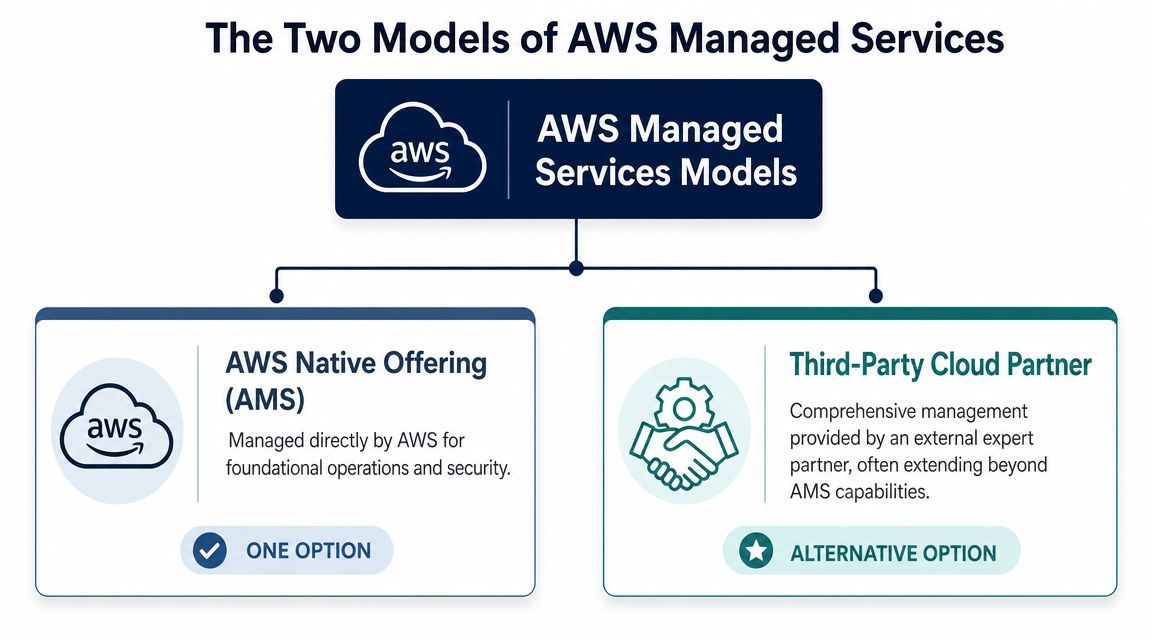
The first model is AWS Managed Services (AMS) itself. AWS introduced AMS in 2014, and AWS says it extends a customer's team with capabilities such as monitoring, incident management, security, patching, backup, and cost optimisation, while providing 150+ managed guardrails as part of its operating model, as described on the AWS Managed Services overview.
The best analogy is a car manufacturer's official service programme. It's designed around standard procedures, approved methods, and a repeatable framework. That can be a strong fit if you want consistency, defined controls, and enterprise-style governance.
AMS was built for large-scale, structured operations. That's useful when your priority is standardisation across accounts and workloads. It may be less ideal if you want a partner that adapts thoroughly to your internal processes, business rhythms, or local regulatory concerns.
The second model is working with a third-party managed services provider, often an AWS-focused partner that operates and supports your environment on your behalf. This model is more like working with a specialist mechanic who knows your fleet, your routes, and your operating constraints.
A third-party MSP can go beyond baseline operations. It may help with architecture decisions, cloud migration planning, policy design, user support, vendor coordination, and strategic roadmap work. In other words, it often blends cloud operations with advisory support.
For organisations running event-driven systems and data platforms, it also helps to evaluate how specialised your partner really is. A technical comparison like Streamkap versus Msk is a good reminder that service quality often comes down to depth in the stack, not just broad cloud branding.
The question isn't whether one model is universally better. It's whether you need a platform-operated service or a relationship-driven operating partner.
The practical difference usually appears in areas like these:
If security oversight is part of your evaluation, this guide to security managed services for modern organisations is worth reviewing alongside your AWS plan.
A managed service only has value if it covers the work that causes problems when no one owns it. That means you should judge any provider by capabilities, not by marketing language.
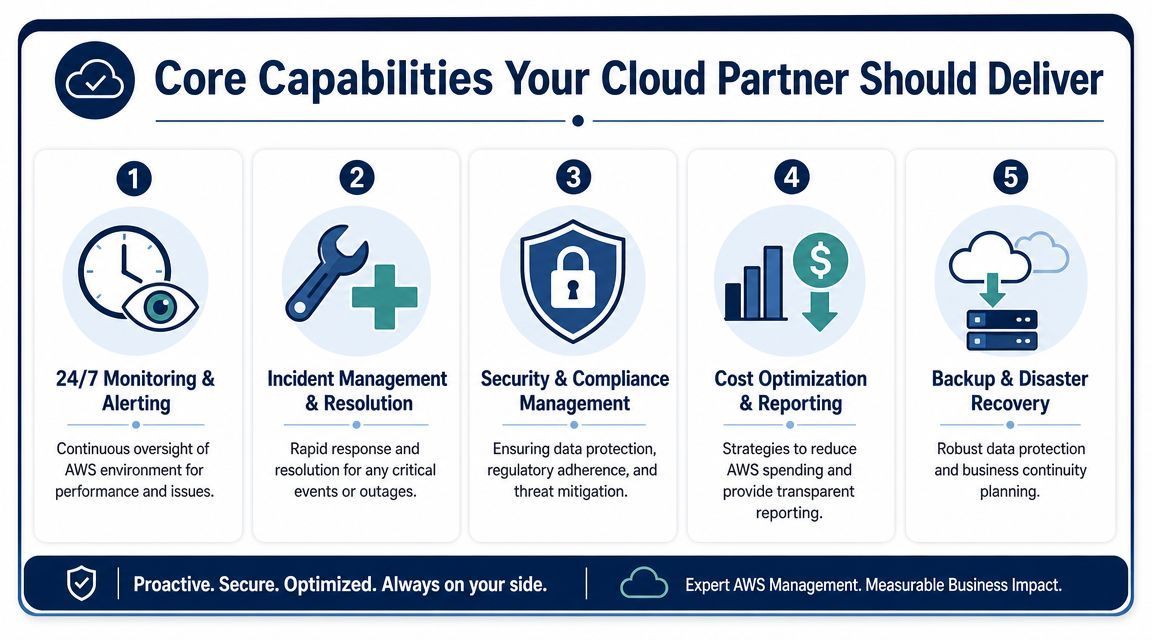
The first baseline is continuous monitoring and incident response. Alerts by themselves don't solve anything. Someone has to interpret them, decide what matters, escalate correctly, and document the response.
If your provider says it monitors your environment, ask what happens after the alert. Do they investigate? Do they act? Do they own the handoff if an outage affects production? Good cloud operations reduces noise and speeds up decisions.
The next layer is routine operational care. Many internal teams struggle with this, as the work is necessary but rarely urgent until something breaks.
You should expect:
A lot of cloud incidents aren't dramatic security events. They come from neglected maintenance, failed changes, and restore processes no one has validated.
Security management needs to be active, not theoretical. That includes reviewing findings, maintaining preventive controls, supporting audit evidence, and making sure operational shortcuts don't create compliance problems later.
Cost management matters too, but it should be handled with context. A good provider doesn't just cut spend. It helps you understand whether the environment is sized correctly for risk, performance, and business use.
Good managed services should lower operational friction without reducing visibility. If a provider makes decisions but can't explain them, that's a warning sign.
One way to benchmark these expectations is against a broader managed infrastructure model. This overview of infrastructure managed services helps frame what “full responsibility” should include beyond simple cloud administration.
Use these questions in any provider conversation:
Those answers tell you far more than a generic service brochure.
Most Canadian SMBs don't need a theoretical definition. They need a buying framework. The clearest way to compare the options is to line them up against the issues that affect day-to-day operations and governance.
| Criterion | AWS Managed Services (AMS) | Third-Party MSP (e.g., CloudOrbis) |
|---|---|---|
| Operating model | Standardised AWS-run service built around repeatable controls and defined processes | More flexible service model shaped around your environment and business needs |
| Best fit | Organisations that want enterprise-style governance and consistent AWS-native operations | SMBs and mid-market firms that want support aligned to internal realities |
| Customisation | More structured and less personalised | Usually easier to tailor workflows, reporting, escalation, and advisory support |
| Canadian compliance context | Can support in-country AWS deployment, but may not be built around local business nuance | Often better suited when you need a partner that understands Canadian privacy and sector expectations |
| Strategic support | Strong on managed operations within the AWS framework | Often broader, including planning, optimisation, and business-facing guidance |
| Support relationship | AWS service model and operating procedures | Direct relationship with a partner team that may act as an extension of internal IT |
| Service scope | Focused on AWS operational management | Can extend into adjacent IT, security, user support, and business continuity processes |
If your organisation values a consistent AWS-led operating model, AMS may be the right fit. This usually suits environments where standardisation matters more than local tailoring.
If your business needs your provider to understand internal politics, compliance concerns, leadership expectations, and service realities on the ground, a third-party MSP often works better. That's especially true when your cloud environment is only one part of a broader IT estate.
A useful outside perspective is this guide for technical leaders vetting MSPs. It's helpful because it pushes the evaluation beyond features and into operating maturity, responsiveness, and fit.
Watch for these patterns during selection:
“The best managed service is the one that matches how your business actually runs, not the one with the longest feature list.”
If you're comparing providers in more detail, this overview of managed services companies and evaluation criteria can help sharpen the shortlist.
For Canadian SMBs, managed AWS operations becomes strategic when the internal team is capable but stretched. The value isn't only technical coverage. It's the ability to operate with more discipline without hiring a full internal cloud operations function.
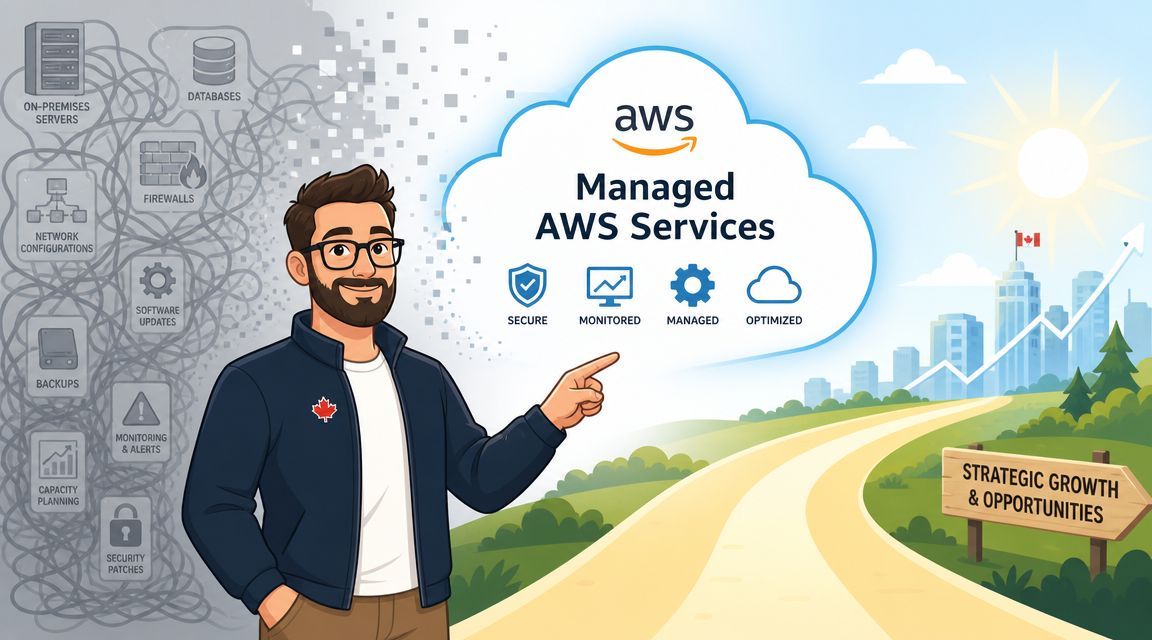
For many organisations in healthcare, finance, legal, and other regulated sectors, the issue isn't just who patches systems. It's whether data, logs, backups, and operational access can stay aligned with Canadian expectations.
AWS documentation confirms that using AWS Canada (Central) Region in Montreal is important for data residency and sovereignty needs, and that combining in-country infrastructure with managed operations can simplify compliance considerations for regulations such as PIPEDA, particularly in sectors like healthcare and finance, as outlined in the AWS Managed Services shared delivery documentation.
That has practical implications. If your workloads sit in Canada but your support process, access model, backup handling, or incident workflow creates unnecessary cross-border exposure, you haven't really solved the compliance question. You've only moved it.
For an SMB leader, the strongest benefits usually look like this:
A good managed model can also support broader business goals. This perspective on how managed software services can drive measurable business growth is useful because it connects operational stability to execution speed and management focus.
A local MSP can have an advantage. A Canada-based provider may be better positioned to discuss residency, support access, privacy expectations, and escalation paths in plain business terms. That matters when executive teams need clear answers, not generic cloud language.
CloudOrbis is one example of this model. It provides Canada-based managed IT and cloud support, which can matter for organisations that want AWS operations connected to broader security, user support, and continuity planning rather than handled in isolation. If that wider operating view is relevant, this overview of information technology managed services in Canada gives useful context.
The right path usually becomes clear once you stop asking for a generic definition and start looking at operating fit.
Use this checklist with your leadership and IT team:
What works is clarity. Clear ownership. Clear support boundaries. Clear escalation paths. Clear reporting. Whether you choose AMS or a third-party MSP, those basics matter more than polished messaging.
What doesn't work is a half-managed environment. That's the setup where tools are in place, but no one is fully accountable. Alerts go to several people. Backups exist, but testing is informal. Security findings are visible, but deferred. Those environments often look fine until pressure exposes the gaps.
Pick the model that your team can govern consistently. Cloud operations fail more often from unclear ownership than from missing technology.
If your organisation values standardisation and wants AWS to provide the operating model directly, AMS is a logical option. If you want closer collaboration, local context, and support that aligns cloud operations with the rest of your IT function, a dedicated MSP is often the better fit.
If you're weighing those options and want a practical second opinion, CloudOrbis Inc. can help you assess your current AWS operating model, identify support gaps, and decide whether a standardised AWS-native approach or a more customized Canada-based managed service makes more sense for your business.
Book a 30-minute call with a senior engineer. No sales script, just straight answers about your environment.


