A Strategic Guide to IT Solutions Calgary for SMBs
Discover the top IT solutions Calgary offers for SMBs. This guide covers managed IT, cybersecurity, and cloud services to help you choose the right partner.

Discover the top IT solutions Calgary offers for SMBs. This guide covers managed IT, cybersecurity, and cloud services to help you choose the right partner.

Choosing the right IT solutions in Calgary is about more than just finding someone to fix your computers when they break. It’s about finding a partner who understands your business goals. In a city built on innovation, the right IT provider is a proactive force that drives your growth, secures your data, and boosts your efficiency. Let's break down what a modern technology partnership looks like for a medium-sized organization.

In a competitive market like Calgary, with major players in energy, healthcare, and manufacturing, a strategic IT partner is no longer a luxury; it's the engine that powers your operations. The traditional break-fix model, where you call for help only when something breaks, is not only outdated but also incredibly costly in the long run.
This guide provides valuable insights into what a genuine IT partnership means for a medium-sized business. You will learn how proactive managed services can transform your technology from a source of unpredictable costs into a powerful, predictable asset that delivers a real competitive edge.
This article walks through the essential services every Calgary business needs, from robust cybersecurity and cloud migrations to reliable data backups. We will also decode the common pricing models you'll encounter, helping you understand the true value behind each one. Consider this your playbook for turning IT from a necessary expense into a strategic advantage.
By the end, you will feel confident enough to ask the right questions and choose a provider who can support your long-term vision. That knowledge is critical for any business leader serious about leveraging technology for growth. For a deeper dive into what to look for, exploring a full overview of Calgary IT services is an excellent place to start.
A proactive IT strategy is about preventing problems, not just reacting to them. The goal is to create a secure and efficient environment where your team can focus on what they do best, driving the business forward.
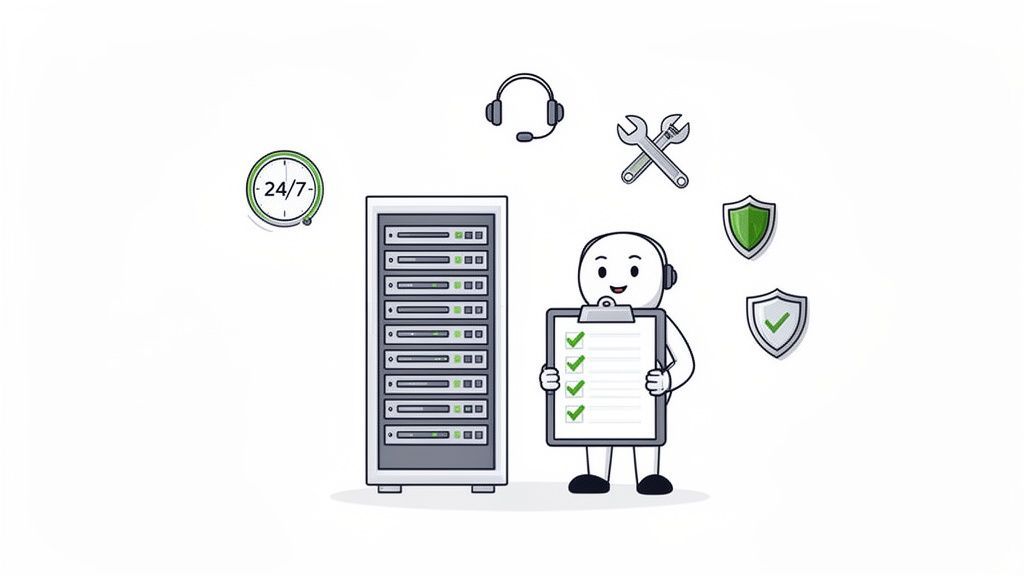
The term "IT support" has often been associated with the old break-fix model, where you only call for help after something has already gone wrong. This reactive process is chaotic, disruptive, and almost always more expensive because you pay a premium for emergency service.
Modern managed IT services flip that script entirely. Think of it less like an emergency repair service and more like a dedicated property manager for your entire digital infrastructure. This partner does not wait for things to break. They constantly perform maintenance, identify issues before they cause downtime, and ensure everything runs at peak performance, 24/7.
This proactive approach is the core of what makes effective IT solutions for Calgary businesses so powerful. Instead of constantly reacting to problems, you get a stable, secure, and efficient technology environment that helps your team be more productive and enables your company to grow.
The real game-changer is the shift from a reactive to a proactive model. A managed services provider (MSP) becomes an extension of your team. Their goals are tied to yours, when your business succeeds, they succeed. This partnership is built on three key pillars that deliver consistent value.
These components work together to create a seamless technology experience for your team:
One of the most significant benefits of this model is gaining control over your budget. The traditional break-fix method leads to unpredictable swings in IT costs. One month might be quiet, but the next could bring a sudden server replacement bill, making financial planning a challenge.
Managed services convert that unpredictable cost into a fixed, predictable monthly fee. This single operational expense covers everything from daily maintenance and helpdesk tickets to cybersecurity monitoring and strategic advice.
By moving to a managed model, businesses can reduce IT operational costs by up to 40% while simultaneously improving service quality and uptime. It’s not just about saving money; it’s about investing in stability and efficiency.
This predictable cost gives you access to enterprise-grade tools and a team of specialists that would be prohibitively expensive to build in-house. It allows you to budget effectively and reinvest those savings into other areas of your business. To see what this looks like in more detail, you can explore the different types of managed IT services and what they cover. Ultimately, this partnership ensures your technology is an asset that actively contributes to your bottom line, not a liability that drains it.
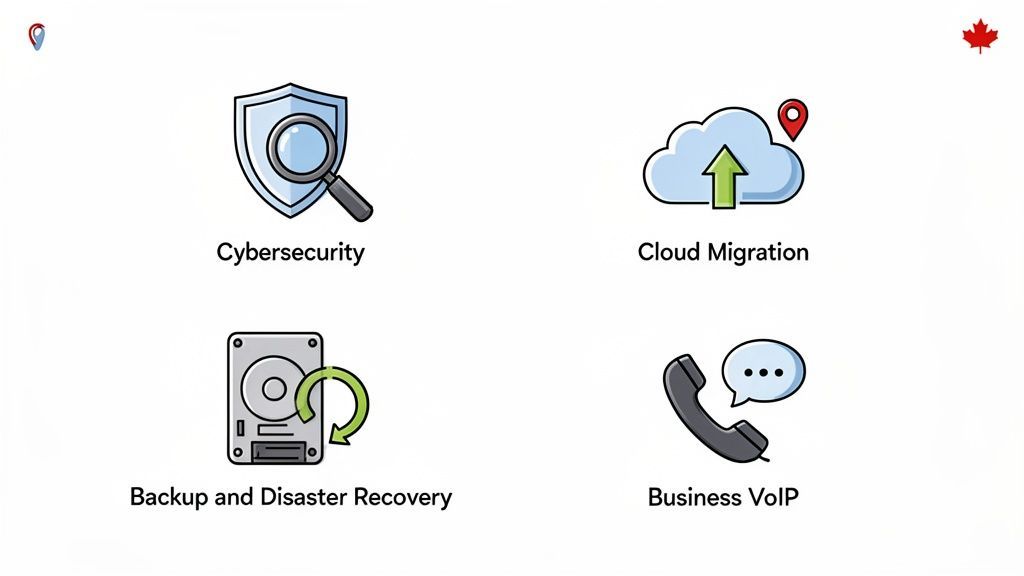
For a Calgary business to truly compete, its IT foundation must be built on several interconnected pillars, all working together. These core services are not just "nice-to-haves"; they are the absolute baseline for resilience, agility, and growth in today's market.
Think of it like the essential systems in a modern building. You need solid security at every entrance, a flexible electrical grid to power different floors, a reliable backup generator for emergencies, and a clear communication system to connect everyone inside. Let's explore what these essentials look like for your business.
Basic antivirus software is no longer sufficient. Modern cybersecurity is an active, ongoing effort that assumes threats are always trying to get in and works tirelessly to find and neutralize them before they can do real damage. It is all about building layers of defence.
This means being proactive. We are talking about vulnerability assessments that actively scan your network for weak points and endpoint protection that secures every device connected to it, from servers and laptops to mobile phones. This is your front-line defence against ransomware, data breaches, and other attacks that can bring a business to its knees.
Cybersecurity is the fastest-growing segment of Canada's IT industry, and Calgary businesses are at the forefront, especially given the high stakes in industries like oil and gas. The IT Security sector is projected to grow at an 11.2% CAGR through 2030. In Calgary, this translates to a high demand for managed security as cyber-insurance requirements become stricter and ransomware gangs specifically target energy supply chains.
The cloud is much more than just a place to store files online; it’s a complete shift in how businesses operate. Moving your infrastructure to platforms like Microsoft Azure or fully embracing tools like Microsoft 365 gives your team the power to work securely from anywhere, at any time.
This move, known as a cloud migration, unlocks new levels of collaboration and efficiency. Instead of being tethered to a server in a closet, your team can access shared files, communicate in real-time, and run critical software from a centralized, secure platform. A successful migration requires careful planning to ensure zero downtime and a smooth transition for your employees. To get a better feel for the possibilities, you can explore our guide on how to approach cloud solutions in Calgary strategically.
At the heart of many businesses are systems that manage everything from customer relationships to finances. For a deep dive into these capabilities, it's worth exploring integrated business management platforms like Microsoft Dynamics 365.
Ask yourself this: what would happen if a fire, flood, or critical server failure hit your office tomorrow? Without a robust backup and recovery plan, the answer is likely catastrophic data loss and days, or even weeks, of downtime. This is where a Business Continuity and Disaster Recovery (BCDR) plan is absolutely vital.
A BCDR plan is your business's insurance policy against the unexpected. It’s not just about backing up files; it’s a detailed strategy to get your entire operation back online quickly and efficiently after any incident.
A proper BCDR strategy involves:
With a solid plan in place, you can reduce potential downtime from days to mere minutes, protecting your revenue, reputation, and the trust you have built with your customers.
Traditional phone systems are becoming outdated. Business Voice over IP (VoIP) uses your internet connection for calls, delivering far more flexibility and functionality than a traditional landline. A modern VoIP system integrates all your team's communication, voice, video conferencing, and messaging, into a single, easy-to-use platform.
This is especially critical for businesses with remote or hybrid teams. Your employees can make and receive calls from their business number on any device, whether it’s a desk phone in the office, a laptop at home, or their smartphone on the go. It ensures seamless communication with clients and colleagues, helping you maintain a professional image no matter where your team is working.
A generic, one-size-fits-all IT plan is a recipe for frustration and wasted resources. Calgary’s core industries are far too specialized for off-the-shelf solutions. Each sector faces unique operational challenges, security threats, and regulatory hurdles that demand a purpose-built IT strategy.
When your technology is aligned with what makes your industry tick, it stops being a cost centre and becomes a genuine competitive advantage. An effective IT partner takes the time to understand those distinct needs, building a resilient, secure, and productive environment that helps you achieve your business goals.
For Calgary’s vital oil and gas industry, IT is much more than the computers in the head office. It is the lifeline connecting remote field operations to decision-makers and the shield protecting critical infrastructure. Operations often depend on rugged hardware that can withstand harsh conditions and reliable networks that remain stable in remote locations.
Cybersecurity here is paramount. With so much at stake, energy companies are prime targets for cyberattacks, making robust security protocols and 24/7 threat monitoring non-negotiable. Many organizations in this space find a co-managed IT model works best, allowing an external expert to supplement their internal team with specialized security expertise.
In healthcare, protecting patient data is not just good practice, it is the law. Calgary's clinics, medical facilities, and practitioners must operate under the strict rules of the Personal Information Protection and Electronic Documents Act (PIPEDA). This makes data encryption, secure networks, and rigid access controls fundamental.
A healthcare-focused IT strategy always prioritizes these three areas:
For manufacturing and construction firms, every second counts. Operational efficiency separates profitable projects from losing ones. Technology is the glue that connects job sites, manages complex supply chains, and keeps workflows moving. This is where scalable cloud services shine, allowing these businesses to scale resources up or down to match project demands.
A unified Business VoIP system is also a game-changer, connecting office staff with crews in the field on a single, reliable communication platform. When you need clear, constant contact to meet tight deadlines and maintain on-site safety, you cannot afford dropped calls or unreliable service. For a deeper look at how we support these sectors, feel free to explore our approach to industry-specific IT solutions.
A tailored IT strategy addresses the specific pain points of an industry. For a construction firm, that means resilient connectivity at a new job site; for a law firm, it means impenetrable data encryption and secure file sharing.
Calgary's position as the heart of Canada's energy sector has fueled significant demand for IT services, with aggressive digitization in oil and gas driving above-average market growth. This trend makes professional IT support more accessible, with managed IT services in Calgary typically costing between $95-$150 per user per month. This pricing is ideal for SMBs, from healthcare clinics needing PIPEDA-compliant setups to manufacturing outfits scaling with VoIP and cloud migrations. Underscoring this boom, eStruxture announced in October 2024 a USD 540 million AI-ready data centre in Calgary, adding 90 MW of power to fuel this expansion. You can find more insights on the Canadian IT services market growth on mordorintelligence.com.
For lawyers and financial professionals in Calgary, confidentiality is everything. Their reputation is built on data integrity. A single data breach is not just an inconvenience; it can be catastrophic, making top-tier cybersecurity an absolute necessity. The right IT partner for this sector understands the critical importance of data encryption, both for information at rest on servers and for files in transit across networks.
Beyond that, secure file-sharing platforms are essential for collaborating with clients without putting sensitive information at risk. Any IT strategy for these firms must also be built around their strict regulatory requirements, ensuring every piece of technology and every process meets the compliance standards set by their governing bodies.
The needs of Calgary’s industries are diverse, but they all share a common thread: technology must be a reliable, secure, and strategic asset. The table below breaks down the primary focus for each of our city's key sectors.
A summary of the primary IT focus areas and required solutions for Calgary's key business sectors.
| Industry Sector | Top IT Priority | Essential Solutions |
|---|---|---|
| Oil & Gas | Operational Uptime & Infrastructure Security | Ruggedized Hardware, Co-Managed Security, Remote Connectivity |
| Healthcare | Patient Data Protection & PIPEDA Compliance | Encrypted Networks, Secure EHR Management, Access Controls |
| Manufacturing | Production Efficiency & Supply Chain Integration | Cloud Scalability, Business VoIP, Process Automation |
| Construction | Job Site Connectivity & Project Management | Mobile Device Management, Resilient Networks, VoIP Systems |
| Legal & Financial | Confidentiality & Data Integrity | Advanced Encryption, Secure File Sharing, Compliance Auditing |
As you can see, a cookie-cutter approach does not work. The right IT support comes from a team that knows your industry's pressures and speaks your language.
Making a smart investment in your company’s technology begins with understanding the costs. When you look for IT solutions in Calgary, you'll encounter a few different ways providers structure their pricing. Getting this choice right is crucial, it directly affects your budget, the efficiency of your business operations, and your ability to plan for the future.
Let’s walk through the most common models you will find. This will help you confidently select the one that best fits your business goals and financial strategy.
The oldest and most straightforward approach is the break-fix model. It’s exactly as it sounds: when something breaks, you call a technician. They arrive, fix the problem, and you receive a bill for their time and any parts needed.
While it seems simple, this reactive approach has serious hidden costs. You are not just paying for the repair; you are also paying in lost productivity, frustrated employees, and potential damage to client relationships while your systems are down. Because the provider is only paid when you have a problem, there is no incentive for them to prevent issues from occurring in the first place.
This model often traps businesses in a frustrating cycle of recurring problems and unpredictable, often shockingly high, invoices for emergency support.
In stark contrast, the managed services model is all about prevention and predictability. Instead of waiting for things to go wrong, you pay a consistent, flat monthly fee, usually per user or per device. In return, you get a dedicated partner who is constantly monitoring, maintaining, and optimizing your entire IT environment behind the scenes.
This all-in-one approach covers everything from 24/7 helpdesk support and cybersecurity monitoring to data backups and long-term strategic planning.
The real value of managed services is that it aligns our goals with yours. We are financially motivated to keep your systems running smoothly because fewer problems for you mean more efficiency for us. This model transforms IT from a volatile capital expense into a predictable operational one.
The powerful ROI becomes clear when you weigh the monthly fee against the immense costs of downtime, a data breach, or hiring even a single full-time IT staff member.
What if you already have an IT person or a small team in-house? The co-managed IT model offers the perfect hybrid solution. It’s a collaborative partnership where an external provider like CloudOrbis complements your existing staff, filling expertise gaps and handling more time-consuming tasks.
This has become a popular choice for Calgary businesses that need specialized help in complex areas, like advanced cybersecurity or cloud infrastructure management. Your internal team can focus on big-picture strategic projects while your managed provider handles the day-to-day monitoring, helpdesk tickets, and after-hours support. It truly gives you the best of both worlds: dedicated internal knowledge backed by enterprise-grade external resources.
To help you decide which model fits best, here's a quick comparison.
| Feature | Break/Fix Model | Managed Services Model | Co-Managed Model |
|---|---|---|---|
| Cost Structure | Unpredictable, hourly rates | Flat, predictable monthly fee | Predictable monthly fee, often project-based additions |
| Service Approach | Reactive (fixes problems after they occur) | Proactive (prevents problems before they start) | Collaborative (proactive support for specific functions) |
| Business Suitability | Best for very small businesses with minimal IT needs and high risk tolerance | Ideal for SMBs wanting to outsource all IT for stability and growth | Perfect for companies with an internal IT team needing extra capacity or specialized skills |
Each model serves a different purpose, but for most growing SMBs in Calgary, the stability and strategic advantage of a managed or co-managed approach far outweigh the perceived simplicity of break-fix.
The infographic below shows how different IT needs map to Calgary's key industries, helping you visualize where your focus should be.
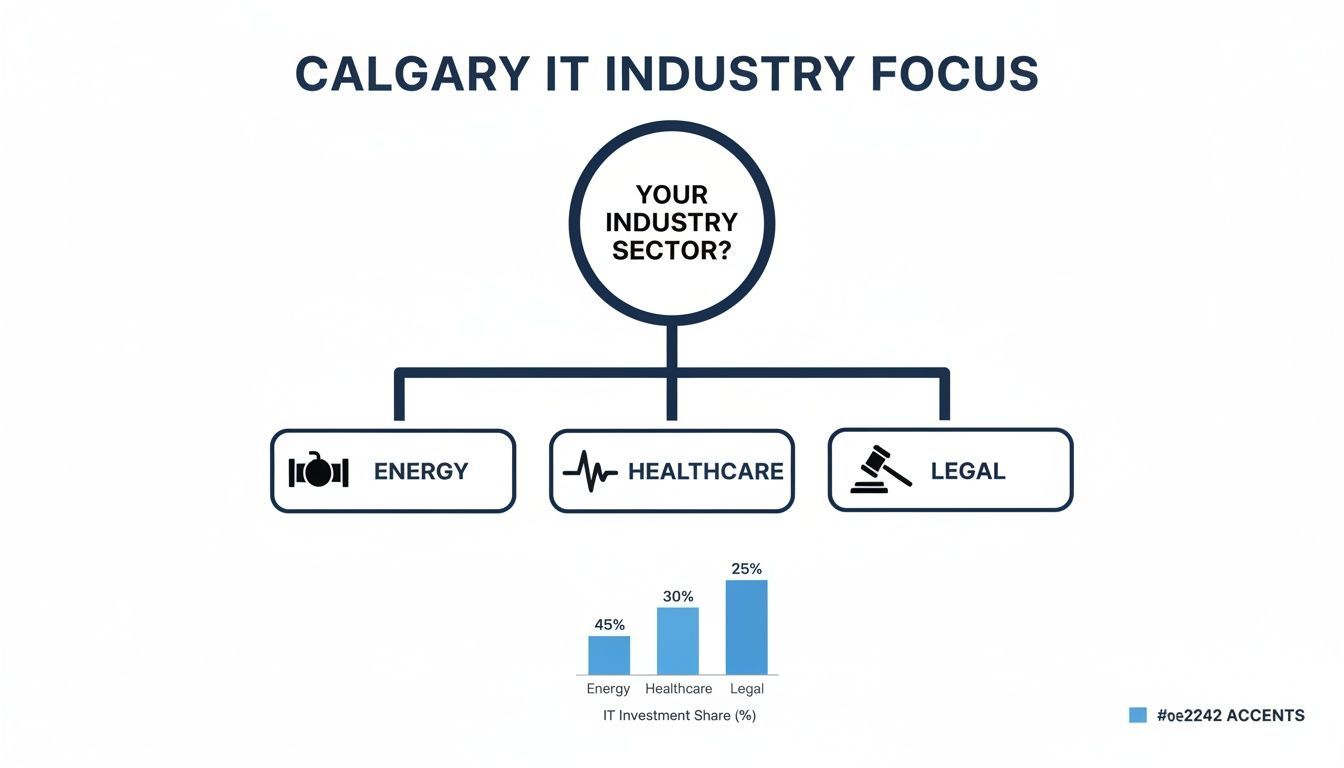
This visual highlights that while every industry needs solid IT, the specific priorities, like robust infrastructure for energy or tight compliance for healthcare, drive different investment decisions.
Cloud adoption is reshaping Calgary's IT scene, with more businesses moving to hybrid solutions that mix on-premise and cloud resources. This shift is driving demand for professional and managed IT services to new highs. For SMBs, the savings are significant: a managed plan for 10-20 users can cost $1,900-$3,000 per month, a fraction of the $95,000-$130,000 annual salary for a single in-house employee.
This trend is part of a larger movement across the country. Canada's IT services market is projected to grow from USD 25.4 billion in 2024 to USD 71.8 billion by 2033, fueled by this wave of digital transformation. You can learn more about these market trends on imarcgroup.com.
You have a handle on the services and pricing models, now for the most important part: the who. Selecting the right partner for your IT solutions in Calgary is a major business decision. It will directly impact your security, day-to-day efficiency, and your ability to grow in the future.
To make the right choice, you need to ask the right questions. You also need to know what a healthy, transparent partnership looks like from the start. This is about more than hiring a vendor; you are looking for a team that will feel like an extension of your own, one that is actively invested in your success. A good partner does not just fix what's broken, they work with you to stop things from breaking in the first place.
Before you consider signing a contract, you need a checklist of crucial questions. The answers you receive will tell you everything you need to know about a provider's skills, transparency, and whether they are the right fit for your company. Any quality partner will have clear, confident answers for every single one.
Here are the questions you must ask:
From the very first conversation, a partnership should feel structured and professional. There needs to be a clear roadmap showing you exactly what to expect at every stage. If a provider is vague about their process, that is a major red flag.
A great IT partner doesn't just sell you services; they guide you through a strategic journey. The process should begin with listening to your challenges and end with a long-term plan for your success, with clear communication at every step.
A solid engagement process typically looks like this:
This structured approach ensures nothing is missed. As you prepare to make a choice, understanding the finer points of selecting a managed service provider, even for specific platforms, can be a great help. For more tips, our guide on evaluating IT support companies offers even more questions and criteria to consider.
Stepping into the world of managed IT can feel like learning a new language. It is natural to have questions, and we hear many of them from Calgary business leaders. Here are some of the most common ones we receive, with straightforward answers to help clarify things.
For most small and medium-sized businesses, you can expect to budget between $95 and $150 per user, per month. So, if you have a team of 10 to 20 people, you are likely looking at a monthly investment of $1,900 to $3,000 for comprehensive support.
That price typically covers everything from 24/7 monitoring and helpdesk support to robust cybersecurity and data backups. When you compare that to hiring a single in-house IT professional, which can easily cost $95,000 to $130,000 annually before benefits and other overheads, the value becomes clear.
Absolutely. In fact, this is a perfect setup for what we call a co-managed IT partnership. It is not about replacing your internal staff; it is about empowering them.
A co-managed partnership frees up your internal IT team to focus on the big-picture projects that drive your business forward. We handle the daily monitoring, helpdesk tickets, and complex security tasks, giving you the best of both worlds.
Your provider complements your existing IT person by taking on specialized or time-consuming tasks. This gives your team access to enterprise-grade tools and a deep bench of experts without you having to build that team from the ground up. It is a smart way to scale your IT capabilities.
Supporting Calgary's oil and gas industry requires more than just standard IT knowledge. It demands specific, hands-on expertise in the sector’s unique operational challenges, from rugged field equipment to intermittent connectivity in remote locations.
Even more critical is a deep understanding of cybersecurity for protecting critical infrastructure against highly targeted threats. Any provider you consider must have proven experience with industrial control systems and a track record of helping energy companies navigate stringent compliance and security standards.
When done correctly, it should not be disruptive at all. A professional provider will manage the entire transition to be as seamless as possible, led by a dedicated project manager who keeps you informed every step of the way.
A well-planned onboarding process usually unfolds over a few weeks and includes:
The entire point is a smooth, carefully planned handover that allows you and your team to start enjoying better IT support without the headache of a chaotic transition.
Ready to partner with a team that offers proactive, reliable, and secure IT solutions in Calgary? CloudOrbis Inc. provides the strategic support you need to stop worrying about technology and start focusing on growth. Let's build a secure and efficient future for your business together.
Book a 30-minute call with a senior engineer. No sales script, just straight answers about your environment.


