HIPAA Compliance Encryption for Canadian Clinics
HIPAA compliance encryption for Canadian clinics: data at rest, in transit, key control, and when a locked file still counts as a breach.

HIPAA compliance encryption for Canadian clinics: data at rest, in transit, key control, and when a locked file still counts as a breach.

A laptop left in a car overnight. A referral faxed to the wrong number. A spreadsheet emailed to the wrong patient. None of those incidents needs a hacker, and every one of them is a reportable privacy breach that encryption is supposed to prevent.
That gap between what encryption promises and what a clinic deploys is where this topic gets interesting. A cipher on a laptop is a lock on a chart folder. It says nothing about who holds the key, whether the backup restores under pressure, or whether the incident still has to be reported to a regulator.
Work through it in this order: the control map that shows what an auditor expects, the implementation sequence that turns a cipher into a control, the channels that carry patient data every day, the cases where encryption is present and protection still fails, the harm judgement after a lock, and the evidence packet a privacy officer will ask to see.
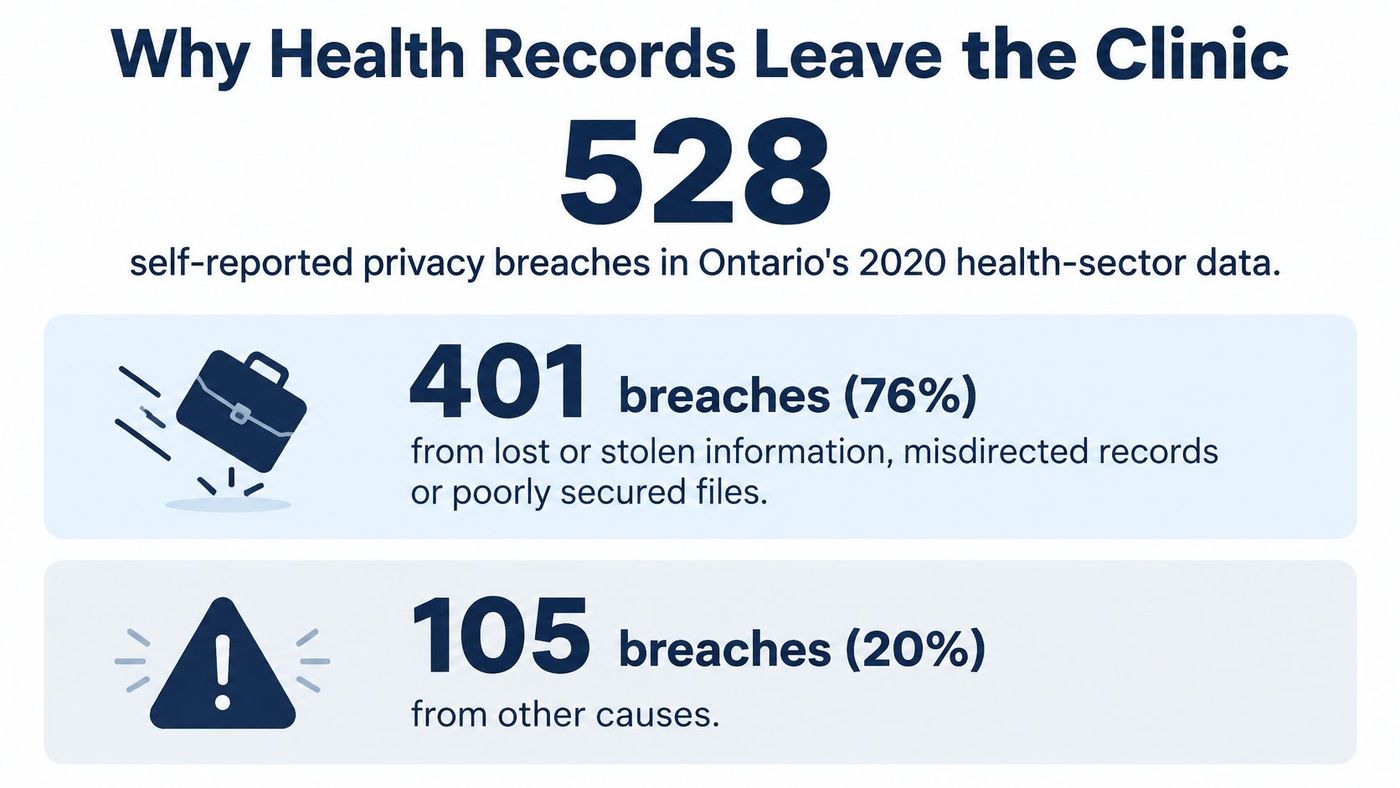
Ontario's privacy commissioner reported 528 self-reported health-sector privacy breaches during 2020 at the 2021 PHIPA Connections Summit, and the composition of that number should reshape how a clinic spends its security budget (Ontario IPC fact sheet).
401 incidents, or 76%, involved lost or stolen personal health information, misdirected information, improperly secured records, or other collection, use and disclosure problems. 105, or 20%, were snooping incidents. 22, or 4%, were ransomware or other cyberattacks.
Read that ordering twice. The expensive, embarrassing, reportable events in a clinic are usually not elaborate intrusions. They're the laptop left in a car, the USB drive in a coat pocket, the referral emailed to the wrong Jennifer.
Picture a paper chart in a locked folder. The lock stops the stranger who finds the folder on a bus seat. It does nothing about the staff member who has the key, or about the chart that gets placed in the wrong courier envelope. Encryption behaves exactly the same way. Full-device and removable-media encryption shrink the exposure when a phone, laptop or backup tape disappears; transport encryption protects what moves between clinics, laboratories, patients and service providers. Neither one addresses a legitimate login used badly.
One clarification before the controls. HIPAA is United States law. An Ontario custodian's daily duty comes from PHIPA, which requires reasonable steps to protect personal health information against theft, loss, unauthorized use and disclosure. Calling an environment "HIPAA-compliant" in a Canadian clinic describes an intention, not a legal status.
Misdirected files deserve their own fix, because they're the single largest category in the commissioner's file. HIPAA-compliant file sharing covers the link expiry, recipient verification and access logging that stop a wrong-recipient email from becoming a notification letter.
The milestone at the end of all this isn't a product label. It's a documented, risk-based program covering data at rest, data in transit, key management, authentication, access control and periodic review. A clinic that can't produce that file hasn't finished, whatever the invoice says.
Six areas decide whether a clinic's HIPAA compliance encryption posture survives a review. Each row names what you're protecting, the practice to enforce, and the artefact that proves the practice is running. Scan the last column first. Any row with nothing behind it is your work list.
| Area | What to protect | Practice to enforce | Evidence to keep |
|---|---|---|---|
| Data at rest | Servers, laptops, phones, USB and backups | Full-disk and database encryption with a peer-reviewed algorithm | Device and repository encryption status report |
| Data in transit | Email, portals, referrals, labs and prescriptions | TLS or encrypted email; encrypted fax only as a documented exception | Channel inventory and exception log |
| Encryption keys | Keys and recovery tokens | Separate key store, rotation, and a tested recovery path | Custodian record and rotation log |
| Authentication | Anyone who can decrypt | Multifactor authentication and role-based access | Quarterly access review |
| Backups | Copies needed after an outage or attack | Immutable or offline copies and a separate admin identity | Restore test with recorded RTO |
| Breach safe harbour | Lost or stolen media holding ePHI | Encryption to the applicable standard and keys not compromised | Incident note on key custody |
HIPAA treats encryption of electronic protected health information as an addressable safeguard, and addressable has never meant optional. A covered entity either implements encryption or documents why it isn't reasonable and appropriate in its specific environment, then deploys an equivalent measure with comparable protection. A missing decision isn't a decision. It's the finding an investigator writes down.
The agency is equally clear that a cipher isn't a complete answer. HHS guidance on cloud computing and HIPAA states that encryption alone cannot adequately protect confidentiality, integrity and availability. That's why the safe-harbour row sits at the bottom of the map rather than at the top. It applies only when the encryption meets the applicable standard and the key stayed out of an attacker's hands.
Canada has no single national HIPAA regime. Canadian healthcare organizations generally operate under provincial health-privacy statutes and, in many commercial settings, the federal Personal Information Protection and Electronic Documents Act. The Office of the Privacy Commissioner of Canada explains that PIPEDA's safeguards principle doesn't prescribe one mandatory technology. Protections must reflect the sensitivity of the information, the volume held, how widely it's distributed and how risks are evolving, and the guidance lists passwords, encryption, firewalls, patches, access restrictions, staff training, audits and testing among the measures that deliver it.
That matters for a clinic marketing itself as HIPAA-compliant while holding Ontario records. The same encryption has to be explained twice, once against HIPAA expectations for any United States patient data or covered-entity work, and once against PHIPA's duty to take reasonable steps. A vendor label doesn't carry that explanation. Your documentation does.
Dictation is a channel that falls outside the map. Secure dictation for clinical staff sets out where recorded notes live, who can retrieve them, and how audio and transcripts are protected while they're in transit, which is exactly the kind of subprocessor detail the key-custody row is meant to catch.
Mark any blank proof column now, before the implementation detail. The blank is the honest starting point.
Encryption can protect health records, but only when the keys, recovery process and supporting safeguards work together. Ontario's Information and Privacy Commissioner identifies four considerations for strong health-information encryption: a rigorously peer-reviewed algorithm, independent testing of its implementation, effective key protection and management, and secure authentication for authorized users (IPC Ontario guidance). The guidance also addresses plaintext remnants in browser caches or laptop storage, secure defaults, and data availability when a password or security token is lost.
Turn those considerations into practical controls.
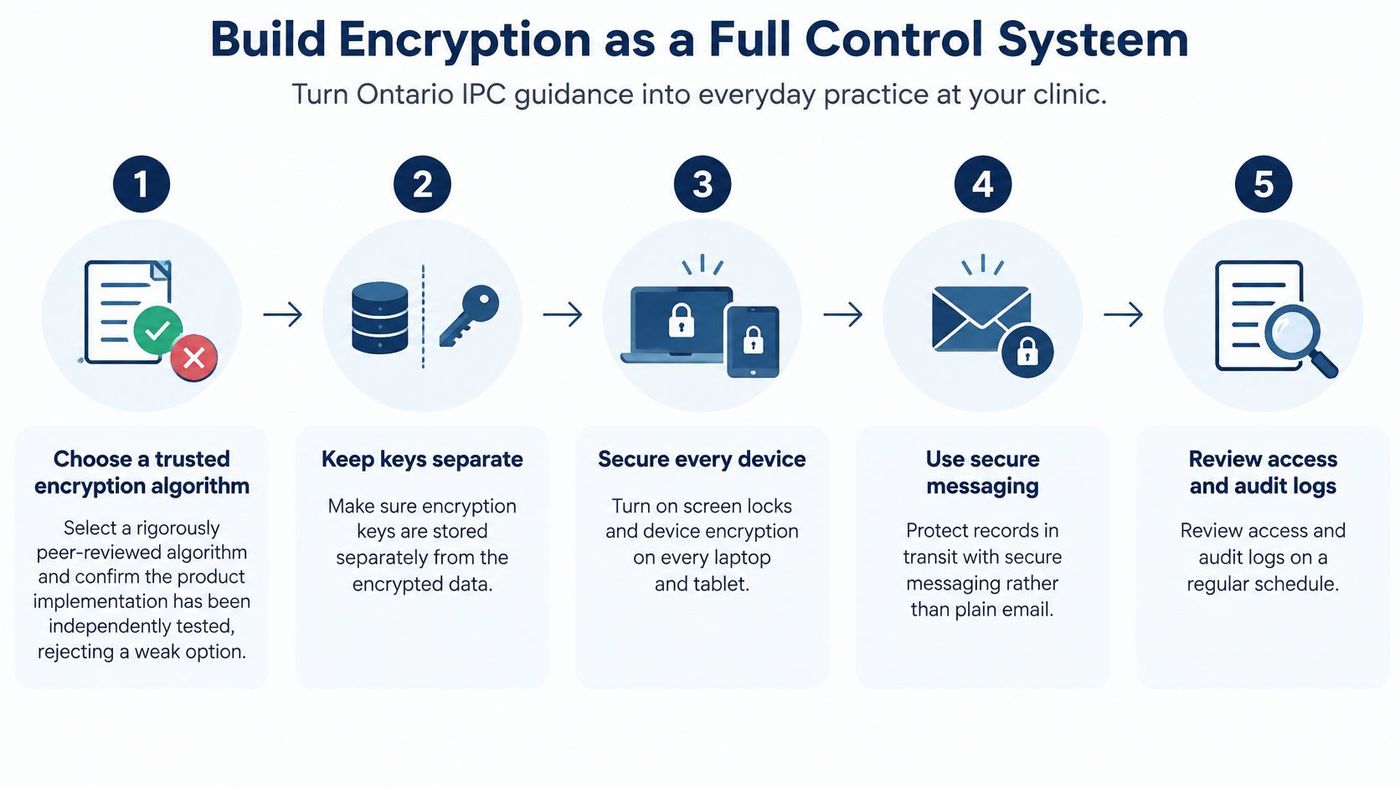
The test that matters: Can you identify who holds the keys and when recovery was last tested? Without clear answers, encryption may create confidence without reliable control.
A clinic may enable full-disk encryption through a management console and then leave recovery keys accessible through the same administrative account that manages the devices. If that account is compromised, the records and the means to decrypt them may be exposed together.
Shared technology providers can create a similar concentration of risk when one administrative identity reaches multiple client environments. Separate key custody, documented access and tested recovery help reduce that risk.
A cipher alone does not establish compliance. The healthcare IT compliance controls, including access reviews, logging, device lifecycle management and audit evidence, help show how encryption fits into a wider program.
Keep the algorithm choice, key location, alert owner and latest recovery-test record together. For clinics subject to HIPAA or Canadian privacy requirements, that evidence helps demonstrate how the control works, not merely that encryption is switched on.
A physician's laptop leaves a car in a parking garage on a Friday night. Full-disk encryption decides whether that becomes a notification letter or a footnote, and it only limits exposure if the key isn't stored on the same laptop and the screen lock is switched on. Allow access to the encrypted volume by password alone and you've handed the finder both halves of the problem.
A referral or a lab result then moves between clinic, laboratory and patient. The Office of the Privacy Commissioner of Canada recommends replacing traditional faxing of personal health information with more secure digital alternatives, naming encrypted email, secure patient portals, electronic referrals and electronic prescribing (OPC joint resolution).
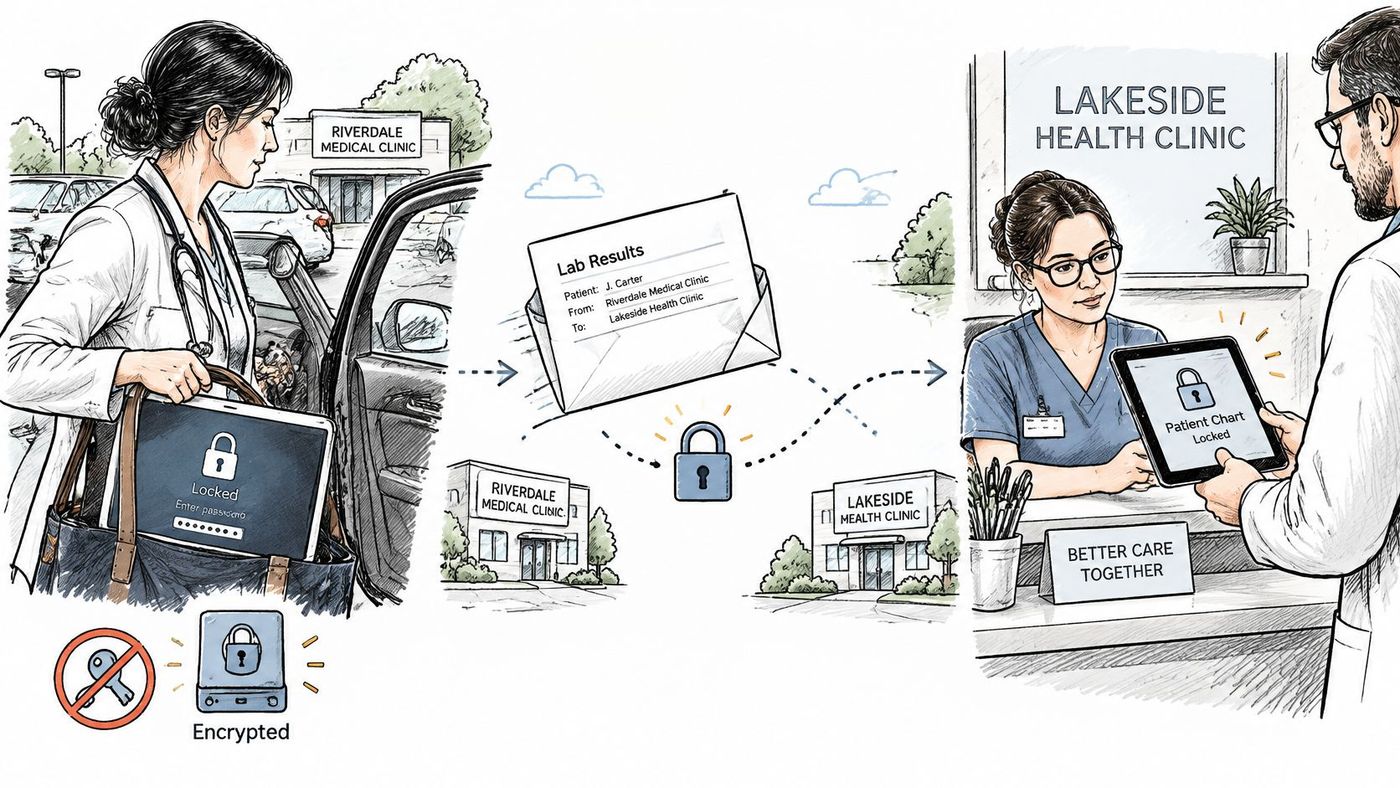
Where fax remains, the same guidance asks for equipment that encrypts transmissions and requires a password before anyone can view or print what arrives, and it asks you to confirm that a computer-based fax inbox isn't open to every login in the building. If a patient requests fax anyway, explain the privacy and security risks, describe the mitigation, and record informed consent before you dial.
Portable media completes the set. A USB stick or backup tape that leaves the building gets encrypted at the media level, and the password travels by a separate channel. Never in the same envelope, never in the same email thread.
A privacy investigation reviewed by the federal commissioner looked at an organization that already used firewalls, encryption of sensitive information, separate storage and obfuscation of encryption keys, and multiple intrusion-detection systems (OPC breach report). After the incident, the recommended improvements included salted hashing, stronger encryption and additional network isolation for sensitive data.
The lesson isn't that the organization did nothing. It's that competent, layered encryption still left room for a stronger cipher, better credential handling and tighter segmentation. Salted hashing belongs on credentials and verification data, not reversible encryption. Keys belong in a separate trust zone from the records they protect. Intrusion detection belongs in more than one place.
Device encryption only holds while the endpoint itself is managed, patched and locked. Endpoint security best practices covers the device management layer that keeps a cipher working after the laptop leaves the building.
Write down every live path for referrals, lab results, prescriptions and patient messages. Mark the unencrypted ones, and retire plain fax everywhere except where consent is documented.
Encrypted does not mean protected. HHS treats properly encrypted electronic protected health information as outside breach notification only when the cipher meets the applicable standard and the key stayed safe. Every other combination leaves a problem behind, and some of those combinations are the ones clinics are most proud of.
| Situation | Encryption present | Still a problem | Why |
|---|---|---|---|
| Lost laptop, standard cipher, key held elsewhere | Yes | Often no US notification | Safe harbour can apply if the key stayed safe |
| Lost laptop with the key on the same device | Yes | Yes | The key is compromised with the data |
| Ransomware encrypts reachable files | Attacker's cipher | Yes | Availability is lost even if privacy encryption was on |
| Encrypted backup inside the production domain | Yes | Recovery may fail | The attacker can reach the copy |
| Weak or outdated protocol | Technically yes | Yes | Presence is not the applicable standard |
| Password sent in the same email as the file | Partial | Yes | The secret travelled with the data |
The Canadian Centre for Cyber Security describes remote encryption, where one compromised device is used to encrypt data on other networked devices, and hybrid encryption that stacks multiple layers to hinder recovery (Canadian Centre for Cyber Security). Both flip the control on its head. Your encryption protects confidentiality. Theirs destroys availability, and it works through legitimate credentials rather than a broken cipher.
A clinic that encrypts databases, laptops and backups reduces the risk of unauthorized disclosure. It does nothing to stop an attacker who already holds valid credentials from locking the systems those credentials can reach.
Sometimes. The answer depends on four things, and only one of them is encryption. Immutable or offline copies, separate administrative identities that the production domain can't use, restoration that has been drilled rather than assumed, and key material that lives somewhere the attacker never reached.
Encrypted backups restore a practice only when the attacker can't reach them and can't reach their keys. Everything else is a copy with a padlock on a door in the same hallway.
There's a jurisdictional trap too. The HHS safe harbour concerns HIPAA breach reporting, while Canadian provincial obligations can still apply to unauthorized access, use or loss. A checklist that skips recovery testing and provincial duties manufactures the exact false assurance it claims to remove.
Circle any row above where the key, the backup or the cipher would fail a review. That circle is the project.
Encryption changes the harm analysis. It doesn't remove it. Under PIPEDA, a breach of security safeguards includes the loss of, or unauthorized access to, use of or disclosure of personal information, whether or not a cipher was switched on (OPC interpretation bulletin). Where the incident poses a real risk of significant harm, the organization reports to the Office of the Privacy Commissioner and notifies affected individuals and relevant third parties. It also keeps a record of every breach, whether or not notification was required.
Health information normally sits at the sensitive end of that test, which raises the assessed probability of misuse.
Take two real-world shapes. In the first, a clinic laptop is stolen from a vehicle. The disk was encrypted with a current standard, the recovery key lives in a separate key store with multifactor authentication, and the access log shows no decryption attempt. Misuse probability is low, the exposure is contained, and the incident file explains why.
In the second, a billing clerk emails a patient list to the wrong outside address. Encryption was enabled on the mail server, so the team calls it contained. It wasn't. The recipient was authorized to receive nothing, the file was decrypted on arrival, and no key custody question arose at all.
A snooping login behaves like the second case. So does a backup sitting in the same vault whose credentials the attacker already used. Ontario custodians may still owe action under PHIPA in situations where a HIPAA safe harbour would apply, which is why the harm judgement belongs in writing rather than in a hallway conversation.
Write down five things for each incident: what was exposed, whether encryption and key management limited access, how likely misuse is, what containment happened, and who was told. The federal regulator already lists passwords, firewalls, patches, access limits, training, audits and testing beside encryption, so a one-line claim that the disk was encrypted won't carry the file.
Keep a one-page record template your privacy lead reuses. Systems touched, key custody at the time, harm rationale, notices issued, and the date the safeguards will be reassessed. Reviewing your obligations under Canadian data privacy laws alongside that template stops the two regimes from drifting apart.
Make one decision this month. Either the control map is complete enough to put in front of a privacy officer, or every named gap gets an owner and a date. Nothing in between is defensible.
Five items, no policy rewrite required.
Book a 90-minute working session with the privacy lead and the IT lead. Not a new policy project, just the two people who can answer for the keys and the evidence, walking the packet row by row.
Where a clinic doesn't have staff to deploy that stack and keep the evidence current, CloudOrbis Inc. carries the operational load as a managed service. We specialize in regulated industries including healthcare, legal, finance and insurance, and our security is compliance-first with SOC 2 behind the documentation. That support runs alongside key custody and recovery testing rather than in place of them.
Book a short review of the packet against HIPAA expectations and Ontario duties, then set the next reassessment date on the calendar before the meeting ends, because systems and threats both move. The HIPAA risk assessment checklist is a reasonable place to test whether the file you've assembled answers the questions an assessor will ask.
The practical outcome is quieter than a security pitch. Leaders spend the review on missing proof rather than debating whether a checkbox that says encrypted is enough.
CloudOrbis Inc. builds and runs the encryption, key custody and recovery testing this evidence depends on, for clinics that carry both HIPAA expectations and Ontario duties. Our team reviews your control map, drills a restore, and hands you the documentation packet an auditor asks for, backed by a security program that has recorded zero ransomware incidents for clients on our full security stack. Visit CloudOrbis Inc. to book that review.
Book a 30-minute call with a senior engineer. No sales script, just straight answers about your environment.


