SOC 2 Compliance Requirements: Canadian SMB Guide
Master SOC 2 compliance requirements for your Canadian SMB. Clear explanations of Trust Services Criteria, Type I vs Type II audits, and a practical readiness

Master SOC 2 compliance requirements for your Canadian SMB. Clear explanations of Trust Services Criteria, Type I vs Type II audits, and a practical readiness
A customer has sent your team a security questionnaire, and one question keeps appearing: “Do you have SOC 2?” Your operations lead searches for a certificate, your IT provider checks a few policies, and someone suggests adding “SOC 2 compliant” to the website. That approach creates confusion because SOC 2 compliance requirements aren't a universal checklist or a government licence.
For Canadian small and mid-sized businesses, the practical task is to define the service being examined, select the relevant trust criteria, operate appropriate controls, and preserve evidence that those controls work. The result is an independent report that customers can evaluate alongside your contracts, privacy obligations, and risk profile.
A managed IT provider may answer a vendor questionnaire by stating that it has completed SOC 2. A careful customer should then ask which system, services, criteria, and review period the report covers. Those details carry more meaning than a badge on a sales page.
In Canada, SOC 2 is an independent assurance engagement performed under CSAE 3000, not a government certification or self-declaration. CSAE 3000 is the Canadian standard for attestation engagements other than audits or reviews of historical financial information. Canadian practitioners apply the American Institute of Certified Public Accountants' Trust Services Criteria, covering Security, Availability, Processing Integrity, Confidentiality, and Privacy. Canadian SOC 2 guidance explains how the Canadian attestation standard and the American control criteria work together.
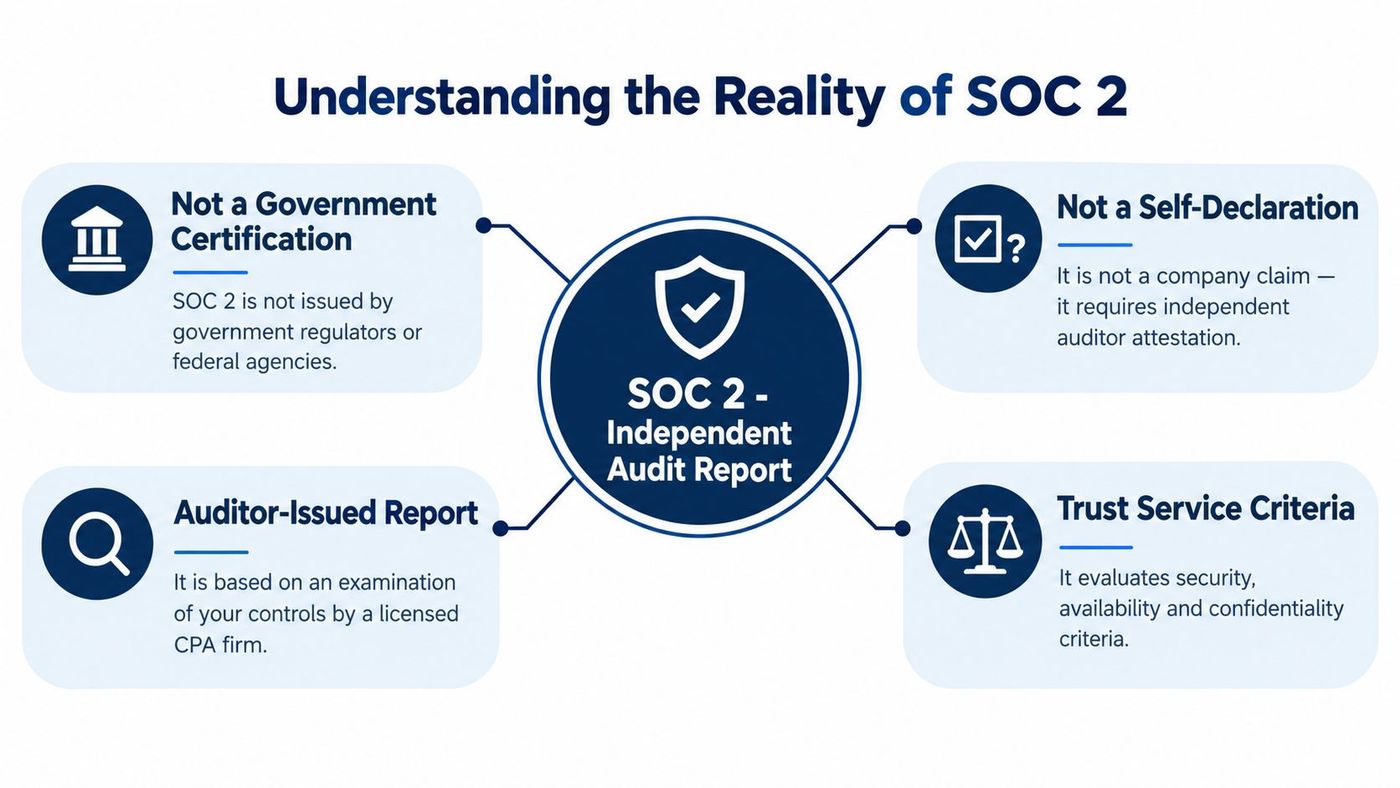
The auditor does not compare every Canadian company with one technology list. The report examines your system description, customer commitments, selected criteria, people, processes, infrastructure, applications, data, and third-party services.
A cloud operator might define its hosting environment, support team, identity systems, backup processes, and critical suppliers. A legal technology vendor may need evidence focused on confidentiality. A managed service provider that supports disaster recovery may select Availability because it makes specific service commitments to customers.
The defined scope determines what the attestation can support. “SOC 2 compliant” can therefore be incomplete. Customers should request the independent report and review its scope, rather than treating a marketing statement as equivalent to an issued attestation. Teams can use a practical checklist for tracking compliance milestones, adapting it to the defined system and applicable Canadian obligations.
Practical rule: Document what you deliver and how you deliver it first. The auditor can assess only controls connected to that defined system.
The five criteria work as a selection system rather than a mandatory package. Security is the foundational and mandatory criterion. The remaining criteria are included when they match your services, commitments, and customer risks, as outlined in Canadian SOC 2 certification guidance.
Security addresses the controls that protect systems and information from unauthorised access and harmful activity. It includes logical and physical access, risk assessment, monitoring, system operations, change management, and risk mitigation. Access reviews, vulnerability remediation records, incident handling, and supplier oversight can all support the evidence trail.
Availability becomes relevant when customers rely on your systems or support services being available. A managed IT company making availability or disaster recovery commitments needs controls and records that demonstrate how it monitors service operation, manages disruptions, and tests recovery arrangements.
Processing Integrity focuses on whether systems process information completely, accurately, and in a timely manner. It can matter to a software provider whose customers depend on reliable transactions, calculations, workflows, or data transfers.
Confidentiality protects information that customers expect you to restrict. A legal, financial, or professional-services platform may need clear access rules, secure handling procedures, retention decisions, and disposal evidence for sensitive client information.
Privacy applies where the service handles personal information and the organisation makes relevant privacy commitments. It can support evidence around collection, use, retention, disclosure, access, and disposal, but it doesn't replace Canadian privacy law.
The framework is outcome-based. It doesn't require one firewall, cloud platform, endpoint product, or email configuration. Your chosen controls must be suitably designed and operating effectively against the commitments described in the report. For a related operational example, review CloudOrbis's guidance on data security and privacy, and use a focused email authentication guide when assessing how your messaging environment supports access and security objectives.
The choice between Type I and Type II changes what customers can conclude from your report.
A Type I examination evaluates whether controls are suitably designed and implemented at a specific point in time. It answers a snapshot question: did the organisation establish appropriate controls by the examination date?
A Type II examination also tests whether those controls operated effectively throughout a defined observation period, commonly six to twelve months according to Canadian SOC 2 guidance from CPA Canada. It answers a continuity question: did the organisation operate the controls consistently during the period under review?
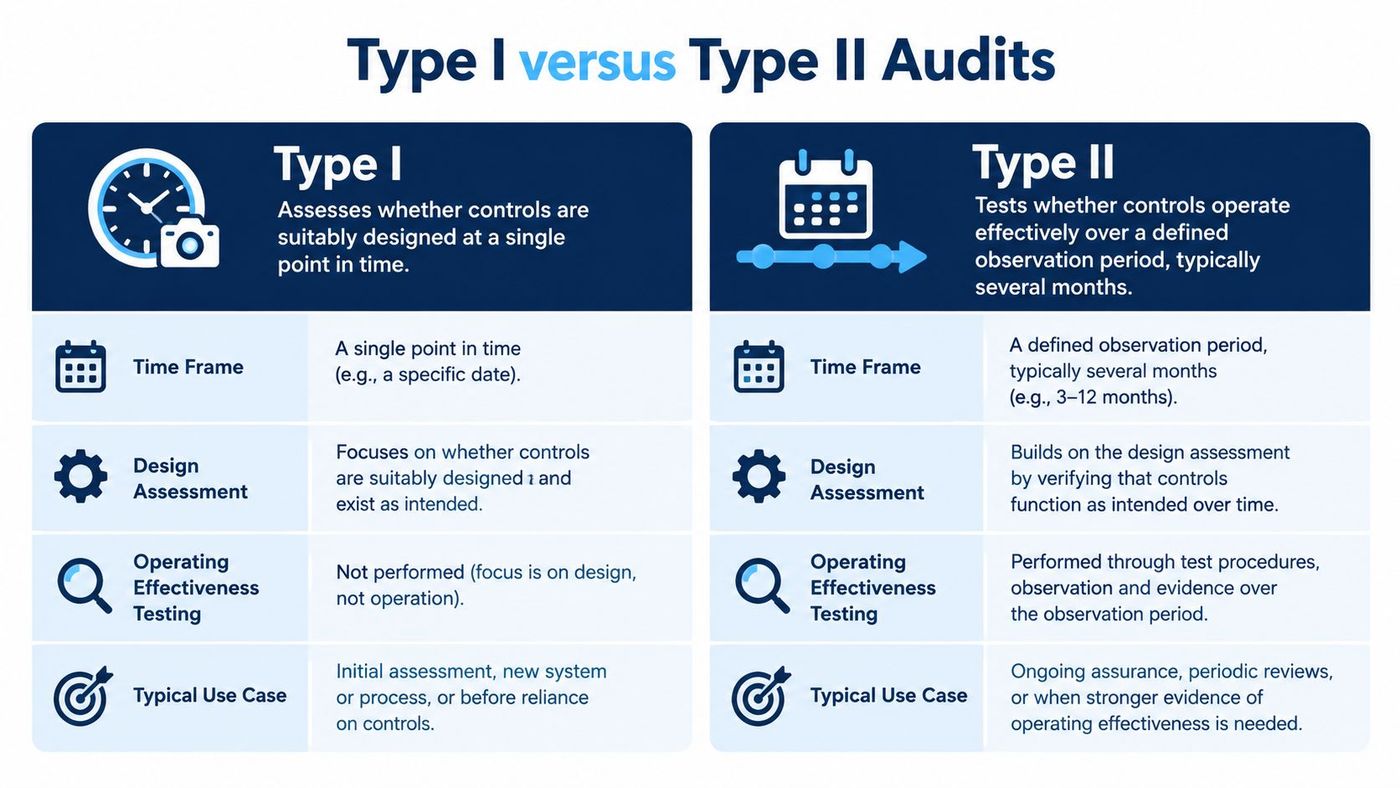
Type I may help a growing provider establish a baseline and show customers that its control environment has been designed and implemented. Type II requires a much deeper operating record. Policies alone won't demonstrate recurring performance.
Auditors may need contemporaneous evidence such as:
A Type I report may fit an organisation building its first formal control environment. Type II is usually more persuasive when customers need evidence of sustained operation. The terminology can be confusing, so a glossary covering single audit definitions may help distinguish different assurance concepts.
For Canadian organisations preparing for either path, a structured security audit service can help identify missing ownership, records, and control activities before the CPA firm begins its examination.
Small organisations shouldn't copy an enterprise checklist and hope the result is manageable. The Canadian Centre for Cyber Security defines small and medium-sized organisations as those with fewer than 500 employees and provides baseline controls designed for practical implementation. Its guidance also expects organisations to identify in-scope systems and assets, document exclusions, and acknowledge the risks associated with those decisions. The baseline cybersecurity controls provide a useful foundation for SOC 2 readiness.

First, build an asset inventory. Record the systems, applications, devices, data stores, staff roles, suppliers, and customer-facing services that support the relevant offering. Mark exclusions and explain why they sit outside scope.
Next, assess the potential harm to confidentiality, integrity, and availability. This creates a defensible reason for prioritising controls instead of trying to secure every system at once. An IT risk assessment can help connect business services to technical assets and control ownership.
The Cyber Centre identifies 13 baseline control categories, including incident response, automatic patching, security software, secure configuration, strong user authentication, employee awareness training, backup and encryption, mobility security, perimeter defences, cloud and outsourced IT services, website security, access control and authorisation, and portable-media security. Its implementation guidance positions these measures as lower-cost, lower-burden starting points for organisations with limited resources.
Sequence the work so each control produces evidence:
This approach turns readiness into a sequence of manageable decisions rather than an attempt to “boil the ocean.”
SOC 2 can strengthen privacy-related controls, but it isn't a Canadian privacy certification. A SOC 2 report describes the controls within a defined system against selected Trust Services Criteria. It doesn't determine whether an organisation satisfies every obligation under PIPEDA, Ontario's PHIPA, Quebec privacy requirements, or another applicable provincial law.
The correct mapping starts with the data flow. Identify what information you collect, why you process it, where it moves, which province is connected to the activity, whether it crosses a border, and which subcontractors handle it. Then map those facts to both the SOC 2 control environment and the legal duties that apply to the specific activity. Canadian privacy guidance notes that some provincial laws can exempt covered activities from PIPEDA, while PIPEDA may still apply to federally regulated organisations and certain cross-border commercial flows. This overview of Canadian data privacy laws can help business leaders frame that analysis.
A clinic might include its patient scheduling platform in a SOC 2 scope, but that report doesn't automatically demonstrate compliance with PHIPA. A software provider may have strong confidentiality controls while still needing contracts, retention rules, disclosure procedures, and privacy assessments customized for its customers and processing activities.
For healthcare, legal, and financial clients, adding Confidentiality and Privacy can produce stronger evidence around personal-information handling, retention, disclosure, and secure disposal. Those criteria still operate alongside the applicable law.
Keep the boundary visible: SOC 2 asks whether described controls are designed and operating effectively. Privacy law asks what the organisation may collect, use, disclose, retain, and destroy.
PIPEDA also creates concrete breach mechanics. When an organisation reasonably believes a breach creates a real risk of significant harm, it must report the breach to the Office of the Privacy Commissioner of Canada and notify affected individuals. It must keep records of every breach of security safeguards for two years, including breaches that don't meet the reporting threshold. The Commissioner's breach guidance sets out the information required in a report, including what happened, when it occurred, the information involved, affected individuals, harm-reduction steps, notification plans, and a contact person.
A company can have written policies, security software, and an IT lead who understands the risks, while managers and employees still treat security as someone else's responsibility. SOC 2 readiness exposes that gap because an auditor examines how controls operate in daily work, not only what leaders intended to implement.
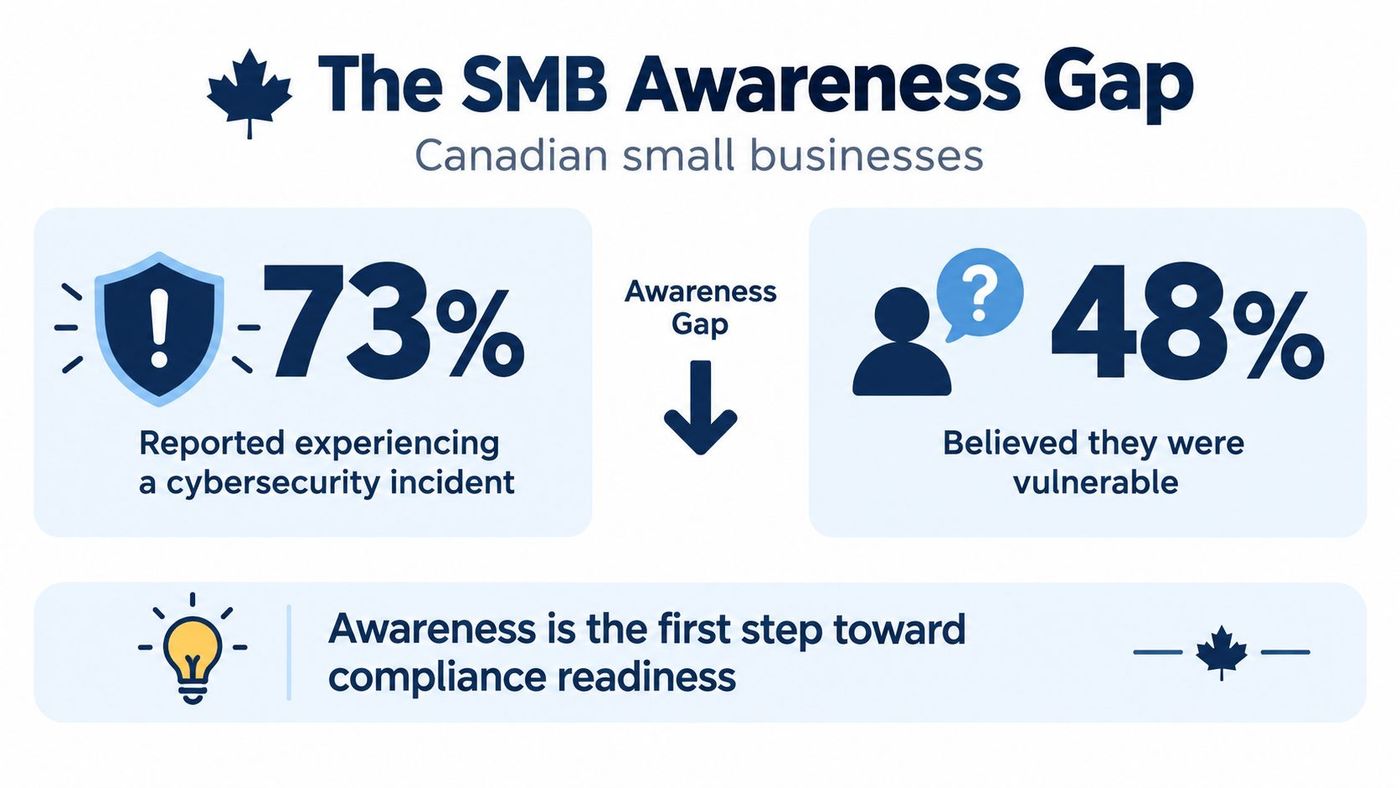
Canadian small businesses show why this matters. Seventy-three per cent reported experiencing a cybersecurity incident, while only 48% believed their business was vulnerable, according to Canadian business research summarised by the Business Development Bank of Canada in its discussion of small-business cyberattacks. The difference does not prescribe identical controls for every organisation. It does show why control ownership, staff awareness, and consistent evidence collection must involve the wider business.
Canadian businesses spent approximately $1.2 billion recovering from cybersecurity incidents in 2023, double the figure reported for 2021. The recovery burden makes governance a continuity decision, not merely a response to a customer questionnaire.
Each control should connect to a business consequence:
The Canadian Centre for Cyber Security's baseline approach supports this operational view by asking organisations to consider confidentiality, integrity, and availability, then document why systems are included or excluded. Security awareness training reinforces the human decisions that policies cannot control on their own.
Readiness becomes practical when managers can answer three questions without searching through disconnected spreadsheets: What are we protecting? Who owns the control? What evidence proves it operated?
Begin with the system boundary. Write down the service customers rely on, the applications and infrastructure that support it, the data flows involved, the people who administer it, and the third parties that participate in delivery. Don't start by buying a compliance tool or rewriting every policy.
Then audit the asset inventory and access policies. Look for former employees with active accounts, broad administrator permissions, unrecorded devices, unsupported applications, and suppliers with unclear responsibilities. Assign an owner to each remediation item and establish where recurring evidence will live.
A workable readiness engagement should produce operational outputs, not just a gap report. CloudOrbis's 10-step engagement model can support assessment, strategy, implementation, employee training, and ongoing optimisation, while its 24/7 Canada-based helpdesk can help maintain the day-to-day service environment. CloudOrbis Inc. can also map an organisation's environment to SOC 2, document controls, collect evidence such as logs and access-review records, and support audit preparation.
Before speaking with an auditor, ask your team to show the latest asset inventory, access review, backup test, vulnerability record, incident-response exercise, and supplier review. If those records don't exist, that isn't a reason to delay. It identifies the first practical work to complete.
CloudOrbis Inc. helps Canadian small and mid-sized businesses define SOC 2 scope, strengthen controls, organise evidence, and prepare for independent assurance engagements. Visit CloudOrbis Inc. to discuss your current asset inventory and access policies with a Canada-based IT team.
Book a 30-minute call with a senior engineer. No sales script, just straight answers about your environment.


