When a critical tech problem brings your operations to a halt, it's more than just frustrating—it's a direct hit to your bottom line in Edmonton's competitive market. This is where specialized small business IT support in Edmonton steps in, shifting your strategy from a reactive 'break-fix' cycle to a proactive partnership that prevents issues before they start. The goal is to transform your technology from a source of stress into a powerful asset for growth.
Why Edmonton Businesses Need Specialized IT Support
In Edmonton's dynamic business environment, technology is not just a tool; it's the engine driving your operations, customer relationships, and competitive edge. However, many small and medium-sized organizations treat their IT like a car they only service after it has broken down. This reactive, or 'break-fix,' approach is a significant hidden liability. Each system crash results in lost productivity, potential data loss, and damage to your reputation.
A proactive IT partnership, in contrast, functions like a skilled co-pilot for your business. Instead of waiting for a crisis, a dedicated IT support team continuously monitors your systems, identifies potential vulnerabilities, and implements preventive measures. This is not merely about fixing technical glitches—it's about building a robust technology foundation that actively supports your business objectives.
Beyond Break-Fix: The Strategic Advantage
Transitioning from a reactive to a proactive mindset unlocks tangible benefits. A strategic IT partner helps you look beyond daily technical issues and focus on long-term success. Different businesses have unique technological needs. For instance, understanding the specific requirements for specialized IT for digital marketing agencies is crucial for their cloud-heavy operations and demanding deadlines.
This strategic support translates into several key advantages:
Enhanced Security: Proactively identifying and patching security vulnerabilities before cybercriminals can exploit them.
Improved Efficiency: Optimizing your network and systems for peak performance, allowing your team to work without frustrating slowdowns or crashes.
Predictable Budgeting: Moving from unexpected, high-cost repair bills to a fixed monthly investment covering all your IT needs.
Scalable Growth: Designing an IT infrastructure that grows with your business, rather than hindering expansion.
By viewing IT support as a strategic investment rather than an expense, business leaders in Edmonton can gain a significant competitive advantage, ensuring their technology actively contributes to their success.
Ultimately, specialized IT support provides peace of mind. Knowing that experts are managing your technology allows you to focus on what you do best—running and growing your business. For a structured approach, our guide on the essential IT checklist for businesses in Edmonton can help you assess your current standing and identify areas needing attention.
The Core IT Services Every Edmonton Business Needs
Navigating the complexities of IT can feel overwhelming. At its core, however, a robust IT support framework consists of a few essential services working in concert to protect and grow your business. For any organization in Edmonton, understanding these components is the first step toward building a resilient and efficient operation.
Consider it like constructing a building: you need a solid foundation, strong walls, a secure roof, and a contingency plan for storms. These IT services are not just for when a computer fails. They form a proactive shield that defends against modern threats, provides the flexibility to expand, and ensures business continuity no matter the circumstances.
Let’s break down the essential pillars of small business IT support in Edmonton and examine their real-world applications.
To provide a clearer picture, here is a summary of key services and their significance for a local business.
Essential IT Support Services at a Glance
Service
Primary Benefit
Example Scenario for an Edmonton Business
Managed IT Services
Proactive problem prevention, minimizing downtime and keeping your team productive.
A logistics firm avoids a costly network outage during peak season because its IT provider identified and replaced a failing server component in advance.
Cybersecurity Defences
Multi-layered protection for your sensitive data, customer information, and finances.
A local retail business protects its customer payment data from a potential breach, preserving trust and avoiding significant fines.
Cloud Services
Secure, flexible access to data and applications from anywhere, on any device.
A construction project manager accesses updated blueprints on a tablet from a job site, ensuring the crew works from the correct plans.
Backup & Disaster Recovery
Ensures a rapid return to business operations after a major data loss event.
An accounting firm recovers its client files within hours of a ransomware attack, meeting tax deadlines without disruption.
These services are not standalone; they integrate to create a comprehensive safety net for your business, allowing you to focus on your core objectives.
Proactive Managed IT Services
Managed IT Services are the foundation of any modern IT strategy. Instead of the outdated "break-fix" model where you wait for a server to crash or a network to fail, a managed services provider (MSP) offers continuous oversight. They constantly monitor your systems to detect and resolve problems before they can disrupt your business. This approach is about prevention, not reaction.
Imagine an Edmonton-based logistics company that relies on its network to manage inventory and dispatch drivers. Unplanned downtime is not merely an inconvenience; it can bring their entire operation to a standstill. With managed services, potential issues like failing hardware or software glitches are identified and resolved discreetly in the background, often before the company is even aware of the risk.
Effective IT support extends beyond troubleshooting; it involves maintaining your digital tools in optimal condition. For a deeper look, explore these insights on comprehensive software maintenance and support services.
Robust Cybersecurity Defences
In today's digital landscape, cybersecurity is not an optional add-on—it is as essential as locking your office doors at night. Cyber threats are constantly evolving, and a single breach can be devastating for a small or medium-sized business. A robust cybersecurity service builds multiple layers of defence to protect your critical data, financial information, and customer details.
This involves more than just antivirus software. A comprehensive defence includes:
Threat Detection and Response: Actively hunting for and neutralizing threats that may have already penetrated your network.
Endpoint Protection: Securing every device connected to your network, from office desktops to employee smartphones.
Employee Security Training: Empowering your team to become a human firewall by teaching them how to identify and avoid phishing scams and other sophisticated tactics.
For a local Edmonton retailer, protecting customer payment information is non-negotiable. It is fundamental to maintaining trust and avoiding severe penalties. A multi-layered security strategy ensures their point-of-sale systems and customer databases are secure, safeguarding their reputation and bottom line.
Flexible Cloud Services
The cloud provides businesses with incredible flexibility and the ability to scale on demand. It allows your team to access data and applications securely from anywhere, at any time. This is a game-changer for Edmonton businesses with remote staff, travelling sales teams, or field crews, as operations are no longer confined to a physical office.
Consider a construction firm here in Edmonton. With cloud services, project managers can access blueprints and files directly from a tablet on-site. Architects can collaborate on designs in real-time from different locations, and the administrative team can manage invoices seamlessly. This agility enhances efficiency and keeps projects on track.
A critical question for any business leader is: what would happen if a fire, flood, or major cyberattack wiped out your systems? A Backup and Disaster Recovery (BDR) plan is your business's insurance policy against such a catastrophe. It involves regular backups of your critical data and a clear, tested plan to restore operations quickly.
A strong BDR strategy is not just about backing up files; it's about ensuring business continuity. The goal is to minimize downtime and enable your business to recover from any disaster with minimal disruption.
This is vital for any organization. An Edmonton accounting firm, for example, cannot afford to lose client financial data, especially during tax season. With a solid BDR plan, even if a ransomware attack encrypts their servers, they can restore data from a clean backup and be operational again in hours, not weeks, turning a potential disaster into a manageable event.
Understanding IT Support Pricing Models in Edmonton
Determining the cost of IT support can feel complex. Many Edmonton business leaders are left wondering if they are receiving true value or a low-cost deal that will prove more expensive in the long run. Choosing a pricing model is a strategic decision that impacts your budget, operational stability, and capacity for growth.
The wrong model can lead to surprise invoices and unexpected downtime. The right one, however, offers predictable costs and proactive care, allowing you to focus on your business. Let's review the most common pricing models for small business IT support in Edmonton to help you make an informed financial decision.
The Old Way: Break-Fix Support
The most traditional model is break-fix support. The process is simple: when something breaks—a server fails, a laptop malfunctions, or software glitches—you call for assistance. You then pay an hourly rate for the technician's time plus the cost of any required parts.
On the surface, this appears cost-effective as you only pay when an issue occurs. The problem? This model contains significant hidden costs. The primary issue is that your IT provider's financial interests are misaligned with yours; they only generate revenue when your technology fails. This creates no incentive for them to prevent problems, which often leads to more frequent and costly downtime for your business.
Modern Proactive Models
Fortunately, most modern IT providers in Edmonton have adopted proactive, subscription-based models. These plans align the provider's success with your own, as their goal is to keep your systems running so smoothly that you rarely need to contact them.
Here are the main structures you will encounter:
Per-Device Pricing: In this model, you pay a flat monthly fee for each piece of equipment your provider manages, such as desktops, laptops, servers, and firewalls. It is straightforward and easy to budget for, especially if your team has a consistent number of devices. However, costs can increase quickly if your staff uses multiple devices.
Per-User Pricing: This is an increasingly popular option where you pay a flat monthly fee for each employee, regardless of the number of devices they use. It simplifies budgeting, particularly for businesses with remote or mobile teams, and often includes support for personal devices used for work (BYOD).
Flat-Rate or All-Inclusive Model: This model bundles a comprehensive package of services into a single, fixed monthly price. It typically covers all your IT needs, from server management and network security to helpdesk support and strategic consulting, offering maximum budget predictability.
Making the Right Financial Choice
So, which model is right for you? The answer depends on your business's size, complexity, and growth plans. A per-user plan may be ideal for a growing sales team with multiple devices, while a per-device plan could suit a small office with a fixed number of workstations.
The key is to shift your mindset from viewing IT as an unpredictable expense to seeing it as a fixed, strategic investment. Predictable monthly costs empower you to budget effectively and focus on growth, not on worrying about the next IT emergency.
Many small and medium-sized businesses in Alberta find the cost and complexity of an in-house IT team prohibitive. Consequently, outsourcing has become the preferred strategy. Industry data shows that outsourced IT services in the region typically range from $100 to $250 per user per month, which is often far more cost-effective than hiring full-time staff. These services usually include 24/7 monitoring, network management, and cybersecurity—all essential for minimizing operational risks. You can find more insights on IT support costs in Alberta on HappierIT.com.
Ultimately, transparency is paramount. A trustworthy provider will clearly outline what is included in their plans and what might incur extra costs, such as large-scale projects or hardware purchases. For a clear breakdown, you can explore CloudOrbis' transparent pricing models to see how a straightforward, all-inclusive approach can benefit your Edmonton business.
How to Choose the Right IT Partner in Edmonton
Selecting a provider for small business IT support in Edmonton is a critical decision. It is less like purchasing a service and more like onboarding a long-term business partner. The right choice can become a strategic ally invested in your success. The wrong one can be a constant source of frustration and unexpected costs.
To make the right choice, you need to look past sales pitches and focus on the details that truly matter. It is about finding a team that not only possesses the technical expertise but also understands the unique dynamics of Edmonton's business community. They should feel like an extension of your own team.
Scrutinize the Service Level Agreement
The Service Level Agreement (SLA) is the most important document you will sign. It defines the rules of your engagement and outlines the precise standards of service you can expect. A provider offering a vague SLA—or none at all—is a significant red flag.
A robust SLA will clearly define several key commitments. These are non-negotiable guarantees that protect your business.
Here’s what to look for in a solid SLA:
Guaranteed Response Times: How quickly will they acknowledge an issue? This should be clearly defined for different urgency levels (e.g., within 15 minutes for a critical server outage vs. within one hour for a minor software issue).
Resolution Times: Beyond responding, how long will it take to resolve the issue? The SLA should set realistic target resolution times for various problems.
System Uptime Guarantees: For your most critical systems, such as servers and networks, the provider should guarantee a specific uptime percentage, like 99.9%.
Clear Escalation Procedures: What is the plan if an issue is not resolved within the agreed timeframe? A good SLA defines a clear path for escalating the problem to senior technicians or management.
Evaluate Their Local Presence and Expertise
While much IT support can be delivered remotely, having a local team in Edmonton is a significant advantage. A local provider understands the regional business climate, from industry-specific challenges to the simple fact that sometimes an on-site presence is necessary. They operate in your time zone and can be at your office quickly when a hands-on solution is required.
However, location is not everything. You need proof of their expertise. Do not just take their word for it—ask for evidence.
A provider's true value is reflected in their clients' success. Look for an IT partner who is transparent about their track record and eager to share how they've helped businesses like yours overcome challenges and achieve their goals.
To gauge their skill, you should:
Request Client Testimonials and Case Studies: Ask for specific examples of how they have helped other Edmonton businesses, particularly those in your industry.
Check Online Reviews: See what clients are saying on Google and other platforms for an unfiltered view of their reputation.
Inquire About Their Onboarding Process: A professional team will have a clear, structured plan for bringing you on as a client, indicating their organization and commitment.
Assess Communication and Cultural Fit
Ultimately, you are choosing people to work with. The best technical skills are of little value if the provider is difficult to reach or communicates only in technical jargon. As you speak with potential partners, pay close attention to their communication style. Are they responsive? Do they take the time to explain complex technical issues in plain, accessible language?
A good cultural fit means they share your sense of urgency and are genuinely invested in your success. They should feel like a proactive part of your team, not just a reactive helpdesk. For a more detailed checklist, our guide to evaluating IT support companies can help you make a confident decision.
Navigating Local Industry Compliance and Regulations
For many Edmonton businesses in sectors like healthcare, finance, or law, IT is not just about operational efficiency—it's about legal compliance. Handling sensitive client information requires adherence to a strict set of rules. Navigating provincial regulations such as Alberta's Personal Information Protection Act (PIPA) is a fundamental aspect of doing business.
This is where expert small business IT support in Edmonton serves as an essential safeguard. A strong IT partner does more than fix technical issues; they understand the regulatory landscape you operate in. Their role is to implement the necessary technical controls, maintain mandatory audit trails, and ensure your data is managed in a way that meets all legal standards.
Failure to comply can lead to significant fines, legal disputes, and reputational damage. A compliance-savvy IT provider helps you avoid these risks by building a secure and compliant technology foundation from the start.
Building a Compliant IT Foundation
Achieving compliance is not a one-time task; it is a continuous process of managing risk. A strategic IT partner helps integrate compliance into your daily operations, ensuring your technology actively supports your legal and ethical obligations.
This involves several key actions:
Data Encryption: Implementing strong encryption for data, both when stored on a server (at rest) and when transmitted over the internet (in transit).
Access Controls: Ensuring only authorized personnel can access sensitive information, with systems that log every interaction.
Secure Data Backup: Creating robust, compliant backup and recovery plans that protect data from loss while respecting data residency laws.
Regular Security Audits: Proactively scanning for vulnerabilities to identify and remediate security gaps before they can be exploited.
These technical measures are the building blocks of a trustworthy business, demonstrating to both clients and regulators that you take data privacy seriously.
A proactive approach to compliance turns a potential liability into a business advantage. By embedding regulatory requirements into your IT strategy, you not only mitigate risk but also strengthen your reputation as a secure and reliable partner for your clients.
Connecting with Local Support and Resources
Staying compliant also means being aware of available local resources. A recent Edmonton Business Retention and Expansion Study revealed that many local companies are not fully aware of the support available to them. The study found that only 27% of businesses know about municipal grant programs, and just 23% are aware of one-on-one support services for permits and licensing, indicating a knowledge gap that could hinder IT improvements. You can discover key findings on Edmonton.ca.
Partnering with a local IT provider who understands both regulatory demands and the regional support ecosystem can be a significant asset. They can help implement necessary technical controls while ensuring you are positioned to leverage available programs. For a deeper dive into our approach to security and compliance, review our guide to cybersecurity compliance solutions.
Why Edmonton Businesses Partner with CloudOrbis
Choosing the right IT support in Edmonton is about finding a local partner invested in your success. Businesses in Edmonton choose CloudOrbis because we are more than just a helpdesk. We are a dedicated local team whose mission is to transform your technology from a source of frustration into a competitive advantage.
We understand that onboarding a new IT provider can seem disruptive. That is why we have developed a 10-step engagement model—a structured, transparent process designed to ensure a seamless transition. From the initial assessment of your current setup to full implementation and ongoing optimization, we minimize interruption to your daily operations.
Our Proven Client-Centric Process
Our process is designed to build a strong foundation for a long-term partnership. It begins with listening. We take the time to understand your business—your unique challenges, industry pressures, and long-term goals. This allows us to create a strategic IT roadmap that aligns with your objectives.
We believe that the best IT support is proactive, not reactive. Our goal is to solve problems before they impact your business, ensuring your systems are always secure, efficient, and ready to scale.
From there, we proceed to a methodical implementation phase, followed by hands-on employee training and continuous monitoring. We become an integrated part of your team, providing the strategic guidance needed to make informed, forward-thinking technology decisions.
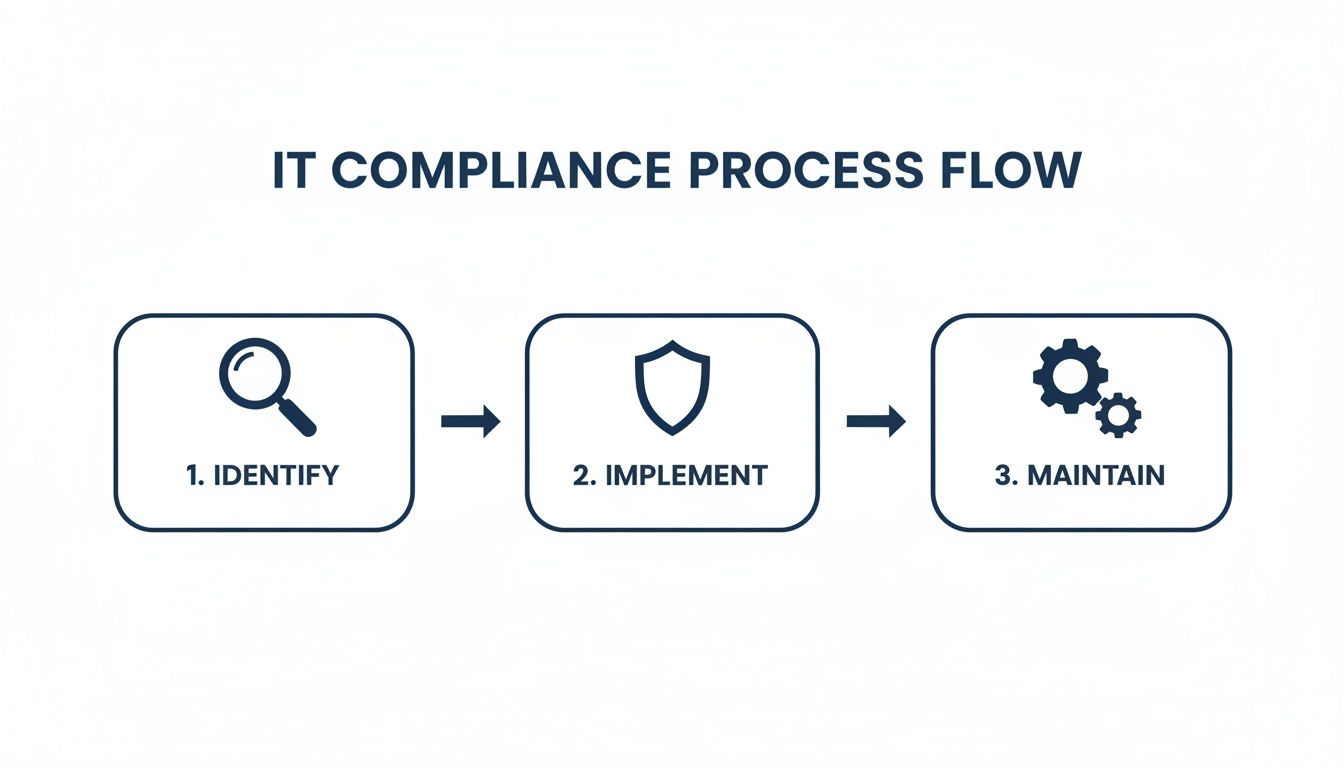
This systematic approach ensures every detail is covered.
This simple flow—identifying risks, implementing robust solutions, and providing around-the-clock maintenance—is the core of how we protect our clients and maintain their compliance.
Real Results for Local Businesses
Our track record demonstrates our commitment. We have helped numerous Edmonton businesses transform their technology from a recurring issue into a powerful asset for growth.
For a local construction firm, we built a scalable cloud environment that provided their field teams with real-time access to project files, significantly improving on-site efficiency. For a healthcare clinic, we implemented a robust, PIPA-compliant security framework that not only protected sensitive patient data but also simplified their internal workflows.
These are not just success stories; they are evidence of our commitment to building secure, scalable, and strategic technology environments. When you partner with CloudOrbis, you gain a strategic ally dedicated to your success in the Edmonton market.
We Get It, You’ve Got Questions
Making a significant decision about your business's technology is a major step, and it is natural to have questions. We have compiled answers to some of the most common inquiries we receive from business leaders in Edmonton to provide the clarity you need to move forward confidently.
How Much Downtime Should We Expect When We Switch IT Providers?
This is a primary concern for many businesses, as any downtime directly impacts revenue. The short answer is that with a professional team, the goal is zero operational downtime. A well-managed transition should be virtually invisible to your team.
An experienced provider will follow a structured onboarding process, including:
A thorough discovery phase to understand your current systems.
A detailed migration plan that schedules major changes for after-hours or during low-activity periods.
Running the new system in parallel with the old one for a brief period to ensure a flawless cutover.
With careful planning, the switch should be seamless, allowing your team to continue their work without interruption.
Is Outsourcing Really Cheaper Than Hiring an In-House IT Person?
For most small and medium-sized businesses in Edmonton, the answer is a definitive yes. It is easy to compare the monthly fee for managed services to a single salary, but this does not capture the full picture.
When you outsource, you are not just getting one person. You gain access to an entire team of certified experts—cybersecurity specialists, network engineers, cloud architects—for a fraction of the cost of hiring them individually. This collective expertise provides a level of support that a single employee cannot match.
When you factor in the hidden costs of an in-house hire—recruitment, benefits, paid time off, and continuous training—outsourcing your small business IT support in Edmonton is clearly the more cost-effective and reliable option. You receive enterprise-level expertise without the enterprise-level cost.
What Specific Security Threats Are We Facing Here in Edmonton?
While global threats like ransomware are a concern for everyone, Edmonton businesses often face localized attacks. We see a high volume of sophisticated phishing scams that use the names of familiar local companies or reference current events in the city to deceive employees.
Key local industries such as construction, manufacturing, and logistics are also prime targets for attacks designed to disrupt supply chains or steal sensitive project data. A local IT partner understands these regional threat patterns. We can implement specific defences, such as advanced email filtering to detect local scam tactics and employee training relevant to the threats your business will actually encounter. This local advantage is key to keeping your business secure.
A practical guide to IT support for private career colleges in Alberta. Learn to navigate compliance, security, and technology for your institution's success.
Discover how IT consulting Edmonton services drive growth. This guide covers key services, costs, and how to choose the best partner for your business.

%20(1).webp)