
September 13, 2026
Third-Party Risk Management for Canadian SMBsMaster third-party risk management for your Canadian SMB. Learn OSFI compliance, vendor monitoring frameworks, and how to secure your supply chain.
Read Full Post%20(1).webp)
Usman Malik
Chief Executive Officer
January 30, 2026
In Toronto's competitive market, the right IT support for your small business separates the businesses that struggle from those that thrive. It’s about moving from a reactive "break-fix" mindset to a proactive IT strategy—one that ensures your technology is a powerful asset, not a constant headache. This guide provides business and IT leaders with insights into building a resilient and growth-oriented IT framework.
In an economy as dynamic as Toronto’s, technology is the engine that keeps everything moving. For most medium-sized organizations, however, managing that technology can be a major distraction. Juggling software updates, defending against the latest cyber threats, and dealing with unexpected hardware failures pulls your team away from what really matters: serving your clients and growing your business.
This is why so many Toronto business leaders are changing how they think about IT. They are moving from seeing it as just another expense to viewing it as a strategic investment. When you partner with a dedicated IT support provider, you delegate the technical complexities to experts whose success is directly tied to keeping your operations secure and running smoothly.

Outsourcing your IT is about more than just having a helpdesk on call; it’s about giving your business a real competitive edge. It allows you to:
This isn't just a local trend. Medium-sized businesses worldwide are projected to spend over $90 billion on managed IT services by 2026. Here in Toronto, organizations often find that partnering with a professional IT provider costs 50-70% less than hiring internal staff, all while gaining access to a deeper well of expertise and the ability to scale on demand.
A strategic IT partner does more than fix problems—they prevent them. By proactively monitoring your systems 24/7, they ensure your operations are secure, efficient, and always ready to scale with your ambitions.
To truly compete and grow, Toronto businesses can explore various IT solutions tailored for small and medium businesses. Making a smart investment in professional IT support for your small business in Toronto isn’t just buying a service. You’re securing a partnership genuinely dedicated to your long-term success. Ready to learn more? See how you can find the best Toronto IT managed services for your specific needs.
Have you ever calculated what an hour of IT downtime really costs your business in the GTA? It’s far more than just a frustrating break in the workday. For most businesses, a system failure during peak hours isn't just an inconvenience; it's a direct hit to your revenue, reputation, and the trust you've built with your customers.
Picture this: your point-of-sale system crashes during the lunch rush at your downtown café. Or imagine your logistics company’s dispatch software going dark, leaving drivers stranded and deliveries piling up across the city. These aren't just technical issues—they're critical business failures, and the consequences escalate immediately.
With every minute your systems are down, the costs multiply. It’s not just about the sales you lose in that moment; it's the ripple effect that follows.
The most obvious impact of downtime is the financial hit. When your team cannot access their essential files, applications, or communication tools, productivity grinds to a halt. You're still paying employees who are sitting idle, effectively turning your payroll into a sunk cost for however long the outage lasts.
Beyond internal losses, the direct revenue loss can be staggering. A recent analysis, adapted for the Canadian market, found that for many Toronto medium-sized businesses, a single hour of IT downtime can cost an average of $10,000 in lost revenue and productivity. With the average incident stretching to about 80 minutes, that kind of financial damage can seriously set back a growing organization.
While the financial toll is easy to calculate, the long-term damage to your brand can be far more severe. In Toronto’s hyper-competitive market, customer trust is your most valuable asset. An outage that stops a customer from making a purchase or receiving a service can destroy that trust in an instant.
Consider the fallout:
In today's connected world, your digital storefront is just as important as your physical one. An 'offline' sign on your website can be more damaging than a 'closed' sign on your door, as it instantly communicates a lack of reliability to a global audience.
This is where proactive, managed IT support for your small business in Toronto changes the game. It shifts the focus from reacting to disasters to preventing them. By monitoring your systems around the clock, a dedicated IT partner can spot and fix potential issues before they cause these costly interruptions. Our guide explains how IT downtime is a hidden threat to your productivity and what you can do about it.
Ultimately, investing in reliable IT support isn't just a technical decision—it's a crucial investment in your business's reputation, resilience, and future growth.
Picking the right IT support framework for your Toronto business is a significant decision, one that directly shapes your budget, team efficiency, and growth potential. It can feel like a complex choice, but it really boils down to three core models.
Think of it like maintaining a commercial building: you could call a plumber every time a pipe leaks, hire a full-time superintendent to proactively manage everything, or bring in an expert partner to share the duties with your on-site staff. Each path has a different price tag, level of involvement, and strategic payoff. Understanding these differences is the key to choosing the model that truly fits your business.
When you're weighing the options, remember what's at stake. Downtime isn't just an inconvenience; it's expensive. This decision tree shows just how quickly the costs spiral beyond a simple repair bill, hitting your sales, sinking team productivity, and eroding customer trust.
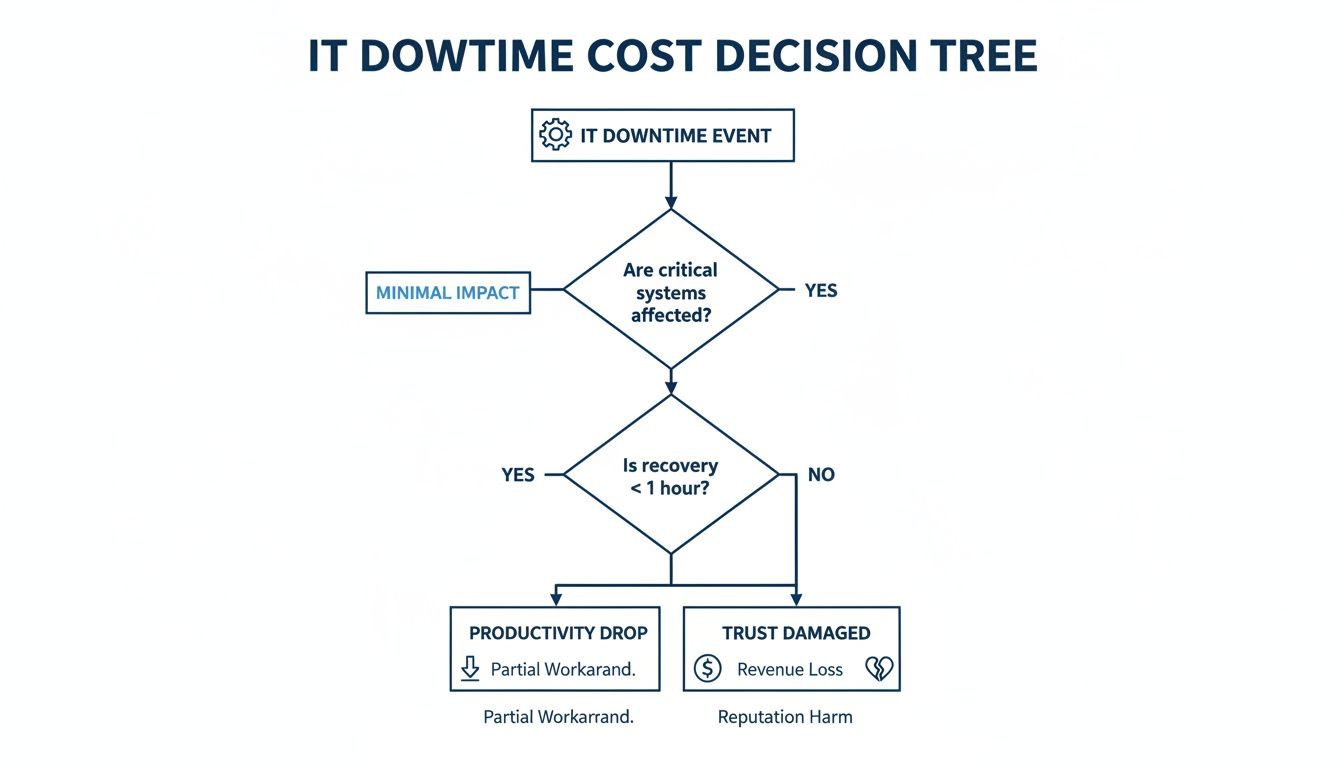
As you can see, an IT problem is a business problem. It has real financial and reputational consequences that can linger long after the technical issue is fixed.
The break/fix model is the traditional way of handling IT support. It works exactly as it sounds: when something breaks, you call a technician to fix it. You receive a bill for their time and any parts needed to solve the problem.
On the surface, this might seem like the cheapest option since you only pay when something goes wrong. However, the real costs are hidden. Your IT provider has no financial incentive to prevent problems—in fact, they make more money when your technology fails. Every call means unpredictable costs and, worse, significant downtime while you wait for a fix. This purely reactive stance often leads to the same issues recurring, which harms productivity.
A Managed Services Provider (MSP) offers a completely different approach. Instead of waiting for a crisis, an MSP proactively manages your entire IT environment for a flat, predictable monthly fee. This model aligns their success with yours. They only profit when your systems are running smoothly, not when they are down.
This partnership provides comprehensive IT support for your small business in Toronto, covering everything from 24/7 monitoring and cybersecurity defence to data backup and long-term strategic planning. An MSP essentially becomes your outsourced IT department, dedicated to preventing problems before they disrupt your business. The predictable costs simplify budgeting, while proactive maintenance slashes downtime and strengthens security, turning your technology from a liability into a genuine asset for growth.
If you want to dig deeper, we explore all the benefits in our guide on what is a managed IT service.
Choosing an MSP is like having a dedicated building superintendent for your technology. They're not just fixing leaks; they are actively maintaining the entire infrastructure to ensure everything works seamlessly, preventing costly emergencies from ever happening.
Co-managed IT is a hybrid approach, perfect for organizations that already have an in-house IT person or team but need to expand their capabilities. Perhaps your internal staff is swamped with day-to-day helpdesk tickets, or they lack deep expertise in critical areas like cybersecurity or cloud infrastructure.
In a co-managed setup, an external provider works alongside your internal team, filling in the gaps where you need it most. This could mean taking routine monitoring and maintenance off their plate, providing access to advanced security tools, or offering high-level strategic guidance. This collaborative model empowers your in-house staff to focus on larger projects that drive the business forward, all while ensuring you have the expert backup needed to stay secure and competitive.
To help you see the differences at a glance, here’s a side-by-side comparison of the three main IT support models. This table should help you determine which approach is the right fit for your business.
By carefully weighing these factors against your company's needs and goals, you can pinpoint the IT support model that will best position your Toronto business to succeed and grow.
A solid IT strategy is much more than just having a helpdesk to call when something breaks. To truly protect and grow a modern Toronto business, you need a set of proactive services that work together. These are the essentials that form the backbone of your IT, ensuring your operations are secure, efficient, and ready for what comes next.
Think of it like building a house. You wouldn't just focus on the paint colour; you’d start with a solid foundation, a sturdy frame, and a leak-proof roof. Your business technology needs those same essential layers to function properly and protect your assets. This is what comprehensive IT support for small business Toronto providers should deliver.
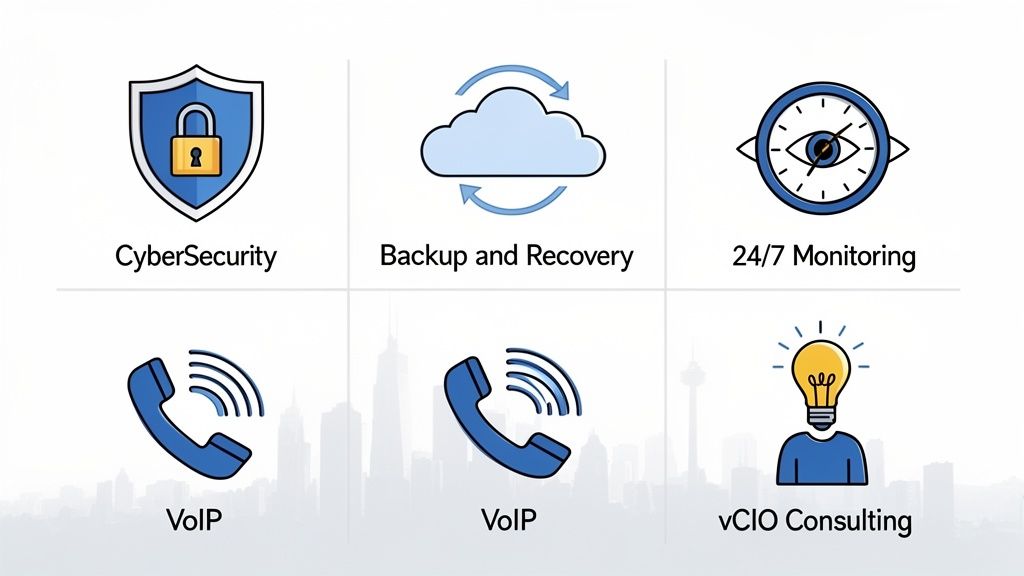
In today’s climate, strong cybersecurity isn’t just a "nice-to-have"—it's your first line of defence. Cyber threats are relentless and becoming more sophisticated, targeting businesses of all sizes. A true security service goes far beyond basic antivirus software.
It’s about building a multi-layered defence to shield your network, data, and employees from ransomware, phishing scams, and other malicious attacks. This includes actively hunting for threats, training your staff to spot suspicious activity, and managing firewalls to keep your digital perimeter secure.
The best way to fix an IT problem is to prevent it from happening in the first place. That’s the entire purpose of 24/7 proactive network monitoring. Using specialized tools, a dedicated team keeps a constant watch on your entire IT infrastructure—servers, computers, and all.
This constant vigilance allows your IT partner to spot and fix potential issues, like an overheating server or a failing hard drive, before they can take your business offline. It’s the difference between patching a small leak and cleaning up a major flood. When you do need immediate help, you can learn more about how our IT helpdesk support delivers fast, expert solutions.
Ask yourself this: what would happen if your critical business data vanished tomorrow due to a hardware failure, cyberattack, or even a fire? A solid data backup and disaster recovery (BDR) plan is your business's insurance policy, ensuring you can get back on your feet quickly.
This is more than just dragging files to an external drive. A proper BDR strategy involves:
A strong BDR strategy isn't just about recovering data; it's about recovering your entire business. It’s the plan that ensures a single catastrophic event doesn’t become a business-ending one.
Cloud services offer Toronto businesses incredible flexibility and efficiency. Whether it’s moving your servers to a secure platform like Microsoft Azure, getting the most out of Microsoft 365, or using cloud-based applications, the right solutions can completely change how you work. A good IT partner helps you navigate the options to build a cloud setup that cuts hardware costs, boosts collaboration, and lets your team work securely from anywhere.
Old-school phone systems are quickly becoming relics. Voice over Internet Protocol (VoIP) systems offer a more flexible, feature-rich, and affordable way for modern businesses to communicate. With VoIP, you get crystal-clear calls, video conferencing, and the ability to take your office number with you on any device. You stay connected with clients and colleagues, no matter where you are.
Finally, strategic guidance is the element that holds all these technical services together and aligns them with your business goals. A virtual Chief Information Officer (vCIO) acts as your high-level technology advisor. They help you build a long-term IT roadmap, manage your tech budget, and ensure your IT investments are actually driving real business value. It’s the expert foresight you need to make smart decisions and turn technology into a genuine competitive advantage.
A generic, one-size-fits-all IT plan is bound to fail in an economy as diverse as Toronto’s. Different industries face completely different operational pressures, regulatory hurdles, and security risks. True strategic IT support for a small business in Toronto means having a partner who speaks your industry’s language and understands the specific challenges you face daily.
It’s about more than just keeping the lights on. Your IT solutions must actively support your unique business goals, whether that’s protecting sensitive patient data, keeping a production line running without interruption, or securing confidential client files. A provider with proven experience in your sector can deliver strategies that solve real-world problems and drive meaningful results.
This specialized approach moves beyond basic technical fixes and becomes a core part of your business strategy, ensuring your technology is an enabler of success, not a source of friction.
For medical and dental clinics across Toronto, protecting patient information is not just good practice—it's the law. The Personal Health Information Protection Act (PHIPA) sets strict rules for how electronic health records (EHR) are managed, stored, and shared. A data breach doesn't just damage patient trust; it can result in severe financial penalties and legal action.
Specialized IT support for healthcare focuses on:
For a busy Toronto clinic, this could mean setting up a secure network that allows doctors to access patient files on tablets while preventing any data from leaving the clinic's protected environment.
In the fast-paced world of manufacturing and logistics, every minute of downtime costs money. When a server controlling your production line goes down or your supply chain software crashes, the entire operation grinds to a halt. The priority here is absolute reliability and operational continuity.
An IT partner experienced in this sector understands that technology must support the physical workflow.
For manufacturers, IT isn't just about office computers; it's about the machinery on the factory floor and the software that coordinates every step of the supply chain. Proactive monitoring and rapid-response support are essential to prevent costly production bottlenecks.
Key IT services include 24/7 monitoring of critical systems to preempt failures, creating resilient data backup plans to recover quickly from any disruption, and optimizing network performance to ensure seamless communication between your warehouse, machinery, and front office.
Law firms and financial services companies in Toronto handle incredibly sensitive client data, making them prime targets for sophisticated cyberattacks. The consequences of a breach are catastrophic, leading to financial loss, ruined reputations, and serious regulatory violations. For these industries, security isn't just a feature; it is the foundation of their entire IT infrastructure.
A provider specializing in this area will focus on:
By understanding these industry-specific needs, a true IT partner delivers more than just technical support; they provide peace of mind and a competitive advantage.
Choosing a provider for your IT support for small business in Toronto is one of the most important decisions you will make. This isn't just about hiring a company to fix computers; it's about bringing on a strategic partner who will protect your assets, keep your operations running smoothly, and help you grow. To make the right choice, you need a clear way to evaluate your options.
The best partner goes far beyond closing helpdesk tickets. They become an extension of your team, offering proactive guidance and tech solutions that are perfectly aligned with your business goals. This requires a careful look at their capabilities, their track record, and their commitment to your success.
Before signing a contract, you need to ask insightful questions. Your goal is to understand not just what they do, but how they do it—and whether their approach is a good fit for your company’s culture and daily needs. A solid vetting process will help you avoid common issues and find a provider you can truly trust.
Start with these critical points:
These questions help you cut through the sales pitch and get to the heart of their service delivery. You can explore a broader list of essential questions in our guide to choosing the right IT support companies.
The Service Level Agreement (SLA) is the most critical part of your contract. It details the provider’s commitments, including guaranteed response times, uptime percentages, and how they will handle issues. Look for an SLA that is clear, specific, and measurable. Vague promises are a significant red flag.
A strong SLA is your assurance of quality and accountability. It should clearly outline what happens if the provider fails to meet their obligations, ensuring your business is protected.
Equally important is transparent pricing. Avoid providers who give you confusing quotes or hide extra costs in the fine print. A trustworthy partner will provide a clear, itemized proposal that explains exactly what you’re paying for, with no surprises down the road.
The Toronto IT services market is valued at over $60.08 billion, and with 71% of Canadian medium-sized businesses now using AI tools, the demand for expert support is higher than ever. Yet, 60% of these businesses struggle with new technology because of their outdated systems. A great MSP closes this gap, offering scalable solutions and training to bring your business into the modern era.
Ultimately, your goal is to find a provider who acts like a true partner. When you're searching for the right IT support in Toronto, it can be helpful to see how others approach similar challenges, like in this resource for finding IT companies in other tech-focused regions. This kind of proactive approach ensures you find a team that is genuinely invested in your growth, not just in maintaining the status quo.
Choosing the right IT support for your business in Toronto is a big decision, and it’s natural to have questions. Getting clear answers is the first step to making a choice you can feel confident about. Here are some of the most common questions we hear from local business leaders.
The cost of IT support in Toronto depends on your business’s size, the complexity of your technology, and the service model you choose. The traditional 'break-fix' approach might seem cheaper initially, but it often leads to higher long-term costs from unexpected bills, extended downtime, and recurring problems.
Managed IT services, on the other hand, typically operate on a predictable, flat-rate monthly fee per user. This model is often more cost-effective than hiring a full-time IT employee, giving you access to an entire team of experts and advanced tools for a fraction of the cost. We provide custom quotes after a detailed assessment to ensure you only pay for what you need.
No business is too small to be a target for cyberattacks or to be impacted by the high costs of downtime. In fact, smaller businesses can be more vulnerable because they often lack the enterprise-grade defences of larger companies.
Managed IT services are designed to be scalable, which means they can effectively support a business with a few employees just as well as one with over 50. A good provider will offer flexible plans that grow with you. This ensures you have top-tier security and reliable support from day one, which is crucial for building a solid foundation for your future.
A professional IT provider makes the transition to their services seamless and non-disruptive. At CloudOrbis, we have perfected a 10-step engagement process that starts with a deep dive into your current setup, followed by a detailed strategic plan.
A smooth onboarding process handles all the technical heavy lifting behind the scenes. Your team should experience no interruptions, allowing them to remain focused on their work while we manage the entire migration—from deploying monitoring agents to providing training.
Not at all. Working with an MSP is about strategic delegation, not relinquishing control. Think of it as gaining a dedicated partner who manages the day-to-day technical operations, freeing you up to focus on high-level business decisions and strategy.
You will receive regular, transparent reports on your IT system’s health, security, and performance. Services like our virtual CIO (vCIO) also ensure your technology strategy stays perfectly aligned with your business goals, giving you complete visibility and control without having to deal with the technical complexities.
Are you ready to see how a strategic IT partner can help your Toronto business thrive? The team at CloudOrbis Inc. provides proactive, 24/7 managed IT services to keep you secure, efficient, and ready for growth. Schedule a consultation with us today.
September 13, 2026
Third-Party Risk Management for Canadian SMBsMaster third-party risk management for your Canadian SMB. Learn OSFI compliance, vendor monitoring frameworks, and how to secure your supply chain.
Read Full Post
September 12, 2026
Managed Services Cost: A Practical Guide for Canadian SMBsUnderstand managed services cost for Canadian SMBs. Learn pricing models, industry factors, ROI, and how to choose the right provider for your business.
Read Full Post
September 11, 2026
Managed EDR Services: A Practical Guide for Canadian SMBsLearn how managed EDR services detect, contain, and respond to threats around the clock. A practical guide for Canadian SMBs evaluating providers, pricing
Read Full Post
