IT Solutions in Business: A Strategic Growth Guide
Unlock growth with our guide on IT solutions in business. Discover how managed IT, cloud, and cybersecurity drive efficiency and security for Canadian SMEs.

Unlock growth with our guide on IT solutions in business. Discover how managed IT, cloud, and cybersecurity drive efficiency and security for Canadian SMEs.
For many businesses, IT is still seen as a cost centre, the department you call when something breaks. But what if your technology wasn't just about fixing problems? What if it was the core engine driving your growth, efficiency, and security?
A modern IT strategy does just that. It shifts technology from a background expense to a powerful competitive advantage. This guide provides business and IT leaders in medium-sized organizations with valuable insights into leveraging IT solutions for strategic growth.

It’s time to stop thinking of IT as just an operational cost and start seeing it for what it truly is: a powerful tool for growth. For today’s medium-sized organizations, technology has firmly moved from the backroom to the boardroom. A reactive, "keep the lights on" approach simply won't cut it anymore.
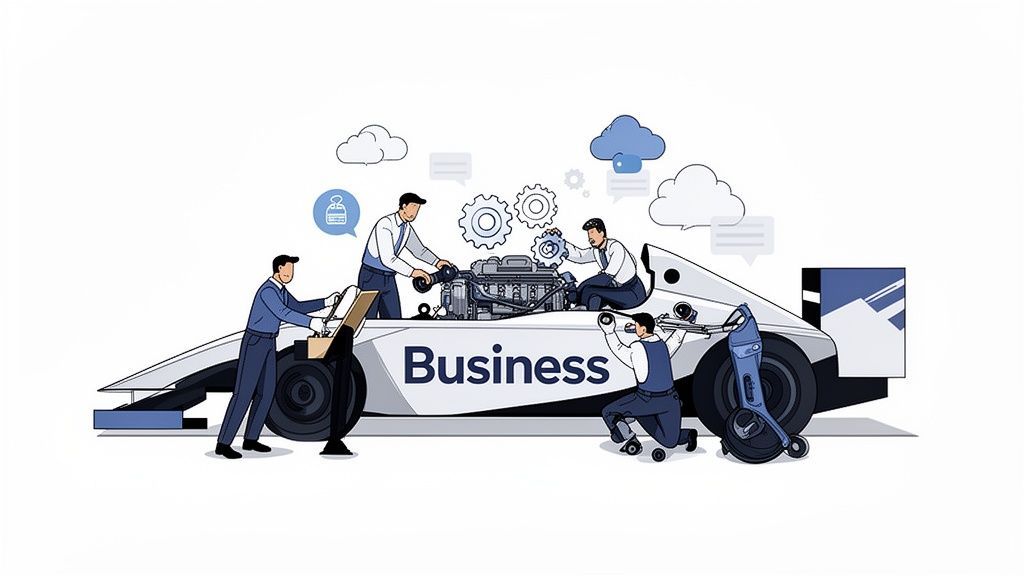
Think of your business as a high-performance race car. Strategic IT solutions in business are the engine, the navigation system, and the roll cage all in one. They don’t just get you on the track; they determine whether you win the race. A proactive IT strategy is what empowers your teams, secures your critical data, and prepares your entire organization to scale.
This shift from reactive fixes to proactive strategy is where the real value lies. Instead of waiting for a server to crash or a security threat to appear, a modern approach anticipates needs and builds a resilient foundation from the ground up. This means integrating core solutions that work together to drive performance, not just patch holes.
This new model is built on a few key pillars:
This integrated approach is no longer just a trend, it's a fundamental business movement, especially for Canadian companies looking to gain a competitive edge. For instance, cloud computing adoption among Canadian small and mid-sized businesses (SMBs) has exploded, with projections showing over 90% of organizations will have implemented cloud technologies by 2026.
This shift is driven by the need for scalable solutions and constant support, particularly in demanding sectors like healthcare and manufacturing. We've seen businesses in hubs like Toronto and Calgary report cost savings of up to 40% by outsourcing their IT to a managed provider.
An integrated IT framework allows you to do more than just operate; it lets you innovate with confidence. It ensures your technology is actively supporting your business goals, providing a stable and secure platform for whatever comes next. You can learn more about the specific benefits of managed IT services in our detailed guide.
Making sense of business technology can feel like learning a new language, full of confusing acronyms and technical jargon. This section cuts through the noise. We translate the tech-speak into clear business value, breaking down the core IT solutions that modern Canadian companies rely on to grow and stay resilient.
Think of these solutions not as separate, siloed products, but as an interconnected ecosystem. Each one has a specific job to do, but their combined power is what truly pushes a business forward. Let's dig into the essential services that form the foundation of a modern IT strategy.
Imagine having an expert pit crew for your business, one that’s constantly tuning performance, checking for wear and tear, and ensuring your operations run at top speed. That’s the real essence of Managed IT Services.
It’s a massive shift away from the old, reactive "break-fix" model, where you wait for something to go wrong before calling for help. Instead, this is a proactive partnership focused entirely on prevention and optimisation.
A managed services provider (MSP) becomes your outsourced IT department, offering services like 24/7 monitoring, helpdesk support, and ongoing system maintenance. The goal is simple: find and fix potential issues before they can trigger costly downtime. This approach keeps your team productive and ensures your technology is a consistent asset, not a frustrating obstacle.
Think of cloud solutions as your company’s secure, digital headquarters. It's a central hub for all your data, applications, and collaborative work, accessible from anywhere.
Essentially, you move your critical infrastructure from a server closet in the back office to a highly secure, scalable, and resilient environment managed by experts. But this is about more than just remote access; it’s about genuine business agility.
For anyone wanting to go deeper into how these systems are built, exploring the core components of IT infrastructure is a great next step.
While managed services and the cloud provide the engine for your business, you still need an elite security detail and a reliable recovery plan. This is exactly where cybersecurity and disaster recovery come into play.
Cybersecurity is your 24/7 guard, actively defending all your digital assets from threats like ransomware, phishing, and data breaches. Backup & Disaster Recovery (BDR) is your guaranteed comeback plan, ensuring you can restore operations quickly and completely after any incident, from a simple server failure to a natural disaster.
To help you see how these pieces fit together, here’s a table summarising each solution and the real-world value it delivers.
| IT Solution | Primary Function | Key Business Benefit |
|---|---|---|
| Managed IT Services | Proactive monitoring, maintenance, and support. | Minimises downtime and boosts team productivity. |
| Cloud Solutions | Centralised, scalable access to data and apps. | Increases agility and reduces hardware costs. |
| Cybersecurity | Defence against digital threats and breaches. | Protects sensitive data and business reputation. |
| Backup & Disaster Recovery | Data backup and operational restoration. | Guarantees business continuity after an incident. |
| VoIP Phone Systems | Modern, internet-based communications. | Improves communication flexibility and cuts costs. |
| Virtual CIO (vCIO) | Strategic, high-level technology guidance. | Aligns IT investments with long-term business goals. |
This table shows that a comprehensive IT strategy isn't just about fixing problems, it's about creating opportunities and building a more resilient, efficient, and competitive business.
To round out your IT ecosystem, there are two more critical components: your communications hub and your strategic guide.
A modern Voice over IP (VoIP) phone system is much more than just a way to make calls. It's a flexible communications platform that integrates with your other business tools, scales as you grow, and delivers features a traditional phone line simply can't match.
Finally, a Virtual Chief Information Officer (vCIO) provides high-level strategic guidance without the high cost of a full-time executive salary. A vCIO works alongside your leadership team to build a technology roadmap that aligns perfectly with your long-term business goals, ensuring every dollar you spend on IT delivers a measurable return.
Let’s be direct: the question is no longer if your business will face a data breach, but when. We see it every day across Canada. Ransomware can bring a manufacturing supply chain to a halt, and a simple compliance mistake can put a healthcare clinic's sensitive patient data at risk. Generic warnings are not enough.
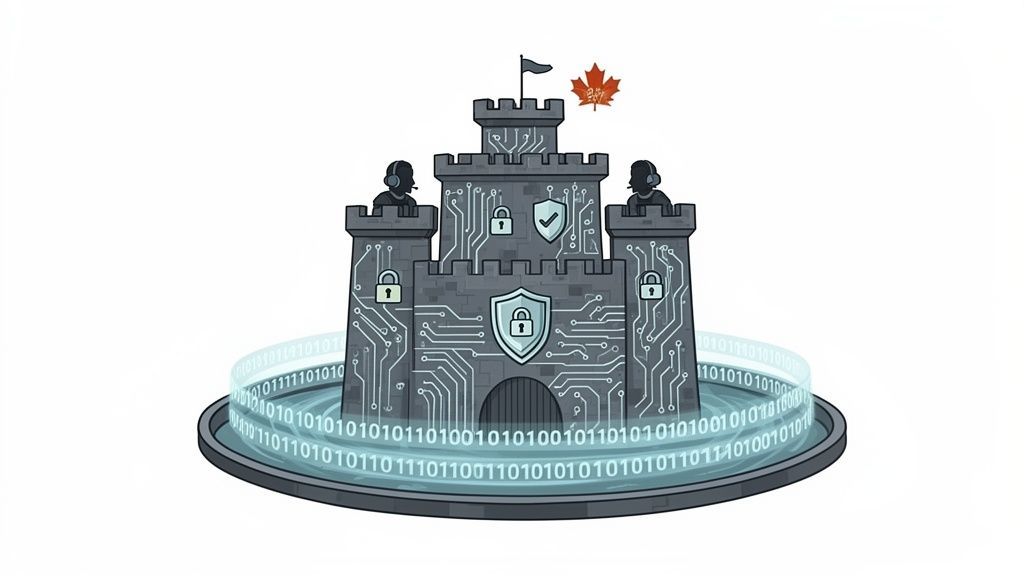
Think of your business’s security like a medieval castle. You wouldn't rely on just one high wall to protect everything inside. A real fortress has layers: a moat to slow attackers, strong walls as a barrier, and guards on patrol actively scanning for trouble. Modern cybersecurity works the same way.
Proper IT solutions in business cybersecurity go way beyond just installing antivirus software and calling it a day. A real strategy weaves together multiple layers of protection that work in concert to shield your digital assets, just like that castle's defences.
This approach should always include:
And since so many tools we use today are in the cloud, understanding the best practices for data security in B2B SaaS is a critical piece of the puzzle.
These technical layers aren't just for the IT department; they translate directly into business resilience. Every defensive measure you add helps protect the reputation you’ve worked so hard to build, ensures you meet strict regulatory standards like PIPEDA, and helps you avoid the catastrophic costs of downtime.
A strong security posture is a direct investment in your brand's trustworthiness. It tells your clients, partners, and employees that you take the protection of their data seriously, which is a powerful differentiator in any market.
Across Canada, cyber incidents are on the rise, and small to mid-sized businesses have become prime targets. Taking proactive steps is a matter of survival, and the numbers back it up. For instance, some Ontario healthcare providers using tailored cybersecurity have reported 36% fewer incidents. A 2026 study also found that SMBs outsourcing their IT security save, on average, 40% compared to maintaining an in-house team.
Having a Canada-based, 24/7 security team gives you a massive advantage. Local experts understand the specific threat landscape and compliance demands Canadian businesses face. They're in your time zone, ready to act on any incident the moment it happens, making sure your digital fortress is never left unguarded.
For a deeper dive into what that involves, you can read our guide on essential cyber security services. This local knowledge is invaluable for navigating the unique challenges of the Canadian market and keeping your business safe.
Handing over your IT to a dedicated partner delivers a return on investment that goes beyond trimming the budget. It's about tapping into a new level of productivity and accessing specialised expertise that’s often too costly and difficult to build in-house. This is how you stop wrestling with technology and turn it into a powerful, reliable engine for your business.
For years, the standard approach was 'break-fix.' You’d wait for something critical to go down, then scramble for help while operations ground to a halt. It’s like only calling a mechanic after your car has sputtered to a stop on the side of the highway.
A proactive managed services model flips that script entirely. Think of it as having regular, scheduled maintenance for your business. Small issues are spotted and fixed long before they can become major headaches, ensuring your operations run smoothly.
The real value of managed IT solutions in business is found in efficiency and opportunity. When your technology just works, your teams are free to focus on their actual jobs instead of fighting with glitches and error messages. That shift alone has a direct, measurable impact on your bottom line.
A partnership with a managed services provider (MSP) frees up your leadership to focus on what they do best: growing the business. By offloading day-to-day IT management, you can redirect your most valuable resources, your people’s time and attention, toward strategic initiatives, client relationships, and innovation.
This model is quickly becoming the standard across Canada as businesses realise its clear advantages. In fact, by 2026, most Canadian companies are expected to prioritise optimising their managed IT and cloud services. For medium-sized businesses, the numbers are compelling, partnering with a third-party provider can be up to 40% more cost-effective than managing IT in-house. You can explore detailed IT facts and figures to see more data on this trend.
Managed cloud services are a cornerstone of this efficient approach. They give your teams seamless and secure tools like Microsoft 365, so they can collaborate effectively from anywhere. This creates a foundation that scales with you, letting you add new users, services, and locations without a massive infrastructure overhaul.
A well-managed IT environment also naturally strengthens your security. Proactive management isn't just about preventing downtime; it includes constant monitoring and maintenance that are critical for your defence. It all starts with building your digital fortress from the inside out with robust Workplace Cyber Security measures.
Switching to a managed services model brings several key advantages that directly boost your efficiency and make your business more resilient.
By partnering with an MSP, you’re not just outsourcing a few tasks; you’re investing in a more productive, secure, and scalable future for your company. If you're curious about the specifics of this kind of partnership, our guide on what to expect from a managed IT service breaks it down further.
Theory is one thing, but seeing IT solutions deliver real-world results is what truly matters. Generic advice falls flat because every industry faces its own set of unique challenges, from regulatory pressures to operational demands. A one-size-fits-all IT strategy is a recipe for failure.
An effective IT partner knows this. We don't just sell services; we build strategies that directly tackle your industry's biggest headaches and unlock its unique opportunities.
Here’s a look at how this plays out across key Canadian sectors.
For healthcare providers across Canada, the stakes couldn't be higher. They have a legal and ethical duty to protect sensitive patient data under regulations like PIPEDA, while also delivering modern care through services like telemedicine.
This is where specialised cloud solutions come in. By moving to a secure, compliant cloud platform, clinics and hospitals can protect electronic health records (EHR) with robust encryption and access controls.
This technology is the engine behind modern telehealth, enabling secure video consultations and remote patient monitoring. The right IT framework allows providers to innovate patient care without putting security or compliance at risk.
In manufacturing, downtime is the enemy. Every minute the production line is stopped or a shipment is delayed, money is lost. Smooth operations depend entirely on flawless communication between the factory floor, the warehouse, and logistics partners.
A reliable, scalable network is the foundation, ensuring all machinery and inventory systems are online. Modern VoIP phone systems tie your people together.
A well-implemented VoIP system unifies communications, allowing teams to connect instantly via voice, video, or messaging, whether they are in the head office or on the shipping dock. This instant connectivity speeds up decision-making and helps prevent costly delays in the supply chain.
Law firms and financial institutions operate under a microscope of regulatory scrutiny. They handle some of the most sensitive client data imaginable, where a breach isn’t just a PR problem, it can be a business-ending catastrophe.
For these sectors, the focus is on absolute security and data integrity. This means ironclad data archiving for audit trails, secure collaboration portals to protect client confidentiality, and multi-layered cybersecurity defences. These aren't just features; they are foundational to maintaining client trust and regulatory standing.
The primary workplace for a construction company is a remote job site, often with no existing infrastructure. Yet, crews on the ground need constant, reliable access to blueprints, project management tools, and communication channels to keep projects on time and on budget.
Providing that connectivity is a specialised skill. It requires deploying rugged networking hardware and secure wireless solutions built to withstand harsh environments. With a stable link back to the office, you empower site managers with the real-time data they need to build safely and efficiently.
To see more on how we help these and other sectors, you can explore the industries CloudOrbis serves.
The oil and gas industry often has a capable in-house IT team, but they can be stretched thin or may lack the niche expertise required to defend against today's sophisticated cyber threats. In these situations, a co-managed IT approach offers the perfect blend of internal knowledge and external power.
In this partnership model, an MSP acts as a specialised extension of your existing team. For example, our team might run the 24/7 security operations centre (SOC) and handle advanced threat detection, which frees up your staff to focus on day-to-day operations and strategic projects. It’s a collaboration that elevates your security posture without making your internal team redundant.
Feeling overwhelmed by all the IT options out there? You're not alone. Figuring out the right IT solutions for your business can feel like a huge undertaking, but it doesn't have to be.
With a clear, step-by-step roadmap, you can cut through the noise and make confident decisions that truly support your long-term goals. Let's break the journey down into four simple phases, taking you from initial discovery to continuous improvement.
Every smart IT strategy starts with a thorough assessment. Before you can choose a solution, you need to understand exactly where you are now and where you want to go. It's like planning a road trip, you can't pick a route without knowing your starting point and final destination.
In this first phase, your focus is on gathering information. You need to identify:
This discovery process gives you the hard data needed to build a strategy that solves real-world problems.
Once you have a handle on your needs, the next step is finding the right partner, not just a supplier. A true IT partner is invested in your success, offering strategic advice that goes beyond selling a product.
When you're evaluating potential vendors, look for a partner who:
Choosing a vendor is one of the most critical decisions you will make. This is a long-term relationship, so prioritise transparency, expertise, and a shared commitment to your business objectives. A good partner becomes an extension of your own team.
With a partner chosen, it’s time to build a tailored strategic plan. This roadmap connects the goals from the assessment phase with the solutions your partner provides, all while staying within your budget. This plan should clearly detail the "what, why, and how" of your IT overhaul, including timelines and key milestones.
Next comes deployment and migration, where the plan becomes a reality. A skilled provider will manage this process meticulously to ensure everything goes smoothly. The goal is simple: implement new systems with minimal impact on your daily operations, keeping your team productive throughout the entire process.
Technology is only as good as the people using it. Comprehensive employee training is essential to ensure your team adopts the new tools and you get the best return on your investment. The training should be practical, role-specific, and focused on showing your staff how the new tools make their jobs easier.
The journey isn't over once everything is up and running. Ongoing optimisation is how you unlock continuous value from your technology. Your IT partner should be regularly reviewing system performance, checking security reports, and gathering user feedback to make steady improvements. This ensures your technology evolves right alongside your business, remaining a powerful asset for growth.
Even with the best roadmap, exploring new IT solutions in business can feel like venturing into uncharted territory. It’s natural to have questions. Here, we tackle some of the most common concerns we hear from business leaders, offering clear answers to help you navigate your technology decisions with confidence.
If you find your team constantly putting out tech fires or waiting on reactive support, you're likely ready for managed IT services. A major red flag is when your staff spend more time wrestling with IT problems than doing their actual jobs. Technology should be enabling growth, not getting in its way.
Another clear sign is the lack of a forward-thinking technology plan. If you're worried your systems are aging and falling behind the competition, it's time for a change. A great managed service provider delivers the proactive strategy needed to turn your IT from a liability into a real business advantage.
The process starts with a structured plan, long before any new tech is deployed.
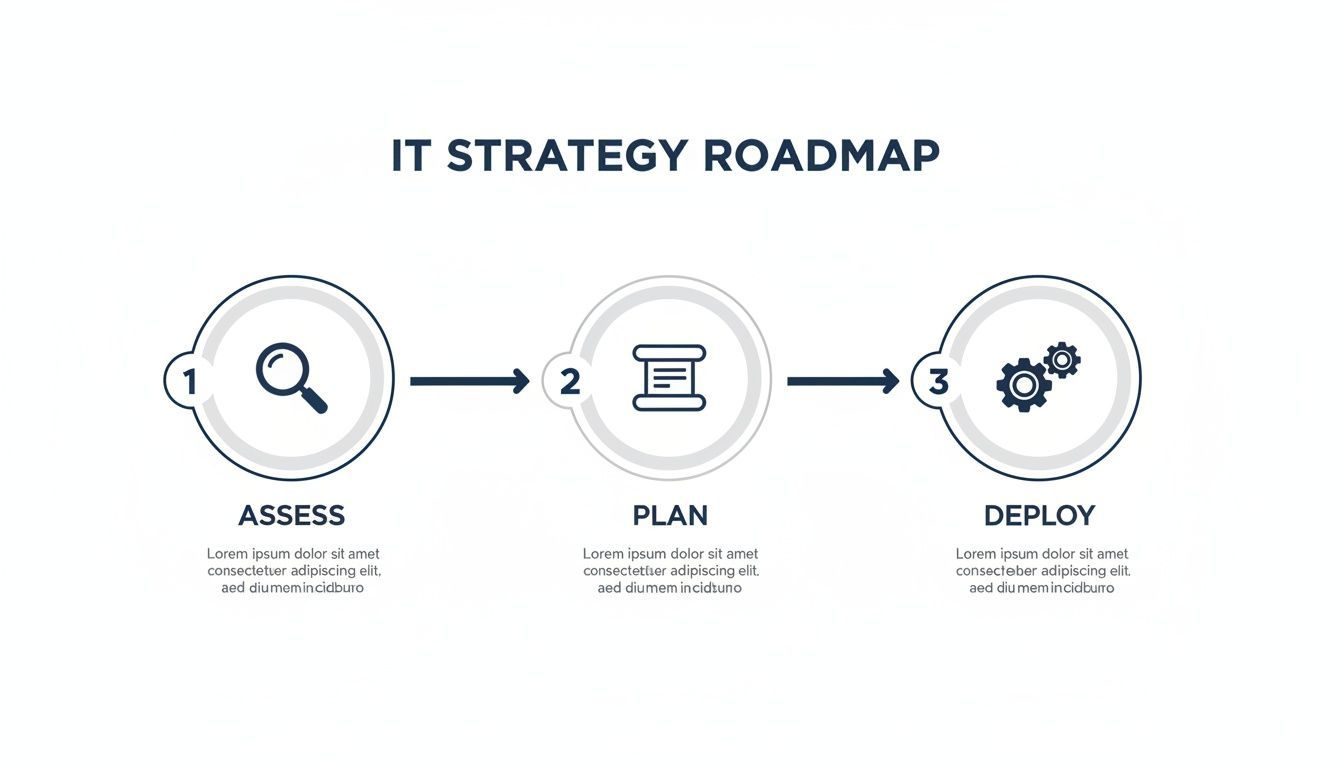
This methodical approach highlights that a successful IT strategy isn't just about the tools themselves, it's about the disciplined planning that comes first.
It’s a common point of confusion, but the distinction is critical. Think of cloud services, like Microsoft 365, as your digital head office, it’s where your team actively works every day. On the other hand, data backup is the off-site, fireproof vault that holds secure copies of everything in that office.
While your digital office might be in a secure building (the cloud), you absolutely need that separate, isolated vault in case of a fire, flood, or major theft (like a ransomware attack). A solid business continuity strategy requires both: cloud services for day-to-day operations and a robust backup plan to ensure you can restore everything and get back to work, no matter what happens.
While every business is different, a good benchmark for a mid-sized company is to set aside 3% to 6% of its annual revenue for technology. For many, partnering with a managed services provider is a far more predictable and cost-effective approach than trying to build and retain a full in-house IT department.
The best first step is always a professional IT assessment. An experienced provider can analyse your current setup and business goals to develop a tailored proposal that aligns with your budget and delivers a clear return on investment.
Ready to transform your technology from a cost centre into a growth engine? The expert team at CloudOrbis builds resilient, secure, and efficient IT environments for Canadian businesses. Book your free consultation today and discover how a proactive IT strategy can give you a true competitive advantage.
Book a 30-minute call with a senior engineer. No sales script, just straight answers about your environment.


