
September 13, 2026
Third-Party Risk Management for Canadian SMBsMaster third-party risk management for your Canadian SMB. Learn OSFI compliance, vendor monitoring frameworks, and how to secure your supply chain.
Read Full Post%20(1).webp)
Usman Malik
Chief Executive Officer
December 10, 2025

Running a business in Toronto means technology is at the heart of everything you do. But managing that technology can feel like a constant cycle of reactive fixes—solving one problem just as another emerges. IT managed services offer a different path forward, providing expert support and preventing issues before they start, all for a predictable monthly fee.
This approach gives your medium-sized organization access to an entire team of specialists—from cybersecurity professionals to cloud experts—without the significant cost of hiring them in-house. It’s about shifting your IT strategy from firefighting to future-proofing.
Imagine this scenario: you could wait for a pipe to burst in your office before calling a plumber, dealing with the resulting stress, cost, and disruption. That is the traditional, reactive way of managing infrastructure.
Alternatively, you could partner with a building management company that regularly inspects the plumbing, services the HVAC system, and monitors security. They work to prevent disasters, ensuring everything runs smoothly.
That is precisely what IT managed services do for your technology. It's a strategic move away from the "break-fix" model, where help is only called after a server has crashed or a data breach has occurred. Instead, a Managed Services Provider (MSP) becomes your proactive technology partner.
An MSP’s primary role is to keep your IT infrastructure operating smoothly and securely, 24/7. They don’t just respond when something is broken; they work behind the scenes to prevent issues from happening in the first place. They achieve this through continuous monitoring, regular maintenance, and strategic planning.
This forward-thinking model is gaining significant traction. The managed services market in Canada generated approximately CAD 27.2 billion and is projected to grow to about CAD 59.6 billion by 2030. This growth is a clear indicator that businesses are moving away from reactive IT.
This partnership allows you to delegate the daily responsibilities of IT management. Instead of your team spending valuable time on printer problems or software glitches, they can focus on their core competencies: growing your business.
An MSP transforms IT from a reactive cost centre into a strategic asset. The focus shifts from "What's broken today?" to "How can technology help us achieve our goals tomorrow?"
To fully understand the difference, let’s compare the two models. The proactive approach of an MSP is fundamentally different from the stressful, unpredictable nature of break-fix support.
Seeing it laid out this way makes the choice clear. The managed services model is built to support business growth, while the break-fix model is limited to resolving immediate issues.
For medium-sized organizations aiming to succeed in a competitive hub like Toronto, access to top-tier technology and expertise provides a significant advantage. Realistically, hiring a full-time cybersecurity expert, a cloud architect, and a network engineer is not feasible for most companies.
An MSP levels the playing field. You receive all that specialized knowledge on a fractional basis, bundled into a single, predictable monthly cost. This empowers your business to:
When you partner with the right provider, you are not just outsourcing IT support. You are investing in a more resilient, secure, and efficient future. To learn more, explore our deeper dive into what makes a great managed IT service.
When you engage an IT managed services provider in Toronto, you receive more than just technical support. You are investing in a complete suite of proactive services designed to keep your business secure, productive, and scalable. Each service is tailored to solve a specific business challenge, transforming your IT from a reactive cost into a strategic advantage.
Let's move beyond the technical jargon and examine what these core services deliver for your business operations.
Ultimately, IT support is about empowering your team. When an employee cannot access a critical file, a key application crashes, or a printer malfunctions, work grinds to a halt. Every minute of that downtime translates into lost productivity and significant frustration.
A managed 24/7 helpdesk provides your team with an immediate connection to technical experts who can resolve issues quickly. This isn't just about fixing computers; it’s about ensuring your people have the tools they need to perform their jobs without interruption. This level of responsive support is the foundation of business continuity, keeping your operations running smoothly. You can see how this works in practice by exploring the benefits of a dedicated IT helpdesk support team.
In today's digital landscape, a cyberattack is a matter of when, not if. A single breach can be devastating, leading to substantial financial losses, reputational damage, and serious legal consequences. Relying on a basic firewall and antivirus software is insufficient against modern, sophisticated threats.
Proactive cybersecurity from a managed services provider (MSP) acts as a multi-layered shield protecting your entire organization. This is not a single product, but an ongoing service that includes:
This comprehensive approach strengthens your defences from every angle, protecting your data, your clients, and your bottom line.
Cloud platforms like Microsoft Azure offer incredible opportunities for businesses to become more agile and cost-effective. However, migrating to and managing the cloud requires specialized skills. A poorly planned cloud migration can quickly lead to security vulnerabilities, unexpected costs, and performance issues.
An MSP helps you develop and execute a cloud strategy that aligns with your business objectives. They manage everything from assessing your current infrastructure to migrating your applications and data with minimal disruption. Once in the cloud, they manage the environment to ensure it remains secure, optimized, and cost-effective as your business evolves.
By outsourcing cloud management, you gain access to enterprise-grade infrastructure and expertise without the significant upfront investment. It allows you to scale resources up or down as needed.
This chart illustrates the clear difference between the proactive, predictable cost model of managed IT services and the reactive, unpredictable costs of traditional break-fix support.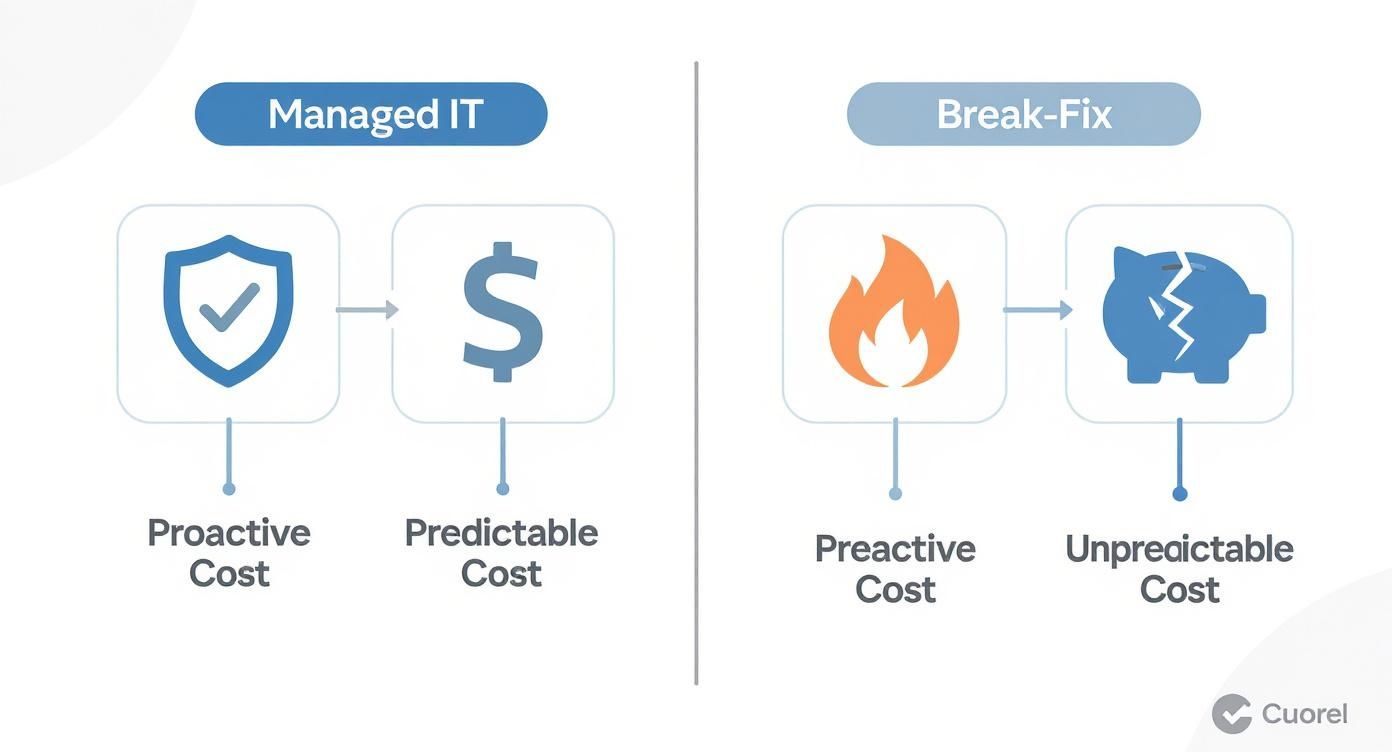
As you can see, the managed approach provides financial stability and enables forward planning, while the break-fix model leaves you vulnerable to emergency expenses and operational chaos.
What would happen if a fire, flood, or major cyberattack affected your office tomorrow? A solid Business Continuity and Disaster Recovery (BCDR) plan is what distinguishes a minor disruption from a complete catastrophe. It is the framework that ensures you can maintain operations and restore critical systems quickly following any incident.
An MSP will collaborate with you to build a robust BCDR strategy that covers all essential components:
This planning provides genuine peace of mind, knowing your business is built to withstand unforeseen events. It’s no surprise that the Managed IT Infrastructure & Data Centre segment leads the market, accounting for 32.5% of total revenue, driven by the need for scalable and secure IT environments.
Many medium-sized organizations require high-level IT strategy but cannot justify the salary of a full-time Chief Information Officer. This is where a virtual CIO (vCIO) service from an MSP fills the gap. You receive the C-level guidance necessary to make intelligent, forward-thinking technology investments without the C-level cost.
Your vCIO acts as your senior technology advisor, assisting with:
This strategic oversight ensures your technology not only supports your daily operations but also becomes a powerful engine for future growth.
If you operate a business in Toronto's healthcare, finance, or legal sectors, you understand that compliance is a legal requirement, not a suggestion. Navigating the complex web of regulations can be a full-time job. A single misstep can lead to significant penalties, reputational damage, and a loss of client trust.
This is where your choice of an IT managed services provider in Toronto becomes a critical strategic decision. A specialized Managed Services Provider (MSP) does more than fix computers; they act as your compliance partner, translating legal requirements into concrete technical safeguards.
They understand that for a healthcare clinic, protecting patient data means strict adherence to the Personal Health Information Protection Act (PHIPA). Similarly, a financial firm in the GTA must maintain robust security to meet guidelines from regulators like the Office of the Superintendent of Financial Institutions (OSFI).

An expert MSP doesn't just install software; they build a comprehensive security and compliance framework. Specific managed services become essential tools for meeting your legal obligations and demonstrating due diligence during audits.
Consider the following:
These are not just line items on an invoice; they are the foundational elements of a robust compliance posture. It is also important for businesses in the GTA to consider digital accessibility, especially when navigating cross-border accessibility compliance and adhering to AODA standards.
Every industry has a unique regulatory landscape. A generic, one-size-fits-all approach to IT security and compliance is inadequate. That's why Toronto-based enterprises in sectors like investment banking, manufacturing, and real estate are major adopters of managed IT services—they require partners who understand their specific operational challenges.
An MSP with deep experience in your field can anticipate challenges you haven't yet considered. They bring proven best practices from other clients in your sector, helping you stay ahead of evolving threats and regulations.
This specialized knowledge is invaluable. A provider familiar with the legal industry will know precisely how to secure client-attorney privileged information. Likewise, an MSP serving healthcare clients will have deep, practical expertise in building PHIPA-compliant environments.
When you engage a partner with industry-specific expertise, you are not just purchasing IT support. You are building a more resilient, compliant, and trustworthy operation. To achieve this, you need to explore comprehensive compliance solutions designed for the specific demands of your industry.
Understanding the cost of IT managed services in Toronto can seem complex, but it doesn't have to be. Let's clarify how providers structure their pricing, so you know exactly what you are paying for and why a predictable monthly fee is one of the most strategic investments your business can make.
The primary goal is to eliminate the unpredictable costs of traditional "break-fix" IT. Instead of receiving an unexpected invoice every time a server fails or a laptop requires service, you pay a single, flat monthly fee. This model aligns your provider with your success; it is in their best interest to keep your systems running smoothly to minimize support incidents.
When you request quotes, you will likely encounter a few standard pricing models. Each is designed for different business needs, but all aim for predictability and transparency.
Regardless of the model, the objective is to provide a clear, all-inclusive cost that covers everything from proactive maintenance to emergency support. For a transparent example, you can explore different managed IT service pricing plans and see how these services are bundled.
The monthly fee does not tell the whole story. The true value of managed IT services becomes apparent when you consider the Total Cost of Ownership (TCO). TCO includes not only the direct cost of the service but also all the hidden expenses of managing IT internally or with a break-fix provider.
Consider the indirect costs. What is the real cost of an hour of server downtime in lost sales and frustrated employees? When you add the high fees for an emergency call-out, the "cheaper" break-fix option often proves more expensive.
A predictable monthly fee for managed IT services isn't just an expense; it’s an investment in operational stability. It effectively mitigates the financial risks of unexpected hardware failures, cyber incidents, and productivity-killing downtime.
This approach transforms IT from a volatile capital expense into a stable, manageable operational expense, making budgeting more accurate and less stressful.
The most important document in any managed services partnership is the Service Level Agreement (SLA). The SLA is the provider's written commitment to you. It is a binding contract that specifies exactly what services will be delivered, the performance standards they must meet, and their responsibilities.
A strong SLA is your guarantee of accountability, turning vague promises into measurable commitments. When evaluating proposals from any provider offering IT managed services in Toronto, the SLA is where you should focus your attention.
Key metrics to look for include:
A detailed SLA gives you the confidence to evaluate providers effectively. It ensures you partner with a company that stands behind its service and is accountable for keeping your business operational.
Selecting a partner for your IT managed services in Toronto is a major business decision, not just a technical one. The right provider becomes an extension of your team—a strategic asset that facilitates growth and secures your operations. The wrong one can lead to frustrating downtime, security vulnerabilities, and wasted investment.
It's tempting to compare prices alone, but this is a mistake. You need a structured way to vet potential providers to find a partner who understands your business goals and the unique demands of the Toronto market. This framework will help you ask the right questions and distinguish a vendor from a true partner.
First, are they genuinely local? While most IT support is now remote, having a team that understands the Toronto business environment is a significant advantage. A local presence means they can provide on-site support quickly for critical emergencies that cannot be resolved remotely.
However, being "local" is not enough. You need to investigate their team's qualifications. Technical skill is the baseline, so do not hesitate to ask for proof.
Technical skills are only half the equation. An MSP's communication style and cultural fit are just as critical for a successful long-term partnership. If their communication is unclear during the sales process, it is unlikely to improve after you sign a contract.
Look for a provider who listens more than they talk. They should be asking intelligent questions about your business goals, your biggest challenges, and your five-year vision.
A great MSP isn't just selling a list of services; they are co-creating a technology roadmap designed to help you succeed. Their primary goal should be to understand your vision, not just your network.
Clear, consistent, and honest communication is the foundation of a strong partnership. You need to feel confident that you can contact someone who knows your business and is ready to help, not just log another ticket.
When you hire an MSP, you are entrusting them with your data, systems, and reputation. Therefore, their own internal security must be robust. A provider cannot secure your business if they cannot secure themselves.
This is where you need to be thorough. Ask direct questions about their operations.
Choosing the right MSP is similar to selecting any long-term business partner. Due diligence is essential. To help structure your evaluation, we’ve created a checklist of key criteria.
Ultimately, you're looking for a provider who is as invested in your success as you are. For more guidance on this process, our article on what to look for in an IT outsourcing company offers additional valuable insights.
When searching for IT managed services in Toronto, you are not just hiring a vendor. You are seeking a true partner who understands your business—one who is as invested in your success as you are. At CloudOrbis, we have built our entire service model around being that strategic ally for Toronto’s medium-sized organizations.
It begins with our local roots. Our helpdesk is 100% based in Canada, which means your sensitive data never leaves the country, ensuring compliance with local privacy laws. When you require support, you are speaking with an expert who understands the Toronto business landscape, not a remote call centre.

Trust is paramount, and we believe it is earned through complete transparency. That is why we created our 10-step engagement process. This is not just a sales methodology; it is a proven roadmap that guides our partnership from the initial consultation and strategy session through to implementation, training, and ongoing optimization. You will always know exactly where we are in the process and what to expect next.
We also believe in practical innovations that benefit your team. A perfect example is the CloudOrbis IT Button. We developed this simple, one-click tool to allow your employees to get instant help without drafting an email or making a phone call. It is a small feature that makes a significant difference, reducing frustration and enabling people to return to their work faster.
Partnering with CloudOrbis means you get more than just a vendor—you get a strategic ally dedicated to your growth, armed with a transparent process and tools designed to empower your team.
Our experience is extensive in some of Toronto's most regulated and demanding industries. We have a solid track record of helping businesses in healthcare, finance, and law navigate the complexities of operational efficiency and strict compliance.
This expertise goes beyond technology; it involves understanding the specific rules and challenges you face daily. That industry-specific insight, combined with our local presence and client-first approach, makes CloudOrbis the clear choice for businesses that require more than reactive IT fixes. We are here to help you build a secure, efficient foundation for sustainable growth.
Partnering with a managed services provider is a significant decision, and it is natural to have questions. To help you feel confident in the process, we have compiled and answered the most common questions we hear from business leaders in Toronto.
Our goal is to provide clear, straightforward answers that cut through the technical jargon and empower you to make the right choice for your company.
In the Toronto area, IT managed services typically range from $100 to $250 per user, per month. Your specific cost within that range will depend on several factors: the size of your team, the complexity of your current technology stack, and the level of cybersecurity and compliance your industry requires.
The only way to determine a precise figure is through a thorough assessment. A quality provider will analyze your business goals to build a customized plan, ensuring you only pay for what you truly need.
Not at all. In fact, small and medium-sized organizations often realize the greatest return on investment. An MSP gives you immediate access to a full team of enterprise-level experts—from certified cybersecurity analysts to cloud strategists—at a fraction of the cost of hiring them directly.
It is the ultimate way to level the playing field. You get to focus on running your business while your technology is professionally managed, secured, and optimized for growth. This frees up both your time and your capital for what really matters.
The difference is fundamental. Traditional IT support is reactive—you wait for something to break, then you call for help. The old "break-fix" model is inherently dependent on your business experiencing problems and downtime.
Managed services are the opposite; they are proactive. Your MSP is constantly working behind the scenes, monitoring, maintaining, and securing your systems to prevent problems before they can occur. This approach not only reduces costly downtime but also transforms your IT from a source of frustration into a reliable asset that drives your business forward.
While it may seem that way, the reality is you gain more strategic control. A good MSP handles the day-to-day technical tasks, which frees you and your leadership team to focus on the bigger picture.
You set the vision and business objectives. Your MSP provides the technology roadmap and expert execution to help you achieve them. It is a true partnership that gives you better visibility and command over your technology, ensuring every IT investment directly supports your strategic goals.
Ready to stop reacting to IT problems and start using technology as a strategic advantage? At CloudOrbis Inc., we provide proactive, Canada-based managed IT services that help Toronto businesses grow securely and efficiently. Schedule a free consultation today and discover how a true technology partner can make all the difference.
September 13, 2026
Third-Party Risk Management for Canadian SMBsMaster third-party risk management for your Canadian SMB. Learn OSFI compliance, vendor monitoring frameworks, and how to secure your supply chain.
Read Full Post
September 12, 2026
Managed Services Cost: A Practical Guide for Canadian SMBsUnderstand managed services cost for Canadian SMBs. Learn pricing models, industry factors, ROI, and how to choose the right provider for your business.
Read Full Post
September 11, 2026
Managed EDR Services: A Practical Guide for Canadian SMBsLearn how managed EDR services detect, contain, and respond to threats around the clock. A practical guide for Canadian SMBs evaluating providers, pricing
Read Full Post
