HIPAA Compliant Certification: What Clinics Need to Know
Is there a HIPAA compliant certification? No official one exists. Learn what clinics should verify, how PHIPA applies in Ontario, and a practical roadmap.

Is there a HIPAA compliant certification? No official one exists. Learn what clinics should verify, how PHIPA applies in Ontario, and a practical roadmap.

No official U.S. government HIPAA certification exists, HHS does not endorse private certifications, and a certificate doesn't make a clinic legally compliant. Buying training or choosing a vendor with a badge can support compliance work, but neither replaces the clinic's legal obligations.
The popular advice to “get HIPAA certified” starts with the wrong purchase. For an Ontario clinic, the better starting point is a documented understanding of which laws govern patient information, which safeguards operate, and who can produce the evidence.
HIPAA compliant certification is best understood as an evidence question, not an approval status. A useful assessment should help your privacy officer and IT team demonstrate how they protect information under both HIPAA, where applicable, and Ontario's PHIPA.
There's no official HIPAA certification for a clinic, employee, software product, or IT provider. The U.S. Department of Health and Human Services doesn't endorse or recognize private certifications for HIPAA Security Rule compliance. Holding a certificate also doesn't remove an organization's legal obligations.
Private credentials can still be useful. Training records show that someone completed instruction, while an assessment report can document a review of particular controls. The mistake is treating either document as government approval.
For Ontario clinics, the Personal Health Information Protection Act establishes obligations that a HIPAA-labelled certificate cannot replace. A clinic needs evidence tied to its actual activities, not just a credential with a familiar acronym.
A vendor's badge might cover its hosting infrastructure but say nothing about how your staff configure access, send attachments, or export records. Those decisions still need documented safeguards.
For a concrete example, FaxZen's explanation of email encryption requirements under HIPAA helps distinguish a communication safeguard from a general compliance claim. Encryption is something to configure and verify, not something a badge automatically supplies.
A compliance risk management framework gives clinic managers a way to connect credentials with responsibilities, controls, and evidence.
| Credential | What It Shows | What It Does Not Prove |
|---|---|---|
| Staff course-completion certificate | An employee finished HIPAA or privacy training | Systems and processes meet the Security Rule |
| Vendor “HIPAA certified” label | The vendor claims alignment with HIPAA | The vendor was independently audited or is legally compliant |
| Third-party HIPAA assessment report | An assessor reviewed named controls on a set date | Compliance after that date or outside the stated scope |
| SOC 2 Type II report | Controls operated over an audit period, tested by a CPA firm | HIPAA compliance, since it isn't a HIPAA review |
| HITRUST CSF certification | Controls were assessed against a private framework mapped to HIPAA | Official recognition by HHS or a government regulator |
| Self-attestation | The organization states that it complies | Any independent verification |
None of these credentials is an HHS finding that your clinic complies with HIPAA.
For most Ontario clinics, PHIPA is the starting framework. Think of PHIPA as the building code governing the premises, while HIPAA-related obligations can travel with a data relationship or contract. The analogy has a limit: a contract can impose safeguards, but it doesn't independently determine whether an organization is legally subject to HIPAA.
The Information and Privacy Commissioner of Ontario's explanation of health privacy rights describes custodians' duties to establish and follow information practices, appoint a privacy contact person, educate agents, and take reasonable precautions against theft, loss, and unauthorized handling.
Patient citizenship alone isn't a reliable test of HIPAA status. Your clinic's role, activities, and relationships need examination.
| Clinic situation | HIPAA may apply | PHIPA applies | First action |
|---|---|---|---|
| Ontario clinic serving only Ontario patients | Generally not | Yes | Build a PHIPA privacy program |
| Clinic treating U.S. patients | Possibly, if it is a HIPAA covered entity | Yes | Confirm HIPAA status and map controls to PHIPA |
| Clinic exchanging data with a U.S. covered entity | Possibly, through a business associate relationship and agreement | Yes | Review contract terms against PHIPA duties |
| Mississauga family clinic using a U.S.-hosted scheduling app | Possibly, through the vendor's contract or role | Yes, for its Ontario patient records | Get written safeguards and PHIPA-compatible terms |
| Clinic handling data for a U.S. provider as a vendor | Usually yes, as a business associate | Possibly, according to the data type and circumstances | Confirm roles for each data flow |
In the Mississauga example, the app's hosting location prompts questions about support access, subprocessors, disclosures, and contract terms. It doesn't automatically turn the clinic into a HIPAA covered entity. PHIPA still governs the clinic's Ontario records, while HIPAA-related requirements may accompany the vendor relationship.
Practical rule: Determine the organization's role before deciding which agreement or assessment it needs.
A clinic's healthcare IT compliance review should record that reasoning so procurement, clinical leadership, and IT don't reach different conclusions about the same system.
One control library can support both regimes, but the legal mappings must remain distinct. Your access-control process can serve multiple obligations without pretending those obligations are identical.
The Ontario privacy guidance on collection, use, and disclosure explains that PHIPA generally requires consent or legal permission and prohibits handling more information than reasonably necessary. It also says custodians must not use personal health information when other information would serve the purpose.
| Requirement area | HIPAA (U.S.) | PHIPA (Ontario) | Evidence to keep |
|---|---|---|---|
| Governing rules | Security, Privacy, and Breach Notification Rules | Personal Health Information Protection Act | Written jurisdictional mapping |
| Permitted use and disclosure | Treatment, payment, and healthcare operations permissions; authorization or another permission for other purposes | Consent, or activity permitted or required by law | Consent records and disclosure logs |
| Minimum necessary | Minimum-necessary standard, with exceptions | No more than reasonably necessary | Role-based access reviews |
| Safeguards | Administrative, physical, and technical safeguards | Reasonable precautions against theft, loss, and unauthorized handling | Risk analysis and control matrix |
| Breach notification | Notice without unreasonable delay, subject to applicable deadlines and reporting rules | Notice at the first reasonable opportunity; Commissioner reporting in listed cases | Incident log and notice records |
| Privacy officer | Designated privacy and security officials | Appointed privacy contact person | Appointment and role description |
| Vendor oversight | Business associate agreements where required | Service-provider safeguards and oversight | Signed contracts and review records |
| Retention and disposal | Required retention of compliance documentation | Secure retention and disposal | Retention schedule and destruction records |
Three differences affect daily decisions. Minimum necessary isn't an identical rule in both systems. Notification timing needs a jurisdiction-specific workflow rather than a generic deadline. Documentation retention must be distinguished from clinical record retention; a HIPAA policy-retention rule isn't a patient-chart destruction schedule.
Ontario's PHIPA provisions on information handling reinforce the need to examine secure retention, transfer, and disposal across the information lifecycle.
According to the Office of the Privacy Commissioner of Canada's de-identification guidance, HIPAA and PHIPA require demanding identification thresholds: no reasonable basis under HIPAA, or no reasonably foreseeable circumstance under PHIPA, for identifying the person. HIPAA offers Expert Determination and Safe Harbor; Safe Harbor requires removing specified identifiers and having no actual knowledge that the remainder could identify someone.
Removing names isn't enough. Keep the expert report or Safe Harbor checklist, and don't remove PHIPA obligations from the assessment merely because a vendor calls a dataset de-identified.
For identifiable records, a quarterly electronic health record access review can support both mappings. Keep the user list, role approvals, exceptions, and removal evidence together, then tag the control with each applicable legal obligation.
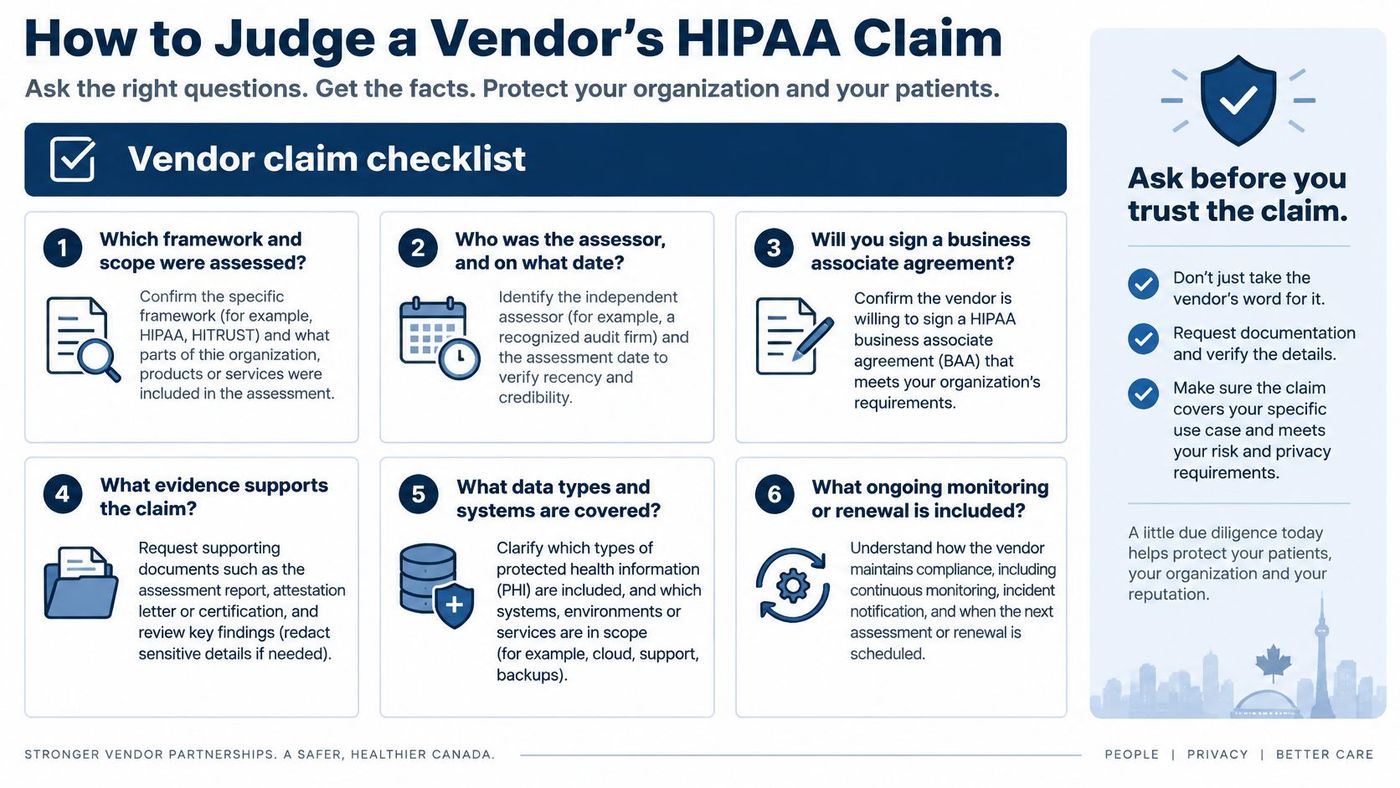
Use a vendor's claim to begin an evidence review, not end procurement. Send these questions before patient information enters the service.
At CloudOrbis, we typically receive administrator access to endpoint management, security tools, and infrastructure monitoring. Access to business-critical applications such as ERP, CRM, and line-of-business systems stays with the client's team unless explicitly delegated. We document, audit, and review all access quarterly.
For a clinic, apply that distinction to the EHR too: infrastructure support shouldn't become permission to browse clinical records.
Cleffex Digital ltd.’s guide to choosing HIPAA-compliant medical software provides additional context for evaluating application safeguards. A documented vendor risk assessment should turn the answers into an approval decision, conditions, and accountable owners.
Treat an unnamed assessor, a logo without a report, or a scope excluding the systems you'll use as warning signs. Treat evidence older than a year as a prompt for updated assurance, not as an automatic legal expiry date.
A successful restoration test tells you something a badge cannot: whether the vendor can recover the service your clinic needs.
The Canadian Centre for Cyber Security's National Cyber Threat Assessment reports that ransomware incidents affecting healthcare have nearly doubled since 2022. The relevant procurement test is whether the vendor can detect disruption, contain it, and restore service with reviewable evidence.
The Office of the Privacy Commissioner of Canada's explanation of provincial health privacy laws identifies PHIPA as substantially similar to PIPEDA in the relevant circumstances. That distinction matters: a HIPAA-only checklist can overlook the Canadian legal basis for handling local patient records.
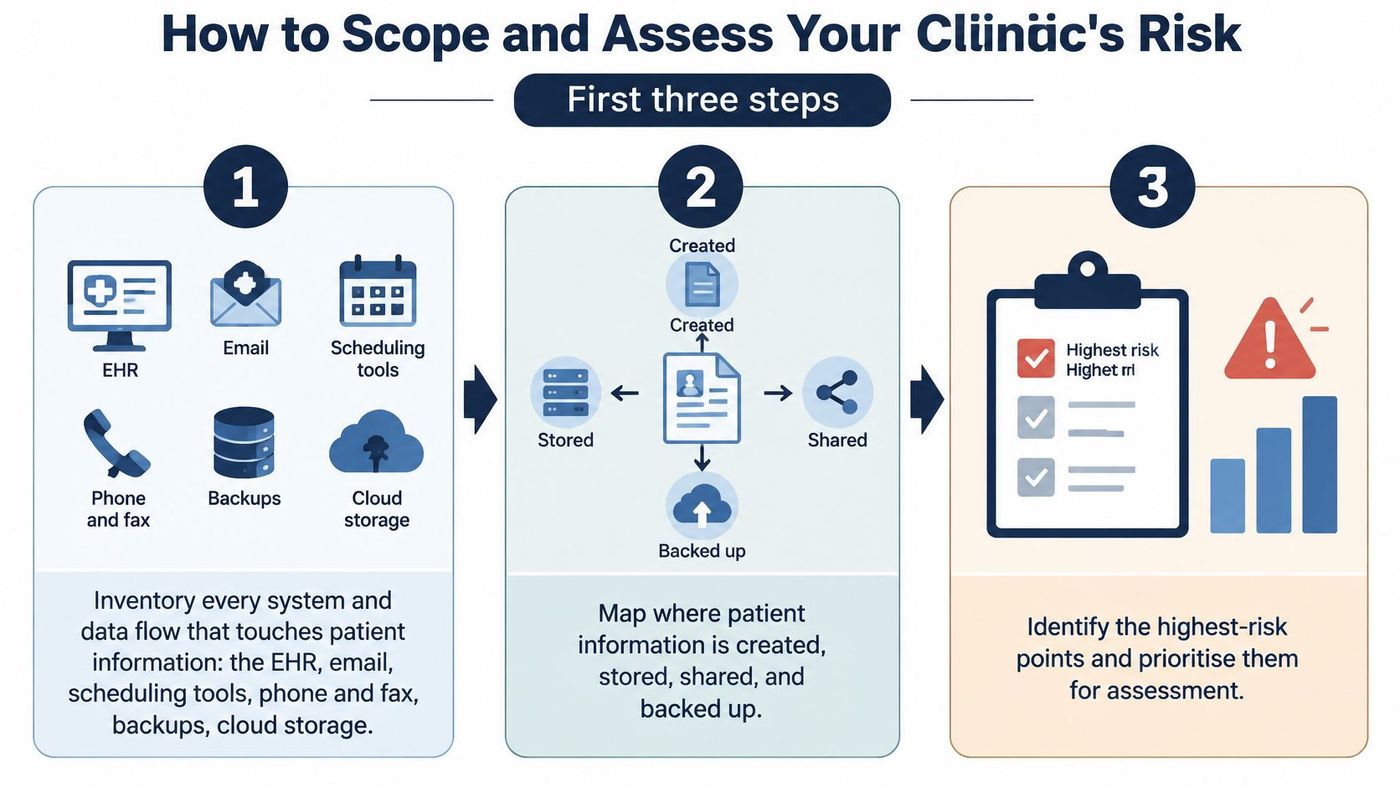
Your matrix should reference asset inventories, data-flow diagrams, access reviews, encryption settings, and backup restoration tests. Add privileged-access logs, vulnerability remediation records, and signed workforce acknowledgements where they demonstrate the control.
Say a scheduling platform exports appointment details to a shared spreadsheet. The inventory should identify the export, its owner, its location, and who can open it. The assessment can then address the actual exposure rather than reviewing only the scheduling application's security documentation.
Our Discovery process begins with an audit of infrastructure, security posture, governance gaps, and compliance risk. That sequence helps separate missing technology from missing ownership or an undocumented process.
A HIPAA risk assessment checklist can organize the work, but the completed record must describe your clinic's environment. Prioritize findings by patient-service impact, information exposure, and the effectiveness of existing safeguards, then assign each action an owner.
Give the drill enough detail to expose uncertainty. Who can retrieve logs? Who decides which individuals are affected? Who prepares notices, evaluates Commissioner or regulatory college reporting, and records information needed for annual breach reporting?
Drill objective: Produce a defensible decision record, not merely a statement that the incident-response plan was followed.
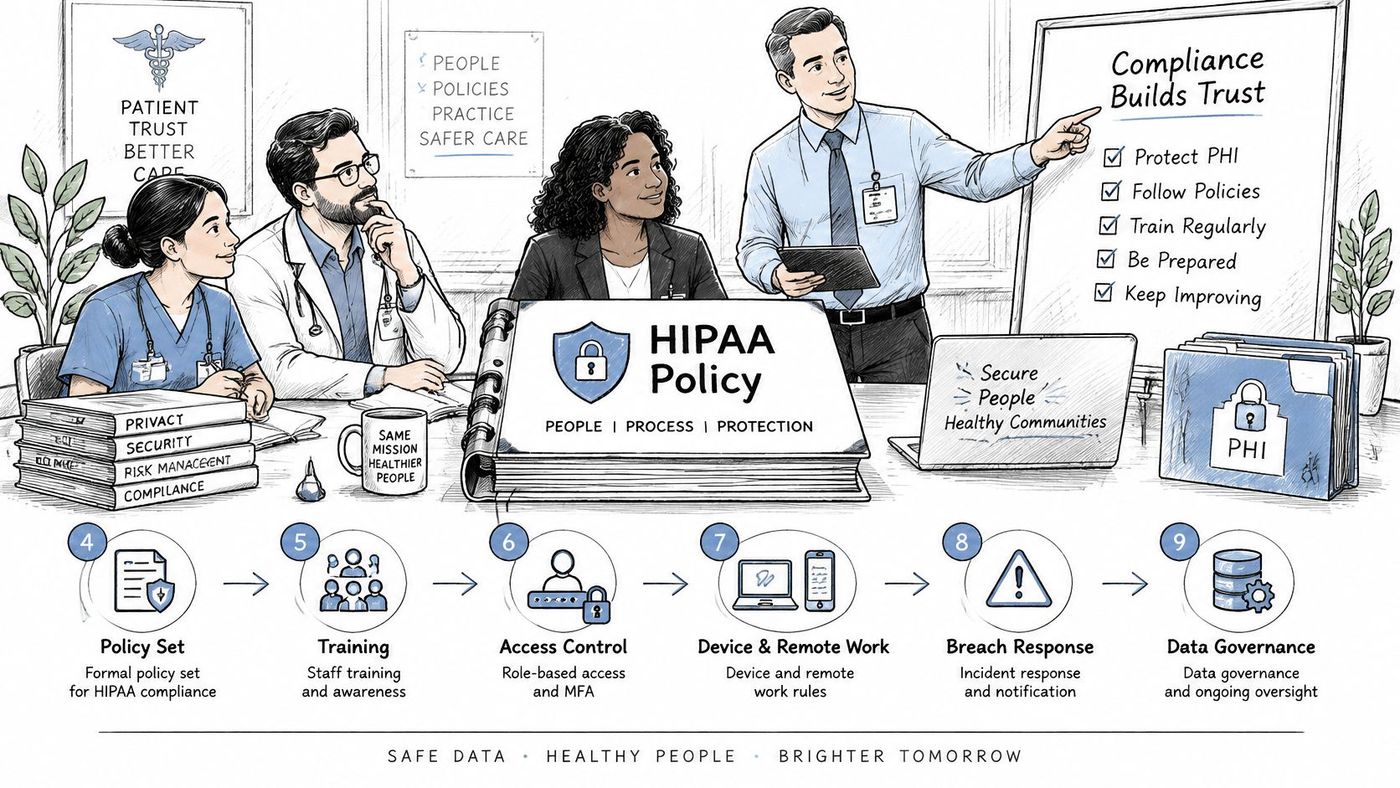
Connect the resulting actions to your healthcare cybersecurity practices. Close findings with configuration records, signed approvals, or test results rather than marking them complete because someone purchased a tool.
There's no official HIPAA certification that settles a clinic's compliance position. The useful evidence is a current, reviewable record of how the clinic meets applicable HIPAA and PHIPA obligations.
For the next month, give your privacy officer and IT lead a shared work list:
You can complete these actions with any provider. The important outcome is a usable evidence set, not a new badge for the clinic website.
CloudOrbis Inc. is a Canada-based managed IT provider working with regulated sectors, including healthcare. Our compliance-first approach includes SOC 2 alignment, but that alignment isn't a substitute for determining your clinic's legal duties.
Our free IT Risk Assessment offers a practical starting point for examining infrastructure, security posture, governance gaps, and compliance risk. Use the findings to set remediation priorities with your privacy officer and distinguish technical fixes from policy, contract, and accountability decisions.
CloudOrbis Inc. offers a free IT Risk Assessment to help your clinic identify the gaps behind HIPAA and PHIPA compliance claims. Visit CloudOrbis Inc. to book an assessment and start organizing the safeguards, responsibilities, and evidence your clinic needs.
Book a 30-minute call with a senior engineer. No sales script, just straight answers about your environment.


