What Is Managed Services in Consulting? a Practical Guide
Find out what is managed services in consulting, how the model works, which services it covers, and what to check before you sign an agreement.

Find out what is managed services in consulting, how the model works, which services it covers, and what to check before you sign an agreement.
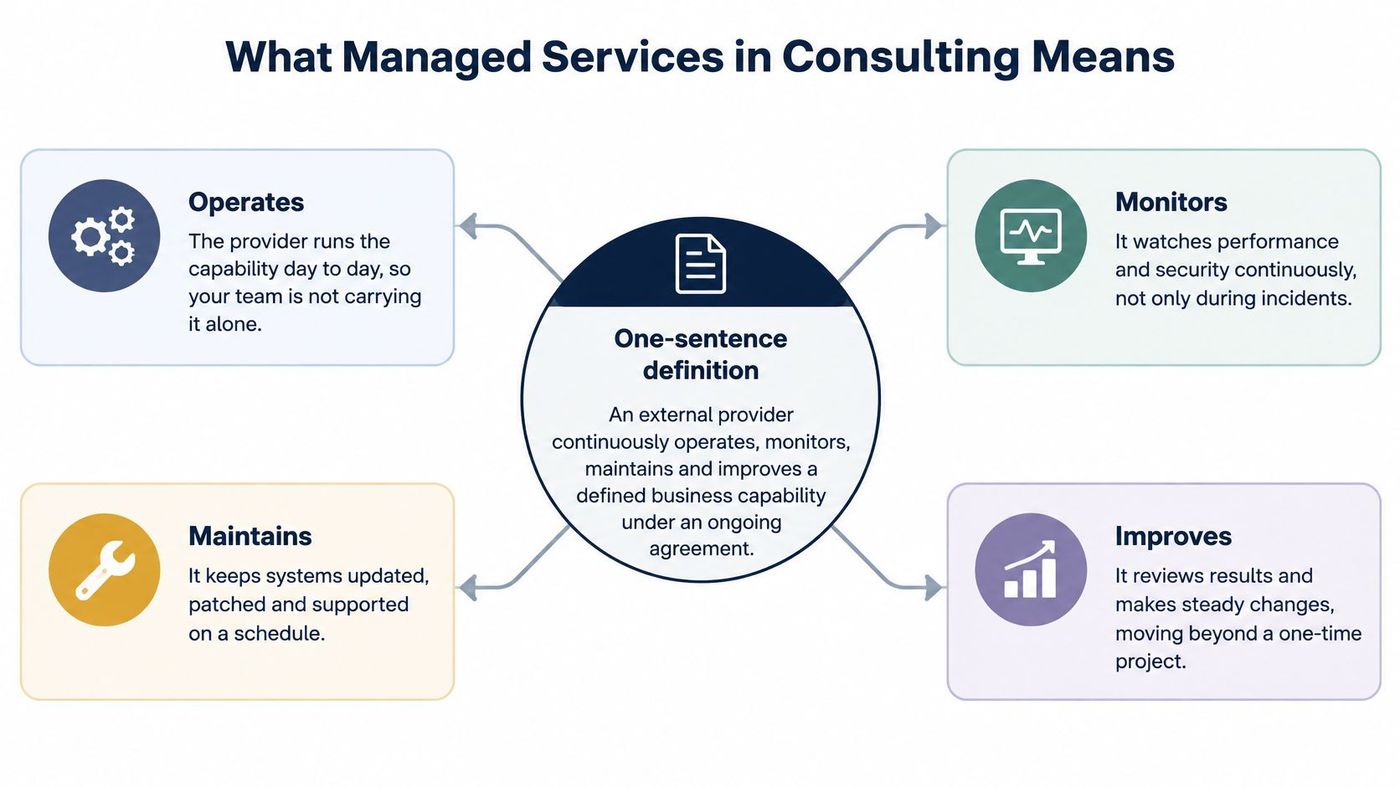
Managed services in consulting is an arrangement in which an external provider continuously operates, monitors, maintains and improves a business capability under an ongoing agreement, with advisory input on what to change next.
If someone else runs your IT, who still decides which business risks are acceptable? That question exposes what a support contract alone can't answer. For a medium-sized organization, the choice involves operational ownership, retained accountability and where business data travels, not just who answers the help desk.
The simplest distinction is between delivering a change and running a capability. A consultant might recommend a technology roadmap or implement a system. A managed-services consultant also takes continuing responsibility for agreed operational results.
Think of a building. A consultant draws the blueprint; the facilities team keeps the building running, repairs the heating and reports on its condition. Managed services adds that operational role while retaining advisory input about what needs upgrading next.
| Criterion | One-time consulting | Managed services in consulting |
|---|---|---|
| Scope | A defined project with a start and end date | An ongoing capability with continuing operations |
| Deliverable | A report, roadmap or implemented system | A running service with measured outcomes |
| Payment | Fixed project fee or hourly billing | Recurring fee plus additional services priced by frequency and complexity |
| Accountability after go-live | Usually ends at handover | Provider stays responsible for agreed service levels |
| Measurement | Project milestones met | Availability, response time, patch compliance and backup success |
Two neighbouring models can cause confusion. Break-fix support waits for something to fail and bills for the repair. Staff augmentation supplies people who work under your direction, rather than assigning the provider responsibility for a service outcome.
Our explanation of what IT consulting involves helps clarify the advisory role. For a narrower security example, ThreatExploit AI's resource on scaling recurring penetration testing services is useful when considering how repeat testing fits an ongoing improvement programme.
Canadian businesses already use external support: in the first quarter of 2025, 14.4% outsourced IT service support, including 8.0% of businesses with 1–19 employees and 29.3% with 100 or more employees, according to Statistics Canada's outsourcing analysis. Outsourcing isn't automatically managed services, but these figures establish the relevance of external operating partners.
Practical rule: If the agreement still matters six months after go-live because someone must keep delivering an operating result, you're probably discussing a managed service rather than a project.
A good engagement begins with understanding the environment, not installing another monitoring agent. The provider needs to know which systems matter, how employees use them and what disruption the organization can tolerate.
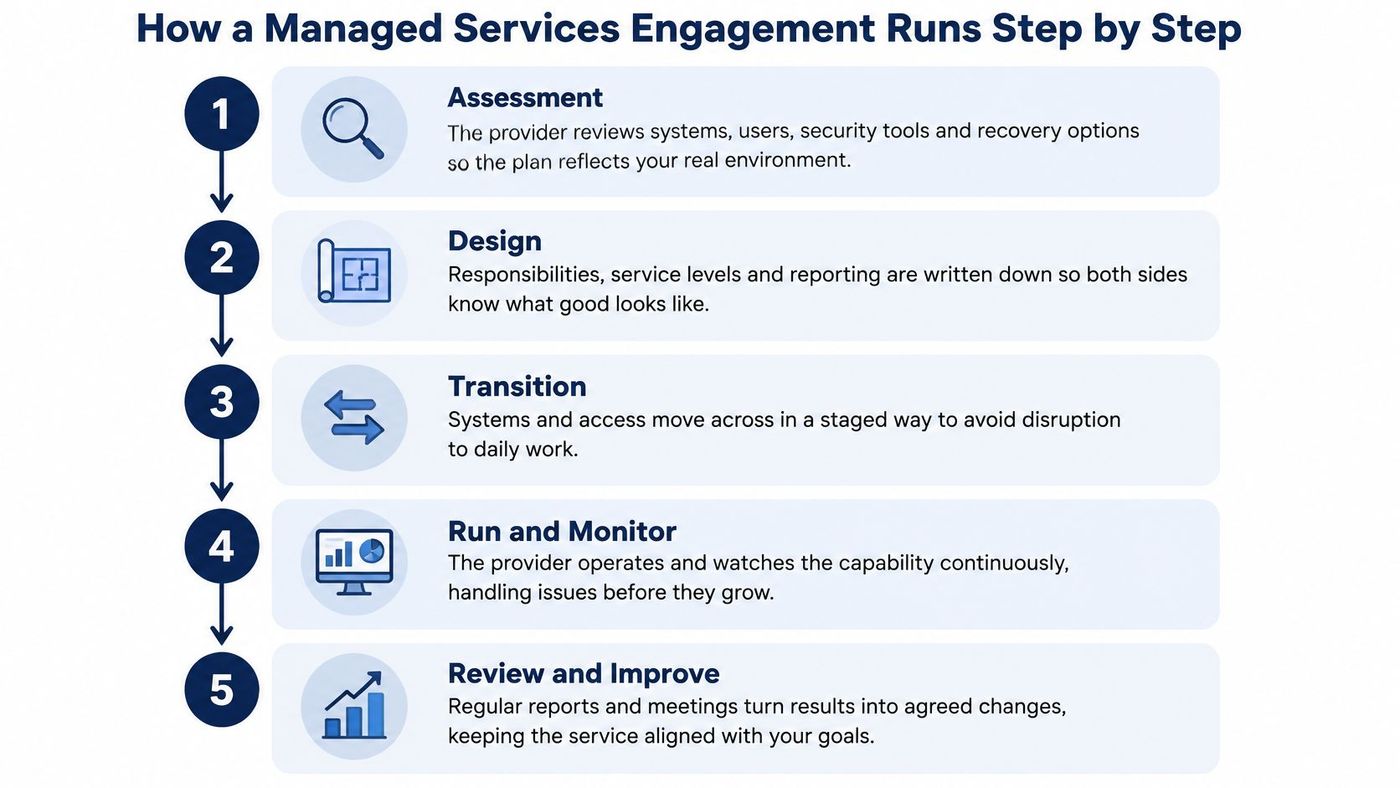
Set the baseline during onboarding: endpoint coverage, detection and response times, patch compliance, privileged-account reviews, backup success and monthly availability. These are practical measures of operational delivery, consistent with the emphasis on availability and security controls in Shared Services Canada's departmental results report.
The consulting layer explains what to do when results miss expectations. Repeated authentication alerts might justify stronger identity controls; recovery tests that miss business requirements might justify redesigning backups or moving an appropriate workload to a cloud platform.
Our guide to improving IT service delivery explores the operating discipline behind this process. At an early service review, look for documented procedures, evidence that recurring incidents are being addressed and a clear list of decisions your leadership team still needs to make.
The following table connects common service areas with the work involved and the evidence a business leader should receive.
| Service area | What the provider handles | Typical measure |
|---|---|---|
| Help desk and end-user support | Ticket handling, remote support and device management | Response time and first-contact resolution |
| Cybersecurity monitoring | Threat detection, endpoint protection and vulnerability scans | Mean time to detect and respond, patch compliance |
| Backup and disaster recovery | Backup schedules, offsite copies and recovery testing | Recovery point and recovery time objectives |
| Cloud management | Migrations, Microsoft 365 administration and optimization | Availability and cost per user |
| Compliance and documentation | Policies, runbooks and audit-ready records | Policy coverage and audit findings |
| Strategic consulting (vCIO) | Technology roadmap, budgeting and planning | Roadmap milestones completed each quarter |
These services work best when the teams connect their findings. A security investigation might reveal that backup administrators have excessive privileges. A recovery test might expose an ageing server that the virtual chief information officer, or vCIO, then places on the replacement roadmap.
Cloud computing was the most widely used information and communications technology among Canadian businesses in 2023, with 48% reporting its use, according to Statistics Canada's technology adoption release. That provides adoption context, not proof of maturity: a consultant must still assess workload suitability, permissions, recovery and cost controls. Our managed cloud computing guide explains the ongoing management involved.
A fully managed agreement assigns most IT operations to the provider. A co-managed agreement extends an internal team; our co-managed model handles routine work so that your employees can focus on strategy.
We provide IT support, network management, software development, and data backup and recovery. Our Foundation services include Cybersecurity & Risk Management, Compliance Solutions, Disaster Recovery & Business Continuity, and vCIO Services; Growth & Strategy includes AI Implementation, Workflow Optimization & Automation, Project Planning & Management, and Procurement.
Not every service belongs in every agreement. Our additional services, including device lifecycle management, after-hours coverage and strategic reviews, are priced by frequency and complexity, so distinguish base coverage from separately scoped work.
A bundle is useful only when each service has a named owner and a measure that tells you whether it's working.
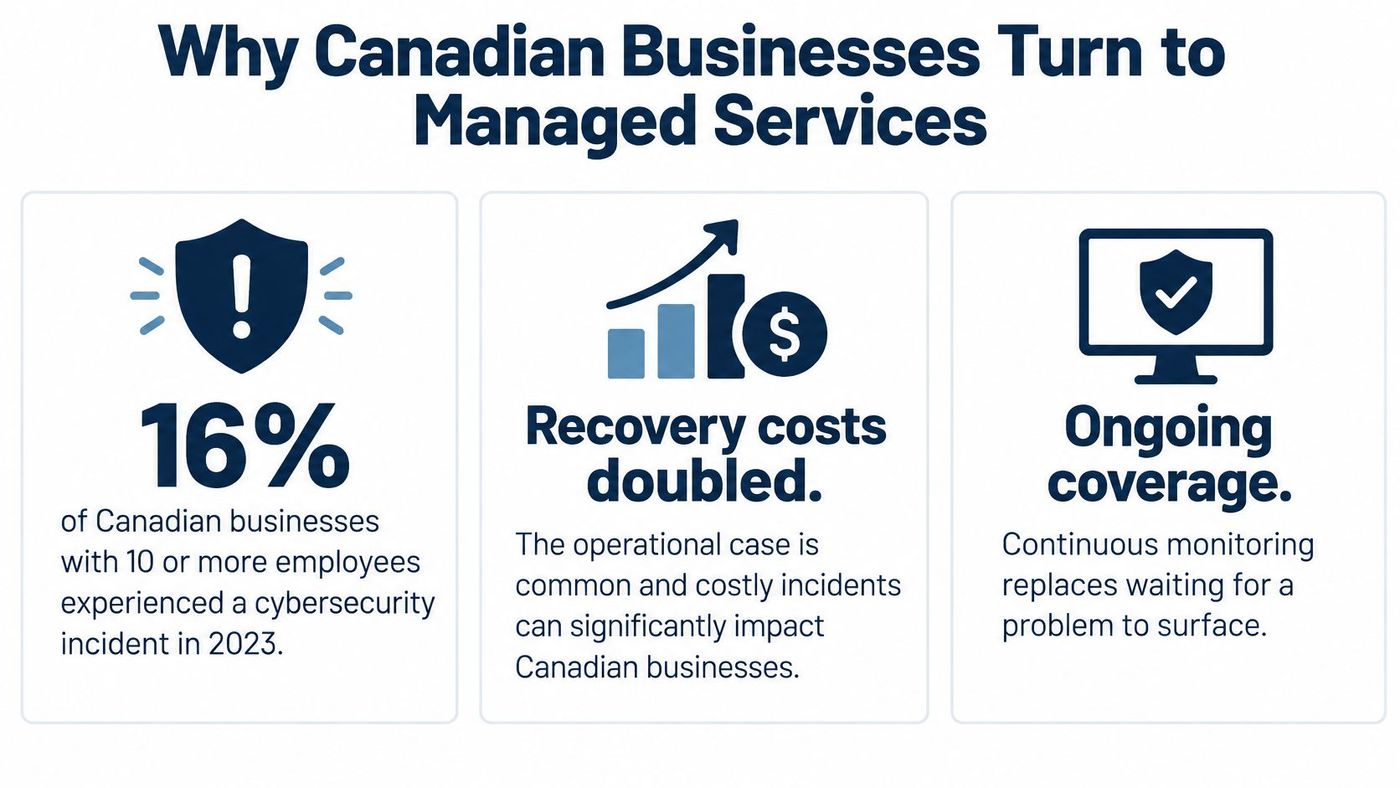
Cyber incidents create an operational problem, not just a technology purchasing decision. In 2023, 16% of Canadian businesses with 10 or more employees experienced a cybersecurity incident, while recovery costs doubled from approximately CA$600 million in 2021 to CA$1.2 billion in 2023, according to Statistics Canada's Canadian Survey of Cyber Security and Cybercrime.
Periodic help leaves intervals when unpatched endpoints, excessive privileges or failed backups may go unnoticed. Continuous monitoring gives an assigned team a way to investigate warning signs and contain problems earlier, although tools alone can't guarantee prevention.
The governance gap matters too: 26% of Canadian businesses had written cybersecurity policies in 2023, and 22% had cyber-risk insurance, according to Statistics Canada's survey findings. A provider's policy and risk-identification work therefore deserves attention alongside endpoint protection.
Say a logistics company's overnight backup fails. The valuable service isn't merely an alert on a dashboard; it's having someone investigate, restore protection and explain whether the next recovery remains achievable.
Our discussion of the benefits of managed IT services develops that business case. The value comes from turning security recommendations into a measured, ongoing management process, not from buying another tool.
Outsourcing operations does not transfer executive accountability for risk. A provider can run controls, but your leadership must still decide what the organization can tolerate, fund and approve.
According to Statistics Canada figures cited in Cyber Unit's Canadian small-business cyber-risk report, 37.1% of small businesses with 10–49 employees used a consultant or contractor to manage cybersecurity risks in 2023, while 45.1% had no employee whose regular duties included cybersecurity. Those findings make internal ownership an important question, not an administrative detail.
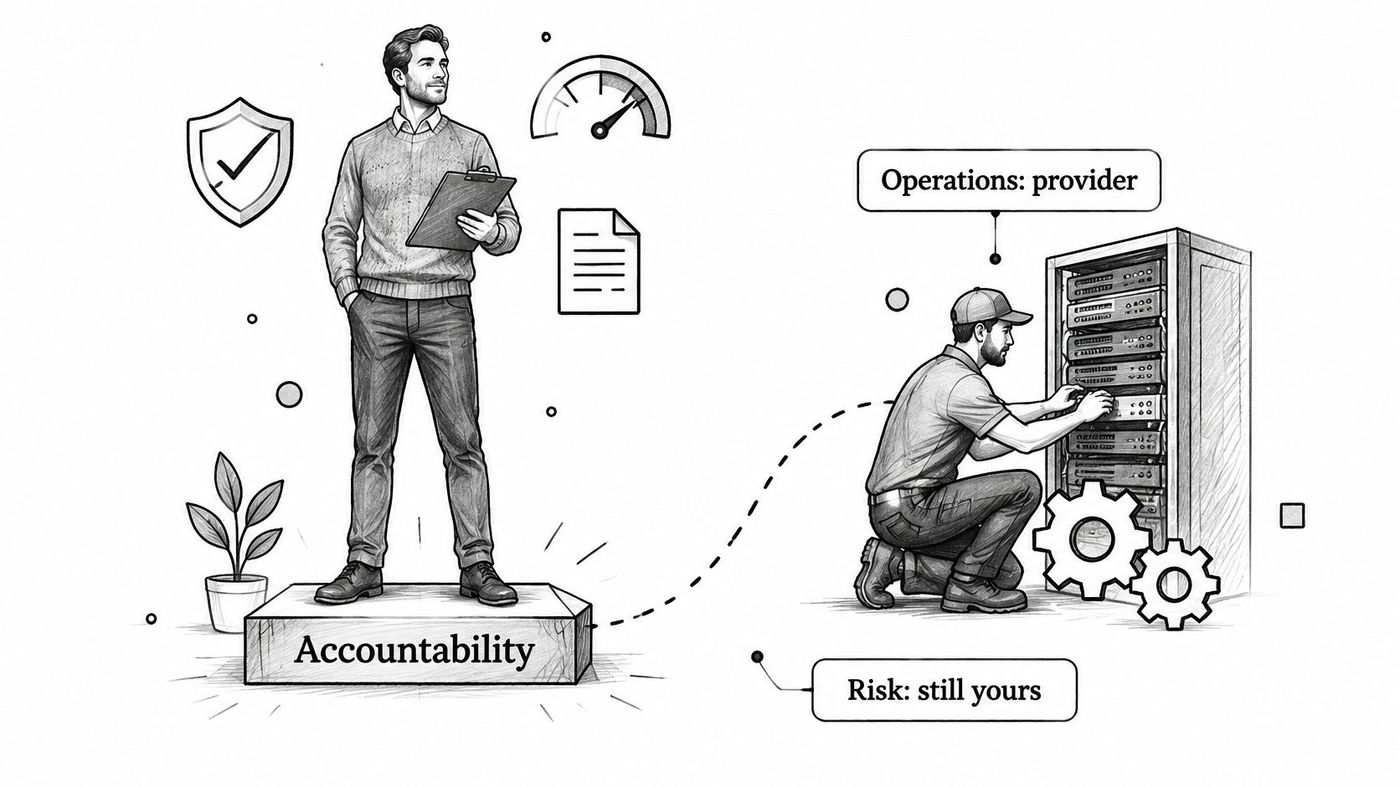
Operational responsibility covers patching, monitoring, backup testing and incident response. Executive accountability covers risk acceptance, regulatory obligations, business continuity and vendor oversight.
In our model, your team owns strategy, internal priorities and business-critical decisions. We own execution support, security operations and documentation.
We typically receive administrative access to endpoint management, security tools and infrastructure monitoring. Access to ERP, CRM and other line-of-business systems stays with your team unless explicitly delegated; all access is documented, audited and reviewed quarterly.
That boundary matters during an incident. An engineer may be able to isolate a compromised device, while shutting down a production application may require a business decision about safety, deliveries or customer commitments.
Managed services can provide scarce expertise and sustained coverage, but compare the total operating cost, not just the monthly fee.
Budget test: Compare what you'll pay for a defined operating result, including your retained responsibilities, rather than comparing a service fee with one employee's salary.
The trade-off is straightforward: you can improve capability without building every specialist role internally, but you must maintain decision rights, escalation paths, audit access and an exit plan.
A useful agreement should let your operations leader, finance team and IT staff reach the same understanding without relying on a salesperson's explanation. Use our managed services questionnaire to prepare a structured discussion.
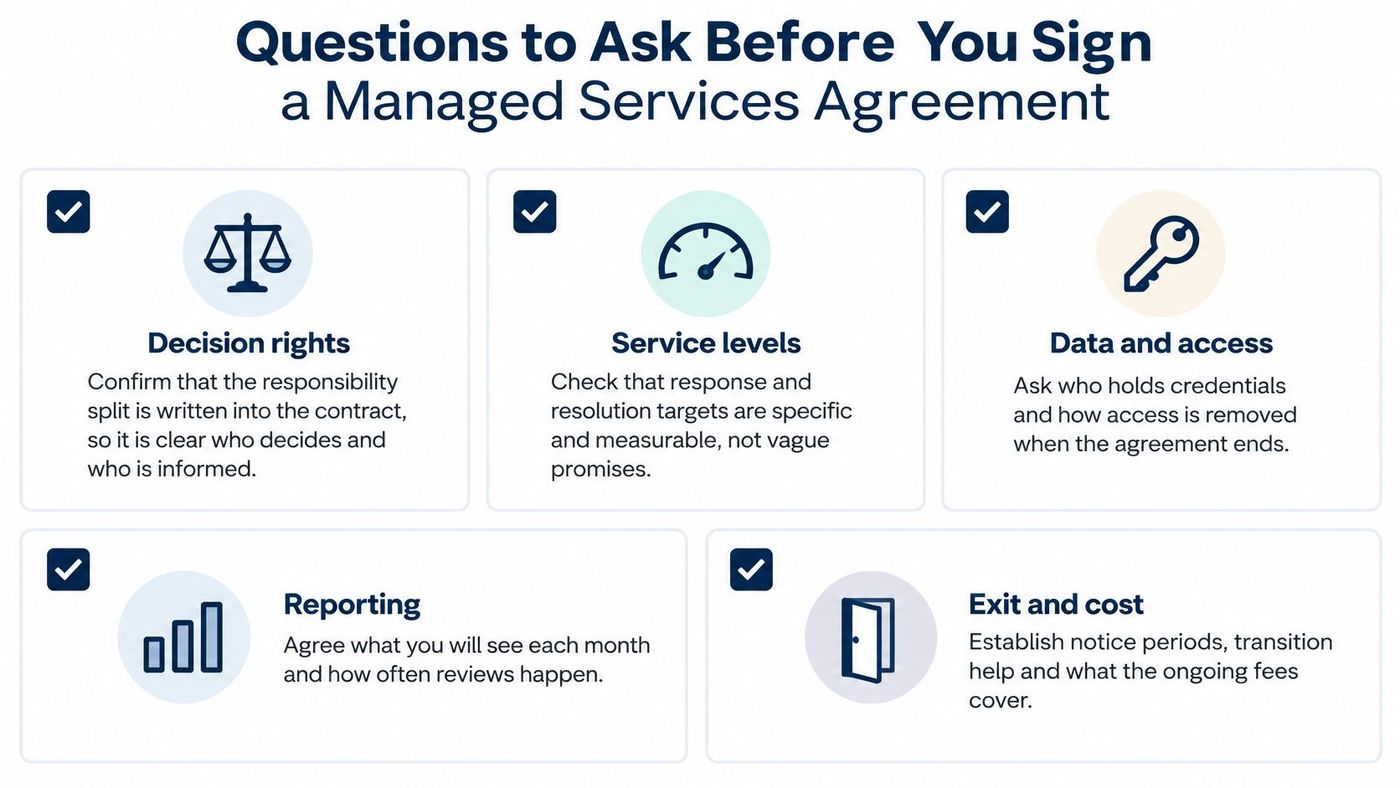
A Canada-based support team does not by itself guarantee that data and administrative access remain in Canada. Cloud regions, backup replication, logging platforms, remote-access tools and subcontractors each need separate examination.
In CIRA's cybersecurity survey reporting, 91% of respondents considered it important for cyber records to be stored and processed in Canada, while 89% considered Canadian ownership, headquarters or local operation important when selecting a cybersecurity vendor. Treat those preferences as procurement questions, not assumptions about what a Canadian office address guarantees.
Request our free IT Risk Assessment to establish what your environment needs, then use a customized roadmap to evaluate structured, security-first management. The lowest price can carry hidden governance costs if your team later has to redesign data flows or reconstruct evidence of how information was handled.
CloudOrbis Inc. offers a free IT Risk Assessment and a customized roadmap showing what structured, security-first IT management would look like for your organization. Visit CloudOrbis Inc. to start with your current environment, clarify the responsibility split and explore whether fully managed or co-managed support fits your team.
Book a 30-minute call with a senior engineer. No sales script, just straight answers about your environment.


