Cost of Cybersecurity for Small Business in 2026
Learn the cost of cybersecurity for small business in Canada, from managed services and tools to insurance and breach costs, with 2026 price ranges.

Learn the cost of cybersecurity for small business in Canada, from managed services and tools to insurance and breach costs, with 2026 price ranges.

For a hypothetical Canadian firm with 10 to 25 employees, CAD 20,000 to CAD 50,000 a year is a working allowance for managed IT with security included, not a published market average. Your actual quote will move with account and device counts, sensitive data, recovery requirements and the work already covered by existing licences.
The cost of cybersecurity for small business isn't just the provider's invoice. It also includes employees' time, insurance, compliance work and the money you'll need if normal operations stop.
A useful budget separates recurring protection, implementation work and incident exposure. That lets you compare proposals fairly without mistaking a cheap collection of tools for a complete security service.
The number of employees is a starting point, not a price formula. A small legal practice handling confidential client files may need more access controls and recovery planning than a larger business with less sensitive information.
The figures below are hypothetical planning allowances, not a survey of Canadian provider prices. Security needs also depend on the systems and services already in place.
Typical annual cybersecurity spend by headcount (indicative, CAD)
| Employees | Typical annual spend | Usual setup | Common gap |
|---|---|---|---|
| 1-10 | Hypothetical allowance of CAD 12,000-30,000 for managed IT with security included | Outsourced managed service with basic tools | Multi-factor authentication not enforced, backups untested |
| 11-25 | Hypothetical allowance of CAD 20,000-50,000 for managed IT with security included | Managed service plus endpoint detection and staff training | No written incident response plan |
According to the Insurance Institute of Canada's report on Coalition's Small Business Cybersecurity Study, 74% of Canadian small businesses allocated 10% or less of their total budget to cybersecurity in 2025. That figure describes budget allocation, not the protection those businesses received.
A managed IT proposal may also include helpdesk support, device administration and routine maintenance. Compare the scope of work, not just the invoice total, and separate security services from general IT support where possible.
Use these checks to set a realistic starting point:
Practical rule: Compare completed work and accountable response, not the number of products listed in a proposal.
For a business with 1-10 employees, first check whether multi-factor authentication is enforced and backups can be restored. For a business with 11-25 employees, clarify who can declare an incident, isolate systems and authorise recovery. Growing firms should formalise access reviews so former employees do not retain permissions by oversight.
Security quotes are comparable only when they specify the billing unit, protected assets and who responds to alerts. A licence that generates alerts does not include the investigation and containment that a staffed service may provide.
Treat the figures below as hypothetical planning inputs, not Canadian market averages or confirmed CloudOrbis prices. Get written quotes for your scope before approving a budget.
Indicative unit prices for common security components (CAD)
| Component | Typical price (indicative) | Billed as |
|---|---|---|
| Endpoint detection and response | Hypothetical input of CAD 6-15 | Per device per month |
| Managed detection and response | Written quote specifying monitoring, investigation and containment | Per user per month |
| Email security filtering | Written quote specifying protected mailboxes and features | Per user per month |
| Multi-factor authentication | Hypothetical input of CAD 0-6; check existing Microsoft 365 entitlement | Per user per month |
| Security awareness training and phishing simulations | Hypothetical input of CAD 30-70 | Per user per year |
| Backup and disaster recovery testing | Quote based on protected data, retention and restoration scope | Per month, depending on data volume |
| Penetration test or vulnerability assessment | Scoped quote identifying systems, methods and retesting | Per engagement |
| Cyber insurance premium | Hypothetical input of CAD 1,500-6,000 for CAD 1-2 million in cover, subject to underwriting | Per year |
Endpoint detection and response, or EDR, monitors computers for suspicious behaviour and supports containment. Count devices, not just employees. Shared workstations and servers can affect the total.
Managed detection and response, or MDR, adds monitoring and human response. Confirm whether the provider can isolate a compromised device or only notify your team. If your team must act on every alert, that responsibility belongs in the comparison.
Email filtering checks messages, attachments and links. Ask whether shared mailboxes are billed and whether impersonation protection is included.
Multi-factor authentication strengthens account access, but a licence alone does not ensure enforcement. Check your Microsoft 365 entitlements before adding another product, then review enrolment, administrator accounts and recovery methods.
Training costs should account for phishing simulations and targeted follow-up. Backup quotes should specify storage, retention and restoration testing, rather than just successful backup-job notifications. For a penetration test, define the systems, methods and retesting in the scope. The guide to penetration testing costs and scope can help shape a request for pricing.
Insurance transfers specified financial risks; it does not prevent attacks. Documented controls can support underwriting and premium discussions, although the insurer determines the terms and price.
CloudOrbis charges per user for end-user support, security operations and reporting. Enterprise-grade protection is included in every partnership, with no extra charge for basic security.
Its cyber-insurance preparation includes formal Acceptable Use, MFA, Device, Remote Work, Incident Response and Disaster Recovery policies; EDR and MDR; password governance; training completion records; patch compliance reporting; backup validation; disaster recovery testing; and monthly compliance reporting.
Before adding subscriptions, check what your current IT agreement and Microsoft 365 licences already cover. Compare the remaining gaps against the specific services and response responsibilities in each quote.
Choose an operating model before comparing product lists. Someone must own patching, investigate alerts, approve exceptions and coordinate recovery.
The comparison below uses hypothetical procurement assumptions, not published salary or provider-price averages. It's intended to show the financial structure of each choice.
In-house, managed and hybrid security models compared
| Model | Indicative annual cost | Coverage | Main trade-off |
|---|---|---|---|
| In-house security or IT hire | Hypothetical salary allowance of CAD 90,000-130,000 before benefits | Business hours, one person unless additional arrangements exist | No built-in cover during leave or after hours |
| Full managed service | Hypothetical CAD 100-250 per user per month, multiplied by users and annualised | Monitoring, patching, helpdesk and tools, with 24/7 response where contracted | Less day-to-day control over technical decisions |
| Hybrid: internal lead plus managed security | Internal lead salary plus a hypothetical CAD 1,500-5,000 per month | Internal knowledge plus 24/7 monitoring where contracted | Two parties must coordinate |
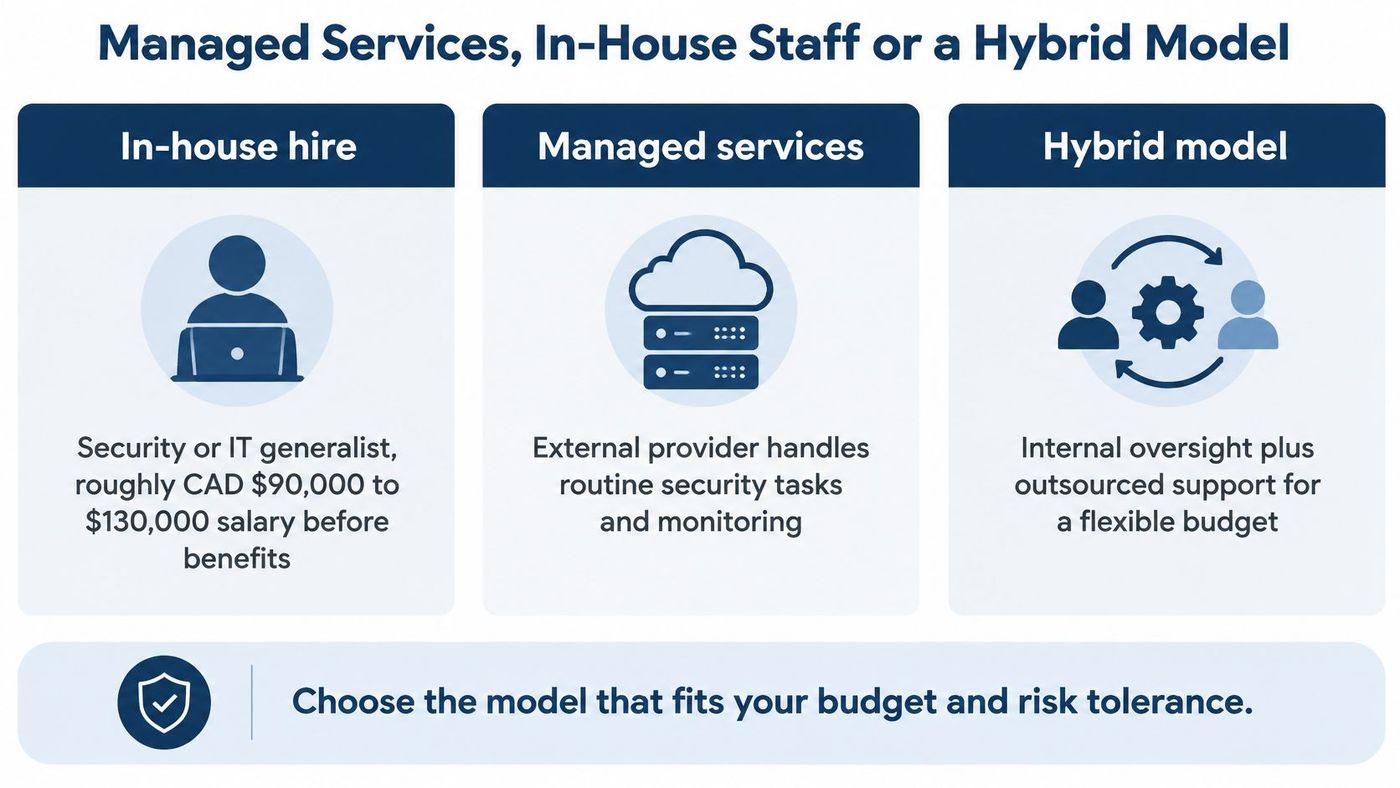
An internal generalist offers business knowledge and immediate contact with staff. The weakness is concentration: the same person may handle helpdesk tickets, infrastructure and security. Buying monitoring separately doesn't remove the need for someone to act on its findings.
A full managed service suits owners who want an external team to run IT end to end. Our Managed IT Services take that full-ownership approach. However, continuous monitoring and continuous response are different commitments; the agreement should define both.
A hybrid arrangement works when an internal IT lead understands production systems, clinical workflows or specialised applications but needs additional security capacity. A virtual CIO can help translate technical findings into priorities, replacement schedules and investment decisions.
Use these questions to choose:
Our approach to managed cybersecurity in Alberta illustrates how outsourced security responsibilities fit into ongoing IT management.
We assess existing technology during discovery and integrate tools that work well, including Microsoft 365, line-of-business applications and CRM systems. Security-critical components, including endpoint protection, password management and MDR, must use our standardised stack.
That distinction matters: preserving useful applications can avoid unnecessary migration work, while standardising protection makes consistent response possible.
Under the hypothetical rates above, a 10-user business would calculate CAD 12,000-30,000 annually for managed cover, compared with the assumed dedicated salary before benefits. That makes managed service financially attractive for a smaller firm, provided its scope meets the business's actual needs.
Security costs rise with the work required to protect and recover your business, not just with employee count. Separate constraints you must accommodate from complexity you can remove.
Privacy work deserves its own allowance. In the Office of the Privacy Commissioner's 2025–2026 business survey, 29% of businesses reported privacy-law compliance costs below CAD 5,000 during the previous 12 months, while 19% reported CAD 5,000 or more, including staff time, training, IT and legal fees.
Low spending doesn't establish low exposure. It may mean a business hasn't formalised its compliance activities.
Under PIPEDA, organisations must report and notify qualifying breaches creating a real risk of significant harm and retain breach records. Prepare decision-makers, evidence-preserving logs and notification procedures before an incident.
A standard security stack and consolidated vendor responsibility can reduce duplicated administration. Cloud services can avoid some hardware purchases, but they still require configuration and oversight.
For the financial distinction between structural costs and controllable spending, AmbitionCFO's guide to business cost drivers provides useful context. Apply that thinking through IT security risk management, prioritising exposed accounts and recovery gaps before cosmetic improvements.
Finish with three questions: What data do we hold? Who can access it? How quickly can we restore it?
Say a hypothetical 20-person office loses access to its systems for three days after ransomware. Employees switch to manual workarounds while the business isolates devices and brings in response specialists.
That scenario is illustrative, not a forecast. In Statistics Canada's 2021 cybersecurity survey, approximately 18% of businesses reported an incident; about 40% of affected businesses experienced downtime averaging 36 hours; and 14% of affected businesses reported revenue loss.
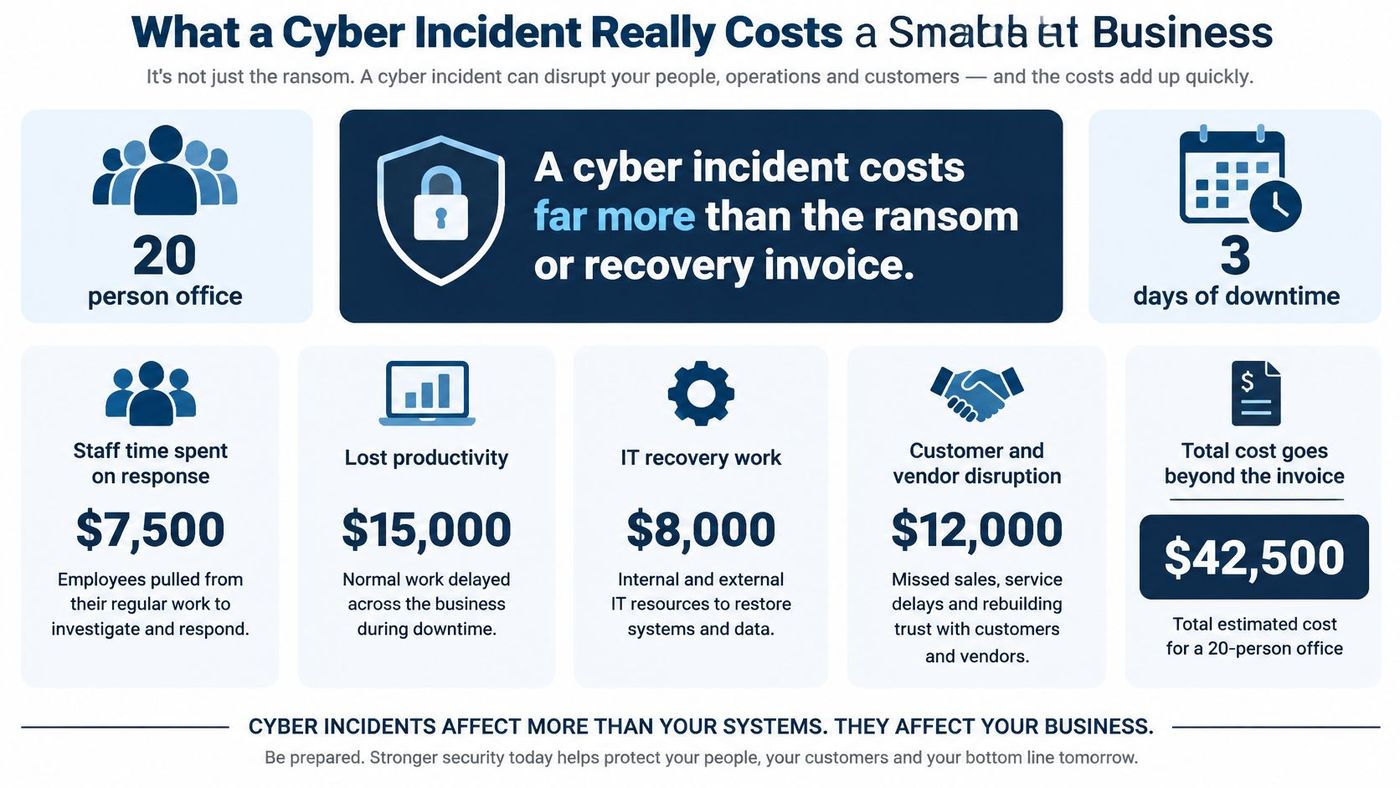
First, the office must contain the compromise and establish what happened. Then it must restore clean systems, validate access and decide whether affected people need notification.
The following amounts are invented scenario assumptions solely to demonstrate budgeting arithmetic, not quoted fees or expected losses.
| Illustrative cost line | Hypothetical amount | What it represents |
|---|---|---|
| Idle time and manual workarounds | CAD 12,000 | Unproductive paid time |
| Forensic investigation | CAD 10,000 | Establishing scope and preserving evidence |
| IT recovery | CAD 8,000 | Rebuilding and validating systems |
| Legal review and notification | CAD 5,000 | Privacy assessment and communications |
| Lost contribution from cancelled work | CAD 6,000 | Lost revenue less avoided delivery costs |
| Illustrative total | CAD 41,000 | Excludes ransom and longer-term losses |
Don't count the same loss twice. Lost contribution should exclude labour already counted as idle time, and delayed revenue isn't necessarily permanently lost revenue.
The recovery invoice measures the supplier's work. It doesn't measure everything your business lost.
The average five-year total cost of a cyber incident affecting Canadian small and medium-sized enterprises was approximately CA$782,560 in NetDiligence's 2024 Cyber Claims Study, as Gascon & Associates reported in 2025. That claims-study figure isn't a prediction for every small business.
Response spending arrives when leaders have little time to negotiate. Privacy decisions, customer communications and operational recovery also consume management attention.
Check how deductibles, sublimits, exclusions and renewal underwriting apply to your policy. Don't assume every cost is reimbursable or that a claim leaves future pricing unchanged.
Use our cyber insurance guide for Canadian SMBs to prepare coverage questions. When reviewing alternatives, you can also compare affordable cyber liability coverage through ThriveXDNA, then validate terms with a licensed broker.
Compare prevention spending with plausible serious-incident losses over your planning horizon. Don't multiply national survey rates by claims averages and call the result your expected loss.
A usable cybersecurity budget shows what each expense protects, who owns the work and how delivery will be checked. That makes it easier to compare proposals and catch costs that sit outside the monthly invoice.
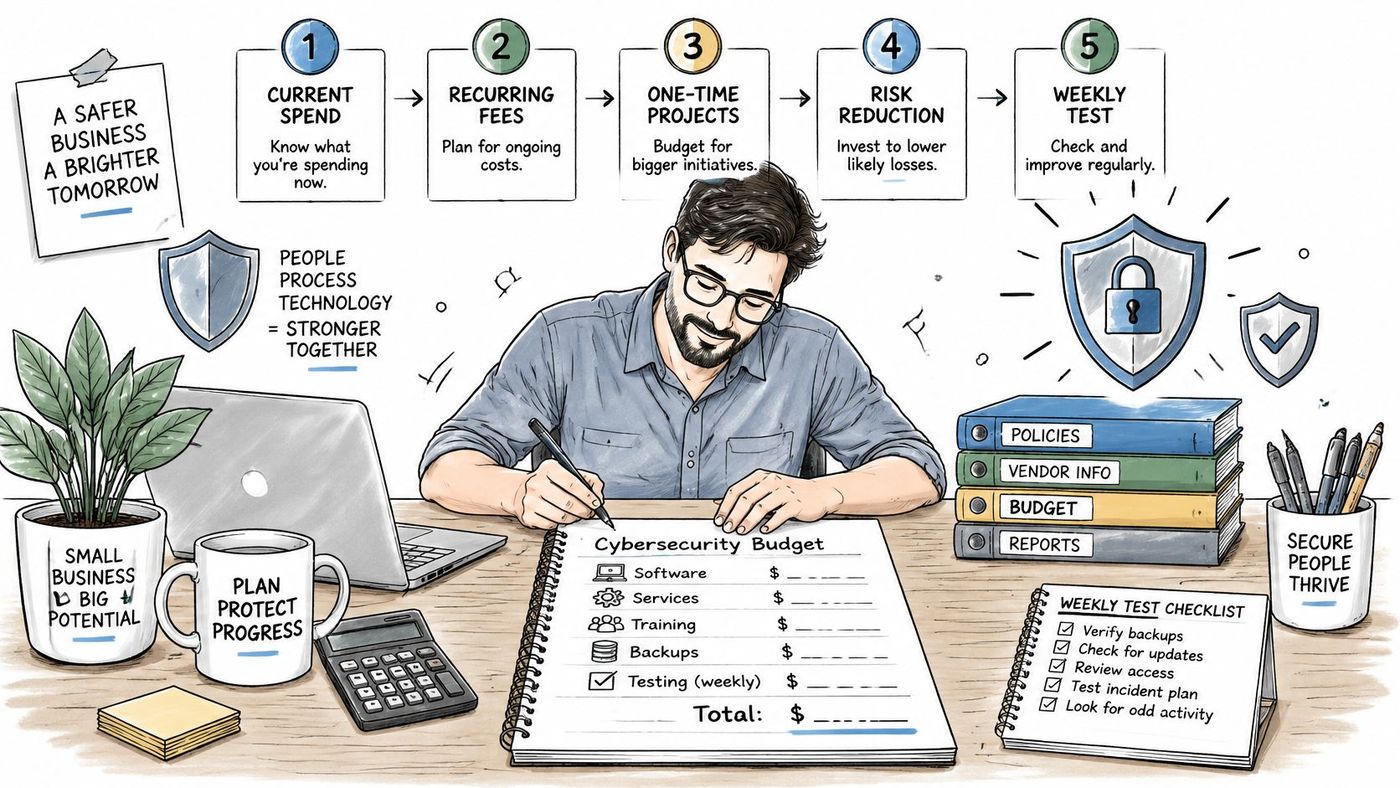
Internal labour can be easy to overlook. Statistics Canada's release on cybersecurity expenditure identifies employee compensation as the largest national prevention-and-detection spending category, at CAD 3.8 billion in 2023. It also reports approximately CAD 2.6 billion in small-business prevention and detection spending alongside CAD 300 million in small-business recovery spending.
These national totals are not a recommended allocation for an individual firm. They do show why a security budget should distinguish labour and recovery from subscription fees.
Use an IT cost-benefit analysis to separate cash savings from risk reduction. Removing a redundant licence creates a measurable saving. Preventing a hypothetical incident does not create booked revenue.
Track the same measures over time:
Compare insurance premiums at renewal, but consider changes in limits, deductibles and policy conditions before attributing a price change to security controls. A well-maintained record of policies, patching, training and restoration tests gives the insurer clearer evidence to assess.
Budget discipline: Request evidence that a control is operating, not just confirmation that a product is installed.
For a law firm preparing for renewal, a useful evidence package includes current policies, patch reports, training records and documented restoration results. A list of purchased tools alone does not show how controls are managed or whether recovery procedures work.
Assign an owner to keep the package current. That avoids rebuilding it under renewal pressure. Keep security results and financial results distinct: a clean incident record does not prove every control works, while a successful restore demonstrates a specific recovery capability.
Gather headcount, active accounts, managed devices, current IT spending, the insurance renewal date and quotation, regulated data types, and must-run applications. Include dependencies such as internet connectivity and specialised software.
Draft the budget using the categories above, then compare it with a proposal scoped to your firm's size. Investigate differences rather than forcing the proposal to fit a headline range.
Check existing Microsoft 365 entitlements for authentication and endpoint protection. Remove overlapping services only after confirming the remaining service provides equivalent coverage and has a clear owner.
Review contract inclusions, billing growth, response authority and recovery responsibilities. Put unresolved items in writing, assign an owner and schedule a restore test.
CloudOrbis Inc. offers a free IT Risk Assessment to help identify security gaps and prioritise spending across protection, compliance and recovery. Visit CloudOrbis Inc. to book an assessment, bringing your current IT agreement, insurance requirements and critical-system list so the discussion starts with your actual budget and risks.
Book a 30-minute call with a senior engineer. No sales script, just straight answers about your environment.


