vCIO Meaning: What a Virtual CIO Does for Your Business
Learn the vCIO meaning: a virtual Chief Information Officer who sets IT strategy, manages risk and budgets without a full-time hire.

Learn the vCIO meaning: a virtual Chief Information Officer who sets IT strategy, manages risk and budgets without a full-time hire.
A vCIO, or virtual Chief Information Officer, provides senior technology leadership on a part-time or fractional basis rather than as a full-time employee. In Canada, the oversight gap is clear: Statistics Canada reported that 28% of businesses said senior management was responsible for overseeing cyber security risks and threats in 2017, while 21% said cyber security incidents affected their operations in 2019.
Those figures point to two different issues. Cyber incidents affected business operations, while senior management had explicit responsibility for overseeing cyber security in fewer than a third of businesses. A vCIO gives that oversight a defined owner, rather than leaving strategic IT decisions to whoever happens to manage daily technical work.
A quick search may define vCIO as “a part-time CIO,” but a title alone does not explain the role's accountability. Who sets technology priorities and approves the budget? Who coordinates a response when a backup restore fails? And if a managed service provider already runs the daily IT work, what does a vCIO add? The distinction is that the provider handles operations, while the vCIO guides decisions and is accountable for strategic direction and measurable outcomes. Without that operating model, the role risks becoming advice without follow-through.
What does a vCIO own? The easiest way to understand the role is to compare it with financial oversight. A bookkeeper records transactions; a controller reviews the numbers, spots a cash squeeze forming, and helps the owner decide what to do. A vCIO provides a similar layer of oversight for technology, connecting daily IT choices to the business's priorities.
A vCIO is a technology leader who provides strategic guidance on a part-time or fractional basis, rather than as a full-time employee. The role can give a business executive oversight of technology planning, cyber security, compliance, budgeting, vendors, continuity and roadmaps without hiring a permanent CIO. This is different from what IT consulting actually covers: the vCIO model is defined by ongoing accountability for decisions and outcomes, not just advice on a particular project.
Who carries cyber security responsibility varies by business size. Statistics Canada's analysis of business cyber security reports that 91% of large businesses, 83% of medium-sized businesses and 72% of small businesses had employees primarily responsible for overall cyber security. The figures show a difference across company sizes, but the title of the person responsible does not tell you whether they have time or authority to plan beyond immediate technical needs.
These responsibilities sit above daily IT operations. Tickets, patching and password resets are the work of the teams running the environment. The vCIO helps leadership choose what that work should achieve and whether the results match the plan.
Consider an aging file server whose vendor has stopped shipping firmware. Replacing the hardware is one option. Moving file shares to Microsoft 365, or adding backup redundancy and delaying the refresh, may also be considered. A vCIO compares the choices in terms of downtime, client commitments and cash flow, recommends a course of action, and remains accountable for that recommendation.
How the vCIO compares with other technology roles
| Role | Main focus | Typical engagement | Typical buyer |
|---|---|---|---|
| Full-time CIO | Strategy, governance and executive leadership | Permanent salaried hire | Larger organisations with a dedicated executive budget |
| vCIO (virtual CIO) | Strategy, risk governance, roadmap and budget | Part-time or fractional retainer | Small and mid-sized organisations |
| MSP technician | Daily support, monitoring and security tools | Monthly managed service contract | Any size of organisation |
| Internal IT generalist | Daily systems, user support and troubleshooting | Permanent employee | Any size of organisation |
The dividing line: the vCIO owns direction and accountability. Technical teams carry out the work and operate the environment.
A business with a capable leadership team that already sets technology priorities may not need a separate vCIO. The role fits when leaders need a consistent owner for decisions, plans and results, while an MSP or internal team handles the daily technical work.
A vCIO is a fractional, externally provided technology executive who turns business objectives into an IT roadmap, governance model, security priorities, budget and measurable targets. The role connects those plans to specific decisions, such as sequencing cloud or Microsoft 365 initiatives and setting backup and disaster recovery requirements.
Core vCIO responsibilities and what each produces
| Responsibility | What the vCIO does | Typical output |
|---|---|---|
| IT strategy and roadmap | Converts business goals into sequenced technology projects | 12-36 month roadmap |
| Cybersecurity governance | Sets policies, assigns owners and tracks controls | Written policies and risk register |
| Budget planning | Prioritises spending by business impact and compares scenarios | Annual IT budget with scenarios |
| Vendor management | Reviews supplier performance, contracts and access | Vendor scorecard and renewal calendar |
| Compliance mapping | Links controls to provincial privacy law and contractual duties | Compliance map with owners |
| Business continuity | Defines recovery objectives for critical systems and data | Backup and recovery requirements |
| Cloud and Microsoft 365 planning | Sequences migrations and licence use against business needs | Migration plan and licence review |
These outputs make the vCIO's work concrete. The roadmap sets the order of projects, while the budget shows what they require. Governance gives people responsibility for risks and controls. Together, they form an operating model with accountability, rather than a job title alone.
The control loop: build an asset and data inventory, score threats by likelihood and operational impact, map controls to regulatory and contractual obligations, assign owners and deadlines, then review metrics such as patch compliance, privileged-account coverage, backup restoration success, incident response time and unplanned downtime.
A four-physician clinic signs a lease on a second location. Before opening, its owners need to decide which systems must be online, what recovery target applies to patient records, whether the new site should have its own server or use the existing network, and who approves access for new front-desk staff.
The technician can configure the systems and access. The vCIO sets the order, standard and budget, then explains the operational risk if the clinic opens before the network is ready. That distinction matters: the person doing the technical work is not necessarily accountable for deciding which work comes first or what risk the business accepts.
The same division applies to routine support. A technician fixes the printer; the vCIO helps leadership decide which systems receive funding first and reports any remaining risk to the people responsible for the business. That reporting should connect decisions to outcomes, not just list completed technical tasks. It is part of strategic IT management, where plans and responsibilities are tied to business priorities.
By the end of a quarter, leadership should have a roadmap with dates and named owners, a risk register showing who owns each exposure, a budget scenario for the coming year, and a short report on whether the previous quarter's commitments were met. Those measures show whether the operating model is working: the value lies not in producing plans, but in assigning responsibility and tracking delivery.
Engagements differ by provider, but the sequence rarely does. The first two moves set the tone for everything after them.
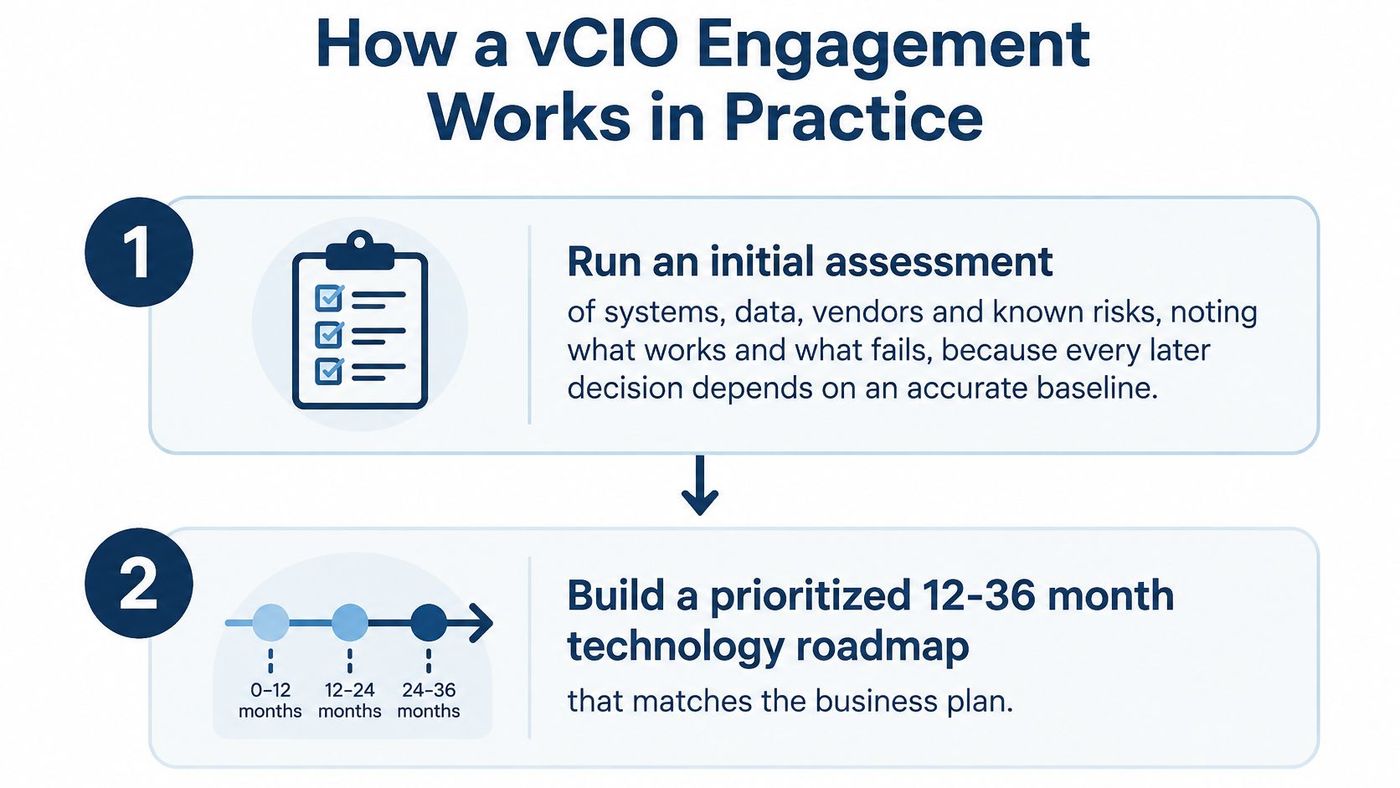
The first 90 days should feel light on paperwork and heavy on proof. Enforcing multifactor authentication, restoring a backup end to end and closing obvious account-privilege gaps all produce evidence within weeks, which buys credibility for the slower items on the roadmap.
Most of that roadmap will fail on adoption rather than on technology. That's why a serious engagement spends time on change management before it spends money on licences.
Who turns cyber security concerns into clear decisions, assigned responsibility and written policy? For a Canadian business, that executive oversight matters because managing risk involves more than buying tools. It means deciding what to protect, who is accountable and how leaders will know whether their approach is working.
Statistics Canada's analysis of how cyber security risks affect Canadian businesses reports that 18% of businesses had written policies to manage cyber security risks or report incidents in 2019, up from 13% in 2017. The figures show a gap between recognising risk and documenting how the organisation will handle it.
Canadian cyber security indicators that show the executive oversight gap
| Measure | Figure | Year |
|---|---|---|
| Businesses with written cyber security risk policies | 18% | 2019 |
| Businesses with written cyber security risk policies | 13% | 2017 |
A policy is like a shared set of instructions for an emergency: it helps people know what to do and who makes decisions. Without one, staff may respond inconsistently, and leaders may struggle to see whether risks have an owner. The vCIO's role is to help make those responsibilities and decisions part of the organisation's operating model, then assess progress against agreed outcomes.
A smaller firm may have fewer people and less spare capacity to manage disruption. If a manufacturer's systems stop supporting quoting, the same team still has to serve customers and keep other work moving. Security decisions therefore need to fit the firm's actual operations, not just a list of available products.
A vCIO does not replace security tools or the provider running day-to-day IT. The role provides executive oversight: setting direction, clarifying accountability and checking whether decisions are producing the intended results. That distinction matters because operational support can keep systems running, while leadership still needs a clear view of priorities, risk and responsibility. Written policies are one part of governance, risk and compliance, which connects those decisions to how the business is managed.
Ask yourself this: who in your organisation owns cyber security risk today, and could they show you where that responsibility is written down?
If the answer is a person but not a documented responsibility, leaders have a practical place to begin: clarify ownership, record the policy and agree how progress will be assessed.
A managed service provider keeps daily IT operations running: it handles support requests, applies patches and maintains systems. A vCIO provides a different kind of accountability, setting priorities with leadership, overseeing risk, and evaluating whether the provider's work supports business goals. The distinction is like the difference between running a vehicle and choosing where it should go.
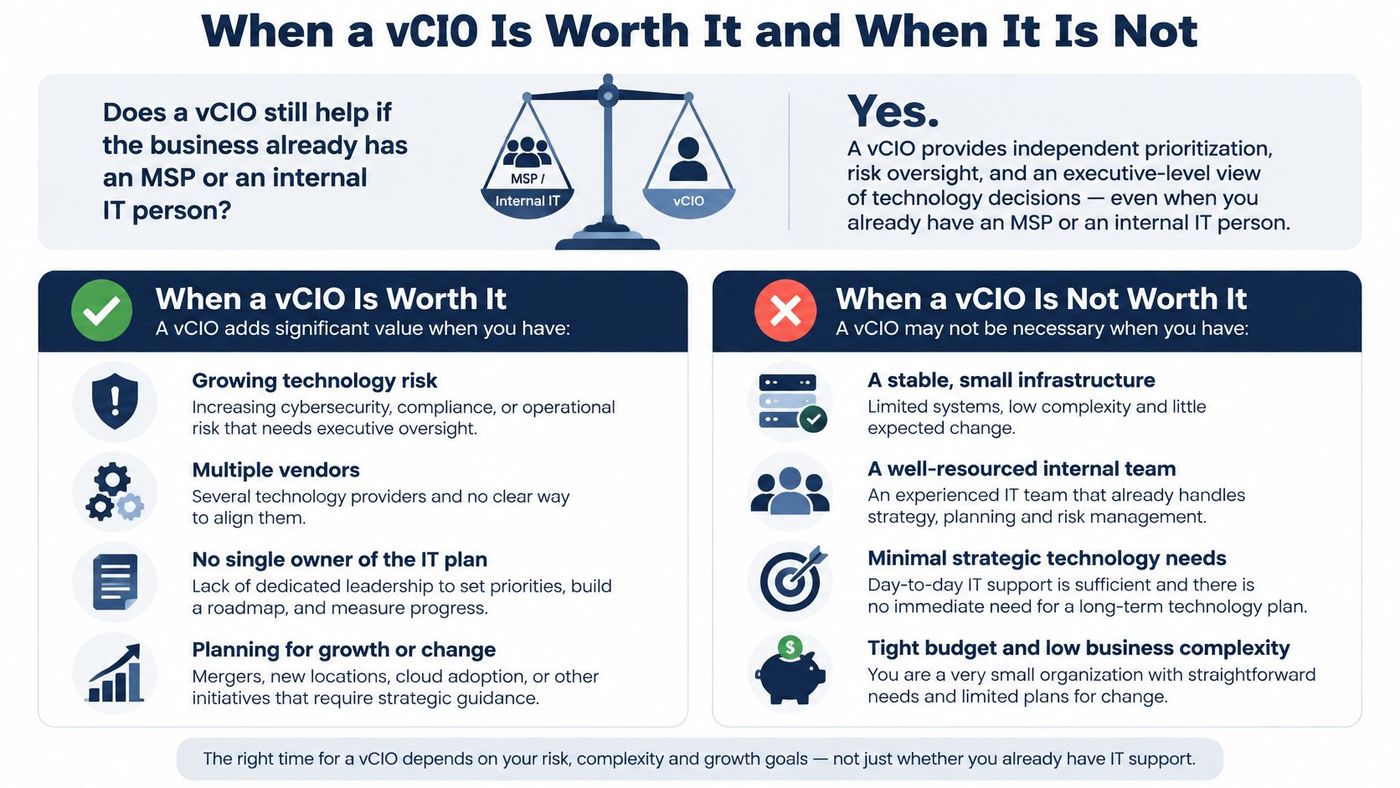
A vCIO is most useful when technology decisions carry deadlines, dependencies or business risk:
A vCIO is not an automatic upgrade. A small organisation with simple, stable systems, little planned change and a leader who already considers risk and budget may do well with a capable provider and an annual review. If nobody will act on the advice, paying for strategic oversight is unlikely to help.
Security spending alone does not create governance. Statistics Canada reported that Canadian businesses spent a combined $7 billion on cyber security in 2019, as discussed in its analysis of cyber security spending. Buying tools does not, by itself, establish who owns a risk, what to do when a control fails or how recovery will be tested. A vCIO can connect those decisions to the business and track whether agreed actions are completed.
For a clinic or law firm, relevant obligations may come from provincial privacy law, client contracts and sector requirements. The vCIO's role is to help map suitable controls to those obligations, rather than assume a standard from another country fits.
If your question is what the daily support layer costs before adding advisory work, this guide to managed services cost can help clarify the distinction between operational support and executive oversight.
Three questions do most of the work.
Two or more honest no's are worth acting on. One no, in a business with stable systems and no change on the horizon, usually isn't.
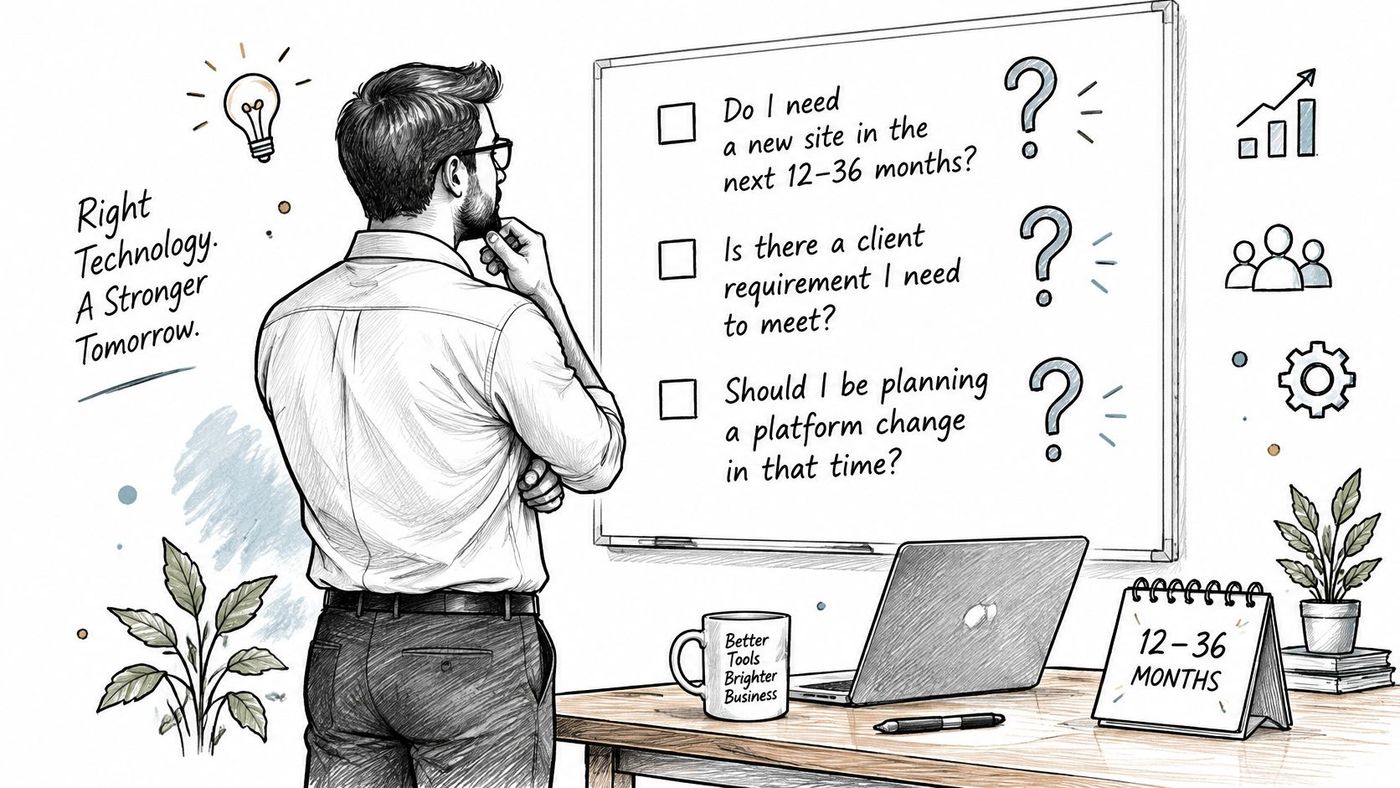
Before you speak to any provider, complete this list. It takes an hour and it changes the conversation:
Bring that to a first meeting and a vCIO can turn it into an assessment and a costed roadmap. CloudOrbis Inc. provides vCIO support for medium-sized organisations, including quarterly roadmap reviews, budget forecasting and independent guidance on decisions such as cloud versus on-premises, ERP replacement or acquisition due diligence, delivered alongside managed IT services for organisations that want one accountable partner.
CloudOrbis Inc. works with medium-sized Canadian organisations that need executive-level technology direction without adding a full-time CIO to payroll. If any part of this article described your situation, a short conversation about the technology decisions already sitting on your next 12 months is the fastest way to find out what's missing. Visit CloudOrbis Inc. to start that conversation.
Book a 30-minute call with a senior engineer. No sales script, just straight answers about your environment.


