Governance Risk and Compliance for Canadian SMBs
Learn what governance risk and compliance means for Canadian SMBs, the frameworks that matter, and how to build a practical GRC program that reduces risk.

Learn what governance risk and compliance means for Canadian SMBs, the frameworks that matter, and how to build a practical GRC program that reduces risk.

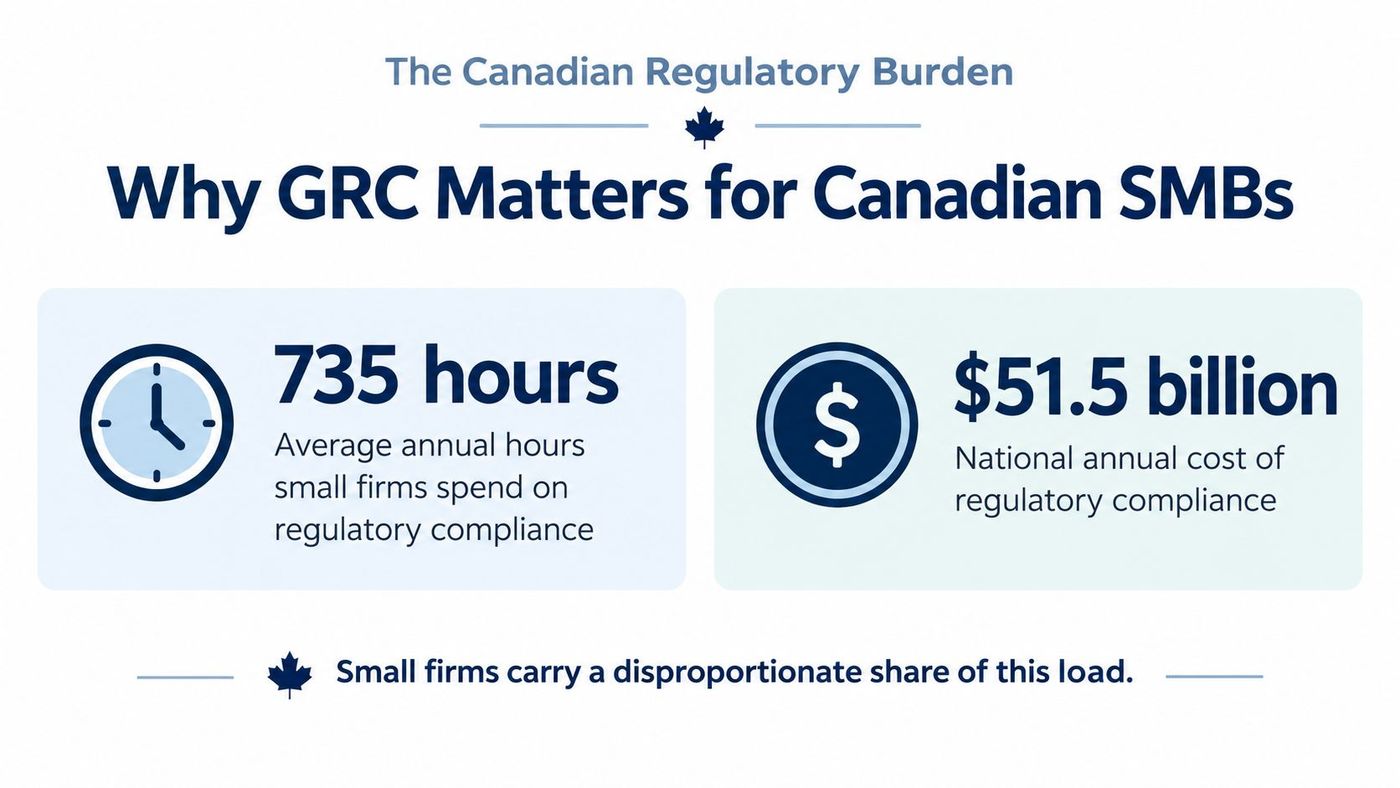
Canadian businesses spent an average of 735 hours, equivalent to 92 working days, dealing with regulation in 2024, including 256 hours on administrative red tape. The total cost reached approximately $51.5 billion, and businesses with fewer than five employees carried an average regulatory cost of $10,208 per employee, more than five times the per-employee cost faced by businesses with 100 or more employees. The Canadian Federation of Independent Business documents this burden.
For Canadian small and mid-sized businesses, governance risk and compliance isn't an abstract boardroom exercise. It affects who can access patient records, whether a supplier can reach production systems, how quickly a business can prove its controls to a customer, and whether leaders can explain what happened after an incident.
A clinic discovers that a former employee's account remained active after departure. The account wasn't obviously abused, and no alarm sounded. Months later, an investigation finds that the account accessed a shared folder containing personal information. The clinic now needs to determine what was viewed, assess the risk of significant harm, preserve evidence, involve leadership, and decide whether a breach must be reported.
The original failure wasn't complex. Nobody owned the access review, the review wasn't documented, and the clinic couldn't prove that its process worked. A small administrative gap became a privacy, operational, and reputational problem.
A manufacturer faces a similar pattern when a supplier's remote access remains enabled after a project ends. The supplier's credentials reach more systems than necessary, logs are incomplete, and the business can't quickly establish whether production data or customer information was exposed. The board doesn't ask which security tool failed first. It asks who approved the access, who monitored it, and why the evidence is missing.
Governance risk and compliance, or GRC, connects decisions to accountability and evidence. Governance defines who decides and who owns the outcome. Risk identifies what could disrupt the business and prioritizes treatment. Compliance demonstrates that the organization meets legal, contractual, regulatory, and internal requirements.
That distinction matters for CloudOrbis's SMB audience. A practical GRC program doesn't start with an expensive platform or a giant policy library. It starts with a manageable set of controls, named owners, and evidence that someone can review without reconstructing the past.
The privacy component deserves particular attention. Organizations handling customer, employee, or patient information need more than a privacy policy. They need data inventories, access controls, retention decisions, supplier responsibilities, incident workflows, and records that show those controls operate. Leaders building that foundation can also use this Canadian data privacy laws guide as a reference point.
Compliance responsibilities also depend on people knowing how to apply policy in daily work. A well-maintained continuing education article library can support role-specific learning for teams that handle regulated information, approve suppliers, or manage operational records.
Practical rule: Every important control needs three things: a responsible owner, a repeatable action, and an evidence trail.
Think of GRC as the operating system of a business. Employees and applications perform the visible work, but the operating system controls permissions, processes decisions, records activity, and coordinates what happens when something goes wrong.
Without that operating system, departments make isolated decisions. IT grants access without a business owner. Procurement signs a cloud contract without asking where data flows. Finance approves a supplier without checking its incident process. Governance risk and compliance brings those decisions into one operating model.
Governance answers, “Who decides, under what rules, and with whose approval?” A Canadian SMB should have a documented approval chain for new cloud vendors. The chain might include the business sponsor, IT, privacy or compliance responsibility, finance, and an executive approver.
The control isn't the meeting itself. The control is the documented decision, including the service's purpose, data handled, risk owner, contract requirements, access model, and review date. If a vendor changes its subprocessors or introduces an AI feature, the owner knows who must reassess the decision.
Risk management identifies threats, evaluates their effect on business objectives, and assigns treatment. An asset register is a useful starting control. It should record systems, data stores, criticality, owners, dependencies, and recovery expectations.
A clinic may rank its patient-management system as critical because unavailable records affect care and operations. A manufacturer may rank an operational technology network or production scheduling system similarly. The rating determines which systems receive stronger access controls, tighter monitoring, tested recovery, and more frequent review.
Compliance is the evidence layer. A policy says backups must be tested, but a restoration record shows whether the control operated. An access standard requires least privilege, but a completed access review shows whether managers checked permissions and removed exceptions.
For organizations using NIST CSF, ISO 27001, PIPEDA, or customer-specific requirements, the same evidence can often support multiple obligations. That is why control mapping is more efficient than maintaining disconnected checklists. The information governance resource provides useful context for connecting information handling rules to operational ownership.
Leaders designing accountability across internal teams and external advisors may also benefit from this 2026 guide to advisory staffing, particularly when deciding which responsibilities belong in-house and which require specialist support.
Governance chooses the direction. Risk decides what deserves attention first. Compliance proves that the organisation followed through.
Framework selection should follow business reality, not software marketing. A clinic handling personal information has different obligations from a manufacturer pursuing enterprise customers. A professional firm serving U.S. healthcare clients may need to satisfy customer expectations that go beyond Canadian privacy law.
Start with a practical baseline, then add sector overlays. NIST CSF 2.0 is usually the most accessible starting point because it helps organise cybersecurity outcomes without requiring certification. ISO 27001 is a stronger choice when customers, procurement teams, or leadership need a formal information security management system and the organisation is prepared to maintain certification evidence.
PIPEDA is a legal obligation for organisations within its scope, not a certification. It should shape privacy controls, breach workflows, data inventories, retention practices, and supplier terms. PCI DSS applies when the business stores, processes, or transmits payment card data. It should be scoped carefully so cardholder-data controls don't unnecessarily spread across the whole environment.
SOC 2 is commonly relevant to technology providers and service organisations that need to demonstrate control design and operation to customers. It involves an attestation process, not the same certification model as ISO 27001. Organisations serving U.S. healthcare customers may also encounter HIPAA-style contractual and security expectations. Canadian firms should define those obligations through customer contracts and service scope rather than assume that a generic privacy programme is sufficient.
| Framework | Best Fit For | Certification | Key Evidence Artefacts |
|---|---|---|---|
| NIST CSF 2.0 | SMBs building a practical cybersecurity baseline | Alignment, not certification | Asset register, risk register, incident procedures, control reviews |
| ISO 27001 | Organisations needing a formal information security management system | Certification available | ISMS scope, risk treatment plan, policies, internal audits, corrective actions |
| SOC 2 | Technology and service providers facing customer assurance requests | Independent attestation | Control descriptions, access reviews, change records, monitoring evidence |
| PCI DSS | Businesses handling payment card data | Validation depends on scope and requirements | Network scope, access records, vulnerability evidence, payment controls |
| PIPEDA | Canadian organisations handling personal information within its scope | Legal compliance, not certification | Privacy assessments, data inventory, consent records, breach documentation |
| HIPAA-style expectations | Canadian firms serving U.S. healthcare customers | Contractual or customer-driven expectations | Safeguard assessments, access logs, incident records, supplier agreements |
Don't attempt every framework at once. Use NIST CSF 2.0 as a cybersecurity baseline, then map PIPEDA, PCI DSS, ISO 27001, SOC 2, or customer requirements to shared controls. In the first year, a realistic target is a defined scope, prioritised risks, working access and incident controls, evidence collection, and a review cadence. Certification or attestation can follow when the business case supports the effort.
A GRC programme earns its place when leaders can see what changed. The strongest measures are operational, not decorative. Track repeat audit findings, the time required to answer customer security questionnaires, the time needed to provision correct access for new hires, the percentage of critical assets with named owners, and the age of unresolved high-priority risks.
The financial case is also clear. Statistics Canada reported that 16% of Canadian businesses experienced a cybersecurity incident in 2023, while the national recovery cost rose from approximately $600 million in 2021 to $1.2 billion in 2023. Medium-sized organisations reported incidents more often than small businesses, at 23% compared with 14%, according to the Canadian Survey of Cyber Security and Cybercrime.
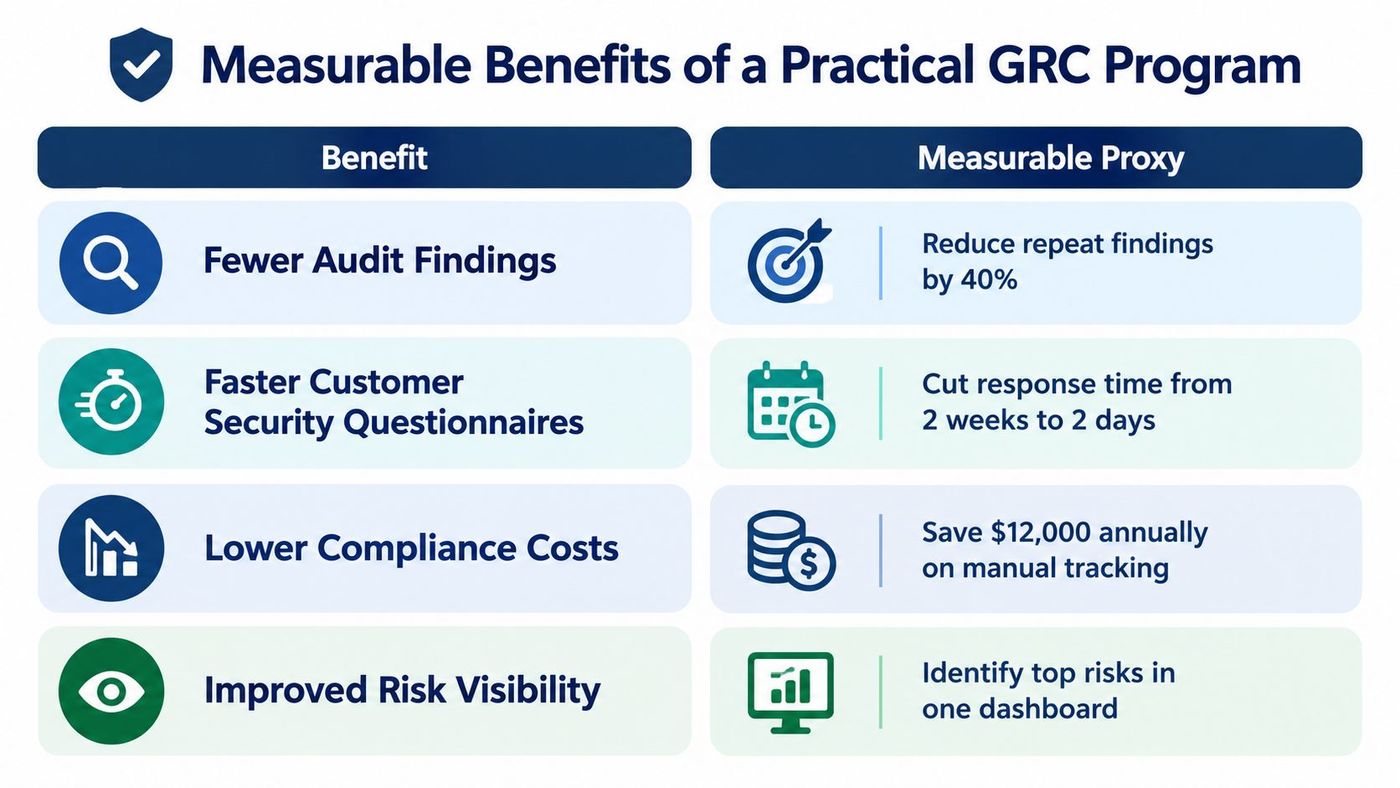
During the first 90 days, focus on visibility and repeatability:
Over the following six to twelve months, measure whether controls remain effective. Look for fewer repeat findings, clearer risk acceptance decisions, faster onboarding with correct permissions, and more consistent supplier reviews. Don't promise lower insurance premiums as an automatic outcome. A stronger control environment can improve the quality of an insurance submission, but the insurer makes the pricing decision.
The benefit is not a dashboard full of green indicators. It's a leadership team that can identify its highest risks, assign action, and verify completion before an incident or audit forces the issue.
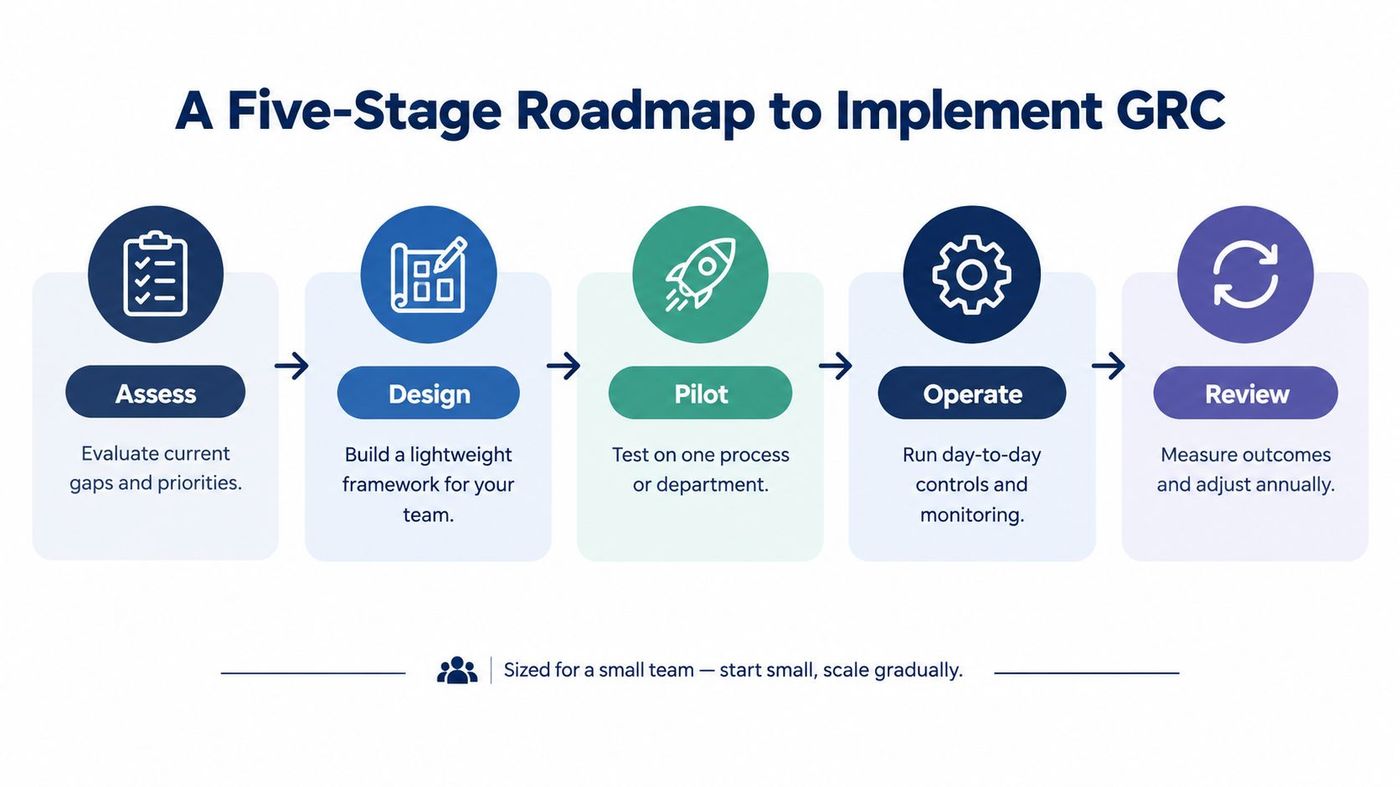
Small teams need a roadmap that produces useful work early. A programme that spends months writing policies before testing a single control will lose credibility. Use five stages, with a deliverable and owner for each.
The first stage establishes scope. Identify critical systems, sensitive information, major suppliers, regulatory obligations, customer commitments, and recovery requirements. The deliverables are an obligations map and a risk register.
The owner should be an executive sponsor supported by IT and business process leads. Keep the first assessment focused on the services that could materially disrupt operations or expose personal information.
Translate priorities into a lightweight control set. Define access approval, joiner and leaver management, backup testing, incident escalation, vendor review, vulnerability management, and evidence retention. Map those controls to the chosen baseline and sector overlays.
Assign one accountable owner per control. Contributors can support the work, but shared ownership without a final decision-maker creates delays.
Test one process or department. A manufacturer might pilot supplier remote access. A clinic might pilot role-based access and backup restoration. A professional firm might pilot client-data classification and secure sharing.
The pilot should produce evidence, expose friction, and reveal where policy doesn't match actual work. Fix the workflow before expanding it.
Move controls into daily operations. Use ticketing, identity systems, backup platforms, endpoint tools, and document repositories to collect evidence where the work already happens. A GRC tool can help, but it shouldn't become another manual spreadsheet that nobody maintains.
Review performance with leadership. Report open risks, overdue actions, incidents, exceptions, control results, supplier changes, and decisions requiring acceptance. Update the risk register when the organisation adopts a new cloud service, changes a critical process, or introduces an AI capability.
The most common failure is treating GRC as a one-time project. Use the change management process guide to manage adoption when controls affect staff workflows, approvals, or access.
A healthcare clinic and a finance firm may use the same risk register template, but their evidence will look different.
A clinic handling personal health information needs role-based access to patient records, documented privacy responsibilities, tested backup restoration, and a breach workflow that identifies who assesses risk and who approves notifications. The Office of the Privacy Commissioner of Canada reported that approximately 20 million individual Canadian accounts were affected by breaches reported under PIPEDA during 2024–2025, and 43% of Canadians said they had been affected by a privacy breach in the same reporting context. The OPC annual report shows why privacy governance must operate across collection, storage, access, disclosure, retention, and disposal.

A finance or accounting firm needs strong segregation of duties, vendor due diligence, durable audit trails, and controls around customer financial information. A manager approving a supplier shouldn't be the only person validating invoices. A system administrator shouldn't be able to alter records without review. Evidence must show not only that a policy exists, but that approvals, changes, and exceptions were recorded.
Cloud location alone doesn't answer the sovereignty question. A Canadian organisation should document where data, backups, logs, support access, subprocessors, encryption keys, and AI prompts or documents may be handled. Contracts should address legal demands, retention, deletion, incident escalation, and changes to service architecture.
This matters for healthcare, legal, accounting, and finance teams using Microsoft 365, AI assistants, U.S.-linked providers, or connected applications. The healthcare IT compliance guide provides a useful sector-specific reference, while a ProMed Certifications training guide can help healthcare leaders structure staff education alongside technical controls.
A sovereignty review should recur when providers introduce new AI features, change subprocessors, modify support workflows, or alter backup arrangements. Selecting a Canadian region once isn't the end of governance.
The first mistake is checklist thinking. A completed policy doesn't prove that access was reviewed, backups were restored, or suppliers were assessed. The second is assigning everything to one IT manager. GRC requires executive decisions, business ownership, privacy input, procurement discipline, and technical execution.
The third mistake is failing to preserve evidence. If a control matters, store the approval, review result, exception, ticket, log, or test record where an authorised reviewer can retrieve it. The fourth is treating cloud region selection as the final sovereignty decision. Review provider control, support access, subprocessors, legal exposure, encryption-key custody, retention, backups, and AI data handling as the service evolves.
The right GRC programme is small enough to operate, strict enough to produce evidence, and flexible enough to grow with the business. It should make the next audit, customer review, supplier change, and incident response more controlled than the last.
CloudOrbis Inc. helps Canadian SMBs assess control gaps, maintain policies and risk records, review access, collect audit evidence, and align environments with frameworks such as NIST CSF, ISO 27001, SOC 2, PIPEDA, and PHIPA. Visit CloudOrbis Inc. to discuss a practical governance risk and compliance programme for your organisation.
Book a 30-minute call with a senior engineer. No sales script, just straight answers about your environment.


