Managed IT Services for Private Career Colleges in Alberta: A Practical Guide
Discover managed it services for private career collages in alberta and learn how to safeguard your institution with expert IT partnerships.

Discover managed it services for private career collages in alberta and learn how to safeguard your institution with expert IT partnerships.
For private career colleges in Alberta, managing rapid enrolment growth, meeting strict provincial regulations, and securing sensitive student data isn't just part of the job, it's everything. A strategic IT partnership is what moves an institution from constantly putting out fires to proactively planning for growth. It allows you and your team to focus on student success, not technology headaches.
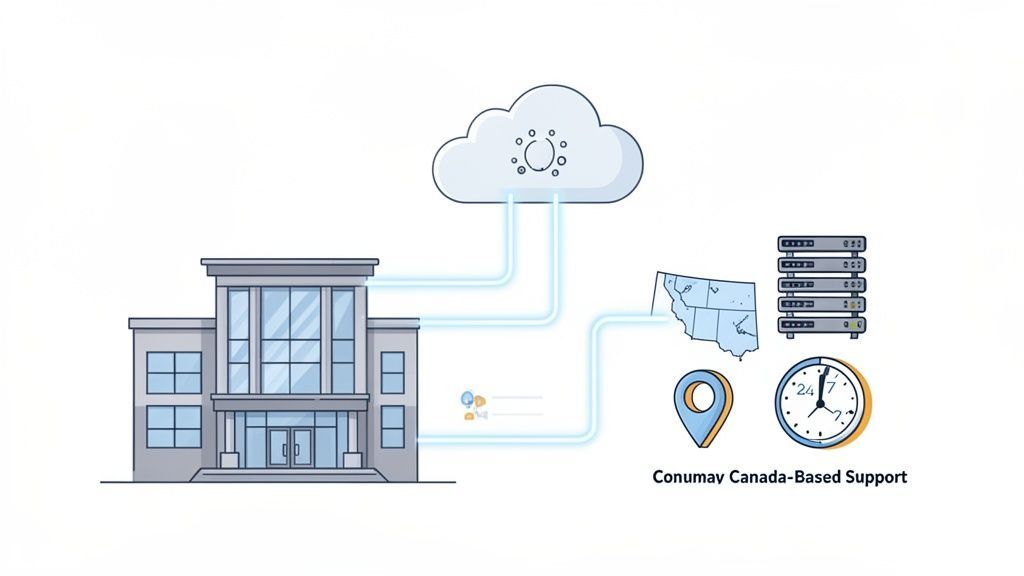
Alberta's private career colleges (PCCs) are at a pivotal moment. The demand for skilled, job-ready training is soaring, and your current IT setup might be feeling the strain. Legacy systems, often patched together over the years, can buckle under the pressure of modern educational demands, complex student administration, and Alberta's rigorous compliance rules.
This is not just about a slow computer here and there. It is about your college's fundamental ability to operate smoothly and expand. The PCC sector is booming, driven by the urgent need for vocational training in fields like healthcare, technology, and the trades. In fact, student enrolments have jumped by over 30% in the last five years, making reliable IT absolutely critical for managing the administrative workload and supporting online learning platforms.
Unlike larger public universities, private career colleges operate under a unique set of pressures. Your technology needs to be nimble, incredibly secure, and directly tied to student outcomes. This reality leaves many institutions stuck in a reactive, break-fix IT model, a frustrating cycle of inefficiency that impacts staff, instructors, and, most importantly, your students.
Does any of this sound familiar?
A proactive IT strategy completely changes the game. Instead of just putting out fires, it prevents them from starting. This approach transforms your technology from a budget line item into a strategic asset that enhances the learning experience.
This is precisely where managed IT services for private career colleges in Alberta come in. Think of it as more than just an outsourced helpdesk; it's a dedicated technology partnership built for your specific needs. You get the expertise of an entire IT department, including high-level strategic guidance, all for a predictable monthly cost.
By handing off the day-to-day IT grind, you free up your team to focus on the mission that truly matters: delivering exceptional career training. Exploring the core benefits of managed IT services can give you a clearer picture of how this kind of partnership fuels real institutional growth and stability.
Navigating the regulatory landscape for private career colleges in Alberta can feel like a full-time job. This is not just about ticking boxes on a form; staying compliant is fundamental to keeping your licence to operate. In this environment, your IT infrastructure is not just a tool, it's the foundation of your risk management strategy.
Provincial oversight is serious and heavily data-driven. The government demands detailed reports on key performance indicators to ensure students are getting a quality education that leads to employment. This is a non-negotiable part of operating, and the consequences for falling short can be severe.
Think of a managed IT partner as your compliance co-pilot. Their role is to ensure the systems you rely on for collecting, storing, and submitting data are not just working but are completely secure and dependable. They build the technological framework that makes accuracy and security the default, not an afterthought.
Alberta’s Personal Information Protection Act (PIPA) sets out strict rules for how any organization, including your college, handles personal data. Student files are a treasure trove of sensitive information, contact details, academic records, financial aid documents, and more. A data breach is not just a technical glitch; it's a full-blown legal crisis that can lead to massive fines and do catastrophic damage to your college's reputation.
A good managed IT service provider tackles PIPA requirements head-on with a layered defence:
By methodically securing every point where student data is stored and transmitted, a managed services provider helps you build a solid, defensible PIPA compliance posture. This proactive stance is your best defence when a provincial audit occurs. For a deeper look, understanding IT compliance services for Alberta private career colleges is a critical step for any forward-thinking institution.
Beyond just protecting data, the government in Alberta requires meticulous reporting on student outcomes. The Private Career College Registry, introduced to address a rise in student complaints, mandates strict reporting where both graduation and job placement rates must exceed 70%. Colleges that fail to meet this benchmark risk serious penalties, underscoring the need for dependable IT to track and report this data perfectly.
Trying to manage this with a patchwork of spreadsheets is a recipe for disaster. It is inefficient and practically invites the kind of human error that can invalidate your numbers. This is where a strategic IT partner brings incredible value.
A skilled IT provider helps integrate your Student Information System (SIS) with other administrative platforms. This creates a single source of truth, automating how data is collected and how reports are generated.
The result? The figures you submit to the government are both accurate and easily auditable.
This automation does more than save a few hours, it adds a thick layer of integrity to your entire reporting process. When provincial auditors arrive, you can confidently produce clean, verifiable data trails. This capability can turn a stressful audit into a routine check-up that validates your college's excellent performance.
The table below breaks down how managed IT services directly address the key compliance tasks you face.
Here is a quick summary of the essential reporting and data management tasks mandated by Alberta's Private Career College Registry, and the IT solutions that make them manageable.
| Compliance Requirement | Data Involved | Managed IT Service Solution |
|---|---|---|
| Annual Reporting on KPIs (graduation & job placement rates) | Student enrollment, graduation dates, employment status | Integration of Student Information System (SIS) for automated data aggregation and accurate report generation. |
| PIPA Compliance for handling personal student data | Names, addresses, SINs, academic records, financial info | Encrypted data storage, role-based access controls, regular security audits, and secure data disposal policies. |
| Secure Data Retention as per provincial guidelines | Student files, financial aid records, administrative documents | Managed cloud backup solutions with versioning and defined retention periods to ensure data integrity and availability. |
| Student Complaint & Grievance Tracking | Complaint details, resolution steps, communication records | Implementation of a secure, centralized ticketing or CRM system to log and manage cases confidentially. |
By mapping specific IT solutions to each requirement, you can see how a managed services provider transforms compliance from a reactive headache into a proactive, systemized process.
For comprehensive guidance on adhering to industry standards and government directives, delve into this practical guide to regulatory compliance risk management.
Ultimately, the right managed IT services turn compliance from a heavy burden into a streamlined, automated, and secure part of your operations. This frees you up to focus on what truly matters, student success.
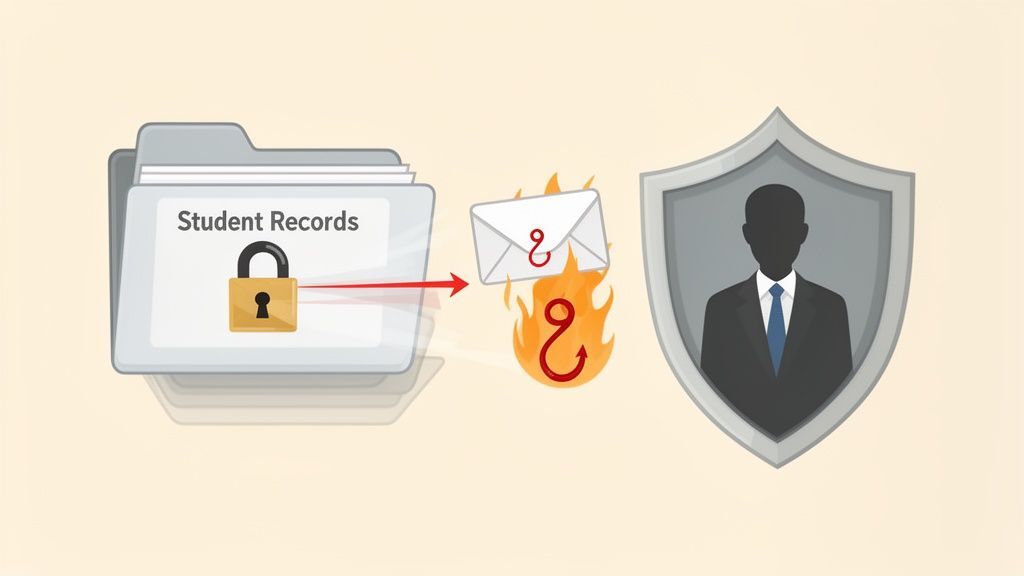
As a leader at a private career college, you are the guardian of incredibly sensitive information. We are talking about financial aid applications, social insurance numbers, and personal details for students who often come from vulnerable populations. Protecting this data is not just a technical task; it's a fundamental duty you owe to every person who entrusts you with their future.
In today's environment, basic antivirus and a standard firewall are not enough. Cybercriminals are sophisticated and relentless, and they see educational institutions as prime targets. A single breach can lead to devastating financial loss, cripple your reputation, and bring on serious regulatory penalties.
This responsibility is amplified when you consider the unique student demographics at many Alberta PCCs. These institutions often serve a high percentage of students from unique backgrounds; for instance, many private career colleges in Alberta see 75% female enrollment, 33% of students have dependent children, and 41% come from households with under $20,000 in annual income. These are not just numbers, they are real people who rely on you, highlighting why secure, cost-effective managed IT is so critical.
A modern cybersecurity strategy is all about layers. Think of it as creating multiple barriers an attacker must break through. This "defence-in-depth" approach is the bedrock of how a professional IT partner will protect your college.
Forget generic advice. These are the non-negotiable security controls every PCC needs:
It is also about staying ahead of specific threats, like actively preventing Man-in-the-Middle attacks, where an attacker secretly intercepts and relays communication.
To see how these layers work in practice, let's walk through a common scenario. A well-crafted phishing email lands in the inbox of someone on your admissions team. It looks like a legitimate inquiry from a prospective student, complete with a link to their "portfolio."
Your staff member clicks the link, and malware is silently installed on their computer.
With a basic IT setup, this is where the disaster starts. The malware could spread undetected for weeks, stealing login credentials and exfiltrating sensitive student data. With a managed security service, the response is immediate and coordinated.
Here’s how a proper security strategy shuts down the threat instantly:
This entire process happens in minutes, not days. The threat is contained and eliminated before any real damage is done, the difference between a minor incident and a full-blown data breach. You can dive deeper into building this kind of defence in our guide on cybersecurity for Alberta private career colleges.
Picking an IT provider is one of the most critical decisions a college leader will make. This is not just about who you call when a printer breaks; it's about handing over the keys to the technology that runs your entire institution. The right choice powers your operations, shapes the student experience, and protects your college's future.
A poor fit, on the other hand, means frustrating downtime, glaring compliance risks, and an unpredictable budget.
The goal is to find a partner that feels like an extension of your own team, one that proactively keeps things secure and running smoothly so you can focus on education. You need a team that understands the unique world of managed IT services for private career colleges in Alberta, not a generic IT shop that treats you like any other business.
The vetting process is where you separate the real experts from the generalists. You should not have to give your IT provider a crash course on how your college operates or the regulations you follow.
Kick off your evaluation with a few direct questions:
These first few questions will tell you a lot. They will quickly show you who has the specialized knowledge needed to support an educational institution like yours.
Once you have narrowed it down to a few potential partners, it is time to get into the details of how they deliver their services. This is where you scrutinize their Service Level Agreements (SLAs) and pricing models to ensure everything is transparent and matches what your college needs.
An SLA is not just another document; it's their written promise to you. It lays out exactly what level of service you can expect, defining the key metrics they commit to.
A strong SLA provides concrete, measurable guarantees. It should clearly define response times for critical issues, specify system uptime percentages, and outline the penalties the provider faces if they fail to meet these commitments. This accountability is the hallmark of a professional partnership.
When you look at pricing, you are looking for two things: clarity and predictability. A transparent model, like a flat monthly fee per user or device, makes budgeting simple and avoids surprise invoices. Be cautious of pricing structures that are overly complex or do not spell out exactly what is included versus what will cost you extra.
Your goal is a predictable cost that fits your operational budget. If you're navigating this for the first time, our guide on evaluating managed IT service companies offers more tips on what to watch for.
To help you systematically compare your options, use the checklist below. It is designed to keep your focus on the factors that truly matter for a private career college, ensuring your decision is based on a solid, comprehensive understanding of what each potential partner brings to the table.
| Evaluation Category | Key Questions to Ask | Ideal Response / What to Look For |
|---|---|---|
| Industry Experience | Can you provide references from other Alberta PCCs you currently support? | They should readily offer case studies or contacts, proving they understand the unique software (LMS/SIS), workflows, and regulatory pressures of your sector. |
| Compliance & Security | How do you ensure our data handling and storage practices comply with Alberta's PIPA? | A specific, detailed answer covering encryption, role-based access controls, Canadian data residency, and regular security audits. Vague promises are a red flag. |
| Service & Availability | Is your support team available 24/7/365, and are they based in Canada? | Unambiguous confirmation of around-the-clock support from a Canada-based team that understands the regional context and is available for your staff and students anytime. |
| Strategic Planning | How will you help our college plan for future technology needs and growth? | A true partner acts as a strategic advisor (vCIO), helping you budget for and adopt technology that supports your long-term institutional goals, not just fix today's problems. |
Using a structured checklist like this ensures you are comparing providers on the criteria most critical to your success. It is the best way to find a partnership that will support your college's mission for years to come.
The idea of overhauling your college’s entire IT infrastructure can feel daunting. But a well-planned transition is the difference between chaos and a smooth, almost invisible, evolution. A structured onboarding process ensures your students and staff experience zero disruption, setting you up for a successful long-term partnership.
The goal here is to move from your current setup to a fully managed, optimized environment in a methodical way. This empowers your college to get the full value of managed IT services for private career colleges in Alberta right from day one, instead of stumbling through a messy changeover.
This process is not just a flip of a switch; it's a journey from vetting and onboarding to continuous growth.
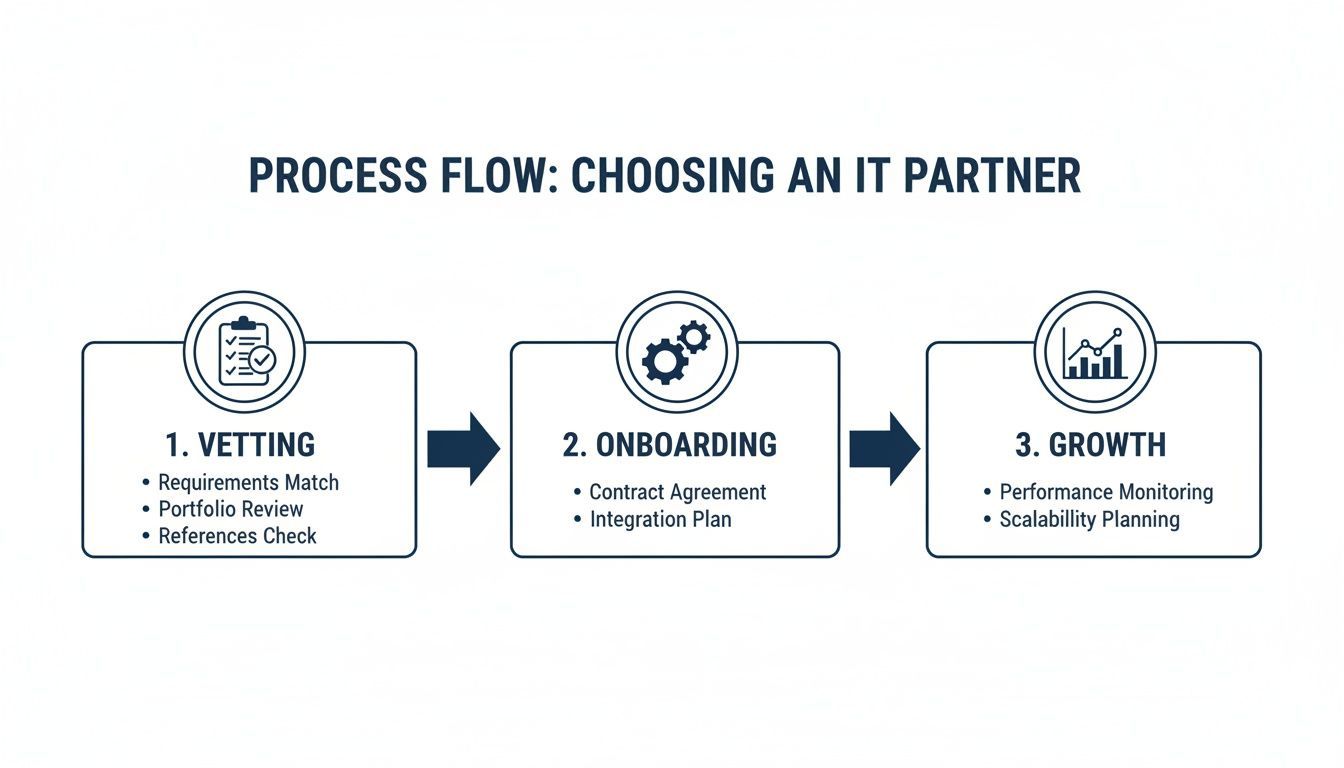
As the graphic shows, onboarding is the critical bridge connecting your decision to the strategic goals you want to achieve.
Any successful transition kicks off with a thorough assessment of your current IT environment. A true partner will not show up with a generic package; they will invest real time in understanding your college’s unique operations. This is more than a quick glance at your servers, it's a deep dive into every piece of your tech stack.
Here's what this initial phase looks like:
This discovery process must be collaborative. Your team's input is absolutely essential to ensure the final IT strategy aligns with your institutional goals and solves the problems your staff face.
Once there's a clear picture of where you are, the next step is mapping out the implementation. A "big bang" approach, where everything changes overnight, is asking for trouble. A phased rollout is much smarter, minimizing the disruption to your daily operations.
For instance, the first phase might focus on deploying foundational security tools, like advanced endpoint protection and setting up secure cloud backups. This immediately strengthens your defences without changing the core systems your team uses every day. Later phases could tackle network upgrades or moving specific applications.
This careful approach is especially critical for complex moves. Our detailed guide on cloud migration services digs deeper into how a structured plan helps you sidestep common migration disasters.
The sign of a truly professional onboarding is that your end-users barely notice it. The goal is for your staff and students to only see the improvements, like a faster network or fewer crashes, without feeling the disruption of the changes happening behind the scenes.
Technology is only as good as the people using it. The final, and perhaps most important, piece of the puzzle is managing the human side of this change. This boils down to crystal-clear communication and targeted training so your staff feel confident, not confused.
To get everyone on board, you have to communicate the "why" behind it all. Explain how the new systems will genuinely make their jobs easier, not just add another complicated step.
Consider these practical steps to drive adoption:
A smooth transition is not about flipping a switch. It's a thoughtfully managed process that respects your college's needs and truly empowers your team for the future.
Choosing a managed IT services provider is not just about fixing computers. It's a strategic move that directly impacts your college's future. For private career colleges in Alberta, a solid IT foundation is inseparable from regulatory compliance, operational efficiency, and, most importantly, student success.
The right partner helps you break free from the frustrating break-fix cycle. Instead of constantly reacting to problems, you move to a proactive framework that supports sustainable growth.
This shift allows you and your team to get back to what you do best: education. Rather than wrestling with technical glitches or stressing about compliance audits, your staff can focus their energy on delivering a standout student experience. A great IT partnership means your technology just works, humming along quietly in the background to support every part of your college.
Ultimately, effective IT management is about giving your college the tools to thrive in Alberta's competitive landscape. It's about building a secure, reliable, and compliant technological backbone so you can deliver exceptional education and produce job-ready graduates.
The first step toward a more resilient and efficient future is getting an honest look at where your IT stands today. By working with a specialist in managed IT services for private career colleges in Alberta, you get the clarity and expert support needed to achieve your institution's goals.
Ready to see how a purpose-built IT strategy can benefit your college? Schedule a comprehensive IT assessment with CloudOrbis today.
When you're exploring managed IT services, many questions can arise. It's a big decision. To help you get a clearer picture, here are the answers to some of the most common things we are asked by private career college leaders across the province.
For predictable budgeting, something every educational institution needs, most costs are structured on a straightforward per-user, per-month model. The final price tag depends on the size of your college, how many users need support, and the specific services you bundle in.
A good provider will never give you a blind quote. They will start with a thorough assessment of your current IT setup. This allows them to give you a transparent, fixed-fee price that covers all the essentials like 24/7 support, cybersecurity, and strategic guidance, so you can say goodbye to surprise IT bills.
This is an excellent question, and the answer is collaboration. An MSP does not replace your team; they enhance it through a co-managed model. The idea is for the managed services provider to take on the relentless, around-the-clock tasks, think network monitoring, cybersecurity threat management, and the helpdesk.
This partnership frees your internal staff to concentrate on high-value projects unique to your college. They can finally dedicate their time to initiatives like rolling out new educational software or upgrading classroom technology, blending external expertise with their deep institutional knowledge.
It’s all about creating a powerful synergy where each team gets to do what they do best.
Technical skill is a given. Every provider should have that. The single most critical factor, however, is their direct, hands-on experience with the regulatory demands of Alberta's Private Career College Registry.
Finding an MSP that already speaks this language, understanding the specific compliance rules and student data privacy requirements, is invaluable.
They can design an IT infrastructure that is not just functional but secure and compliant right from the start. That kind of specialized knowledge minimizes your risk, saves an incredible amount of time, and ensures your technology is actively supporting your educational mission and protecting your college's good standing.
At CloudOrbis Inc., we build resilient, compliant, and efficient IT solutions for private career colleges across Alberta. We understand the unique challenges you face and deliver the strategic support needed to help your institution thrive. Learn more about our tailored IT services at https://cloudorbis.com.
Book a 30-minute call with a senior engineer. No sales script, just straight answers about your environment.


