
September 14, 2026
Vulnerability Management vs Vulnerability AssessmentVulnerability management vs vulnerability assessment explained for Canadian SMBs. Compare scope, process, tools, and how to choose the right approach.
Read Full Post%20(1).webp)
Usman Malik
Chief Executive Officer
December 17, 2025

Effective LMS support for Alberta private career colleges is more than just a technical necessity—it’s the engine that powers student success and ensures your operations run smoothly. A well-supported Learning Management System (LMS) is the key to creating a reliable, seamless digital campus that meets the high expectations of modern learners and gives your instructors tools they can count on.
In Alberta's competitive private career college landscape, your LMS is the heart of the student experience. It’s where your curriculum comes to life, where communication flows, and where you track student progress. However, simply having an LMS is not enough. Its true value is unlocked only when you have a proactive and strategic support framework behind it.
This is not just about fixing the occasional technical glitch. It’s about building a stable, secure, and user-friendly environment where technology facilitates learning, rather than hindering it. When your LMS runs flawlessly, students can focus on their studies without frustration, and instructors can deliver top-notch education without battling the technology.
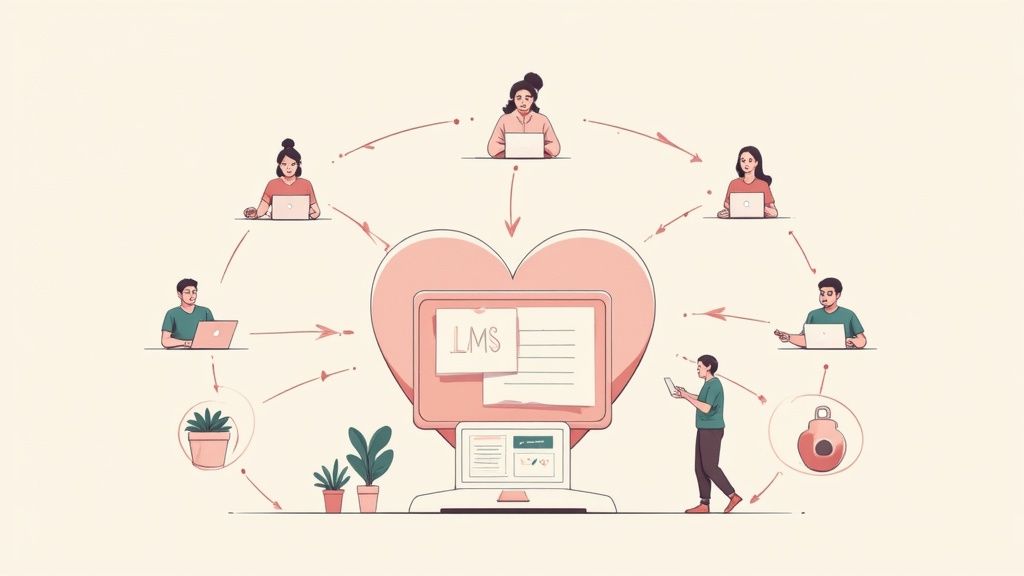
If you view your LMS as merely a repository for course files, you are missing its potential. With strategic support, your platform transforms into the central hub for your entire college community and a significant driver of your reputation.
Consider these core pillars of a healthy LMS ecosystem:
A proactive LMS support strategy transforms your platform from a simple operational tool into a powerful asset for student engagement and institutional growth. It's an investment in the quality of your educational delivery.
Across Canada, the adoption of digital learning in private career colleges varies. Alberta, however, stands out as a province where colleges are actively embracing these technologies. While the national trend has been slower, colleges here are increasingly using LMS solutions to provide students with the flexible, accessible education they demand. A national survey on online and distance education clearly highlights these trends.
This local momentum makes robust LMS support for Alberta private career colleges absolutely critical. Partnering with experts who understand the local environment can make all the difference. For many institutions, exploring the benefits of managed IT services offers an ideal solution. It provides access to expert-level support without the cost and overhead of building a large in-house team, ensuring your college stays ahead of the curve.
Selecting an LMS without a clear roadmap is a recipe for a costly mismatch. Before you review a single demo, the most critical step is to determine what your institution, instructors, and students actually need. This discovery process is the foundation of successful LMS support for Alberta private career colleges, ensuring the platform you choose solves real problems instead of creating new ones.
The goal is to create a detailed requirements document that will serve as your guiding principle. This document will inform every decision, from the initial conversation with a vendor to the final contract signing.
The clearest understanding of your needs will always come from the people who will use the system daily. This involves engaging in meaningful conversations with a cross-section of your college community. A generic survey is insufficient; you need to dig deeper with targeted interviews.
Ensure you consult with these groups:
These conversations will help you distinguish between essential features and optional add-ons.
Every college is unique. What is essential for one school might be an unnecessary expense for another. Your stakeholder interviews will help you build a features list and, more importantly, prioritize it based on genuine needs.
Consider a real-world scenario. An Alberta healthcare college that manages clinical placements has a completely different set of "must-haves" compared to a business school.
Healthcare College - Mission-Critical Needs:
Business School - Mission-Critical Needs:
It’s easy to get distracted by flashy features that are irrelevant to your teaching methods. Focus first on what solves your biggest operational and instructional challenges.
Once you have gathered and organized this information, it's time to formalize it. This document is more than a checklist; it's a strategic tool. A well-defined plan is the backbone of any successful technology implementation. For a closer look at structuring this phase, our guide on effective IT project planning offers a framework you can apply to your LMS search.
Your final document should clearly outline:
Having this document in hand changes the conversation with vendors. Instead of them telling you what their platform does, you will be telling them what your college needs. This shift puts you firmly in control, ensuring you end up with a solution that truly fits.
For private career colleges in Alberta, data privacy is not just a technical checkbox—it's a core promise to your students. Handling personal information correctly under Alberta's Personal Information Protection Act (PIPA) is a fundamental part of delivering solid LMS support for Alberta private career colleges. This extends beyond avoiding fines; it's about building trust and protecting the reputation you've worked hard to build.
When you make data security a central part of your operations, it sends a powerful message. It tells your students that you are safeguarding everything from their grades to their personal contact details and that you take that responsibility seriously.
At its core, PIPA dictates how private organizations in Alberta collect, use, and disclose personal information. For a career college, "personal information" includes everything your LMS touches: student names, enrolment records, assignment submissions, grades, and even discussion forum content. Your responsibilities are clear and non-negotiable.
Here are the key PIPA principles you must integrate into your LMS strategy:
This screenshot of the Private Career Colleges Act outlines the regulatory environment in which you operate.
Think of the act as the foundation for your operational requirements. Data protection is a critical piece of that foundation, essential for maintaining your licence and good standing.
One of the biggest challenges in PIPA compliance is data sovereignty—where your student data is physically stored. While PIPA does not explicitly prohibit data from leaving Canada, keeping it within our borders simplifies compliance and reduces risk. The moment data crosses a border, it falls under the laws of another country, which can create significant privacy complications.
Pro Tip: When evaluating LMS options, make data hosting location a non-negotiable point. Prioritize vendors who guarantee all student data remains on Canadian servers. This single decision can prevent numerous compliance headaches.
As you evaluate potential LMS providers, you must scrutinize their data handling practices. Reviewing a vendor's privacy policy, like this example from Lumi's Privacy Policy, is a mandatory step for PIPA compliance. This scrutiny should extend to every third-party plugin or integration.
Let's translate these principles into day-to-day operations.
Scenario 1: A Student Requests Access to Their Data
A former student submits a formal request to access all personal information your college holds on them in the LMS. Under PIPA, you must provide this within a specific timeframe. Your LMS support team needs a clear, documented process to compile and securely share that data without delay.
Scenario 2: Vetting a New Grading Plugin
Your instructors are interested in a new third-party plugin that offers advanced grading analytics. Before installation, your IT team must conduct a privacy impact assessment.
If the vendor provides vague answers—or none at all—the plugin should not be used. Navigating these complexities is why specialized cybersecurity compliance solutions are so valuable. They help eliminate the guesswork in meeting your legal obligations.
The recent creation of Alberta's Private Career College Registry has increased accountability. With student enrolments jumping by 30% over five years, the registry aims to boost transparency and help the government monitor compliance and educational quality.
Selecting an LMS platform is a major decision, but determining how you will support it is equally critical for long-term success. There is no single "best" support model for LMS support for Alberta private career colleges. The right choice depends on your college's unique resources, budget, and strategic direction. This decision will shape your daily operations and, ultimately, your students' experience.
There are three main paths, each with its own advantages and disadvantages. It’s important to weigh them carefully to find the one that best fits your college's capacity and vision.
Building your own in-house team provides maximum control. Your support staff are deeply familiar with your college's specific needs and curriculum, enabling them to address issues with a comprehensive understanding of your operations.
However, this path requires a significant and ongoing investment in salaries, benefits, continuous training, and necessary tools. Furthermore, attracting and retaining specialized LMS talent can be challenging in today's market, especially for private career colleges.
Turning directly to the LMS vendor for support is a common approach. It provides a direct line to the experts who built the product, and this support is often bundled into your subscription, making costs predictable.
The drawback is that vendor support can often feel impersonal and slow. As one of many customers, your issue might not receive immediate attention unless it is critical. Their assistance is also strictly limited to their software, excluding integrations, user training, or broader IT issues that could be the root cause of the problem.
A third option is to partner with a managed IT services provider, which offers a more strategic and balanced approach. This model combines deep technical expertise with a personalized understanding of your college’s goals.
A dedicated partner brings proactive management, working to prevent problems before they disrupt a class. They can handle everything from daily administration and security updates to complex integrations and strategic planning. This frees up your team to focus on their core mission: delivering excellent educational outcomes.
A managed services partner doesn't just fix what's broken; they become a strategic extension of your team, providing proactive guidance to ensure your LMS supports your college’s growth and educational mission.
This decision tree helps visualize a key compliance issue—data management under PIPA—that will influence your support strategy.
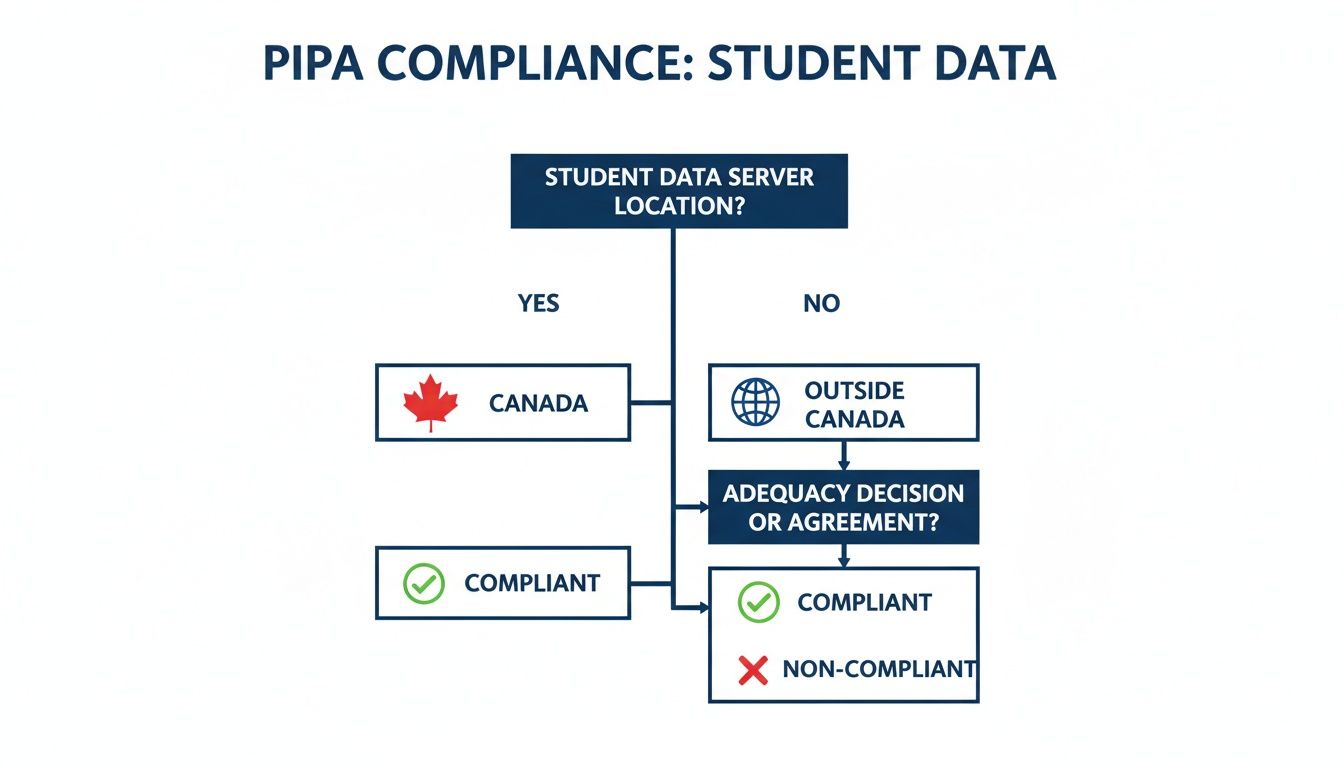
As you can see, data sovereignty is a massive factor, and whichever support model you choose must be equipped to manage it effectively.
To help you make an informed decision, it’s useful to compare how each model performs against key criteria. The process of selecting the right platform is a major undertaking; for guidance on that, check out these insights on how to choose an LMS.
For many private career colleges in Alberta, the managed services model strikes the perfect balance of cost-effectiveness, deep expertise, and true partnership. You gain an entire team of IT professionals for a fraction of the cost of building one from scratch.
Find out more about how managed IT support services can deliver the specialized LMS support for Alberta private career colleges that your institution needs to thrive.
Moving to a new Learning Management System can feel like a daunting task. However, with a solid plan, what seems like a potential disruption can become a smooth, controlled evolution for your college. A successful migration is more than just transferring files; it's a carefully orchestrated process that must account for both technical details and the human side of change.
The primary goal is to prevent disruption. For any institution providing LMS support for Alberta private career colleges, a proactive approach is essential. It ensures instructors can continue teaching and students can continue learning without interruption, protecting the quality of education you promise.
The first and most critical phase is determining what data needs to be migrated and what should be left behind. This is not a simple copy-and-paste job. A legacy system is often a digital attic, filled with outdated courses, duplicate user accounts, and unnecessary files you don’t want cluttering your new platform.
Begin with a thorough content audit:
Think of it like moving houses. You wouldn't just throw everything from your old place into boxes. You would sort through it, discard what's unnecessary, and carefully pack what’s valuable. Data migration requires that same discipline.
This cleanup phase is your chance to start fresh with a streamlined, organized system. The effort you invest here will pay dividends in performance and usability later.
A common pitfall in an LMS migration is underestimating the complexity of your integrations. Your LMS must communicate with your Student Information System (SIS), payment gateways, and other software. A single broken integration can bring administrative processes to a halt.
Before going live, test these connections relentlessly in a sandbox environment. For example, ensure that when a student enrols on your website, their account is instantly created in the LMS and that registration data syncs perfectly with the SIS. This requires simulating real-world scenarios to catch potential failures before they affect your staff and students. This technical challenge is significant, and professional guidance on cloud migration services can be invaluable, ensuring every connection is secure and reliable.
As you approach your launch date, a detailed pre-launch checklist is your final defence against day-one chaos. This should cover every aspect of the transition to ensure a smooth experience for everyone.
Your checklist should confirm:
By methodically working through these stages—data mapping, integration testing, and a final pre-launch check—you can execute a migration that feels less like a risk and more like a confident, well-planned step forward.
A powerful LMS is only as good as the people using it. You can invest in the most feature-rich platform, but if your faculty and staff don’t know how to use it—or are resistant to it—it becomes an expensive liability. This is where smart training and dedicated change management make all the difference for LMS support for Alberta private career colleges.
The goal is to foster a culture where your team views the LMS not as another administrative burden, but as a genuinely useful tool that enhances their work and improves teaching outcomes.

A single, one-size-fits-all training session is ineffective. Your instructors, administrators, and student support staff have different workflows and needs. A much better approach is to create role-specific training that speaks directly to their daily tasks.
Successful adoption depends on providing relevant, accessible, and on-demand training. A blended approach works best, catering to different learning styles and busy schedules.
Consider creating a mix of these resources:
True adoption happens when your team feels confident and capable with the new technology. Frame your training less around features and more around empowering them to achieve their goals more effectively.
This focus on user support directly impacts your college's performance. The Alberta government systematically collects graduate outcomes data from private career colleges, including key metrics on employment rates and student satisfaction. Publishing these KPIs reinforces the need for strong educational delivery—which starts with a well-adopted LMS. You can explore the datasets on Alberta's Open Government portal to see what is being measured.
Beyond formal training, one of the most powerful change management strategies is to identify and empower internal champions. These are the tech-savvy instructors or enthusiastic administrative staff who understand the new system and are excited about its potential.
Provide these individuals with extra training and a direct line to the project team. They will become your on-the-ground advocates, assisting colleagues, sharing success stories, and building positive momentum from within. This grassroots support is often the key to turning hesitation into genuine enthusiasm.
When it comes to Learning Management Systems, Alberta's private career colleges often face similar questions. Obtaining clear, practical answers is the first step toward making smart decisions that benefit your students and staff.
Let's address a few of the most common queries we hear.
This is a critical concern, and the simplest starting point is to prioritize vendors who host all student data within Canada. That single step significantly reduces your compliance burden.
However, your due diligence should not stop there. You must examine their privacy policies, security certifications, and data handling procedures. Your contract must explicitly state their obligation to adhere to Alberta's PIPA standards. Internally, you need robust data governance policies that clarify who can access student information and why. Regular, mandatory staff training on privacy is essential.
The biggest mistake we see? Colleges assume the vendor handles all compliance. PIPA compliance is a shared responsibility. Your internal processes for managing and accessing data are just as critical as your vendor's server security.
By far, the most significant error is focusing entirely on the technology while neglecting the people who must use it every day. You can have the most technically advanced LMS, but it will fail without proper change management.
Too many colleges underinvest in comprehensive, role-based training and fail to build genuine buy-in from instructors and administrative staff. A lack of user adoption is the number one reason LMS projects do not deliver on their promise. Investing time and resources into training and support is not an "extra" cost; it is central to your project's success.
Absolutely. A skilled managed IT services partner can bring significant value to your existing LMS, even if you have no plans to switch platforms. They can take over the daily administration, security patching, and performance monitoring.
Furthermore, a partner can provide expert-level support for your users, integrate the LMS with other campus systems (like your Student Information System) to boost efficiency, and offer strategic advice on maximizing the features you already pay for. This frees up your team to concentrate on their primary roles: developing curriculum and ensuring student success, not wrestling with IT.
Your LMS is the digital heart of your college. Its performance and reliability directly shape your students' experience and your institution's reputation. At CloudOrbis Inc., we deliver specialized, proactive IT support designed to ensure your technology is a powerful asset, not a constant problem.
Discover how our managed IT services can optimize your LMS and secure your digital campus.
September 14, 2026
Vulnerability Management vs Vulnerability AssessmentVulnerability management vs vulnerability assessment explained for Canadian SMBs. Compare scope, process, tools, and how to choose the right approach.
Read Full PostSeptember 13, 2026
Third-Party Risk Management for Canadian SMBsMaster third-party risk management for your Canadian SMB. Learn OSFI compliance, vendor monitoring frameworks, and how to secure your supply chain.
Read Full Post
September 12, 2026
Managed Services Cost: A Practical Guide for Canadian SMBsUnderstand managed services cost for Canadian SMBs. Learn pricing models, industry factors, ROI, and how to choose the right provider for your business.
Read Full Post
