

September 26, 2026
On-Premise to Cloud Migration Checklist: 10 StepsUse this on-premise to cloud migration checklist to plan assessment, compliance, backups, sequencing, testing, cutover, and optimization for SMBs.
Read Full Post%20(1).webp)
Usman Malik
Chief Executive Officer
March 29, 2026
For small and mid-sized businesses across Canada, technology often feels like a necessary expense—something you manage when a computer breaks or a server goes down. But this is an outdated view. The right IT solutions are your engine for growth, security, and a real competitive edge.
This guide is your roadmap to understanding and choosing the modern IT solutions CA-based companies need to not just survive, but to thrive.
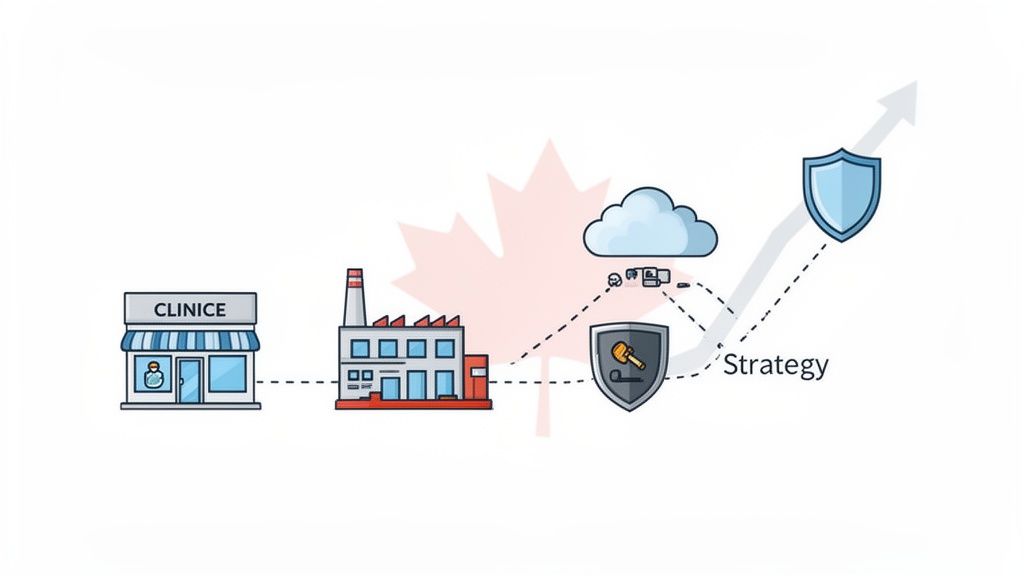
In today's market, treating technology as a simple line item on your budget is a surefire way to be left behind. A smart IT strategy is one of the most powerful assets you can have. This holds true whether you are a healthcare clinic handling sensitive patient records, a manufacturer streamlining a complex supply chain, or a law firm safeguarding confidential client files.
A great partner won't drown you in technical jargon. Instead, they will provide clear, practical advice that connects directly to your business goals. It's all about shifting your IT from a reactive, “break-fix” model to a proactive force that drives your business forward.
This push to modernize is not just a fleeting trend—it is a massive economic shift. The Canadian ICT market is set to grow from USD 136.69 billion in 2025 to an impressive USD 206.47 billion by 2031.
Small and medium-sized enterprises (SMEs)—the backbone of our economy—are at the forefront of this movement. Their share of the market is projected to reach over USD 73.6 billion by 2031, thanks to more affordable cloud services and automation. You can delve into the numbers in the full industry report on the Canadian ICT market.
What does this mean for you? It means your competitors are investing heavily in technology. To stay competitive, you need a clear vision for how IT can serve your own organization.
Your IT partner should function as a strategic asset, not just a service provider. Their role is to deliver a technological edge that translates directly into business value, from enhanced security to improved operational efficiency and customer satisfaction.
Making the leap from a tactical, problem-solving mindset to a strategic one starts with understanding the building blocks of modern IT. This guide will walk you through everything from foundational managed services to advanced cybersecurity, helping you make decisions with confidence.
Here are the key areas we will cover:
Building a solid plan is the first step toward making your business more resilient and efficient. To see how this works in the real world, check out our guide on IT strategy and consulting for SMBs.
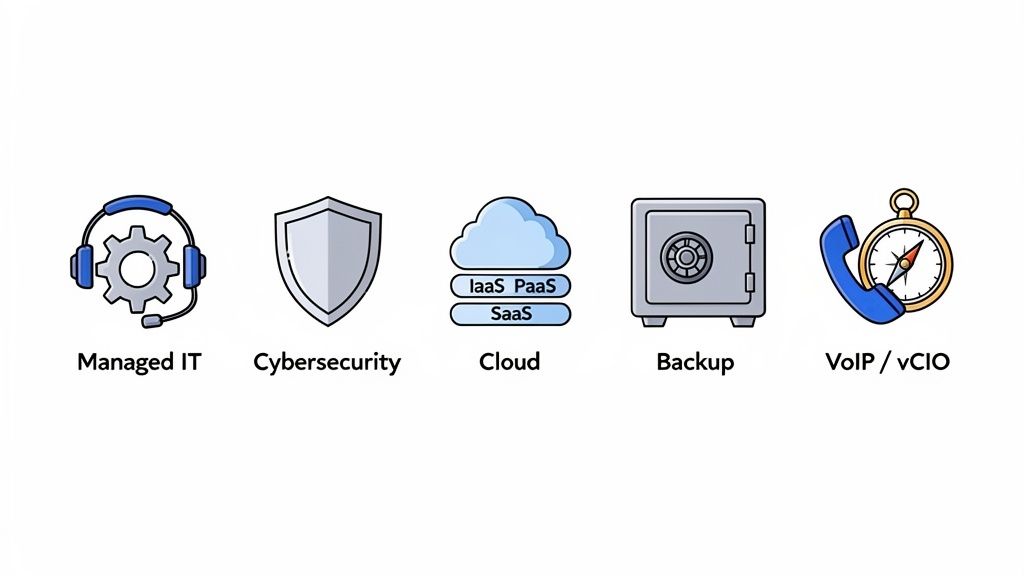
To build a solid technology foundation, you first need to know your options. The world of IT solutions CA can feel overwhelming, but it really boils down to finding the right tools and partners to keep your business running smoothly, securely, and efficiently.
Think of it like assembling a specialized toolkit for your company, where every tool has a very specific job.
Let’s unpack the essential services that form the bedrock of any modern IT strategy for a Canadian business. Understanding these will help you have more meaningful conversations with potential providers and make choices that truly align with your business goals.
Imagine having a full-time, expert IT department on standby, but without the significant overhead of hiring an in-house team. That is the heart of Managed IT Services. A Managed Services Provider (MSP) takes full ownership of your entire technology environment.
This is much more than just fixing things when they break. A true MSP partner provides proactive support, constantly monitoring your network for trouble, applying security patches, and ensuring your systems are tuned for peak performance.
A proactive managed services model is all about preventing problems, not just reacting to them. The goal is to maximize uptime and productivity by solving issues before they ever disrupt your business.
For instance, instead of you calling in a panic when a server crashes and brings your operations to a halt, an MSP would have already spotted the warning signs and resolved the root cause. If you want to go deeper, our article explaining what managed IT services truly entail is a great place to start.
In an age where cyber threats are more sophisticated and aggressive than ever, basic antivirus software just doesn't cut it anymore. Comprehensive cybersecurity services are a non-negotiable part of doing business today. This means building a multi-layered defence to protect every possible entry point into your network.
Effective cybersecurity is not just one thing; it is a combination of strategies:
Cloud solutions are all about shifting your digital operations from physical, on-site servers to a secure and scalable online environment. This move gives your business incredible flexibility and can significantly reduce your hardware expenditures.
There are three main models:
It is best to think of data backup and disaster recovery as your business's insurance policy. It is not a question of if you will face a major disruption—like a hardware failure, cyberattack, or even a fire—but when.
A solid plan ensures you can recover your critical data and have your business up and running again quickly. This service goes far beyond just making copies of files; it involves a detailed, tested strategy to restore your entire business operations with minimal downtime and data loss. It is about having the ability to rebuild your operations, sometimes overnight, after a crisis hits.
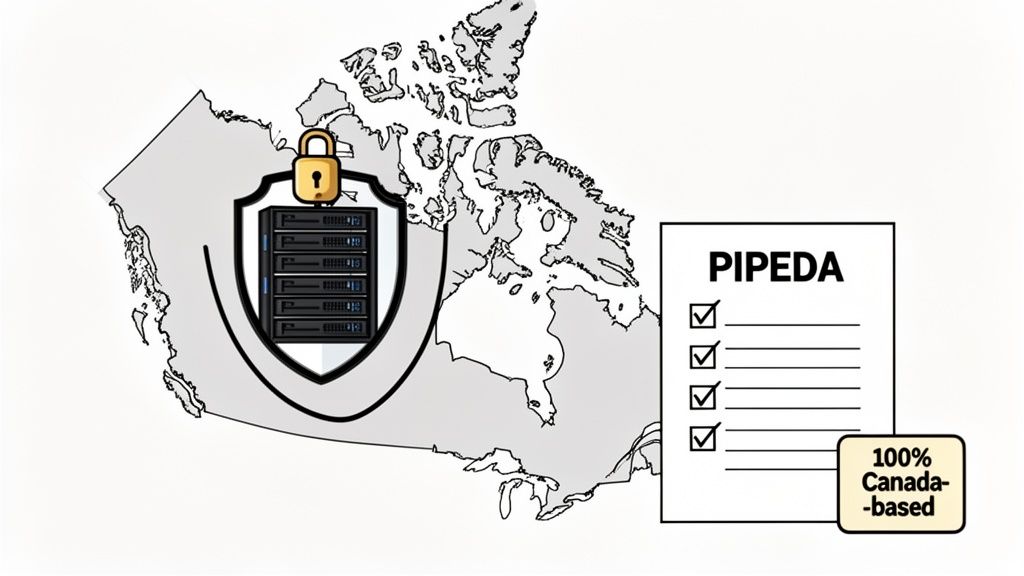
For any Canadian business, compliance is not just a box to tick—it is the bedrock of customer trust. Getting it wrong can lead to serious financial penalties and, more importantly, can permanently damage your reputation. The right it solutions ca providers understand this and build their services around these critical requirements from day one.
When vetting a potential IT partner, your questions cannot just be about technology. They need to dig deeper into trust, security, and legal accountability. Let’s look at two key concepts you absolutely need to grasp: PIPEDA and data sovereignty.
The Personal Information Protection and Electronic Documents Act (PIPEDA) is the federal privacy law that sets the rules for how private-sector businesses collect, use, and share personal information. Think of it as the official guide for handling customer, employee, and client data with respect and security.
Under PIPEDA, your business is directly responsible for several key areas:
That last point is where your IT provider becomes a crucial part of your compliance strategy. Their ability to secure your network, encrypt your data, and manage access is fundamental to meeting your legal duties. For a deeper dive, check out our guide on data security management best practices.
Data sovereignty is a simple but powerful principle: your data is subject to the laws of the country where it is physically stored. For Canadian businesses, this means one thing is absolutely critical: keeping Canadian data on Canadian soil.
When your business data is stored in data centres outside of Canada, it can fall under the jurisdiction of foreign laws and governments. This opens up significant legal and privacy risks, especially if you operate in sensitive industries like healthcare, finance, or law.
Choosing an IT provider with 100% Canada-based data centres is the simplest, most direct way to guarantee data sovereignty. It removes the legal grey areas of cross-border data storage and ensures your sensitive information stays protected by Canadian privacy laws.
This is not just a legal formality; it is a core part of managing risk. Knowing exactly where and how your data is stored, including specific data residency guidelines, is essential for staying compliant and gives you, your clients, and regulators peace of mind.
This focus on local data security is driving major investments. In 2024, Canadian non-profit organizations alone invested USD 11,362.7 million in technology, with hardware making up a 38.36% share. This spending is projected to reach USD 13,631.6 million by 2030 as software and other digital solutions become even more vital. You can find more details in the full research on non-profit technology spending. These numbers show a clear trend across all sectors toward building stronger, more secure, and compliant digital foundations right here at home.
Picking the right IT partner is one of the most important decisions you will make for your business. It is not just about hiring someone to fix a broken laptop. It is about finding a partner you can trust to protect your data, empower your team, and clear the path for your growth.
Let's be honest—every provider’s sales pitch sounds great. The trick is to look past the promises and figure out who can actually deliver. With the right questions and a clear idea of what to look for, you can find a team that becomes a genuine asset.
The first thing to understand is the difference between two very different ways of thinking about IT support. The old-school “break-fix” model is purely reactive. Your systems go down, you call for help, and you get a bill for the time it took to fix the issue.
This might seem cheaper at first, but it creates a massive conflict of interest. They only get paid when your technology fails—which is precisely when your business is losing money and productivity.
A proactive managed services model flips that on its head. You pay a predictable flat monthly fee, and in return, your provider’s entire job is to prevent problems before they happen. Their success is tied directly to your uptime, making your goals one and the same. That is where the real value lies. If you're weighing your options, our guide on evaluating top IT support companies can help you dig deeper.
Your Service Level Agreement, or SLA, is the most critical document in your contract. It is where your provider stops making promises and starts making written commitments. However, they can be dense, so you need to know what to look for.
Forget vague assurances. A good SLA has specific, measurable guarantees. Here is what matters:
A strong SLA is not just legal jargon; it is the foundation of a real partnership. It provides the clarity and accountability you need, turning a handshake deal into a documented commitment where everyone knows what to expect.
To find a provider that fits your budget without any unpleasant surprises, you need to understand how they bill for their services. Most Canadian IT providers use one of three common models, each with its own pros and cons.
Choosing a provider with a 100% Canada-based helpdesk is not just about national pride; it delivers real, tangible benefits that offshore support centres cannot match. When your team needs help, they are not dialing into a call centre on the other side of the world. They are talking to an expert who is in the same time zone and understands the nuances of the Canadian business climate.
For a Canadian business, the location of your IT helpdesk directly impacts everything from data privacy to daily operations. While offshore support might look tempting on a price tag, the hidden costs and risks can quickly outweigh the savings. Onshore, Canada-based support provides a level of security, compliance, and cultural alignment that is difficult to replicate.
Here is a direct comparison to help you understand the trade-offs:
| Evaluation Criteria | Onshore (Canada-Based) Provider | Offshore Provider |
|---|---|---|
| Data Sovereignty | Your data stays within Canadian borders, ensuring full compliance with PIPEDA. | Data may be stored or processed in jurisdictions with weaker privacy laws. |
| Compliance Expertise | Deep, firsthand knowledge of federal and provincial laws (like Quebec's Law 25). | General understanding at best; may be unaware of specific Canadian regulations. |
| Communication | No language barriers. The team understands local business culture and expressions. | Potential for language difficulties and cultural misunderstandings, causing frustration. |
| Time Zone Alignment | Support is available during your actual business hours, ensuring faster resolutions. | Significant time zone differences can lead to long delays for non-24/7 issues. |
| Accountability | You are dealing with a local company, making legal and contractual recourse simpler. | Navigating international legal disputes can be complex and expensive. |
Ultimately, the peace of mind that comes from knowing your IT partner understands and operates under the same legal and business framework as you is invaluable.
Local expertise is especially critical when it comes to compliance. A Canadian team has firsthand knowledge of privacy laws like PIPEDA, a massive advantage over offshore teams who may not fully grasp data sovereignty rules. As technology becomes even more central to business, these local factors matter more than ever. A recent report revealed that 69% of Canadian businesses plan to increase their software spending in 2025, with technology advancements being a key driver for 59% of them. You can read more about these Canadian tech trends on Capterra.ca.
A generic, one-size-fits-all IT strategy just does not work. The day-to-day challenges of a busy Toronto healthcare clinic are worlds apart from those of a Calgary manufacturing plant or an Oakville law firm. The best it solutions ca providers understand this. They build technology plans that fit the specific operations, compliance rules, and growth goals of your industry.
Choosing the right technology is about more than just improving efficiency; it is about giving your business a real competitive edge. To get the most from your tech investments, you should look into industry-specific IT solutions designed for your unique operational needs. This way, IT stops being just another expense and starts driving your business forward.
Let’s look at how specialized IT support solves real-world problems for some key Canadian industries.
For any healthcare provider, protecting patient data is priority number one. A data breach is not just about a fine; it can destroy patient trust and a clinic's reputation overnight. A specialized IT partner for healthcare focuses on building a secure, compliant digital environment from the ground up.
This means putting several key pieces in place:
In the world of manufacturing and logistics, efficiency is everything. The smallest hiccup in the supply chain can cause major delays and drive up costs. Technology is what ties everything together, making your operation more connected and responsive.
For manufacturers, the right IT solution acts as the central nervous system of the entire operation. It connects every part of the process, from the initial order to the final delivery, providing the real-time visibility needed to make smart, proactive decisions.
Strategic IT support for manufacturing focuses on:
Law and finance firms handle some of the most sensitive data there is—confidential client files, financial records, and case details that absolutely must be locked down. For these businesses, security is not just a good idea—it is a legal and ethical requirement.
IT solutions for these sectors zero in on a few key areas:
Choosing an IT provider is not just about buying technology. It is about finding a partner who is genuinely invested in seeing your business succeed. At CloudOrbis, we step away from the traditional client-vendor model to become an integrated part of your team, with a single mission: to help you grow. We blend our local Canadian expertise with a clear, methodical approach to deliver IT that simply works.
The cornerstone of our service is our 24/7, 100% Canada-based helpdesk. When you have an issue, you are not dialing into a random call centre overseas. You are speaking with an expert right here in Canada who understands the local business landscape, which means clearer communication and faster, more effective solutions. This commitment to accessible, local support is at the heart of everything we do.
A smooth, predictable transition to a new IT environment does not just happen by chance. We have learned that a structured plan is the key to minimizing disruptions and delivering real results. That is why we use a 10-step engagement process for every new partnership, ensuring total transparency from day one. It is a journey we take together, from initial discovery all the way to ongoing optimization.
Our structured approach means we:
This process eliminates guesswork. By following a clear, documented plan, we help you move away from a reactive, "firefighting" IT model and establish a modern, secure, and resilient foundation for your business.
As a Microsoft partner, we have deep, hands-on experience with the entire Microsoft ecosystem, helping businesses in Oakville, Toronto, and Calgary get the most out of essential tools like Microsoft 365. We are also helping them prepare for what is next with AI technologies like Copilot.
Our infographic below shows how we put this expertise into action, creating specific IT solutions for different industries.
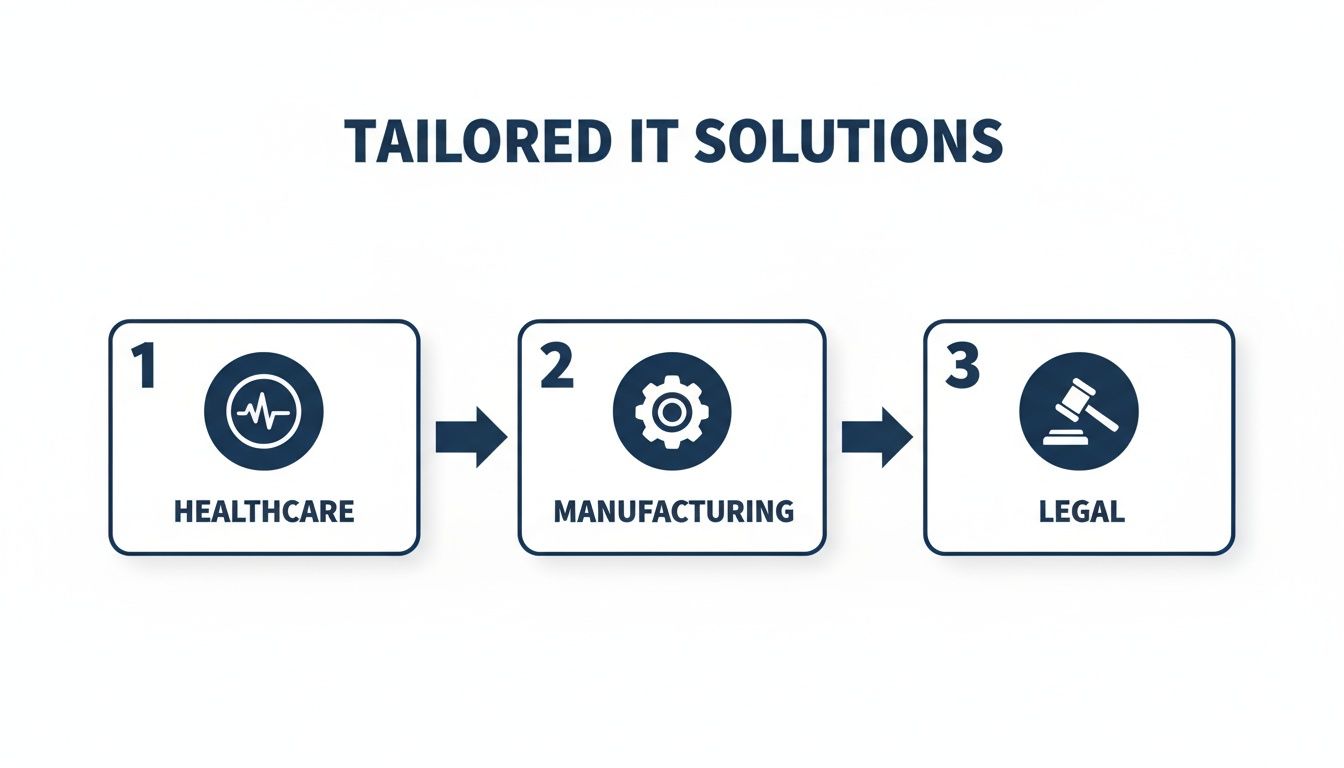
As you can see, our process for developing IT strategies for healthcare, manufacturing, and legal firms is tailored to their unique priorities. This highlights a core belief of ours: a successful IT partnership is built on understanding industry-specific challenges, not just applying generic fixes. Whether your top concern is protecting patient data, boosting supply chain efficiency, or ensuring case file confidentiality, our approach makes sure your technology actively supports your mission.
Microsoft’s commitment to Canada is clear, with a planned $19 billion CAD investment between 2023 and 2027 to expand AI and cloud infrastructure. This investment strengthens the digital backbone that Canadian businesses rely on, making it easier for companies to adopt secure, powerful, and locally-hosted solutions.
This expanding local infrastructure enables us to deliver even more reliable and sovereign cloud services. By specializing in Microsoft technologies, we help you fix today's headaches and build a robust platform for whatever comes next. Combining our proven process with market-leading technology gives you the stability and security you need to focus on what you do best—running your business.
If you are curious about how this approach looks in day-to-day operations, you can learn more about our commitment to proactive IT maintenance and support.
Stepping into the world of IT solutions can feel like navigating a maze. As a business leader in Canada, you have questions, and you need clear, straightforward answers to make the right decision. We have gathered some of the most common questions we hear and answered them just as we would if we were sitting across the table from you.
There is no one-size-fits-all answer, but a common starting point is a predictable monthly fee per user, which often falls between $100 and $250. This typically covers your essential day-to-day support, crucial security monitoring, and device management.
Of course, your final cost will depend on your company’s size, the complexity of your systems, and any specific compliance needs you may have, like PIPEDA. The best path forward is always a custom quote built on a deep understanding of your unique business. Think of it less as a cost and more as an investment—one that pays for itself by preventing expensive downtime and devastating data breaches.
The most critical factor is finding a provider with a proactive mindset and a 100% Canada-based team. Local support ensures a deep understanding of Canadian business culture and compliance laws like PIPEDA.
While technical skills and pricing are definitely part of the equation, the single most critical factor is finding a partner with a proactive mindset. A provider who focuses on preventing problems before they can disrupt your business is infinitely more valuable than one who is just good at cleaning up messes.
When you combine that proactive approach with a 100% Canada-based team, you have a winning formula. Local support is not just a nice-to-have; it guarantees they understand the nuances of Canadian business culture and the specific compliance laws that govern your industry. Your provider should not feel like a vendor—they should feel like a true extension of your own team, completely aligned with your goals for stability and growth.
No, it absolutely should not be. The thought of making a change can feel overwhelming, but a reputable and professional provider will manage the entire transition for you, making it completely seamless.
A quality partner takes on the full responsibility of the switch. They will have a structured onboarding process that looks something like this:
They handle all the behind-the-scenes technical coordination, keeping your data secure and your team supported from day one. Your job is to run your business, not to manage a complicated IT handover.
Ready to partner with a provider that puts your business first? At CloudOrbis Inc., we offer proactive, 24/7 Canada-based support to keep your business secure and growing. Find out how we can build your strategic IT roadmap today.
September 26, 2026
On-Premise to Cloud Migration Checklist: 10 StepsUse this on-premise to cloud migration checklist to plan assessment, compliance, backups, sequencing, testing, cutover, and optimization for SMBs.
Read Full Post
September 25, 2026
Is VoIP Good for Small Business in Canada? a 2026 GuideIs VoIP good for small business in Canada? Explore costs, benefits, reliability, security, and migration tips for SMBs considering VoIP in 2026.
Read Full Post
September 24, 2026
Helpdesk vs Service Desk: Choosing the Right IT SupportHelpdesk vs service desk: understand the key differences and choose the right IT support model for your organization in 2026.
Read Full Post
