HIPAA Compliance Data: What It Covers and How to Protect It
HIPAA compliance data explained: what PHI is covered, the safeguards required, and the IT practices that produce audit-ready evidence in 2026.

HIPAA compliance data explained: what PHI is covered, the safeguards required, and the IT practices that produce audit-ready evidence in 2026.

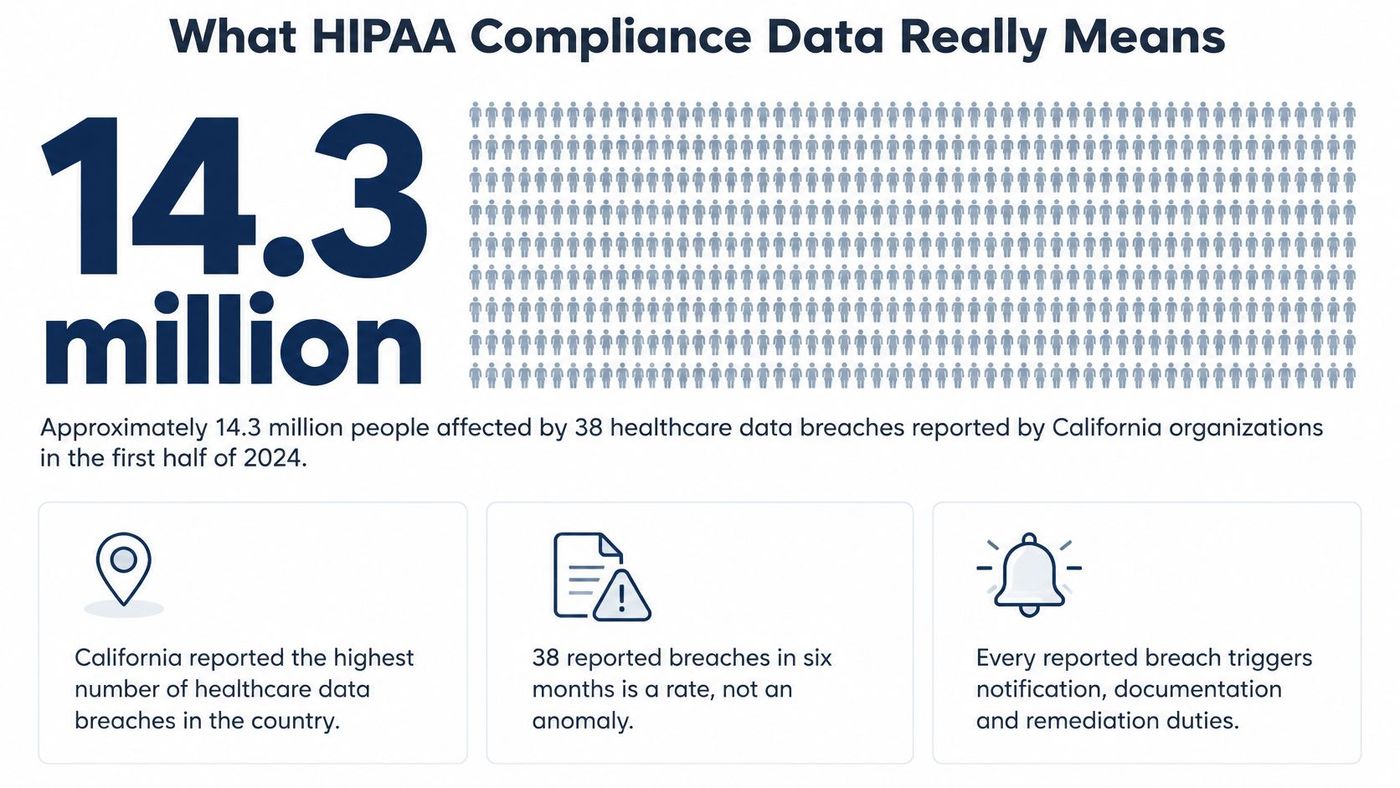
California organisations reported 38 healthcare data breaches affecting approximately 14,330,665 individuals in the first half of 2024, the highest state-level breach count and affected population for that period, according to the HIPAA Journal's breach report. For a clinic leader, that scale changes the question from whether you have a privacy policy to whether you can demonstrate that your safeguards work.
HIPAA, the Health Insurance Portability and Accountability Act, is a US federal law whose privacy requirements govern covered health plans, healthcare clearinghouses and healthcare providers conducting specified electronic transactions, along with their business associates. Its Privacy Rule controls uses and disclosures, its Security Rule protects electronic health information, and its Breach Notification Rule governs notification when unsecured information is breached.
The phrase HIPAA compliance data has two practical meanings. One is the patient information you must protect. The other is the evidence showing how you protected it.
Say a clinic emails a referral containing a patient's diagnosis. The referral is protected information; the approved recipient permissions, secure transmission settings and access logs are compliance evidence. A policy saying staff must send referrals securely doesn't establish that this particular referral was protected.
Good intentions aren't evidence. Keep records showing what happened, who acted and which safeguards were operating.
Evidence also needs protection. Security logs can contain patient identifiers, while incident tickets may include screenshots of clinical records. Collect enough detail to investigate and demonstrate accountability without creating uncontrolled copies of patient information.
For Canadian organisations, geography alone doesn't settle applicability. Handling information for a US covered entity can introduce HIPAA obligations alongside Canadian requirements. Merely treating a US citizen, however, doesn't automatically make a Canadian clinic a HIPAA covered entity.
The useful starting question is therefore specific: Which information do we hold, under which legal role, and what evidence demonstrates that we handle it properly?
Protected health information, or PHI, is individually identifiable health information held or transmitted by a covered entity or business associate, subject to applicable exclusions. As a screening rule, an identifier attached to health information should put the record inside your protection boundary until you've established otherwise.
Electronic PHI, or ePHI, is its electronic subset. It can appear in Microsoft 365 email, messaging threads, billing exports, portal logs and backup media, not just the electronic health record.
The identifier categories commonly associated with HIPAA de-identification include names; geographic subdivisions smaller than a state; individual-related dates; telephone numbers; fax numbers; email addresses; Social Security numbers; medical record numbers; health-plan beneficiary numbers; account numbers; certificate or licence numbers; vehicle identifiers; device identifiers; web addresses; internet protocol addresses; biometric identifiers; full-face photographs; and other unique identifying numbers, characteristics or codes.
These categories have detailed qualifications. Treat the list as an inventory aid, not a complete de-identification procedure.
Which data elements fall inside HIPAA
| Data element | Protected under HIPAA? | Why it counts or does not |
|---|---|---|
| Patient name with a diagnosis in the chart | Yes | Health information plus an identifier |
| Appointment date and time in the EHR | Yes | Dates tied to an identifiable patient are identifying information |
| Billing claim with name, date of service and procedure code | Yes | Identifiable payment information is covered |
| Social Security number on an intake form | Yes | Direct identifier within a healthcare record |
| Email to a patient about a lab result | Yes | The medium doesn't change its status |
| Encrypted ePHI with keys uncompromised | Yes, still PHI | Encryption can support breach safe harbour, but doesn't de-identify information |
| Dataset de-identified by expert determination | No | Outside PHI when the applicable determination establishes very small identification risk |
| Employee health file held in the HR role | No | Employment records held as an employer are excluded |
| Marketing list with names and emails and no health detail | No | No health information, assuming the list doesn't reveal a patient relationship |
| Full-face photograph in a patient record | Yes | Identifying photograph linked to healthcare |
| IP address in a portal log tied to a patient session | Yes | Identifying technical information linked to a patient |
| Backup tape of the billing system | Yes | Copying information doesn't change its protection obligations |
The Office of the Privacy Commissioner of Canada's de-identification guidance explains HIPAA's Expert Determination and Safe Harbour routes, while distinguishing PHIPA's reasonably foreseeable identification test. Removing names alone may leave dates, locations and demographic combinations that identify someone.
Document the method, the fields assessed and the release conditions. A coded patient number isn't automatically anonymous if someone can reconnect it to an individual.
The Security Rule organises safeguards into administrative, physical and technical families. The CalHHS privacy standards and security safeguards connect these protections to confidentiality, integrity and availability.
Addressable doesn't mean optional. Evaluate whether an addressable specification is reasonable and appropriate. Implement it when it is; otherwise, document the reasoning and implement an equivalent alternative where reasonable and appropriate.
An undocumented omission isn't a risk decision. Our guide to HIPAA compliance and encryption explains how encryption fits into that assessment.
Administrative foundations include a risk analysis, risk management plan, named security officer, workforce training, sanctions, contingency planning and business associate agreements. Schedule an annual programme evaluation as an operating baseline, with additional reviews after material changes rather than treating that schedule as a universal legal interval.
Physical safeguards address facilities, workstations and media. Technical safeguards address identity, emergency access, session controls, encryption, integrity and auditability.
Safeguard families and the evidence they leave behind
| Safeguard family | What the rule asks for | Example control | Evidence to keep |
|---|---|---|---|
| Administrative | Risk analysis, security responsibility, training, contingency planning, vendor contracts and evaluation | Annual risk assessment with ranked findings and assigned owners | Signed analysis, training completion records, BAA register, policy review sign-off |
| Physical | Facility access, workstation security, device and media handling | Locked server room, privacy screens, tagged assets, certified destruction | Access logs, inventory with location and warranty, disposal certificates |
| Technical | Unique user IDs, emergency access, automatic logoff, audit controls, integrity and transmission security | MFA, role-based access, encryption and centralised monitoring | Access reviews, configuration exports, retained log samples |
| Incident response | Identify, respond, document and meet applicable notification duties | Tested call tree and named decision-maker | Incident tickets, risk-assessment memos, notification records |
| Ongoing operations | Maintain effective safeguards as systems and risks change | Risk-based patching, quarterly access reviews, monthly phishing simulations | Patch reports, review minutes, simulation results by team |
The final rows describe operating practices, not additional formal safeguard families. Their schedules are recommended programme choices rather than universal HIPAA mandates.
At CloudOrbis, we typically receive administrative access to endpoint management, security tools and infrastructure monitoring. Business-critical applications, including ERP, CRM and line-of-business systems, remain with the client's team unless explicitly delegated; all access is documented, audited and reviewed quarterly.
Practical rule: Record both the control and the last evidence that someone verified it. A configuration screenshot without an owner or review date is difficult to defend.
A covered entity includes a health plan, healthcare clearinghouse or provider conducting covered electronic transactions. A business associate performs relevant services involving PHI on the covered entity's behalf.
A cloud host, billing service, EHR vendor or managed IT provider may be a business associate. Answering services and shredding companies can also qualify when their work involves PHI. The actual service and information access determine the role, not the vendor's marketing description.
A business associate agreement, or BAA, establishes permitted and required uses, safeguards, incident reporting, subcontractor obligations and return or destruction arrangements. It doesn't make the covered entity's own responsibilities disappear, and business associates can have direct obligations themselves.
Compare a hosted platform with its configured clinical workload. The platform provider may protect underlying infrastructure, while the clinic or its IT partner controls user permissions, retention settings, monitoring and recovery configuration. The exact division must be written down.
A signed BAA won't prevent an administrator from granting excessive access. Conversely, a well-configured system doesn't replace the agreement required for the relationship.
Use a vendor risk assessment to connect contractual promises with operational checks.
Check these provisions against the service you're using:
Treat unclear responsibilities as open risks. Assign someone to resolve them before an incident forces both parties to interpret the contract under pressure.
Build around information flows and operational risk, not a folder of templates. The HIPAA Journal's healthcare breach analysis reinforces the importance of treating ePHI as a high-impact operational asset protected through identity controls, monitoring and tested recovery.
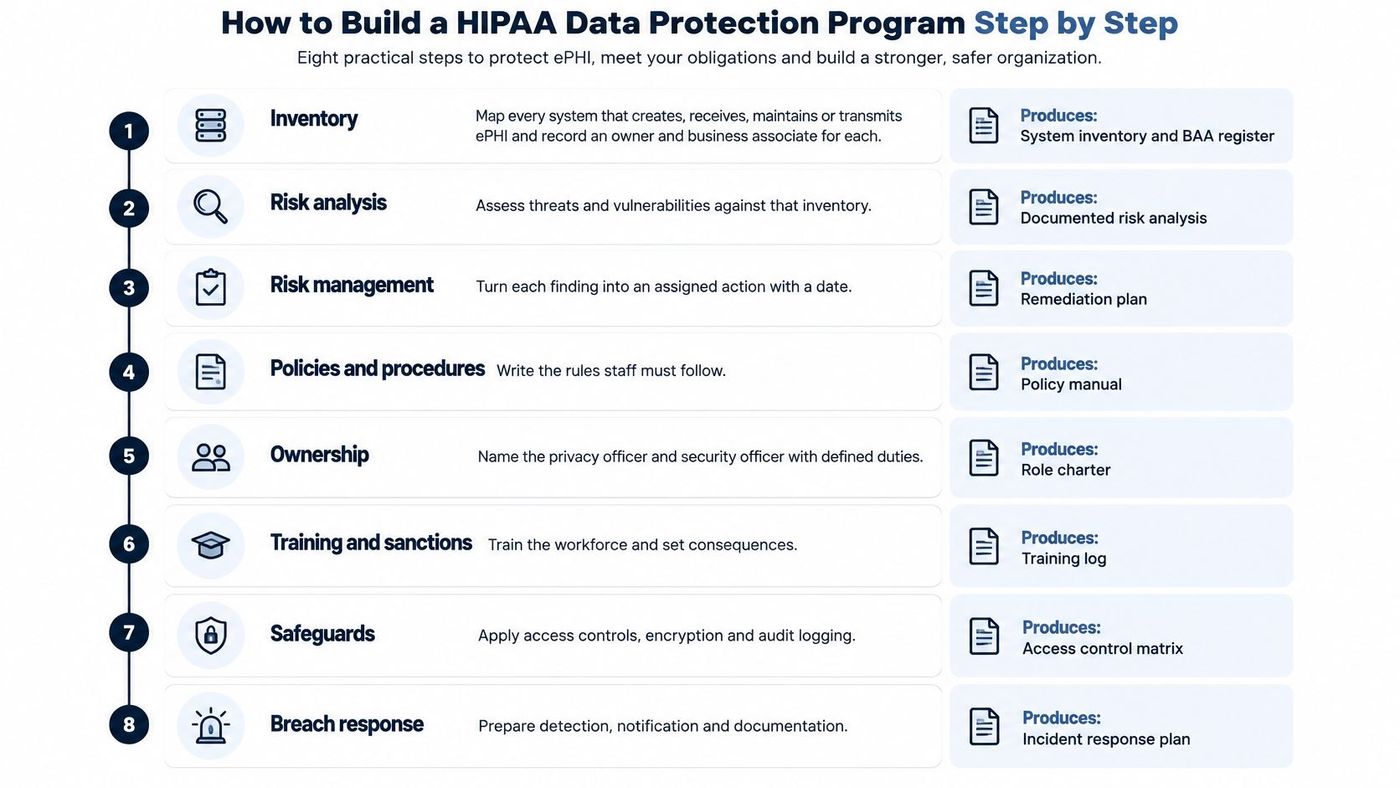
Use quarterly access reviews to catch accumulated permissions. During offboarding, revoke access promptly, preserve required files before wiping devices, and rotate shared credentials the departing employee could reach.
Package the outputs into a leadership-readable compliance report containing findings, owners, overdue actions, exceptions and evidence locations. A compliance risk management framework helps connect those records to decisions rather than leaving them scattered across tickets and spreadsheets.
Among Canadian businesses reporting cyber incidents, 13% identified ransomware as the attack method in 2023, up from 11% in 2021, according to Statistics Canada figures cited in the Canadian Centre for Cyber Security's ransomware outlook. A clinic needs a response script before staff lose access to clinical systems.
The first 72 hours are an operational planning window, not a universal notification deadline.
Preserve first, recover deliberately. Deleting a suspicious file doesn't establish what an attacker accessed.
Your cybersecurity operating practices should identify the response lead before an emergency. Have the designated privacy lead approve the breach-assessment memo with legal input where needed, and file it with the incident record under restricted access.
A badge, contract or completed checklist can look reassuring without demonstrating that patient information is protected. Test each claim against something your team can verify.
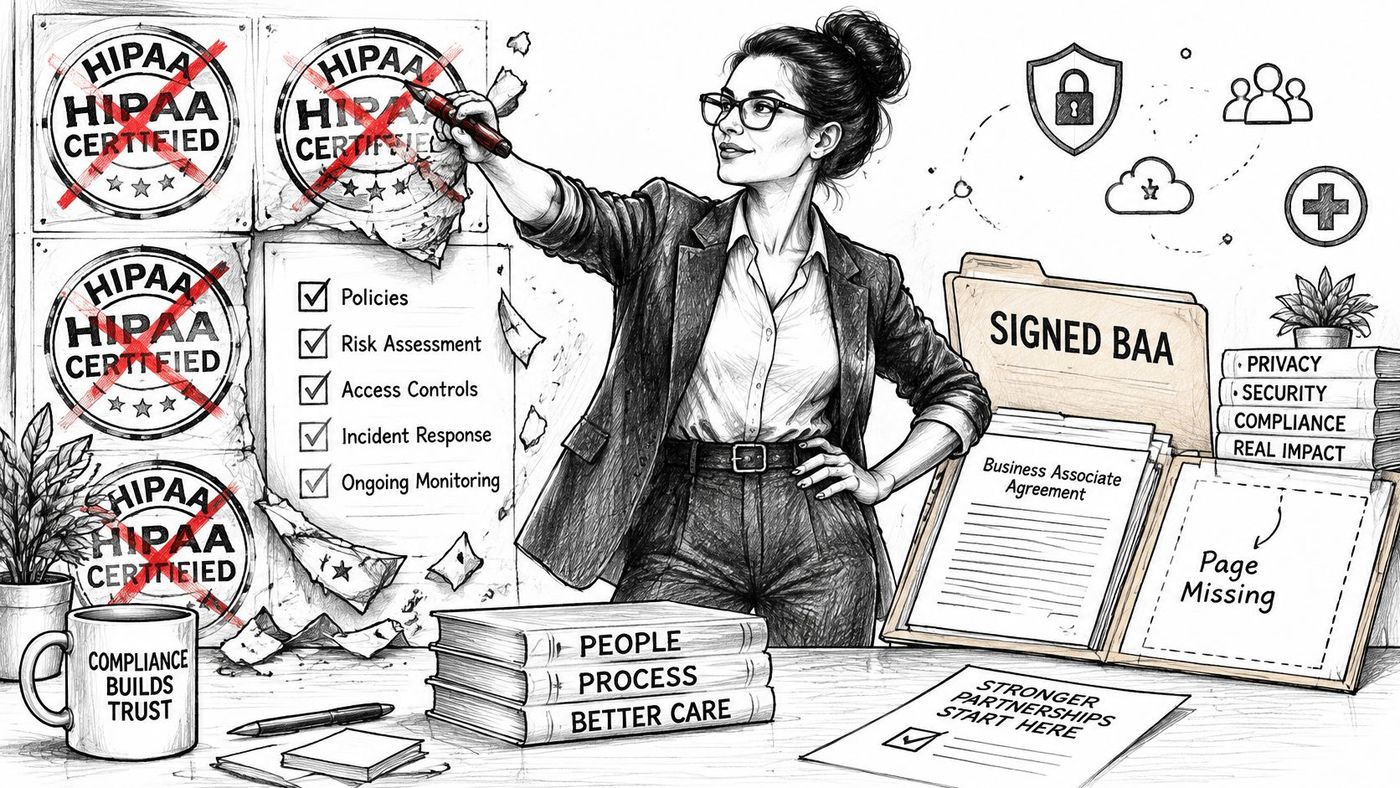
A useful assurance conversation involves showing a revoked account, tracing a reviewed alert or opening a completed recovery test. These checks reveal more than asking whether the organisation considers itself compliant.
Don't mistake a successful demonstration for permanent assurance, either. Staff change roles, vendors introduce integrations and administrators modify settings. Keep checking access, monitoring, recovery and evidence so leadership can distinguish a working safeguard from an old implementation record.
HIPAA doesn't replace Canadian privacy law. Canadian applicability starts with your province, activities and legal role, while US relationships can add HIPAA obligations. Holding a US patient's information alone isn't enough to establish that HIPAA applies.
The Office of the Privacy Commissioner's health-information overview describes the provincial patchwork, including Ontario's PHIPA, Alberta's Health Information Act and PIPEDA's relevance to commercial activities where substantially similar provincial legislation doesn't displace it.
Create a control matrix connecting consent, minimum-necessary access, vendor contracts, breach escalation, retention and evidence to each applicable regime. Where obligations differ, record the difference instead of labelling the whole system HIPAA compliant.
Under the OPC's PIPEDA breach guidance, organisations must report to the OPC and notify affected individuals when a breach creates a real risk of significant harm, considering sensitivity and probability of misuse, and must keep records of every safeguards breach.
How HIPAA, PHIPA and PIPEDA divide the same responsibilities
| Compliance topic | HIPAA (United States) | PHIPA (Ontario) | PIPEDA (Canada, private sector) |
|---|---|---|---|
| Who it governs | Covered entities and business associates handling PHI | Health information custodians and their agents | Private-sector organisations handling personal information in commercial activity, subject to jurisdictional rules |
| Regulator | HHS Office for Civil Rights | Information and Privacy Commissioner of Ontario | Office of the Privacy Commissioner of Canada |
| Breach notification trigger | Breach of unsecured PHI, subject to the applicable assessment | Theft, loss or unauthorised use or disclosure of personal health information | Safeguards breach creating a real risk of significant harm |
| Who gets notified | Affected individuals, HHS and media when applicable | Affected individuals; IPC reporting when prescribed circumstances apply | OPC and affected individuals |
| Record keeping | Breach documentation and risk assessment | Breach records and applicable reporting documentation | Every safeguards breach, including below-threshold events |
| Access standard | Minimum necessary, subject to exceptions | Collection, use and disclosure limited to what is reasonably necessary | Appropriate purposes and limits on collection, use and disclosure |
| Consequences | Civil monetary penalties and possible criminal charges | Provincial offences and IPC orders | Fines for knowing violations of breach-reporting and record-keeping duties |
The table is a screening tool, not a substitute for determining your specific duties. In particular, PHIPA doesn't require an identical IPC notification process for every incident.
A Canadian data privacy law review should connect those differences to your workflows. Encryption, MFA, logging, training and tested backups remain useful across jurisdictions, but their implementation doesn't settle consent, reporting or retention questions.
Choose a manageable first slice of the programme this quarter:
Don't substitute a successful backup job for the restoration test. The test establishes whether staff can resume care.
Our CloudOrbis process begins with Discovery, an audit of infrastructure, security posture, governance gaps and compliance risk. We work with regulated healthcare organisations and deploy security and compliance together rather than as bolt-ons.
For insurance preparation, we bring together formal policies, endpoint protection, password governance, documented training, patch reporting, backup validation, disaster-recovery testing and monthly compliance reporting. Leadership reporting covers training completion, phishing simulation results, patch compliance status and the overall risk posture.
CloudOrbis Inc. helps healthcare organisations connect patient-data protection with documented controls, tested recovery and readable compliance reporting. Visit CloudOrbis Inc. to book a Discovery conversation and identify the first changes your clinic should implement and evidence.
Book a 30-minute call with a senior engineer. No sales script, just straight answers about your environment.


