

September 22, 2026
Security Audit Services Guide for SMBs in CanadaDiscover why security audit services are vital for Canadian SMBs. Explore typical scope, deliverables, timelines, and tips to choose the right provider.
Read Full Post%20(1).webp)
Usman Malik
Chief Executive Officer
May 10, 2026

A Calgary company usually reaches this decision after something breaks, or after growth exposes the limits of the current setup. A server room becomes a business risk. Cloud costs rise faster than expected. A customer, auditor, or insurer asks where data sits and how quickly systems can recover. At that point, choosing a data centre is no longer an infrastructure purchase. It is a business continuity and risk decision.
That is the correct way to approach data centers in Calgary. The essential question is not which building has the most space. It is which provider fits your operating model, your compliance requirements, and your growth plan over the next three to five years. For some firms, that means keeping sensitive workloads in Canada while using Microsoft 365 and public cloud for everything else. For others, it means colocation for core systems, a second site for recovery, and enough carrier choice to avoid a single point of failure.
Calgary gives SMBs meaningful options across downtown connectivity-focused sites and larger facilities built for longer-term capacity. That matters for healthcare, legal, finance, manufacturing, and energy firms that need practical answers on data residency, backup, security controls, and recovery objectives without defaulting to another province.
A broad ARPHost, LLC guide to infrastructure can help frame the bigger colocation environment, but the local decision still needs a Calgary lens. The facilities in this guide are not included just because they exist. They matter because each one solves a different business problem, from low-latency interconnection to compliance-driven colocation to room for future expansion.
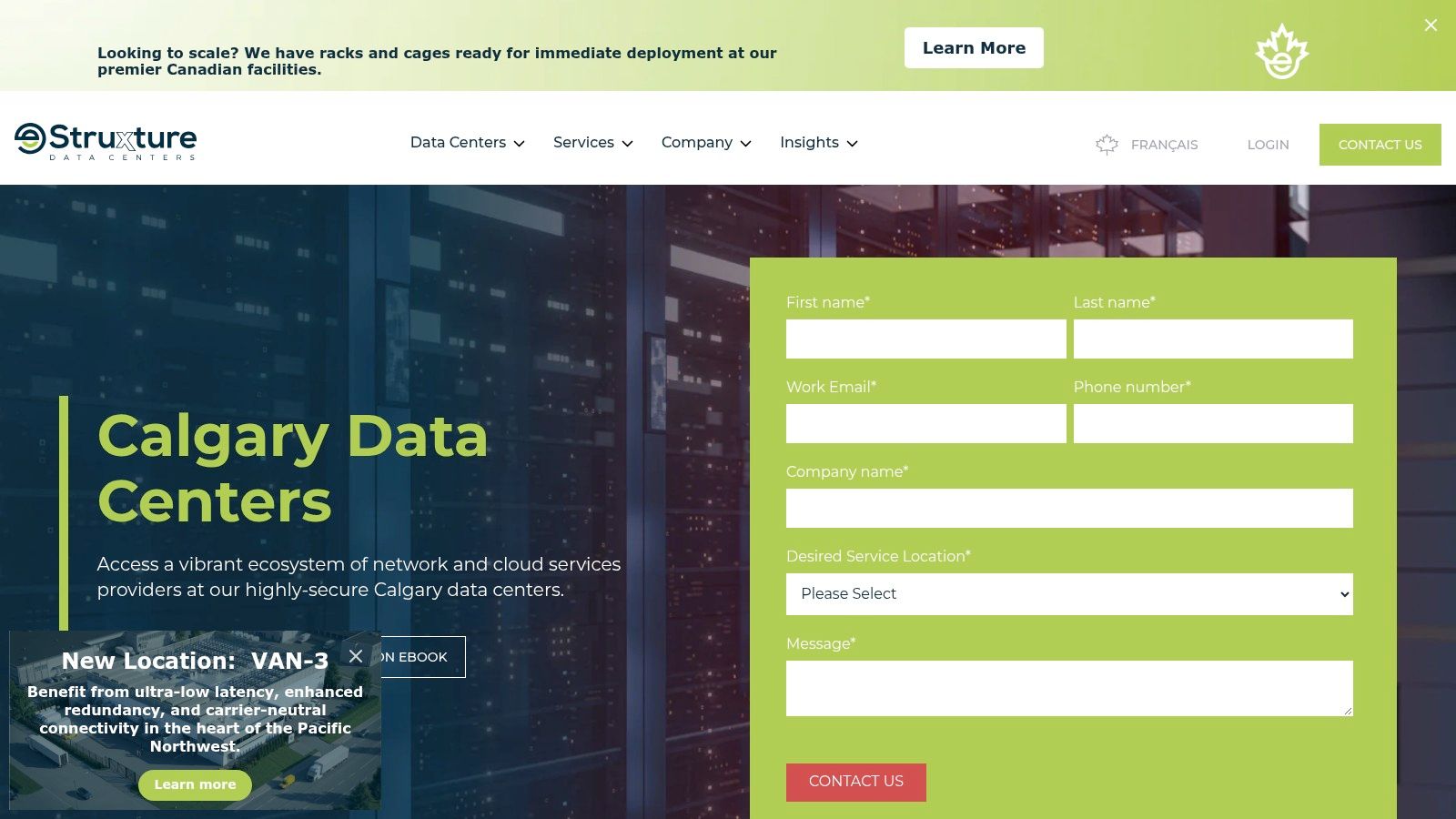
A common Calgary SMB scenario looks like this. Core systems still run on dedicated infrastructure, Microsoft 365 handles collaboration, cyber insurance now asks tougher recovery questions, and leadership wants to avoid another migration in 24 months. In that situation, eStruxture Calgary data centres deserves a close look because it aligns with a longer planning horizon, not just an immediate rack requirement.
The main business case is straightforward. eStruxture gives companies a local colocation option with enough market commitment to support growth, tighter recovery planning, and more formal governance around infrastructure decisions. That matters if the board, auditor, or client is asking where workloads sit, how failover works, and whether the provider can still meet demand as the business adds storage, security tooling, or higher-density compute.
The local expansion story strengthens that position. As noted earlier, eStruxture has announced a major Rocky View County project tied to the Calgary market, with CAL-3 expected in the next phase of buildout. Even if a smaller firm does not need that scale on day one, future capacity can reduce a real procurement risk. Outgrowing a provider is expensive, operationally distracting, and often poorly timed.
eStruxture makes the most sense for businesses choosing a primary colocation partner, not just shopping for the lowest monthly cabinet rate.
Good fits include:
There is also a practical leadership benefit here. Choosing a provider with visible local investment can make executive approval easier. The conversation shifts from "Where can we rent space?" to "Which partner supports our operating model for the next three to five years?"
The trade-off is usually commercial, not technical. Larger operators often run on quote-based pricing, custom terms, and longer sales cycles. That can be reasonable for a serious deployment, but it is less convenient for a smaller company that wants fast budget numbers or a simple month-to-month comparison across providers.
eStruxture can also be more than some SMBs need. If the requirement is one cabinet, limited cross-connects, and a straightforward backup target, a smaller local provider may be easier to buy from and easier to manage.
My advice is simple. Put eStruxture on the shortlist when continuity, compliance, and growth are driving the decision. If the project is purely price-led, validate whether you are paying for future capacity you will not use.
For healthcare practices, legal firms, financial services teams, and energy businesses that want a Calgary colocation anchor with fewer future constraints, eStruxture is one of the stronger strategic options in this market.
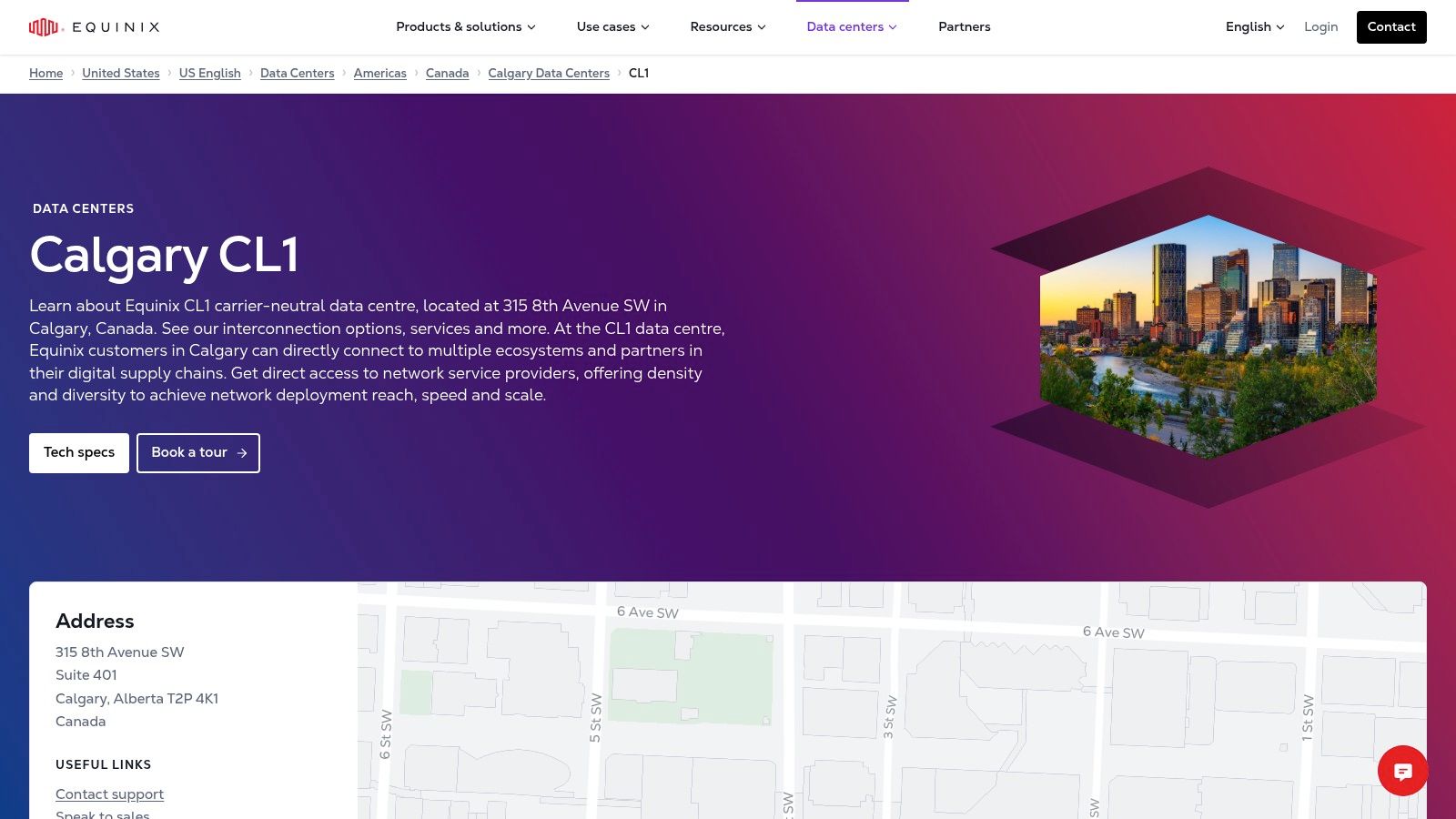
A common Calgary scenario looks like this. Core business systems still run best on dedicated infrastructure, but leadership wants better disaster recovery, lower cloud latency, and a cleaner path into Azure, AWS, or Google Cloud. In that case, Equinix Calgary CL1 and local IBX footprint usually belongs on the shortlist.
Equinix stands out less for raw floor space and more for what a business can do once equipment is in place. The Calgary footprint spans CL1, CL2, and CL3, which gives SMBs more options for separating workloads, building failover plans, and connecting to outside providers without shifting everything out of the city. For an owner or IT leader, that matters because the data centre decision affects application design, vendor choice, recovery planning, and future cloud costs.
Equinix is a strong fit for companies that are past basic server hosting and are starting to treat infrastructure as part of business strategy.
Typical examples include:
This is often where Calgary SMBs make a better long-term decision. A lower-cost colo option may look attractive at the cabinet level, but the value changes if the business later needs private cloud on-ramps, more cross-connects, or a second local site.
Equinix can be expensive for simple deployments.
The base colocation quote is only part of the actual cost. Cross-connect fees, carrier relationships, cloud connectivity, and support structure can materially change the monthly spend. I usually advise clients to model the environment they expect in 12 to 24 months, not the one they need on day one. That is where premium providers can either justify their cost or lose the business.
There is also a buying complexity trade-off. If your team wants one or two cabinets for backup infrastructure and little else, Equinix may be more ecosystem than you need. A smaller provider can be easier to buy from, easier to budget, and easier to operate for that kind of requirement.
Choose Equinix when the business case depends on connectivity, hybrid architecture, or a clearer continuity plan across multiple sites. Pass on it, or at least challenge the quote hard, if the requirement is straightforward colocation with limited interconnection needs.
The key question is not whether Equinix is a good facility option. It usually is. The primary question is whether your business will use the connectivity and design flexibility you are paying for. For firms with cloud adoption plans, stricter recovery targets, or complex partner dependencies, the answer is often yes.
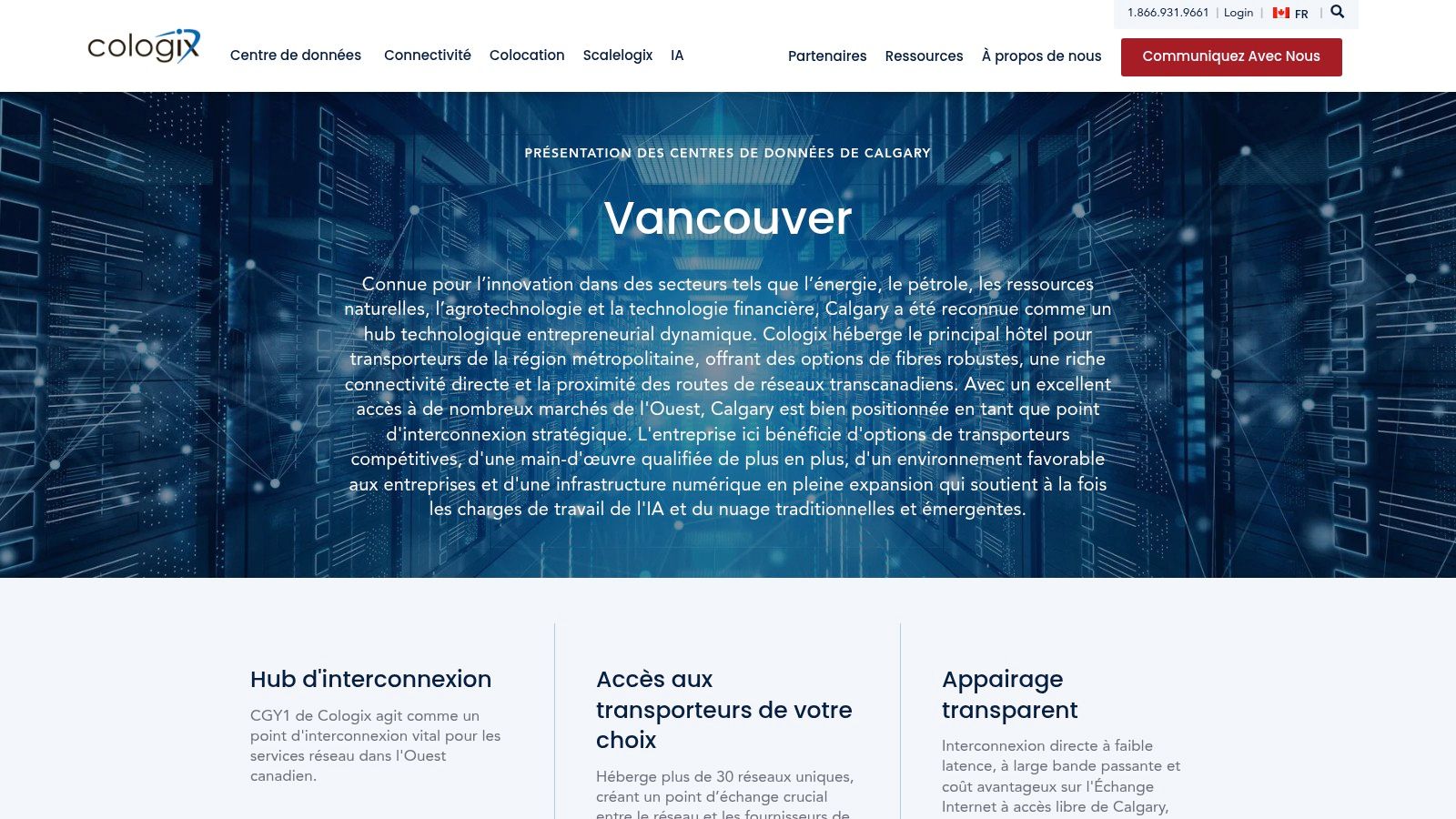
A common Calgary scenario looks like this. The business does not need a large footprint, but it does need dependable carrier access, low-latency local connectivity, and a site that supports revenue-generating applications without forcing everything through a single provider. In that case, Cologix Calgary deserves a serious look.
CGY1 stands out less for campus scale and more for interconnection value. That distinction matters. If the priority is voice platforms, private network handoffs, regional service delivery, trading-related traffic, or branch connectivity, a downtown carrier hotel can align better with business goals than a newer facility built mainly around cabinet space and power.
The practical question is simple. Are you buying space, or are you buying connectivity options that reduce dependence on one network path and give the business more flexibility as it grows?
For the right workload, CGY1 can be a strong fit because it supports strategies such as:
There is a trade-off. CGY1 can work very well as a primary interconnection site, but many SMBs should hesitate before treating one downtown facility as the entire resilience plan.
A single building can create concentration risk. Power and cooling may be well managed, yet business continuity also depends on building access, fibre path diversity, staffing response, and how quickly the company can recover if a local disruption affects that address. That is why I often advise clients to evaluate CGY1 as one part of a broader design, not the whole design.
For Calgary SMBs, the best use of Cologix is often strategic. Put connectivity-heavy production services or network edge functions there, then pair it with a second site in another part of the metro for backup, replication, or recovery. That approach usually does a better job of balancing cost, uptime, and future growth than forcing one facility to solve every requirement.
A common Calgary scenario goes like this. The business has outgrown server room risk, cloud costs are becoming harder to predict, and leadership wants a Canadian hosting option that can support audit requirements without forcing a full enterprise buying model.
In that situation, Qu Data Centres locations is worth a close look, especially for buyers who still know the portfolio under Rogers. The name change matters less than the operating model behind it. For an SMB, the central question is whether Qu can give you a stable colocation base, credible support, and enough site choice to build recovery plans without leaving the Calgary area.
That is the practical appeal here. Qu can fit companies that want more structure than a small local facility may offer, but do not need the procurement complexity or ecosystem focus that often comes with larger interconnection-first providers.
Qu is often a sensible option for firms making a deliberate shift from office-based infrastructure to a governed colocation model. I would put it on the shortlist when the business cares about policy, documentation, and operational consistency as much as raw cabinet pricing.
Strong fit scenarios include:
Qu is not a default choice just because the portfolio has a familiar history. A rebrand should prompt careful verification, not automatic confidence.
Before signing, review current SLAs, escalation paths, remote hands responsiveness, contract flexibility, and any changes in service process since the transition from Rogers branding. That is standard diligence. It matters even more if you are placing backup infrastructure, regulated workloads, or systems that will become part of your recovery plan.
Decision lens: Judge Qu on present-day operations, support quality, and contract terms. Branding history can provide context, but it should not carry the decision.
For Calgary SMBs, Qu is usually strongest as a practical Canadian colocation option for businesses that want compliance-friendly hosting and room to build a more disciplined DR strategy over time.
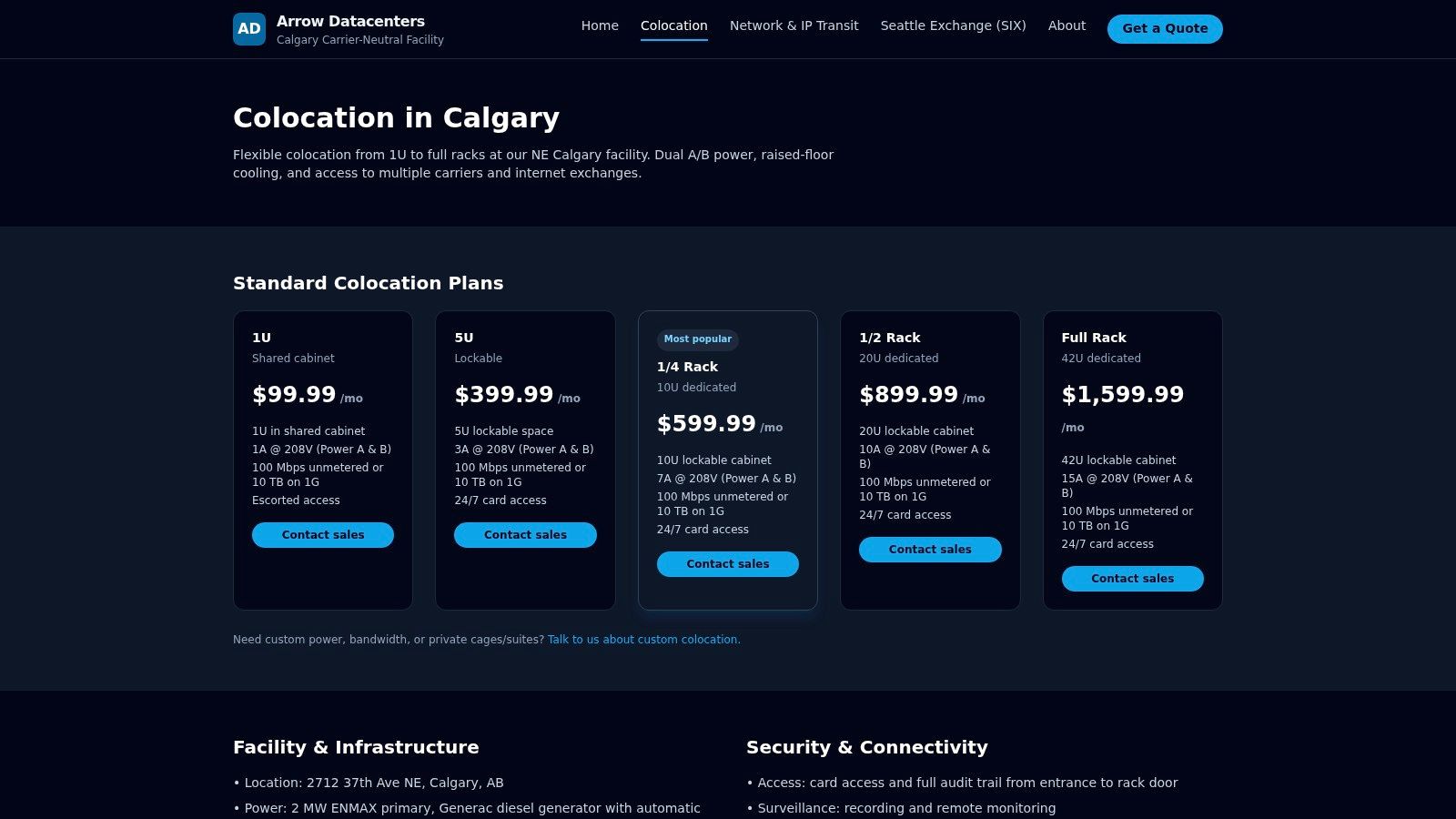
Arrow Datacenters colocation in Calgary solves a problem that larger operators often don't. It gives smaller businesses a more approachable entry point into colocation.
For many SMBs, the obstacle isn't whether colocation is useful. It's whether the buying process is simple enough to move forward. Arrow stands out because it is local, carrier-neutral, and oriented toward straightforward deployments rather than long enterprise sales cycles.
If you need a few U of space, a single rack, or a practical local environment for backup appliances, network gear, or a small production footprint, Arrow is easier to evaluate than many quote-only competitors. That's valuable for companies that don't have a full-time infrastructure procurement team.
Arrow is also a sensible option when your requirements are clear and modest:
The same reason Arrow is attractive can also define its limit. A smaller local facility won't offer the same metro diversity or long-range expansion path as a larger multi-site platform. That doesn't make it weaker. It means you should design around the constraint.
If Arrow becomes your primary site, pair it with another location for backup and disaster recovery. That combination often gives SMBs a better risk-cost balance than jumping straight into an oversized enterprise contract.
Arrow is one of the more practical answers in data centers in Calgary for organizations that value clarity, local support, and a right-sized deployment over brand prestige.

A common Calgary scenario looks like this. A business has a modest server footprint, a downtown office, a few branch connections, and a real need for dependable local infrastructure without paying for capacity it will not use. In that case, AI Dynamics and DataHive services deserves a serious look.
DataHive stands out because it fits a specific business need, not because it tries to compete with larger multi-site operators on scale. A downtown facility with carrier choice and practical colocation options can make sense for firms that care more about continuity, latency to local offices, and predictable monthly cost than about future AI workloads or large private suites.
That makes it a strong candidate for selective production systems, backup environments, security appliances, and voice or network infrastructure that benefits from a central Calgary location. For SMBs building an IT roadmap, this matters. The right data centre is not always the biggest one. It is the one that matches the workload, the support model, and the growth plan.
DataHive is usually a better fit for businesses that know what they need and want to keep the deployment focused. Smaller footprints are often the advantage here, especially if you are placing infrastructure that supports the business but does not justify a larger enterprise contract.
Typical use cases include:
Independent providers can be a good operational fit, but they also require more direct diligence. Public technical detail is often lighter than what you get from national platforms, so the evaluation process needs to be more hands-on.
Ask direct questions about power redundancy, remote hands availability, after-hours access, carrier onboarding, security procedures, and how much room you will have if the environment grows faster than expected. Also test the business fit. If your three-year plan includes major expansion, higher-density deployments, or multi-site failover across provinces, a smaller downtown site may work best as part of your strategy rather than the whole strategy.
That is where DataHive can be most useful. It gives Calgary SMBs a local, business-friendly option for the workloads that need proximity, control, and reasonable cost, while leaving room to place heavier growth or DR requirements with a second provider later.
Hosted In Canada Calgary data center is the most practical option on this list for businesses that want colocation and hosting under one roof. That combination won't appeal to every IT team, but it can simplify life for SMBs that don't want separate vendors for racks, web hosting, VPS, and local infrastructure support.
The appeal here is flexibility at the small end of the market. Shared U-space, half racks, full racks, and private suites create a path for businesses that are still deciding how much infrastructure should remain on dedicated hardware. If your environment includes legacy line-of-business apps, website hosting, and a few security or backup appliances, a blended provider can reduce handoffs.
Hosted In Canada works best when simplicity is the main requirement. It suits organizations that want Canadian data residency, a local footprint, and a straightforward way to host smaller workloads without negotiating with several providers.
That usually means:
This is the kind of provider where confirming technical detail upfront matters. Verify what services are directly delivered versus partner-backed, how support is handled after hours, and what the escalation path looks like if an infrastructure issue crosses service lines.
For some businesses, that blended model is exactly what makes Hosted In Canada useful. For others, it may create too much provider concentration. The right answer depends on your internal IT maturity and whether simplicity is worth giving one vendor a larger role.
| Provider | Implementation complexity | Resource requirements | Expected outcomes | Ideal use cases | Key advantages |
|---|---|---|---|---|---|
| eStruxture Calgary (CAL‑1, CAL‑2, CAL‑3 announced) | Medium–High (multi‑site deployment, compliance integration) | High (30+kW cabinets, private suites; quote‑based costs; plan for CAL‑3) | Regulatory compliance, resilient metro DR, future capacity | Regulated workloads, high‑density compute, multi‑site DR in Canada | Canada‑owned, strong compliance, expanding Calgary footprint, direct carrier/cloud on‑ramps |
| Equinix Calgary (CL1, CL2, CL3) | High (complex interconnection and cross‑connect setup) | Medium–High (premium pricing; cross‑connect fees; global support) | Extensive peering and hybrid/multi‑cloud enablement, geographic diversity | Enterprises needing deep interconnection, hybrid cloud and multi‑site DR | Market‑leading interconnection fabric, global support and certifications |
| Cologix Calgary CGY1 | Medium (carrier‑hotel deployments, low‑latency configs) | Moderate (YYCIX access, 30+ on‑site carriers; quote‑based) | Low‑latency connectivity and neutral peering hub | ISPs, VoIP, fintech, healthcare and latency‑sensitive, peering‑heavy workloads | Downtown location with strong peering and dense carrier ecosystem |
| Qu Data Centres (formerly Rogers portfolio) | Medium (enterprise features; newer brand to validate) | High (campus capacities ~1.8–9 MW; AI/HPC‑ready; quote‑based) | Enterprise‑grade compliance, geo‑diverse DR, AI/HPC readiness | Regulated SMBs, mid‑market enterprises, AI/HPC and in‑Canada hosting needs | Canadian ownership, broad certifications, enterprise support model |
| Arrow Datacenters (NE Calgary) | Low (transparent retail plans, simple onboarding) | Moderate (published retail pricing, standard colo features, YYCIX) | Fast provisioning and cost‑predictable colo with local peering | SMBs seeking published pricing, quick deployment and local connectivity | Clear pricing, rapid provisioning, free YYCIX cross‑connect and carrier diversity |
| DataHive (AI Dynamics) Downtown Calgary | Low–Medium (shared U to private suites; escorted access) | Low–Moderate (smaller capacity suitable for small footprints) | Affordable downtown presence with local carrier/peering access | SMBs needing cost‑effective downtown colocation and YYCIX reach | Central downtown location, cost‑effective entry points, YYCIX/community ties |
| Hosted In Canada – Calgary Data Center | Low (single‑vendor hosting + colo, simple setup) | Low–Moderate (shared U to suites, redundant power; claimed SLAs) | Simplified vendor experience: hosting plus local colocation | SMBs wanting combined web/VPS hosting and local colocation | Single‑vendor simplicity, flexible small‑footprint options and escorted access |
A Calgary business choosing a data centre usually is not buying rack space. It is deciding how much downtime the company can afford, where regulated data will live, how quickly systems need to recover, and what kind of growth the next three to five years may demand.
The strongest option is the one that fits that operating model. eStruxture suits firms planning for larger scale, redundancy across multiple facilities, or future expansion. Equinix fits organizations that expect heavy interconnection, hybrid cloud adjacency, or multi-site network design. Cologix is a serious contender when downtown connectivity and carrier access carry the most weight.
For many SMBs, the practical choice sits lower on the brand ladder and higher on day-to-day fit. Qu can make sense for companies that want Canadian-hosted colocation with enterprise controls. Arrow is attractive when published pricing, faster provisioning, and predictable costs matter more than a premium ecosystem. DataHive fits smaller downtown footprints. Hosted In Canada works for teams that would rather keep hosting and colocation with one provider and reduce vendor sprawl.
That decision only pays off if it connects to the rest of the IT plan. A facility should support your backup design, cybersecurity controls, Microsoft 365 posture, VoIP continuity, compliance requirements, and incident response process. Colocation does not fix weak architecture. It gives a well-designed environment a better home.
Calgary gives SMBs real choice, which changes the strategy. As noted earlier, the local market has enough depth that many companies can keep infrastructure in province without giving up on resilience, compliance, or room to grow. That matters for firms trying to control latency, data residency, support responsiveness, and travel time for hands-on work.
A good shortlist starts with business questions, not provider tours. What systems must recover first? What data must remain in Canada? Which workloads belong in Microsoft 365 or public cloud, and which still need dedicated hardware? How much remote-hands support will your team rely on? Answer those first, then compare providers against those requirements. That is how Calgary SMBs avoid paying for capacity they will not use, or choosing a low-cost site that creates security, recovery, or scaling problems later.
If you're weighing colocation, hybrid cloud, backup, or disaster recovery in Calgary, CloudOrbis Inc. can help you turn that facility decision into a complete IT strategy. CloudOrbis works with Canadian SMBs in healthcare, legal, finance, manufacturing, logistics, construction, and oil and gas to align infrastructure, cybersecurity, Microsoft 365, VoIP, and compliance into one practical operating model. If you want a second opinion before signing with a provider, CloudOrbis can help you assess fit, reduce risk, and build an environment that supports growth instead of slowing it down.
September 22, 2026
Security Audit Services Guide for SMBs in CanadaDiscover why security audit services are vital for Canadian SMBs. Explore typical scope, deliverables, timelines, and tips to choose the right provider.
Read Full Post
September 21, 2026
Secure File Sharing Guide for Canadian BusinessesLearn secure file sharing essentials for Canadian SMBs — encryption, compliance, protocols and best practices to protect data and stay compliant.
Read Full Post
September 20, 2026
Disaster Recovery Plan Business Continuity for SMBsBuild a disaster recovery plan business continuity strategy tailored for Canadian SMBs. Covers risk assessment, RTO/RPO, backup, testing, and ownership.
Read Full Post
