Cybersecurity Testing Services Explained for Canadian SMBs
A practical guide to cybersecurity testing services for Canadian SMBs, vulnerability scans, pen tests, red teaming, deliverables, pricing models, and how

A practical guide to cybersecurity testing services for Canadian SMBs, vulnerability scans, pen tests, red teaming, deliverables, pricing models, and how

Canadian organizations spent about $1.2 billion recovering from cyber incidents in 2023, double the approximately $600 million spent in 2021, while fewer businesses spent money on prevention and detection. The right cybersecurity testing service turns that financial warning into a practical decision about which weaknesses to find, which attack paths to validate, and whether your business can keep operating after an incident.
For a mid-sized Canadian business, testing shouldn't be a technical checkbox or a once-a-year report that sits in a shared drive. A vulnerability scan may show that an exposed system needs attention, while a penetration test can demonstrate whether an attacker could use that weakness to reach production, clinical, financial, or client information. Other tests answer different questions, such as whether a compromised Microsoft 365 account can bypass MFA or whether backups can restore essential operations within an acceptable recovery-time objective.
This guide maps each service to the business question it answers, the evidence a provider should deliver, and the way testing can become part of an ongoing managed-IT relationship.
Statistics Canada reported that Canadian organizations spent about $1.2 billion recovering from cyber security incidents in 2023, twice the approximately $600 million spent in 2021, while the share of businesses spending money to prevent or detect incidents fell from 61% to 56%. Statistics Canada's business cybersecurity data makes the decision clear: recovery can become more expensive even when fewer businesses report an incident.
That changes how leaders should view cybersecurity testing services. The question isn't just, “Do we have antivirus, MFA, backups, and a firewall?” It's, “Can we prove those controls protect the systems and processes that keep the business running?” A business can deploy a security product correctly and still leave an exposed application, excessive account permissions, an untested supplier connection, or an unvalidated backup process.
Testing provides that evidence. Vulnerability scanning looks broadly for known weaknesses. Penetration testing checks whether selected weaknesses can be exploited in a controlled engagement. Application testing examines software behaviour and access controls, while red and blue team exercises evaluate how attackers and defenders perform across a wider scenario.
The practical value lies in matching the service to the risk. A manufacturer may need to know whether an internet-facing gateway can provide a path into production systems. A clinic may need to determine whether a stolen cloud identity can reach patient information. A professional-services firm may need proof that a backup can restore shared files and line-of-business applications.
The business case: Testing costs time and attention, but untested assumptions can turn a manageable weakness into an operational recovery problem.
A complete security program also includes data handling throughout the technology lifecycle. For example, organisations reviewing retired laptops, servers, and storage should understand how myhalo covers secure device retirement steps. Privacy obligations deserve the same practical treatment, which is why Canadian leaders should also review Canadian data privacy laws alongside their technical controls.
The same security question can require very different tests. A vulnerability scan works like a building inspection, checking for visible faults across the property. A penetration test is a supervised break-in attempt against agreed targets. A red team exercise tests whether defenders can spot and handle a realistic intrusion, while application testing examines one important door, such as a customer portal or clinical system.
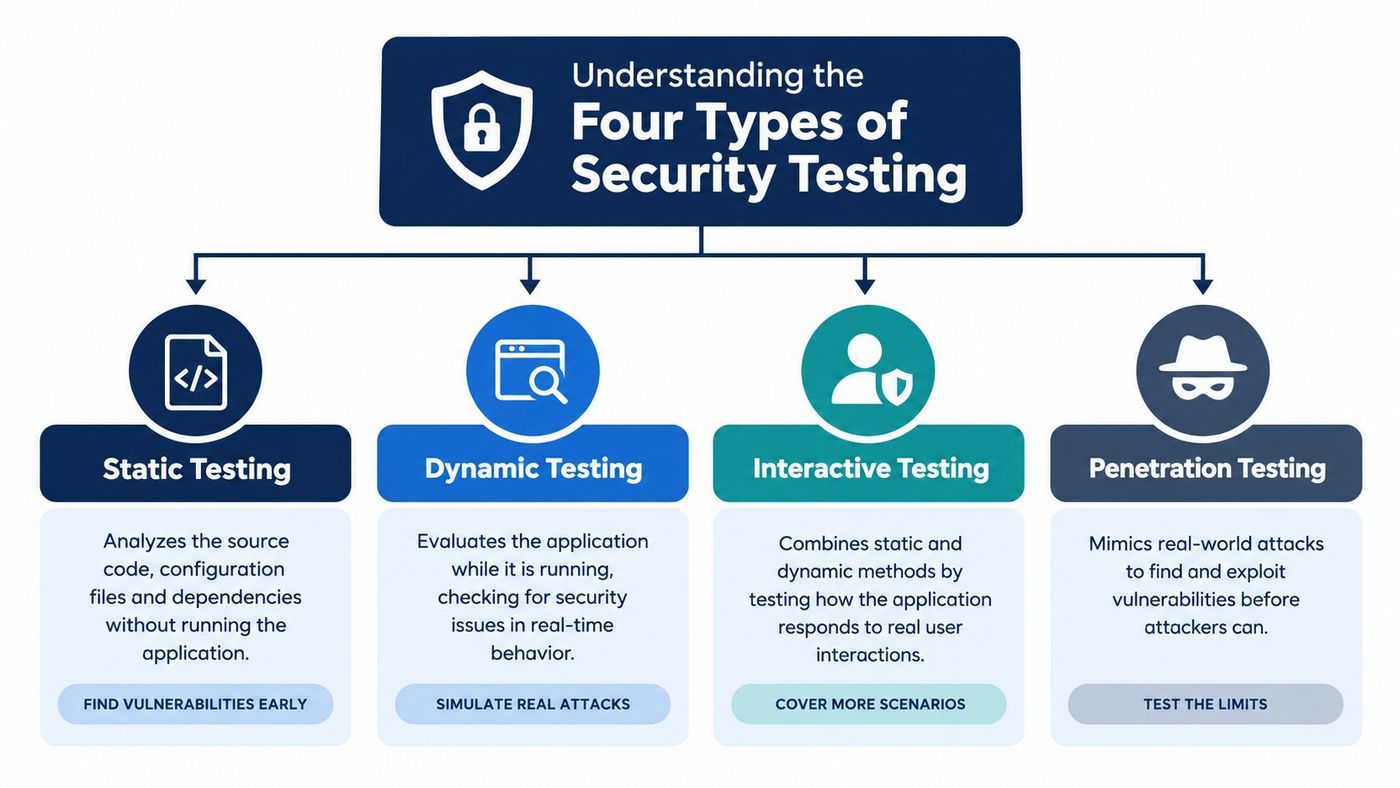
A scanner reviews systems for known weaknesses, missing updates, insecure configurations, exposed services, and other conditions that need investigation. Its value is breadth and repeatability. A managed IT team can use recurring scans to identify newly exposed assets or changes after a patch cycle.
The scan answers: “Where are our likely weaknesses?” It does not prove that an attacker can move through the environment or reach sensitive information. Authenticated scans usually provide better visibility because they can inspect internal configuration and patch details, but the results still need prioritisation and validation.
A penetration tester uses agreed methods and boundaries to simulate an attacker. A penetration testing service typically defines scope, methods, and boundaries before the engagement begins. The work may target an external network, cloud identity environment, web application, wireless network, or several of these areas.
The test answers: “Can an attacker exploit this weakness, and what could they reach next?” A useful engagement connects technical findings to business impact. For example, it may show whether attackers can reach production systems, client records, or administrative accounts. A practical cybersecurity audit can place those findings within a broader review of controls and operating practices.
A red team represents the attacker and may combine technical exploitation, social engineering, identity attacks, and other agreed tactics. A blue team defends, detects, investigates, and responds. Some exercises are coordinated, while others preserve uncertainty within approved safety limits.
The question becomes: “Can our people and processes detect, contain, and communicate during a realistic attack?” This tests more than a list of vulnerabilities. It examines monitoring, escalation, leadership decisions, and coordination with suppliers or legal and privacy advisers.
Application testing focuses on authentication, authorisation, input handling, sessions, data access, and business rules within a particular application. It can identify cases where a normal user reaches another customer's record, a workflow skips an approval step, or an account keeps access after its role changes.
The question is: “Does this application enforce the rules our business depends on?” In 2019, Statistics Canada found that 76% of Canadian businesses used anti-malware software and 73% used email security, yet only 35% installed software or operating-system updates monthly or more frequently. That national data illustrates why deploying controls is different from proving that they work.
A scan finds possible weaknesses. A penetration test verifies exposure. A response exercise shows whether the business can handle the consequences.
The right service depends on what changed, what is exposed, and what decision management needs to make. A vulnerability scan suits broad, recurring coverage. A penetration test suits an important attack path that requires human validation. A red team exercise suits a mature program that wants to test detection and response under pressure.
Run vulnerability scanning on a recurring schedule for internet-facing systems, cloud environments, endpoints, and remote-access infrastructure. Continuous external attack-surface monitoring can identify new exposure between formal tests, while internal scanning helps identify weaknesses that aren't visible from the public internet.
The Government of Canada's guidance recommends penetration testing at least annually and after major system changes, with more frequent testing for higher-risk systems. The federal vulnerability-management guidance supports a risk-based schedule. A major identity, network, cloud, or application change should trigger a scope review, not an assumption that last year's report still applies.
Application testing belongs before a significant launch or update to a web application. It's especially useful when the application processes personal information, supports customer self-service, connects to payment or operational systems, or contains business rules that scanners can't understand.
Red team work should come after the basics are operating. If the organisation can't maintain an asset inventory, patch high-priority weaknesses, or monitor key events, a broad adversary simulation may produce an impressive report without improving resilience. Start with targeted tests that answer urgent operational questions, then expand the scenario as the program matures.
| Testing Service | When to Use It | Business Question It Answers |
|---|---|---|
| Vulnerability scanning | Recurring coverage of internal and external assets, especially after infrastructure changes | Where are known weaknesses, misconfigurations, or exposed systems? |
| Penetration testing | At least annually, after major changes, or when a high-risk path needs validation | Can an attacker exploit the weakness and reach a sensitive asset? |
| Application testing | Before launch and after significant application changes | Does the application enforce authentication, authorisation, and business rules? |
| Red team exercise | When monitoring, response, and security operations are mature enough for a broader simulation | Can the organisation detect, contain, and coordinate through a realistic attack? |
| Identity or phishing testing | When cloud accounts, remote work, or employee-facing controls are material risks | Can a compromised user account bypass MFA or gain excessive access? |
| Backup and recovery testing | During continuity planning and after major changes to backup systems | Can critical services and data be restored within the organisation's recovery objective? |
A business owner comparing providers can also use vulnerability management versus vulnerability assessment to clarify whether a proposal covers only discovery or the complete cycle of prioritisation, remediation, and verification.
A professional engagement should produce more than a spreadsheet of scanner alerts. The report should help a business owner decide what needs attention, help the IT team fix it, and provide evidence that the fix worked.
Look for a prioritised findings report that identifies affected assets, explains the condition, describes realistic exploitability, and connects the issue to business impact. Severity matters, but it shouldn't be the only organising principle. A lower-severity weakness on an exposed system supporting a critical process may deserve faster action than a higher-severity issue on an isolated test asset.
Useful deliverables commonly include:
The final item is often missed. A report can show that a vulnerability existed, but only a retest can show whether the remediation closed the path.
A one-time project can suit a new system, acquisition, major migration, or customer assurance requirement. It provides a defined scope and a clear point-in-time assessment, but the result becomes less representative as the environment changes.
A recurring scanning subscription provides broader and more frequent visibility. It can support asset discovery and prioritisation, but scanning alone won't test complex business logic or prove that an attacker can move through a chain of weaknesses.
An annual retained testing program combines scheduled assessments with agreed support and retesting. A hybrid managed-services model connects testing with patching, endpoint protection, identity management, backup validation, and ongoing monitoring. That approach reduces the risk that findings will sit unassigned after the report is delivered.
The need is clear. A 2025 Canadian SMB survey found that only 34% of small businesses had tested the strength of their cybersecurity measures, while 19% reported a cyberattack or data breach. Small organisations averaged 276 cyberattacks in 2025, with detection taking 6.8 days, incident response 13.3 days, and recovery 25.7 days. The Canadian SMB findings underline why management should demand evidence tied to downtime, detection, restoration, and client impact, not just a vulnerability count.
A provider's sales presentation tells you less than the questions they ask before defining scope. A serious provider should want to understand your business processes, data flows, critical applications, remote-access paths, suppliers, and tolerance for disruption.
Start with these questions:
Certifications can help establish a tester's training and professional background, but they don't replace a clear methodology or relevant experience. Ask to see a sample report with sensitive information removed. The sample should show how the provider expresses uncertainty, ranks risk, explains business consequences, and records retest outcomes.
You can't legally scan a supplier's cloud environment without permission. That doesn't mean third-party exposure should disappear from the assessment. Ask suppliers for independent assurance reports, relevant test summaries, current remediation statements, and clear descriptions of the systems included in any report.
Review contracts for security responsibilities, vendor access, breach-notification obligations, audit rights, subcontracting, and exit arrangements. Then test your side of the relationship by reviewing supplier accounts, privileged access, segmentation, logging, and the simulated compromise of a trusted connection.
2025 Canadian research found that organisations conducting annual security testing averaged fewer infiltration incidents than organisations without regular testing, 23 versus 25, and fewer breaches in the reported comparison. The Statistics Canada research indicates an association, not a guarantee. Attackers can still enter through vendors, identity providers, or SaaS integrations outside the tested perimeter.
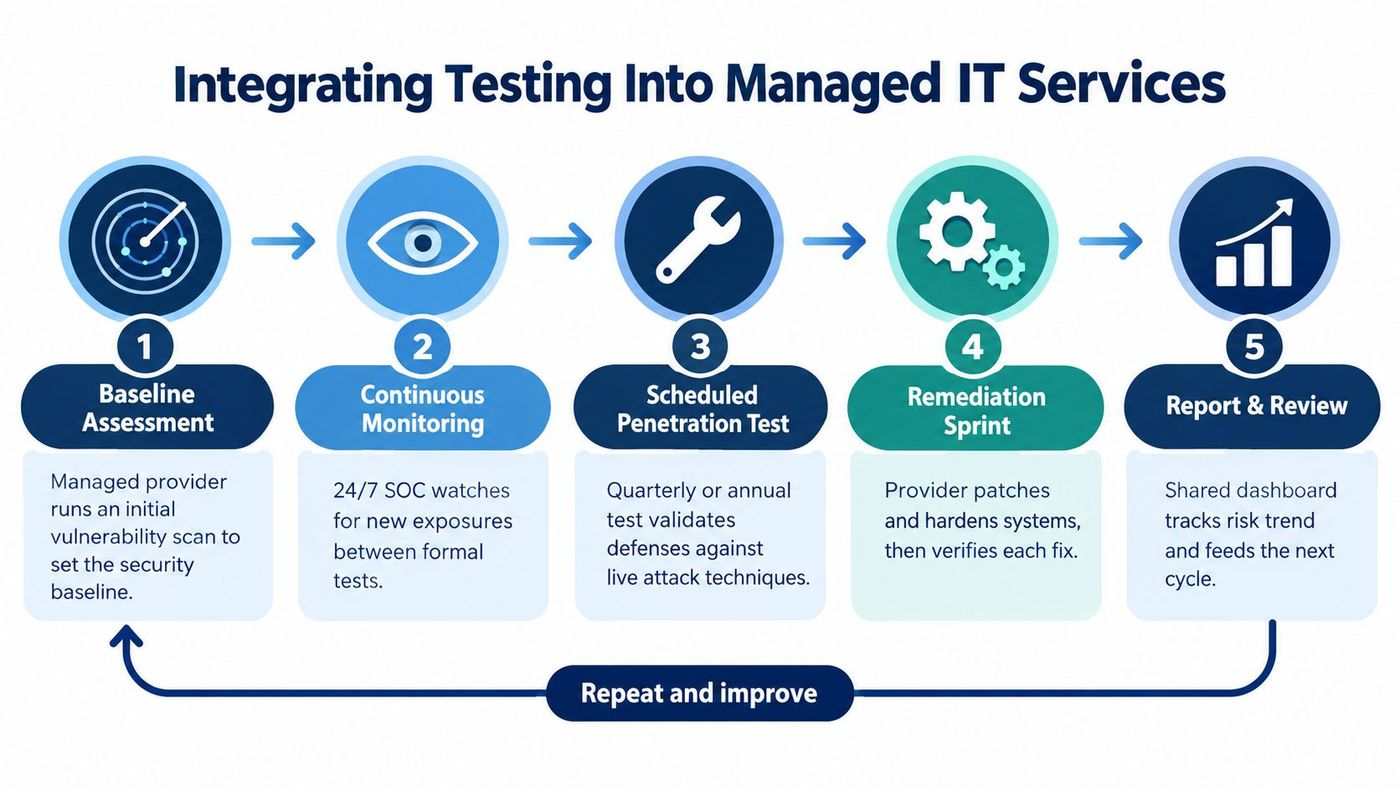
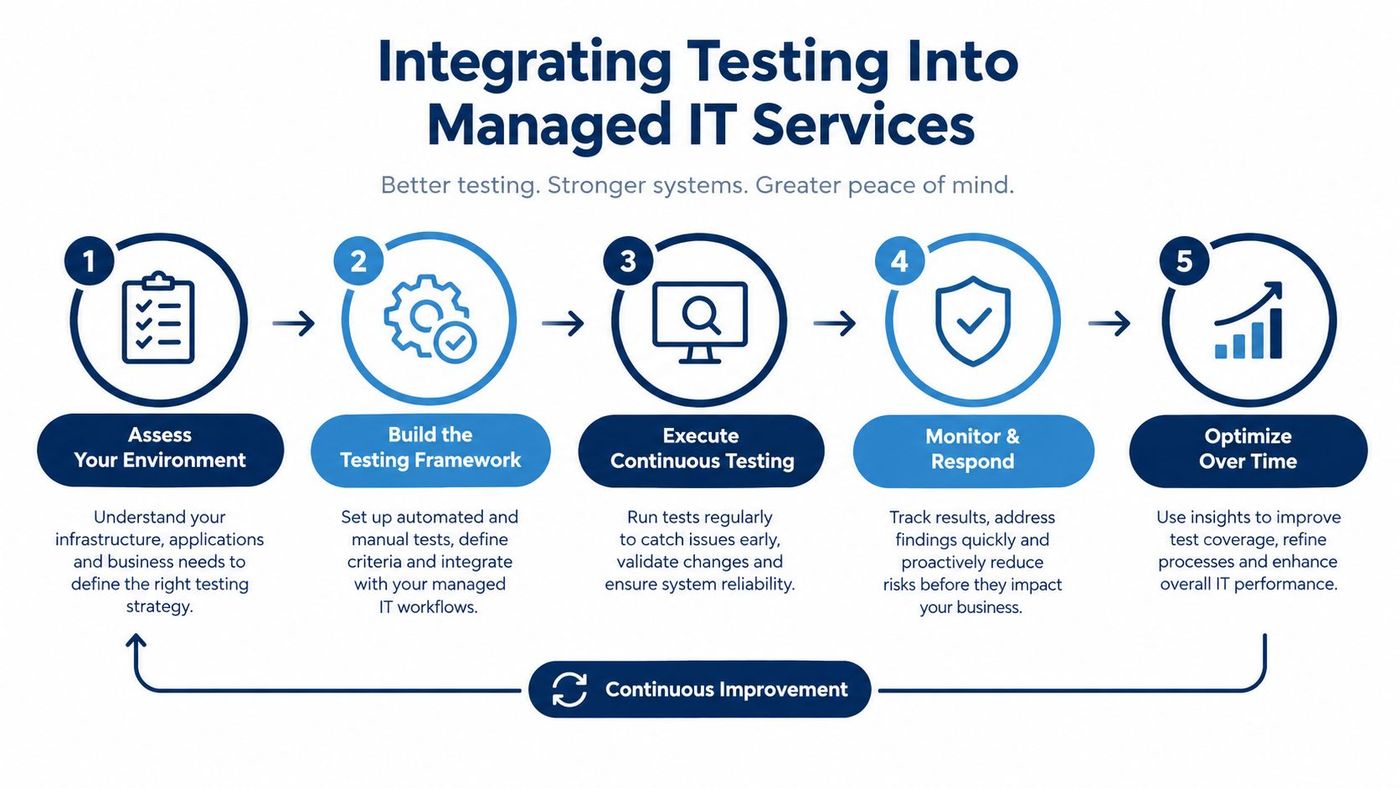
Testing delivers more value as a recurring operating rhythm than as a one-time appointment. A managed provider can monitor the external attack surface between formal assessments, review newly disclosed weaknesses, coordinate remediation, and schedule focused validation after significant changes. This rhythm mirrors how managed IT services for small business connect monitoring, patching, and recovery validation within one ongoing relationship.
The cycle can start with an authenticated vulnerability assessment that establishes a baseline. Monitoring then identifies newly exposed assets and configuration changes. Threat-informed prioritisation helps the team focus on weaknesses that could affect the business most directly. A scheduled penetration test acts like a supervised break-in, checking whether attackers can reach important systems or bypass controls such as MFA. Retesting confirms whether patches and configuration changes closed those attack paths.
Among Canadian businesses affected by a cybersecurity incident in 2021, approximately 40% experienced operational downtime, with average downtime lasting 36 hours. Statistics Canada's incident data offers a practical benchmark for tabletop exercises and recovery validation.
Ask the team to demonstrate whether it can detect an incident, contain affected accounts or systems, restore critical services, and communicate with employees and customers within a comparable period. For a clinic, the exercise might test access to scheduling and patient systems. For a manufacturer, it could examine production dependencies. For a legal firm, it may focus on document access and secure client communication.
The managed-IT relationship should track outcomes, not just close tickets. A useful dashboard can show the percentage of scanned assets with open critical vulnerabilities, so leaders can compare remediation progress across environments of different sizes. It should also show ownership, due dates, retest status, exceptions, and remaining business risk.
PIPEDA requires organisations to report a security-safeguard breach to the Office of the Privacy Commissioner of Canada when it is reasonable to believe the breach creates a real risk of significant harm. Organisations must also notify affected individuals when appropriate and retain records of every breach involving personal information under their control for two years. The Privacy Commissioner's breach guidance explains these obligations.
Testing reports should record the failed control or vulnerability, affected systems and data, discovery date, possible cause, containment steps, and recommended remediation. Linking technical findings to personal information and likely harm helps management prepare a defensible response. Organisations reviewing managed-IT options can also consider how partners for fraud prevention complement technical testing and response planning.
A managed-IT provider such as CloudOrbis Inc. can combine vulnerability assessments, penetration testing, endpoint protection, backup and disaster recovery, compliance support, and ongoing monitoring in one operating model. The practical benefit is coordination. Each test should influence what the team monitors, patches, validates, and reports.
Start with a vulnerability assessment that establishes what assets you have and where likely weaknesses sit. Add targeted penetration testing for the systems that matter most, such as public applications, cloud identities, remote access, clinical platforms, production systems, and trusted supplier connections.
Then make the results part of normal IT operations. Assign owners, prioritise remediation by business impact, retest the fixes, and use recovery exercises to prove that critical services can return when the environment is under pressure. Testing is about evidence, not fear. It tells you where assumptions are wrong and whether your response is improving.
A focused IT risk assessment can help your leadership team turn uncertainty into a practical testing roadmap. Book a cybersecurity assessment with CloudOrbis to identify your highest-value testing priorities and decide which findings need action first.
CloudOrbis Inc. helps Canadian small and mid-sized businesses combine vulnerability assessments, penetration testing, managed IT support, monitoring, and recovery validation into a practical security program. Visit CloudOrbis Inc. to discuss an assessment that connects technical findings to downtime, data protection, and the day-to-day resilience of your business.
Book a 30-minute call with a senior engineer. No sales script, just straight answers about your environment.


