Construction Project Management: A Practical Canadian Guide
Master construction project management with this practical guide covering lifecycle phases, key roles, proven methodologies, and IT tools that drive on-time

Master construction project management with this practical guide covering lifecycle phases, key roles, proven methodologies, and IT tools that drive on-time
Alberta had approximately 22,400 construction managers in the 2025–2027 outlook period, while construction delays in Ontario can cost between CAD 100,000 and CAD 2 million per month. Construction project management is therefore a cash-flow and productivity discipline, not an administrative exercise.
That distinction matters across Canada. A project manager who treats the schedule as a reporting document will discover the schedule in unpaid invoices, idle crews, disputed changes, extended financing, and delayed occupancy. A project manager who treats it as an operating control can connect scope, procurement, labour, quality, technology, and risk before those issues reach the critical path.
Alberta's major-project pipeline shows why the discipline carries such weight. The Alberta Construction Monitor reported $201 billion in the province's major-project inventory in summer 2025, with Alberta representing $148 billion of Canada's $633 billion national inventory and accounting for 111 of 504 projects counted by Natural Resources Canada. These figures point to a market where complex work requires deliberate scheduling, procurement coordination, risk control, and stakeholder governance. (Alberta's major-project inventory and national comparison)
Construction project management is the operating system that turns drawings, contracts, crews, equipment, and materials into a usable asset. It holds five constraints together:
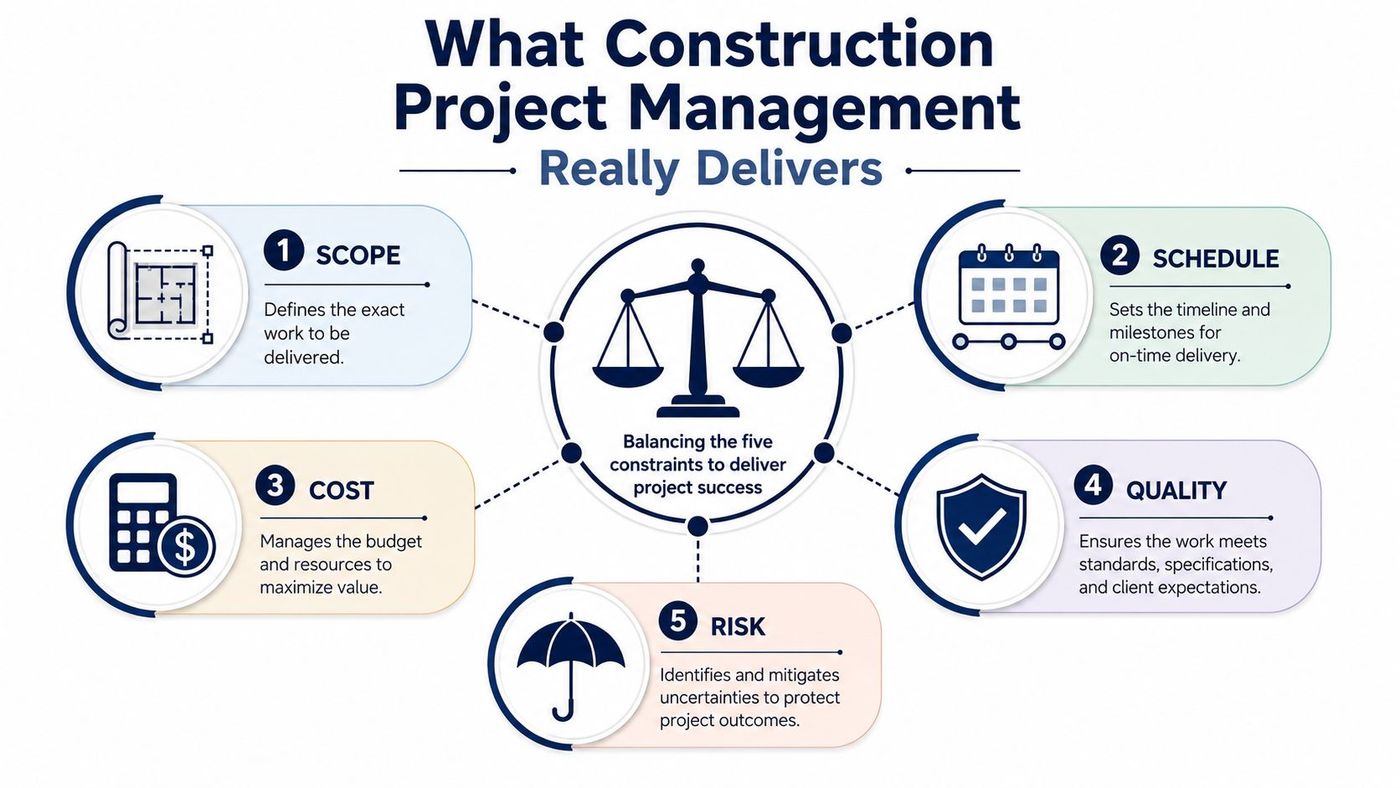
A good PM doesn't manage these constraints in isolation. A late design decision changes procurement. A procurement delay affects installation sequence. A rushed installation creates defects. Defects consume labour, disrupt inspections, and threaten occupancy. The manager's job is to see that chain early and decide which trade-off protects the project's outcome.
Alberta's labour market illustrates the scale. Job Bank reports approximately 22,400 construction managers in the province for the 2025–2027 outlook period. Seventy-five percent work in construction, 30% are self-employed, and 73% work all year. Part-year workers average 46 weeks, compared with 42 weeks across all occupations, according to the Alberta construction labour-market data.
More meetings don't create more control. A meeting is useful only when it produces a decision, assigns an owner, records a due date, or removes a constraint. Otherwise, it gives the team the comfort of activity without changing the work.
Practical rule: Every coordination meeting should end with decisions, owners, dates, and the document or activity those decisions affect.
Start with one approved scope baseline. Build the schedule around real dependencies rather than preferred dates. Tie cost reports to commitments and forecast completion, not just money already spent. Then make quality and risk visible in the same operating rhythm. That's how construction project management protects cash flow while preserving the asset the owner commissioned.
A mid-rise project in the Greater Toronto Area can go wrong before the first excavation. The owner skips a proper feasibility study, pushes design and procurement into parallel tracks, and discovers that key assumptions don't survive engineering review. A six-week schedule slip grows into a five-month delay, approximately $2.1 million in extra carrying costs, and a prolonged warranty dispute. Those figures describe the supplied example, not a universal outcome, but the sequence is familiar: weak early decisions become expensive field problems.
The remedy is sequential gating. The six phases are:
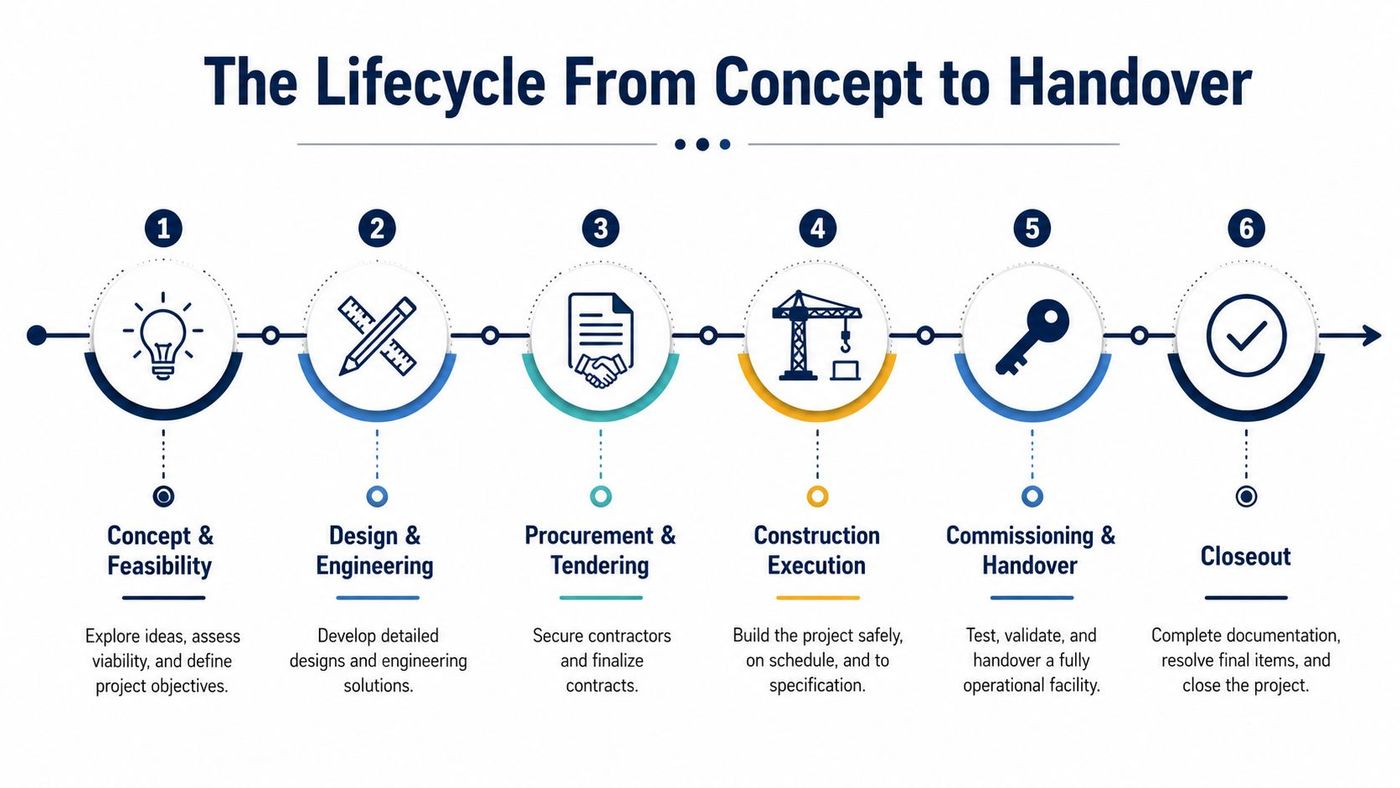
The GTA example failed at the points where one phase handed uncertainty to the next. The owner needed a design freeze before procurement, approved submittals before mobilisation, and completed punch-list work before retainage release. Those aren't bureaucratic preferences. They're controls that prevent one team from pricing, ordering, or installing work based on assumptions another team hasn't approved.
The handover phase deserves particular attention. Owners often focus on substantial completion and leave documentation until the end. That approach creates opportunities for disputes because the asset may be physically present while the evidence of compliance, testing, maintenance, and warranty responsibility remains incomplete.
Set acceptance criteria early. Define who signs each package, what evidence is required, and how unresolved items affect payment. A closeout package should include as-builts, warranties, operating manuals, test records, approvals, and lessons learned. If those requirements first appear during the final inspection, the project team has waited too long.
These methodologies solve different problems. Critical Path Method, or CPM, controls sequence and float. Building Information Modeling, or BIM, coordinates design and construction information. Lean Construction reduces waste and variability in field execution. Integrated Project Delivery, or IPD, aligns the owner, designer, and trades through shared risk and reward.
| Methodology | Primary Focus | Best-Fit Project Type | Key Canadian Advantage | Main Adoption Risk |
|---|---|---|---|---|
| CPM | Sequence, dependencies, and float | Any project with meaningful interdependencies | Gives the team a common schedule-control language | A polished schedule can still describe unrealistic work |
| BIM | Digital coordination and constructability | Complex mechanical, structural, or multi-trade builds | Exposes clashes and interface issues before installation | Teams model information without agreeing how decisions will be made |
| Lean Construction | Workflow reliability and waste reduction | Repetitive builds and work with repeatable production cycles | Improves constraint removal and field predictability | Superficial pull-planning becomes another status meeting |
| IPD | Shared commercial and delivery alignment | Sophisticated owners and collaborative contract structures | Encourages early trade input and collective problem-solving | Parties may resist transparent risk sharing |
CPM is table stakes. Build it at award, validate the logic with the people doing the work, and update it against field reality. BIM becomes more valuable as coordination complexity rises, particularly on large structural and mechanical work. Don't buy BIM for its label. Use it where a coordinated model will change fabrication, sequencing, access, or installation decisions.
Lean Construction earns its place when the project has repeatable work, recurring constraints, or many handoffs. The Last Planner System can help trades make reliable commitments, but only if foremen and superintendents use it to remove constraints rather than report excuses.
IPD is different because it changes commercial behaviour, not just workflow. Use it when the owner, designer, and trades can share information openly and make collective decisions. If the contract still rewards every party for protecting its own silo, calling the project “integrated” won't fix the incentive structure.
For teams selecting digital support, start with the workflow and governance model, then evaluate project management software options against those requirements. Software should reinforce the chosen method, not substitute for one.
The five disciplines operate as one control loop. Schedule slippage changes labour and equipment costs. Cost pressure encourages shortcuts. Shortcuts create quality and safety exposure. An unresolved risk becomes a change order, dispute, or delay.
Start with the critical-path schedule at award. Update it weekly against actual progress, maintain a short look-ahead for the next two weeks, and define what happens when float is consumed. Don't allow every activity to become “critical” because the team is anxious. Identify the work that controls completion and protect its predecessors, access, labour, materials, and approvals.
Ontario evidence shows that more than 40% of construction projects are delayed by three months or more, and delay costs can range from approximately CAD 100,000 to CAD 2 million per month, depending on project size. The Canadian change-order and productivity primer recommends dedicated scheduling expertise to monitor obligations, coordinate owners and contractors, and resolve disputes earlier.
| Discipline | Primary Deliverable | Leading Indicator | Cadence |
|---|---|---|---|
| Schedule | Approved baseline and updated critical path | Missed predecessor, approval, or production commitment | Weekly |
| Cost | Cost-to-complete forecast and change log | Uncommitted exposure and forecast movement | Weekly or biweekly |
| Quality | Inspection and test plan with acceptance records | Failed first-task review or recurring deficiency | At each work package |
| Safety | Site-specific controls and documented conversations | Repeated unsafe condition or incomplete corrective action | Daily and weekly |
| Risk | Owned risk register with mitigations | Trigger event or mitigation past due | Monthly, plus event-driven updates |
Earned value management adds discipline to reporting. Track the Cost Performance Index, or CPI, and Schedule Performance Index, or SPI, alongside physical progress, but don't treat those ratios as a substitute for field verification. Govern change orders through written scope, pricing, schedule impact, approval authority, and cumulative exposure. Set contingency based on the project's risk profile and trade value. A Canadian construction checklist recommends 10–15% contingency for cost overruns, plus buffer time for permits, inspections, weather, and seasonal conditions. (Canadian construction project management checklist)
Quality is cheaper to prevent than to repair. Use mock-ups, first-task reviews, hold points, and inspection-test plans before repetitive work spreads a defect across the site. The practical resource on defect prevention tips for builders is useful for turning quality from final inspection into daily production control. Align site safety practices with applicable COR and CSA requirements, reinforce them through toolbox talks, and assign corrective-action owners. Keep the risk register live through a structured risk management framework, not buried in a monthly report.
A job site's IT environment is now part of the production system. If the superintendent can't access the current drawing, the foreman can't confirm a detail, or the trailer loses connectivity during a critical activity, the project pays for the interruption.
Use a cloud collaboration workspace with controlled permissions, document versioning, BIM viewers, and shareable markups. The site office, trailer, consultant, and subcontractors need one source of truth for drawings, RFIs, submittals, meeting records, and decisions. Microsoft 365 can support this when the team establishes clear SharePoint or Teams structures rather than allowing every project to invent its own folder maze.
Connectivity needs resilience. LTE or 5G failover and SD-WAN can keep a trailer network available when the primary connection fails. That matters for field reports, cloud drawings, video calls, access to schedules, and payment documentation. Don't wait for a network outage to discover that the site has no fallback.
Construction teams carry valuable contracts, drawings, payment information, credentials, and personal data across offices and temporary sites. Use multi-factor authentication, endpoint detection, managed patching, phishing simulations, least-privilege access, and encrypted backups. A stolen laptop or compromised account shouldn't provide a path into the owner's or general contractor's wider environment.
Backups need a recovery test and a defined recovery time objective. Set the project-file recovery target at one hour where the business case requires it, then verify that the backup design can meet that target. VoIP and unified communications can keep superintendents, owners, consultants, and subcontractors reachable without forcing every decision through personal mobile numbers.
Smaller Canadian contractors don't need to build an enterprise IT department internally. A vCIO or fractional IT adviser can establish standards for identity, devices, collaboration, backup, cybersecurity, and project onboarding. CloudOrbis Inc. provides managed IT, cybersecurity, cloud, backup and disaster recovery, VoIP, and strategic IT consulting for Canadian businesses, including construction organizations. Its managed IT services can be evaluated as one way to connect those controls to day-to-day operations.
Better software won't rescue a badly designed workflow. Canadian construction productivity has reached a structural problem: multiple Canadian sources describe the sector as being near a 30-year low in labour productivity, with construction output per hour below 1997 levels and long-run annual productivity growth of only approximately 0.4% until the decline in 2023. (Canadian construction productivity research)
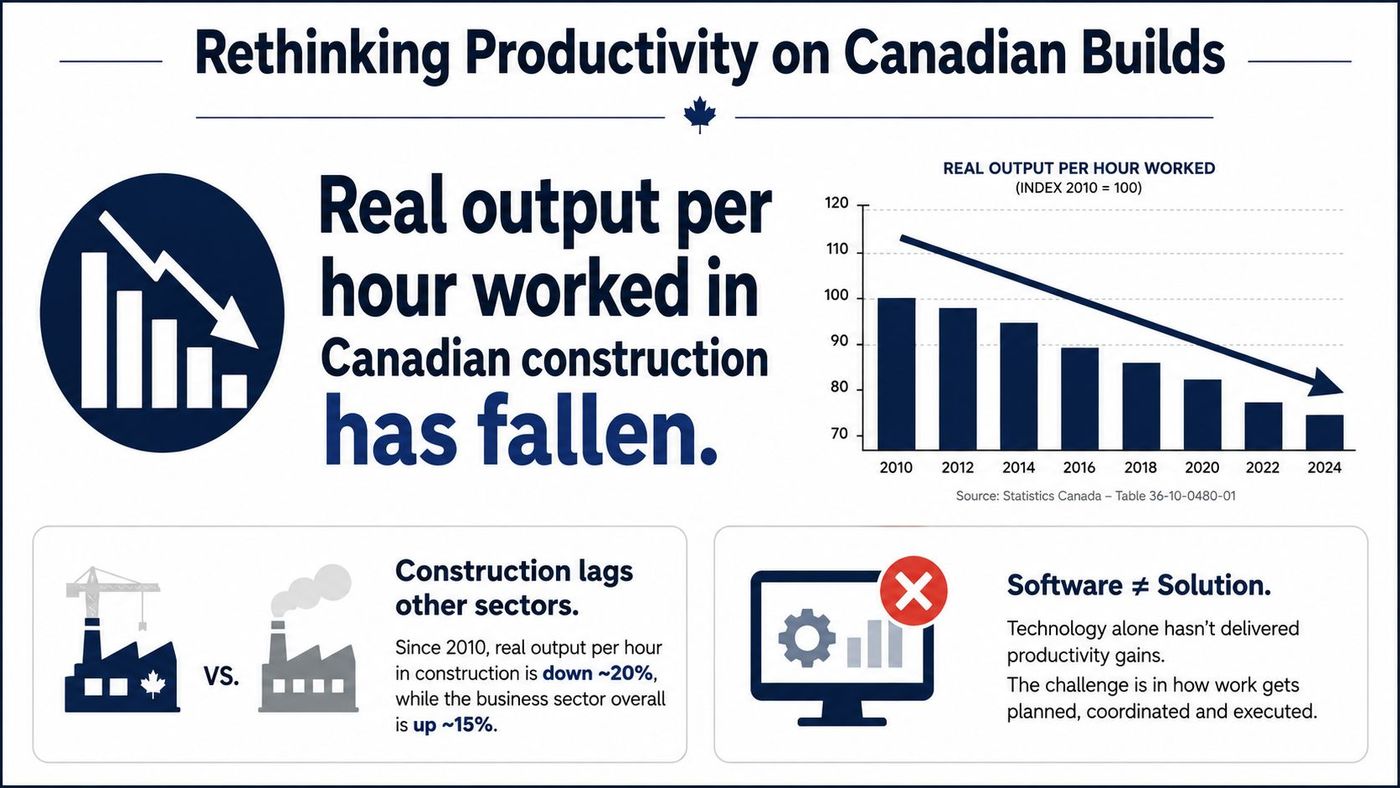
Residential construction deserves sharper attention. Research reports that residential construction productivity fell by an average of 3.8% per year from 2019 to 2024. Residential workers now produce approximately 67% of the output per hour of the average Canadian worker, down from nearly 90% at the start of the 2000s. (Canadian residential construction productivity findings)
That evidence changes the advice. The main bottleneck isn't only labour availability or material cost. It's also design variability, fragmented handoffs, rework, late decisions, inefficient site logistics, and inconsistent production methods. A dashboard can make those problems easier to see while leaving the underlying process untouched.
Use repeating floor plates where the building type allows them. Review prefabricated assemblies early. Run design-for-construction-and-maintenance reviews before procurement packages become fixed. Establish agreed turnaround windows for RFIs and shop drawings, then escalate breaches before they affect installation.
Assign a productivity lead to each project. That person should run weekly constraint analysis, measure installed direct work hours against quantities by discipline, and identify where trade stacking, overtime, access, or missing information is reducing output. Alberta data show that structural-steel installation can require 52.7 work hours per ton, and define productivity as actual installed direct work hours divided by installed quantity. (Alberta productivity and schedule-growth report)
Use a four-week lookahead to plan workface readiness, even when the formal short-term schedule is reviewed more frequently. Technology should then multiply a redesigned process through reliable field capture, shared documents, model coordination, and timely analysis. It can't turn chaotic handoffs into productive work by itself. Teams seeking help with that redesign can review business process optimization for construction operations.
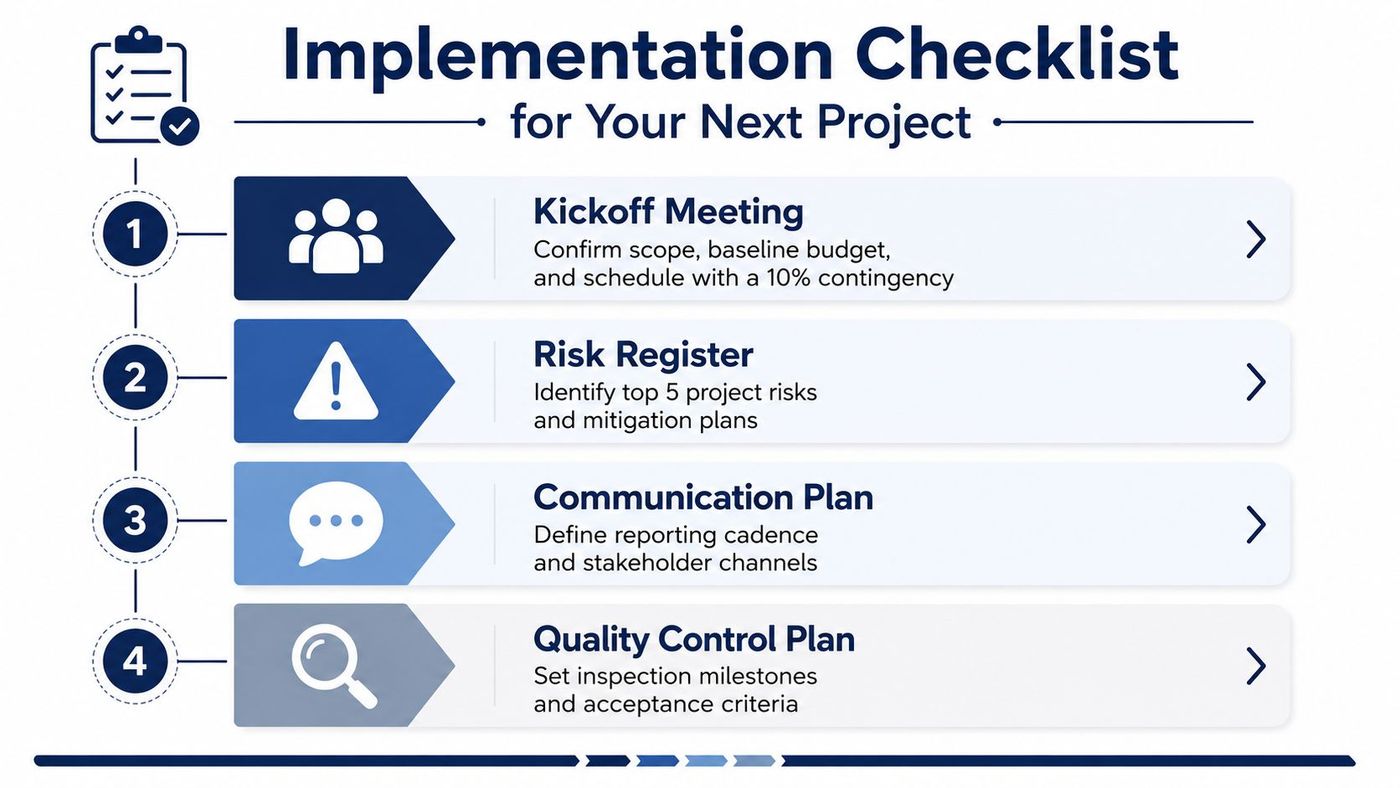
Run this checklist before the next major project reaches mobilisation. It's designed to expose weak ownership, unpriced risk, and IT gaps while the team can still correct them cheaply.
Choose CPM when sequence, dependencies, and completion control dominate. Add BIM when structural, mechanical, and architectural interfaces create significant coordination exposure. Use Lean pull-planning when production is repetitive and constraint removal can compress cycles. Consider IPD only when the owner, designer, and trades are prepared to share information and risk through the contract.
Don't select a method because it appears in a proposal. Ask what decision it improves, which team owns the process, what information it requires, and how the commercial model supports adoption.
Hold monthly governance reviews with the sponsor, PM, design lead, procurement lead, and site lead. Track earned value against milestones, review CPI and SPI trends with physical progress, update the risk register with named owners and mitigation actions, and escalate change exposure before it becomes a funding problem.
Close with evidence, not optimism. Require as-builts, warranties, operating manuals, test records, approvals, deficiency closure, payment reconciliation, and lessons learned before final release. The project isn't finished when the last crew leaves. It's finished when the owner can operate the asset and the team can prove what it delivered.
CloudOrbis Inc. helps Canadian construction and engineering firms connect managed IT, cybersecurity, cloud collaboration, backup and disaster recovery, VoIP, and vCIO guidance to real project controls. Visit CloudOrbis Inc. to assess your job-site connectivity, document management, security, and recovery readiness before they disrupt your next build.
Book a 30-minute call with a senior engineer. No sales script, just straight answers about your environment.


