What Is Business Impact Analysis and Why It Matters
Learn what is business impact analysis, why it matters for SMBs, and how to run one that protects revenue, compliance, and recovery priorities.

Learn what is business impact analysis, why it matters for SMBs, and how to run one that protects revenue, compliance, and recovery priorities.

Business impact analysis is a structured process that identifies critical operations, quantifies disruption impact, and sets recovery priorities such as RTO and RPO. In Canada's federal continuity framework, it defines maximum allowable downtime, minimum service levels, recovery time objectives, recovery point objectives, continuity strategies, recovery priorities, and supporting resources.
A mid-sized Canadian business can lose access to its ERP, customer records, cloud applications, or production systems with little warning. The immediate problem isn't only that technology has stopped working. Employees lose their normal way to serve customers, finance can't confirm transactions, managers make decisions with incomplete information, and suppliers or regulators may expect answers before systems are restored.
That's why what is business impact analysis matters as a practical management question, not just a compliance term. A well-run BIA tells leaders which services must return first, what those services depend on, how much disruption the organisation can tolerate, and what recovery investment is justified.
Consider a 200-employee Canadian manufacturer whose ERP and order portal become unavailable after a cloud configuration error. During the first minutes, new orders stop entering the system. Customer service representatives search for recent emails and use personal laptops to contact account managers. On the shop floor, supervisors can't confirm production schedules or material requirements.
After several hours, the impact spreads. The CFO can't confirm which orders are ready for invoicing, warehouse staff can't reliably match shipments to customer records, and procurement has no dependable view of replenishment needs. A regulator notification clock may also be running if the incident affects protected information or a regulated service.
The business estimates exposure at roughly $18,000 per hour in lost billables, and staff face a manual reconstruction of 600 transactions. Those figures are scenario-specific, not universal benchmarks, but they show why an outage must be assessed through business operations rather than an IT ticket alone.
Practical rule: The question isn't simply, “How quickly can IT restore the server?” It's, “Which business outcome becomes unacceptable first, and what must be restored to prevent it?”
A BIA would have identified the order process, invoicing workflow, production scheduling, customer records, and cloud dependencies as connected operational priorities. It would also have established recovery thresholds before the incident, allowing the response team to follow agreed priorities instead of negotiating them during the crisis.
Leaders reviewing broader operations continuity strategies will find the same principle: continuity planning works best when it starts with the services the organisation must keep delivering.
A BIA isn't a risk assessment. A risk assessment asks what could go wrong and how exposed an asset or process may be. A BIA starts with the business and asks what must continue, what happens when it stops, and how recovery requirements change as downtime continues.
It also isn't a disaster recovery plan. A disaster recovery plan describes technical and operational actions for restoring systems. The BIA supplies the business requirements that make those actions meaningful. Nor is it an audit checklist. Evidence matters, but the purpose is to make defensible recovery decisions.
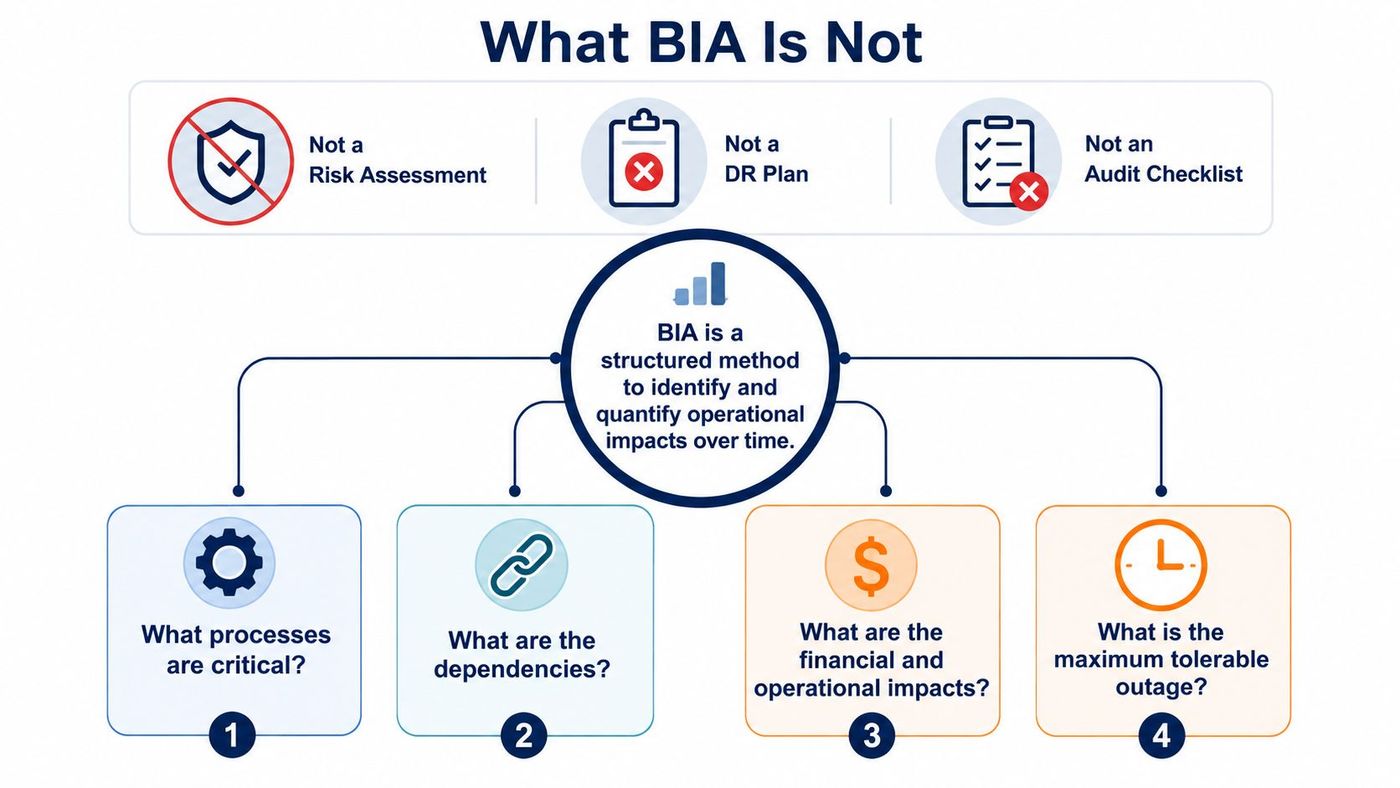
A useful analysis answers four practical questions:
In Canada, Treasury Board procedures require departments to assess direct and indirect disruption impacts, prioritise critical services and associated assets, and obtain senior management approval before continuity planning proceeds. The Government of Canada's business continuity guidance also calls for identifying critical and non-critical operations, determining disruption consequences, and mapping dependencies.
For a mid-market owner, the simplest definition is this: a BIA identifies critical operations, measures disruption impact, and establishes recovery priorities such as RTO and RPO. It becomes the input document for continuity strategies, disaster recovery, vendor requirements, risk treatment, insurance discussions, and investment decisions. CloudOrbis also explains how this analysis fits into business continuity and disaster recovery planning.
A strong BIA produces working management outputs, not a report that sits in a shared folder. Each output answers a different decision question and should be usable by operations, finance, IT, security, and senior leadership.
The prioritised process register ranks business activities by criticality. “Run the business” is too broad to guide recovery. A manufacturer might separate order entry, production scheduling, shipping confirmation, payroll, and general reporting because each has different consequences and dependencies.
The dependency map connects every critical process to its people, applications, data, facilities, suppliers, contractors, and external services. This often exposes hidden concentration risks. For example, an order process may depend on Microsoft 365 for communication, a cloud ERP for inventory, a payment provider for collection, and a single logistics partner for delivery.
RTO and RPO values translate business tolerance into technical requirements. If email has an RTO of 4 hours, the recovery runbook must include a cutover procedure that completes inside that window, including validation and user access. The RPO determines how backup and replication should work. An application that cannot lose recent order data needs a different protection design from an archive used only occasionally.
Impact figures should show how consequences develop across 4-hour, 24-hour, and 5-day windows. The values must come from the organisation's own financial and operational evidence, not a generic template. Include lost revenue or billables, backlog, overtime, contractual exposure, regulatory obligations, safety concerns, customer impact, and reputational damage.
| BIA Output | What It Contains | Downstream Use |
|---|---|---|
| Critical process register | Process owners, criticality, service levels, priorities | Recovery sequencing and continuity plans |
| Dependency map | People, applications, data, vendors, facilities, and suppliers | Architecture, vendor risk, and asset decisions |
| RTO and RPO register | Recovery time and acceptable data-loss requirements | Backup frequency, failover design, and DR runbooks |
| Impact worksheet | Financial and operational effects over time | Budgeting, insurance discussions, and prioritisation |
| Recovery priority sheet | Agreed order and minimum service expectations | Crisis decisions, communications, and exercises |
The CloudOrbis guide to Recovery Time Objective provides useful context for turning recovery expectations into actionable requirements. In Canada's federal framework, the same logic extends to maximum allowable downtime, minimum service levels, continuity strategies, recovery priorities, and supporting resources, which makes BIA a measurable foundation for continuity governance.
An operations lead can run a first BIA without specialist software. The work needs clear sponsorship, disciplined evidence collection, and process owners who understand how their teams operate.
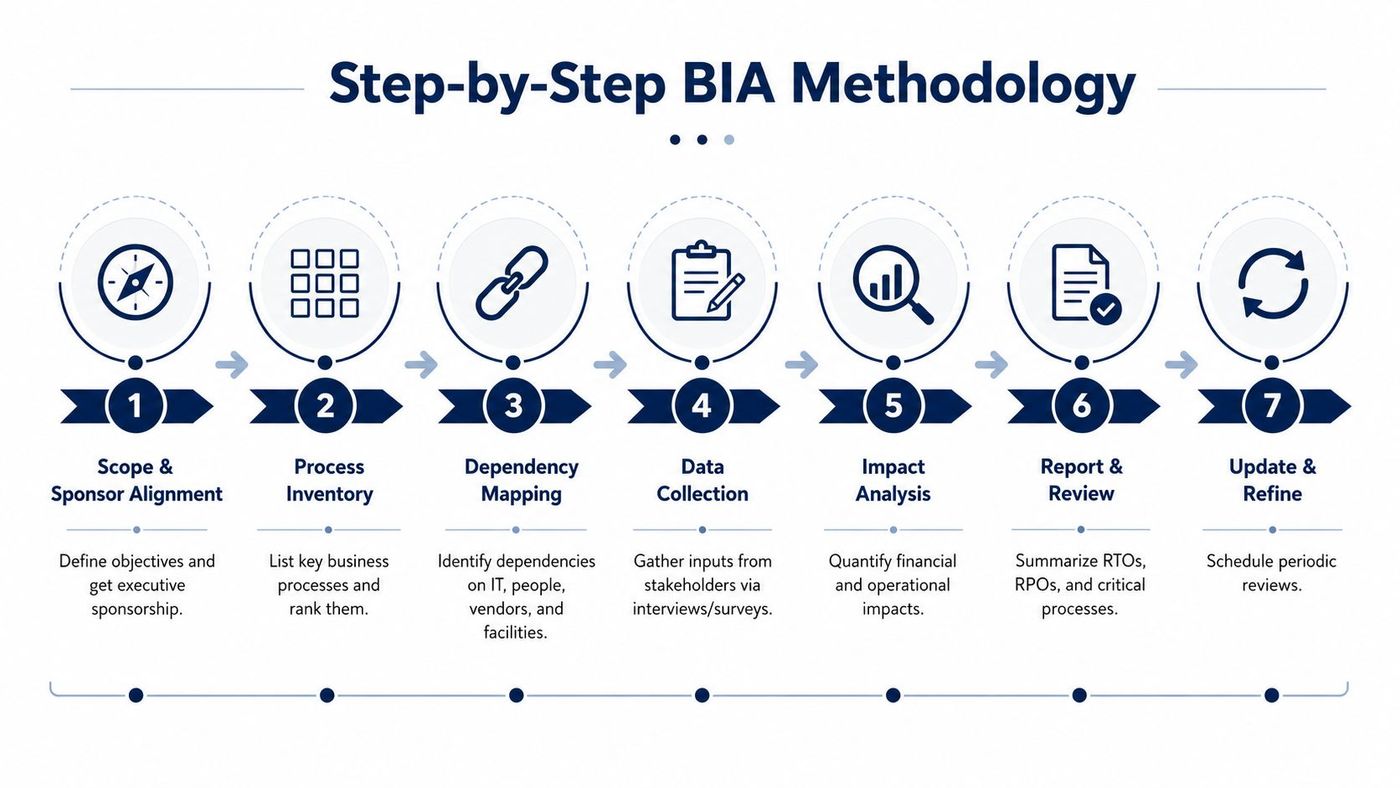
The CloudOrbis risk management framework resource can help connect BIA findings to risk ownership and treatment. Canadian public-sector methodology similarly treats BIA as a data-driven input that quantifies impacts, estimates downtime tolerance, identifies resources, establishes RTO and RPO, and presents results to senior management for decision-making.
The BIA method stays consistent across sectors, but the priorities change sharply. A healthcare clinic, factory, and law firm may use the same interview questions, yet they'll reach different conclusions about acceptable downtime, data loss, dependencies, and recovery order.
Healthcare teams must connect system availability to patient care, privacy, safety, and clinical workflow. An electronic health record outage can affect clinicians, scheduling, medication information, referrals, and billing at the same time. The analysis should identify safe manual procedures, access to essential patient information, communications, and the point at which service limitations create unacceptable risk. Organisations seeking specialist healthcare compliance engineering support may also use the BIA to organise technical and compliance requirements.
Manufacturers focus on production control, worker safety, quality records, inventory, shipping, and just-in-time supplier dependencies. A plant may tolerate delay in a reporting dashboard but not in systems that control production sequencing or support safe operations. The BIA should examine how a line stoppage affects materials, labour, customer commitments, and restart procedures.
Legal and financial firms place particular weight on confidentiality, data integrity, client commitments, transaction records, audit trails, and secure collaboration. A short interruption during a critical transaction may have a different consequence from a longer interruption affecting document archives.
| Sector | Critical Process Example | Regulatory Driver | Typical RTO | Typical RPO |
|---|---|---|---|---|
| Healthcare | Clinical records and care coordination | Privacy, patient safety, and health obligations | Set through the clinic's impact assessment | Set by clinical and data-loss tolerance |
| Manufacturing | Production scheduling and plant controls | Safety, contractual, and operational obligations | Set against safe restart and customer commitments | Set by production and transaction integrity |
| Legal and finance | Secure client or transaction work | Confidentiality, fiduciary, contractual, and audit obligations | Set against client and transaction deadlines | Set against record integrity requirements |
The word “typical” in this table doesn't mean a universal target. An organisation must establish its own values through documented impact analysis. CloudOrbis also addresses sector-specific considerations in its healthcare IT compliance guidance.
BIA is the hand-off point between business expectations and technical action. The critical process list tells the recovery team what comes first. RTO and RPO values determine the restoration sequence, backup design, replication approach, failover architecture, and validation steps.
The dependency map adds operational detail. It can show that restoring an application alone won't restore the service because the process also needs an identity platform, a network connection, a supplier portal, trained staff, clean data, or an alternate facility.
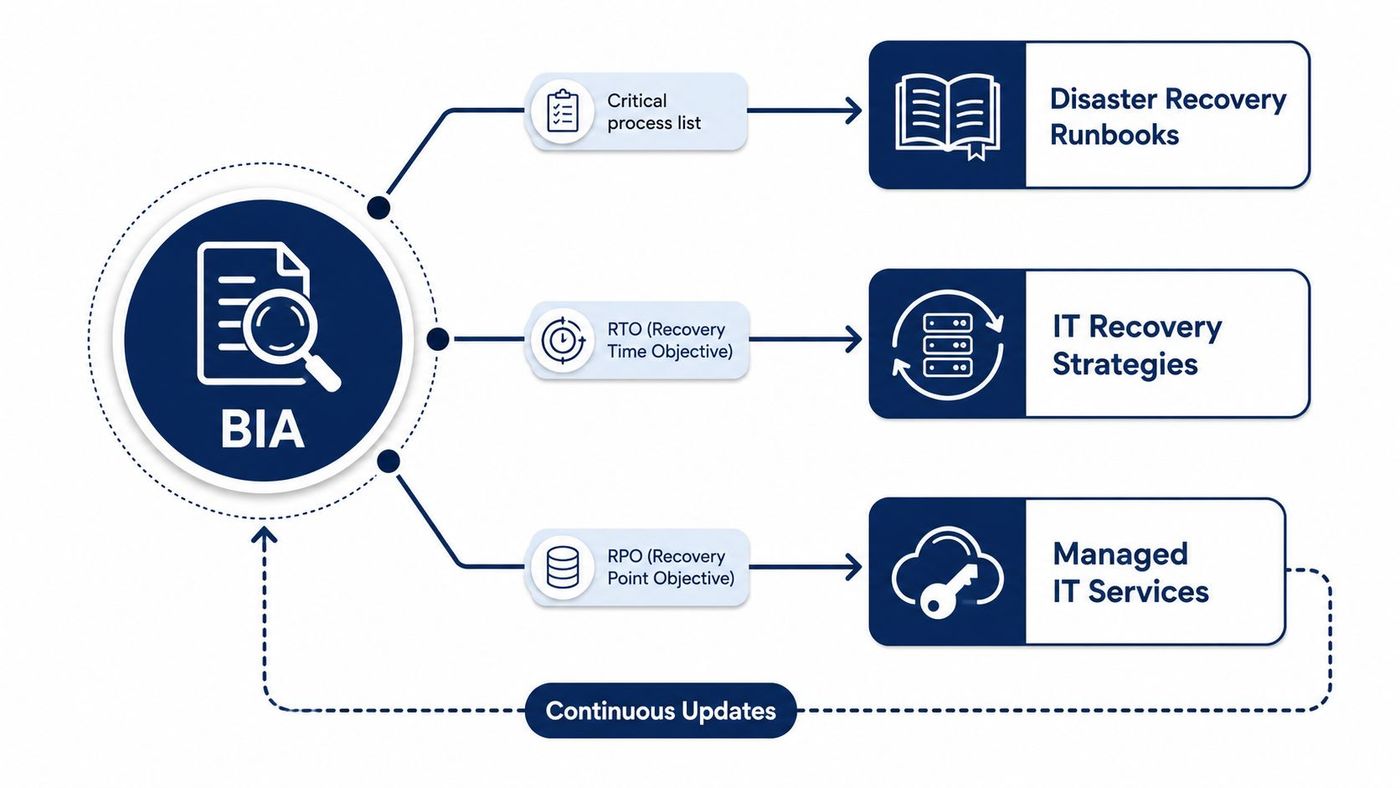
Business continuity planning uses impact findings to define alternate work locations, manual workarounds, crisis communications, and minimum service levels. Disaster recovery turns the technical priorities into runbooks with owners, prerequisites, recovery steps, and testing evidence. Vendor managers use the same findings to negotiate continuity clauses, notification duties, recovery commitments, and access to relevant assurance evidence.
A managed IT partner can use the asset inventory and dependency matrix to scope monitoring, patch management, endpoint protection, backup, cloud administration, and cyber recovery work. That turns an abstract resilience goal into service-level commitments and budget choices. CloudOrbis Inc. provides managed IT support, cybersecurity, cloud solutions, backup and disaster recovery, and strategic IT consulting for small and mid-sized organisations, so a BIA can serve as an input to those operational discussions.
A practical IT disaster recovery plan template is useful only when its priorities reflect the organisation's approved BIA. Otherwise, the plan may restore technically convenient systems while critical customer or operational services remain unavailable.
A BIA shouldn't end when senior management approves the report. It becomes unreliable when critical processes, applications, suppliers, facilities, regulations, or threat conditions change and the recovery assumptions stay untouched.
Event-driven triggers are more useful than relying on a calendar alone. Reopen the analysis after a new electronic health record, factory automation platform, merger, remote-work model, major contract, cloud dependency, or cyber incident changes how the organisation delivers an important service.
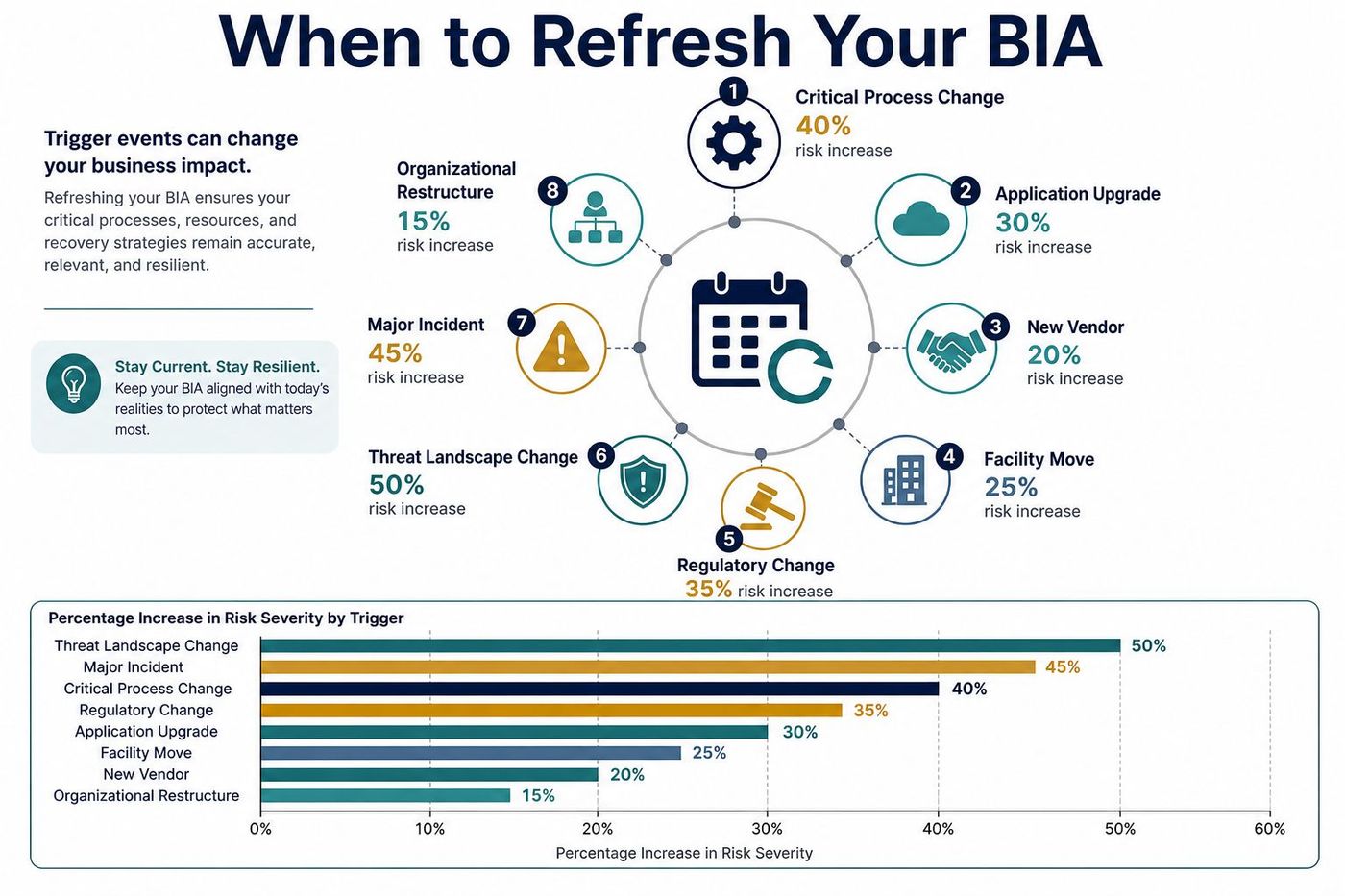
Assign an owner to each process and track overdue reviews. Preserve change history so leaders can see why an RTO, RPO, dependency, or recovery investment changed. Feed test results and real incidents back into the analysis, replacing estimates with observed recovery evidence wherever possible.
The Business Continuity Institute's 2025 report on continuity and resilience practice emphasises exercise and testing as part of resilience practice. That supports a shift away from a static workshop toward ongoing validation, particularly for Canadian SMBs managing cloud services, Microsoft 365 dependencies, cyber risk, vendors, and workforce changes.
A living BIA doesn't require constant rewriting. It requires current, decision-ready priorities.
Use the analysis during continuity exercises, disaster recovery tests, vendor reviews, risk-register updates, and capital planning. Canadian federal training formalised through the self-paced Conducting a Business Impact Analysis, COR312, uses the official Business Continuity Management Program Guide published in 2023, reinforcing the value of structured, repeatable practice.
For additional practical guidance, review these engineering business continuity tips alongside your organisation's own exercise findings.
A focused first month can produce a useful BIA register, even if the organisation has never completed one. Start by appointing an accountable business owner and representatives from operations, finance, IT, security, compliance, and facilities.
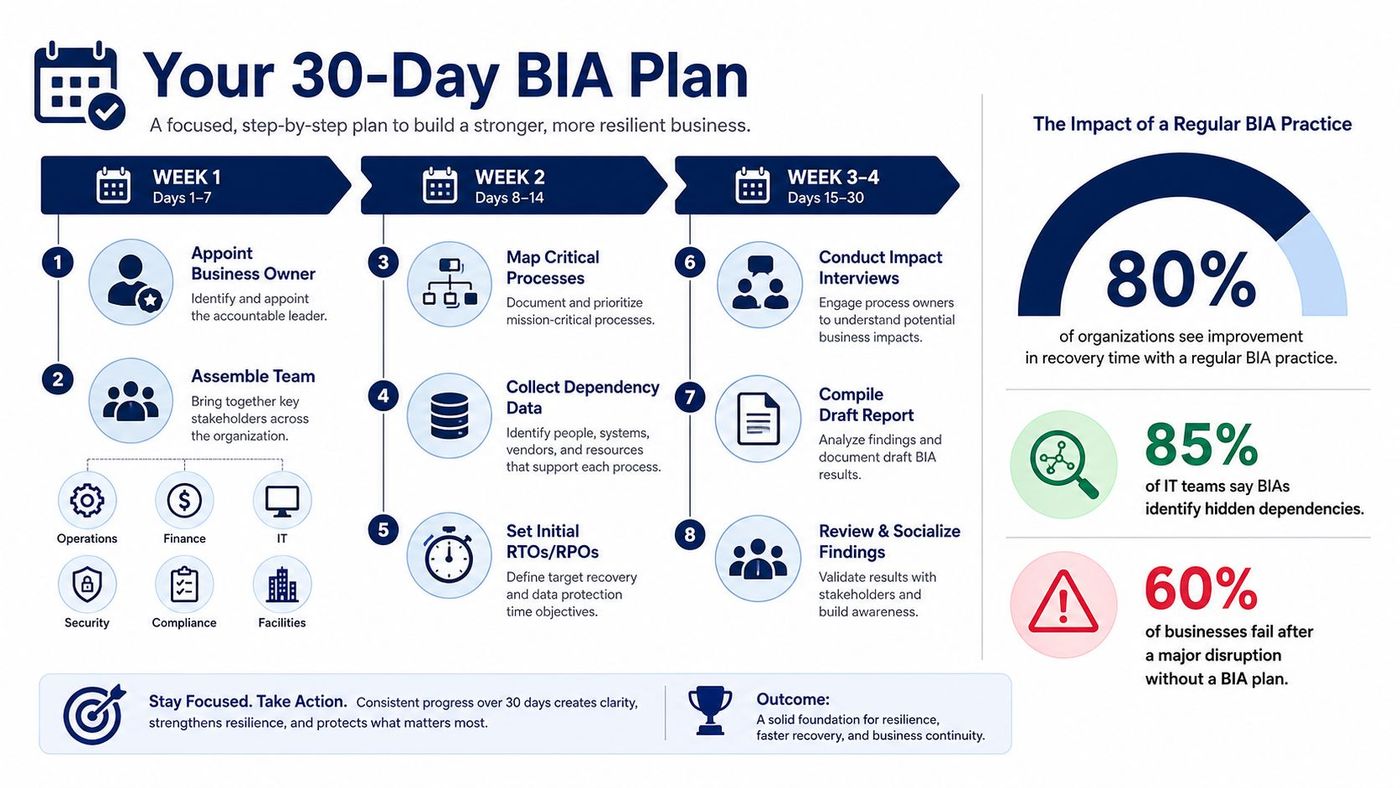
During the first workshop, aim to publish an owner-approved process register and use it immediately to guide resilience decisions. A managed IT partner can validate technical dependencies, automate evidence collection, support testing, monitor recovery controls, and help maintain controlled BIA updates. The analysis becomes valuable when teams use it to fund the right safeguards and measure recovery against agreed targets.
CloudOrbis Inc. helps Canadian small and mid-sized businesses connect BIA findings to managed IT, cybersecurity, cloud operations, backup, disaster recovery, and strategic technology planning. Visit CloudOrbis Inc. to discuss your critical processes, recovery priorities, and the next practical step toward a more resilient operation.
Book a 30-minute call with a senior engineer. No sales script, just straight answers about your environment.


