Outsourced IT Calgary: A Buyer's Guide for SMB Leaders
Explore outsourced IT Calgary options with this buyer's guide covering pricing, cybersecurity, compliance, and how to choose the right managed services partner.

Explore outsourced IT Calgary options with this buyer's guide covering pricing, cybersecurity, compliance, and how to choose the right managed services partner.

Monday morning starts badly at a Calgary logistics firm. A ransomware alert appears just as shipments are being dispatched, the company's lone IT generalist is on vacation, and nobody in leadership can say with confidence which systems are protected, which backups are usable, or who should make the first call. The immediate problem is technical. The larger problem is governance.
That situation is common enough to deserve a harder question than “Who can fix our computers?” Leaders need to decide how much technology risk they're prepared to retain, which controls must be funded first, and whether internal staff, a co-managed arrangement, or a fully outsourced IT partner fits the business. Alberta businesses already show a strong appetite for outsourcing. In early 2025, 53.7% of Alberta businesses reported outsourcing tasks, projects, or short contracts, while 14.4% of businesses that outsourced work identified information technology service support as an outsourced category, according to the Calgary outsourced IT market overview.

The Calgary logistics firm in that opening scenario may have competent people and reasonable tools. What it lacks is dependable coverage, documented accountability, and enough technical depth to handle an incident when the expected person isn't available. Break-fix support creates the same weakness in quieter ways. A failed laptop, an expired licence, or a delayed patch becomes a leadership issue because nobody owns the broader operating picture.
Cyber risk is a major reason Alberta SMBs are reassessing the model. A Calgary-focused cybercrime assessment reports that 51% of surveyed Alberta SMBs said they were attacked by cybercriminals in the past year, 55% paid a ransom within the previous three years, and 65% said legacy IT or OT systems make them vulnerable. Those figures support a practical priority for outsourced IT Calgary buyers: continuous monitoring, hardened endpoints, segmented backups, and a recovery process that has been tested rather than merely documented. See the Calgary cybercrime risk assessment for the underlying data.
Outsourced IT means entering a contractual partnership with a managed services provider, or MSP. The provider monitors, maintains, secures, documents, and strategically guides the technology environment under agreed service levels. Your leaders still approve budgets, business applications, access policies, risk tolerance, and major changes.
It also doesn't require firing every internal IT employee. A co-managed model can leave an internal lead responsible for business context while the MSP supplies security expertise, after-hours coverage, escalation capacity, and project support. The right arrangement depends on the work your organisation must own directly and the capabilities it can sensibly buy.
Practical rule: If one absence can stop support, your IT model has a resilience problem, regardless of how capable that individual is.
The economic argument matters, but it shouldn't lead the decision. Statistics Canada reported that Canadian businesses spent about $500 million on cybercrime-related incident costs in 2023, with small businesses and medium-sized businesses each spending about $300 million, as summarised by KPMG's Canadian cybercrime release. For Calgary leaders, outsourcing is therefore a risk-management choice. A provider should help prevent incidents, contain them faster, preserve evidence, and reduce the operational damage when controls fail.
Alberta also has a substantial technology services base behind this market. For 2026, the IT Consulting industry in Alberta was estimated at $9.3 billion, with 9,722 businesses and 35,970 employees, and average annual growth of 9.7% from 2021 to 2026. Data Processing and Hosting Services was estimated at $1.6 billion, with 439 businesses, 3,467 employees, and annual revenue growth of 3.2% over the same period, according to Statistics Canada's industry data. Outsourced IT Calgary isn't a niche purchase. It sits inside a large, growing provincial ecosystem.
For a practical view of what managed services can include, review CloudOrbis' Calgary managed services guide. The important point is simple: choose a model that gives leadership clear ownership of risk, service quality, and technology decisions.
There isn't one correct IT delivery model for every Calgary SMB. A professional services firm with a mature internal technology lead has different needs from a growing manufacturer with no dedicated IT employee. The decision should follow operational reality, not a provider's preferred package.
In-house staff offer direct control, institutional knowledge, and immediate access to business decision-makers. They understand how dispatch, production, clinical workflows, billing, or client files move through the organisation. That context can be difficult for an outside provider to acquire.
The weakness is concentration risk. Salaries, benefits, training, tools, recruitment, and management all sit with the employer. A small team may also lack deep expertise in identity security, Microsoft 365 governance, incident response, compliance, cloud architecture, and disaster recovery. If the company depends on one generalist, vacation, illness, turnover, or a major incident can expose the gap.
Co-managed IT usually fits a company with one or two internal staff who are stretched thin. The internal team keeps ownership of priorities and user relationships, while an MSP handles specialised or time-sensitive work. Common allocations include:
This model works only when responsibilities are explicit. Two teams can create duplicated tickets, conflicting changes, and arguments over accountability if the contract doesn't define who owns each service.
A fully outsourced engagement places day-to-day technology management with the MSP. The provider supplies support, monitoring, security administration, maintenance, documentation, and strategic planning without requiring the client to build an equivalent internal department.
The attraction is predictable management and broader coverage. The trade-off is reduced direct control over daily technical decisions, unless governance meetings, approval rules, reporting, and escalation paths are built into the relationship. A business should also examine exit rights and data portability before signing.
| Decision Factor | In-House IT | Co-Managed IT | Fully Outsourced IT |
|---|---|---|---|
| Control | Direct internal control | Shared control with defined ownership | Strategic control retained, operational control delegated |
| Internal knowledge | Strongest | Preserved through internal staff | Must be documented and transferred |
| Security depth | Depends on hiring and training | Adds specialist capability | Broad capability included in the service model |
| Coverage | Limited by team availability | Expanded through MSP support | Designed for continuous service coverage |
| Cost predictability | Payroll and project costs vary | Internal payroll plus contracted services | Recurring fee plus clearly defined project work |
| Scalability | Hiring takes time | Capacity can be added selectively | Services can expand or contract with business needs |
| Best fit | Mature IT function with enough depth | Lean internal team needing leverage | SMB seeking full accountability and coverage |
Use CloudOrbis' managed IT service explanation to compare the scope of a managed engagement with your current responsibilities. My recommendation is direct: choose in-house only when you can support more than one person's knowledge and coverage. Choose co-managed when internal context matters but specialist capacity is missing. Choose fully outsourced when leadership needs one accountable technology operator and doesn't intend to build an internal department.
A credible outsourced IT Calgary proposal should connect each service to a business outcome. A list of products isn't enough. Ask what the provider will monitor, who responds, what evidence you'll receive, and how the service reduces downtime, exposure, or decision risk.
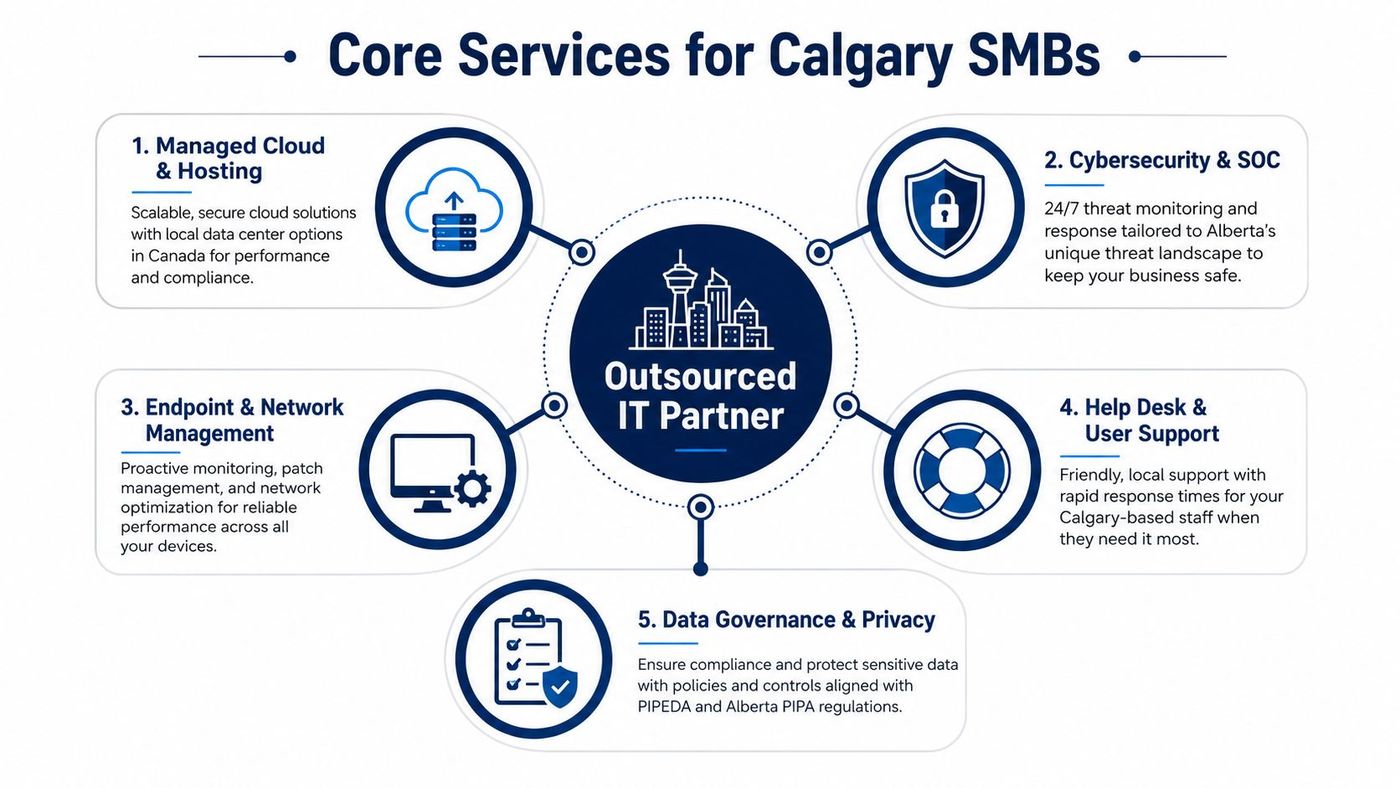
Managed helpdesk support is the operating foundation. It should include ticket intake, triage, escalation, endpoint monitoring, patch management, device lifecycle planning, and coordination with software or internet vendors. The provider should identify failing equipment and recurring incidents before they interrupt customer work.
For a distributed team, support must cover more than office desktops. Staff may work from warehouses, construction sites, clinics, homes, or client premises. A useful managed helpdesk framework explains how support quality depends on response ownership, documentation, and consistent escalation.
Security services should include endpoint protection or EDR, email security, identity controls, security awareness training, vulnerability management, and incident response. MFA and conditional access should protect accounts, while patching and hardening reduce the opportunities attackers exploit.
The result isn't “more cybersecurity tools.” The result is a smaller attack surface, faster detection, and a defined response when an employee clicks a malicious link or an endpoint behaves abnormally.
Microsoft 365 and Azure can improve collaboration and flexibility, but cloud adoption without governance creates uncontrolled subscriptions, excessive permissions, weak retention practices, and unpredictable costs. Your provider should manage identities, licensing, access, backup responsibilities, data classification, and administrative roles.
VoIP and unified communications deserve the same operational discipline. Calgary companies with hybrid teams need reliable calling, conferencing, mobile access, call routing, and continuity plans. The objective is to keep customers and staff connected when offices, devices, or individual users change.
Backup is useful only when restoration works. A provider should define recovery priorities, protect backups from unauthorised alteration, test restoration, and document who makes decisions during an outage. Calgary businesses also need to consider local operational disruption, including flooding and power interruptions, without assuming that a backup service automatically equals business continuity.
A virtual CIO, or vCIO, turns technology administration into planning. This role should connect the IT roadmap to budgets, growth plans, compliance obligations, insurance requirements, application decisions, and risk acceptance. Ask for a written roadmap and recurring business reviews, not vague promises about “future readiness.”
A provider that only closes tickets is a support vendor. A provider that helps leadership choose, fund, and govern technology is an IT partner.
The minimum standard is integrated service ownership. Helpdesk, security, cloud, backup, communications, and strategic planning should share documentation and escalation rules. Otherwise, an incident will move between vendors while nobody owns the business outcome.
Don't start by asking an MSP for every security product it sells. Start by documenting the controls your business needs and the evidence your insurer, customers, auditors, and leadership team may require. Canadian public guidance frames small-business cybersecurity around 13 controls, while regional guidance highlights vendor risk, backup validation, and incident response as persistent gaps. The Canadian Centre for Cyber Security's SMB guidance provides the public baseline.
Alberta guidance for small businesses places foundational protection at roughly 3–6% of revenue, or approximately $400–$1,200 per month for a 10–30 user business, according to Alberta SMB cybersecurity guidance. Treat that as a planning reference, not a universal quote. Scope, risk, legacy systems, compliance, and insurance requirements can move the figure substantially.
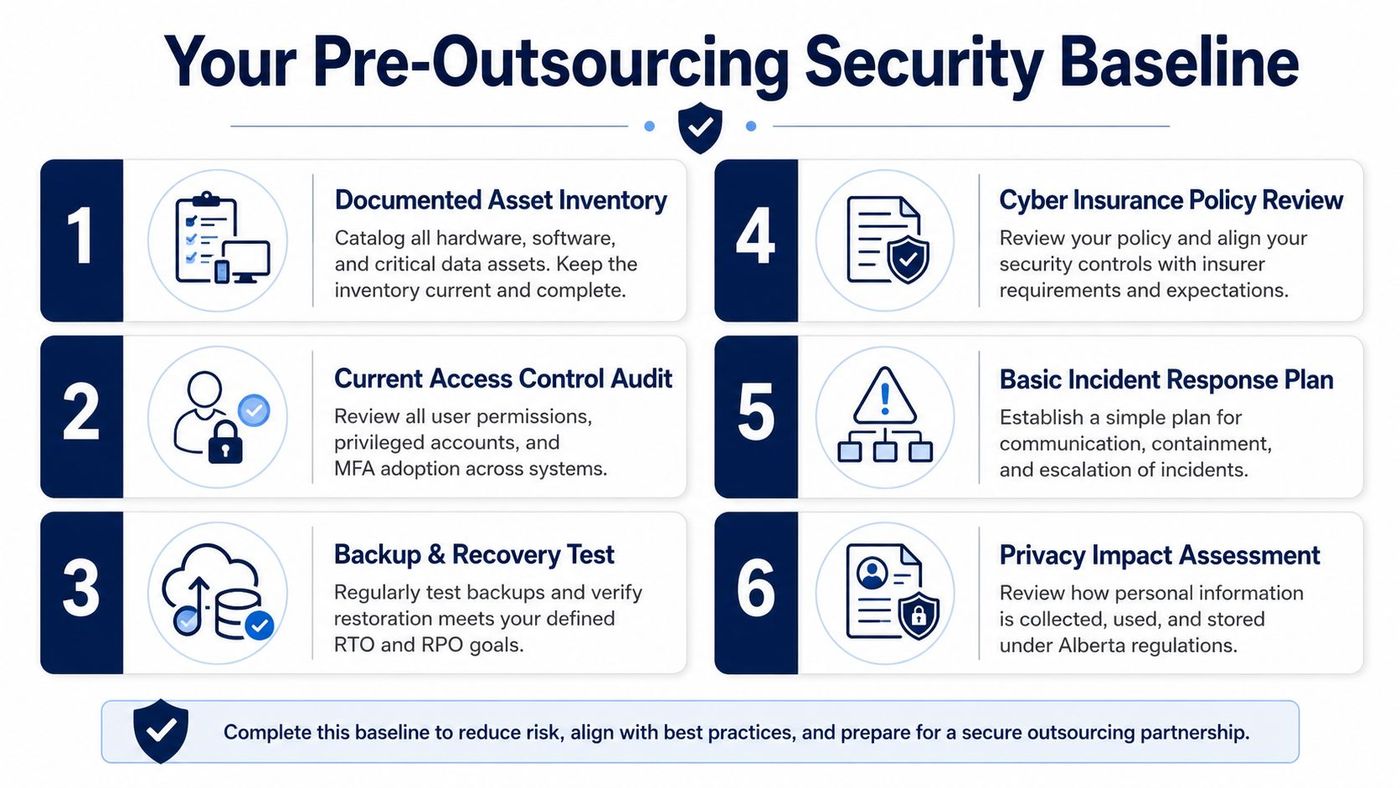
Create an inventory of users, devices, applications, cloud tenants, vendors, data stores, and operational technology. Then review administrator access, stale accounts, shared credentials, MFA adoption, and conditional access rules. An MSP can't protect assets nobody has identified.
Require the provider to return an asset register and access review as deliverables. Your leadership team should know which systems contain sensitive information, who owns them, and what happens when an employee or supplier leaves.
Deploy centrally managed endpoint protection or EDR, establish a patch cadence, and remove unsupported software where possible. Email security should address malicious links, attachments, impersonation, and account takeover. Network segmentation limits the spread of an intrusion, especially where office systems connect to production, warehouse, or OT environments.
Don't accept “we installed antivirus” as the security baseline. Ask for policy enforcement, alert ownership, reporting, and an escalation process.
Use immutable or otherwise protected backups, separate backup administration from ordinary user access, and test restoration. Document recovery priorities, communication contacts, and the order in which systems must return. A backup that has never been restored is an assumption, not a recovery capability.
Before signing, ask the MSP to complete a scorecard covering:
Alberta's PIPA obligations make documentation part of the operating model. Your provider should help maintain policies, access records, incident procedures, vendor assessments, and evidence of control operation. Cyber insurance may also require stronger controls before coverage is granted, so obtain the carrier's questionnaire before finalising the MSP scope.
For a practical control review, use CloudOrbis' business cybersecurity guidance. Set the first ninety days around closing known gaps, validating recovery, and producing evidence. Don't let onboarding become a product installation exercise with no accountable outcome.
A polished sales presentation doesn't tell you how an MSP behaves during a ransomware event, a failed migration, or a billing dispute. Calgary leaders should evaluate the operating model, evidence, and contract before comparing monthly prices.
Start with these criteria:
| Evaluation Criteria | What to Look For | Red Flags |
|---|---|---|
| Service levels | Written response targets, severity definitions, and escalation rules | “Fast support” with no measurable commitment |
| Service desk | Clear staffing model, Canadian coverage, and named escalation paths | Unclear location or reliance on one technician |
| Security operations | Monitoring ownership, EDR response, vulnerability management, and incident process | Security listed as an optional add-on with no response detail |
| Compliance | Relevant control evidence, privacy support, and documented responsibilities | Certification logos with no scope or audit context |
| Insurance alignment | Willingness to map controls to the carrier's requirements | Provider refuses to review the questionnaire |
| Co-managed readiness | Clear division of duties and integration with internal IT | Insistence on taking control of every function |
| Pricing | Transparent per-user or per-device scope and project rates | Unexplained fees, vague bundles, or surprise exclusions |
| Contract exit | Data return, documentation handover, transition assistance, and reasonable termination terms | Auto-renewal traps or no transition plan |
Pricing structure deserves close attention. Per-device pricing can suit a stable workstation environment, while per-user pricing may be easier for companies with several devices per employee. Neither is automatically better. Demand a written definition of billable users, devices, servers, cloud services, projects, after-hours work, and emergency response.
Use the interview to make the provider describe actions, not slogans:
Request local references from Calgary businesses with similar size, operational complexity, and regulatory exposure. Ask those references whether the provider communicated clearly during an outage, honoured the agreed escalation path, and raised uncomfortable risks before they became incidents.
CloudOrbis' Calgary MSP resource can help frame the provider comparison, but your decision should rest on evidence. Select the partner whose operating discipline matches your risk profile, not the vendor with the longest feature list.
A technology transition fails when the MSP starts changing systems before it understands the environment. A disciplined engagement moves from discovery to documentation, protection, integration, user adoption, and governance. CloudOrbis' 10-step process offers a useful reference model for setting expectations, regardless of which provider you choose.
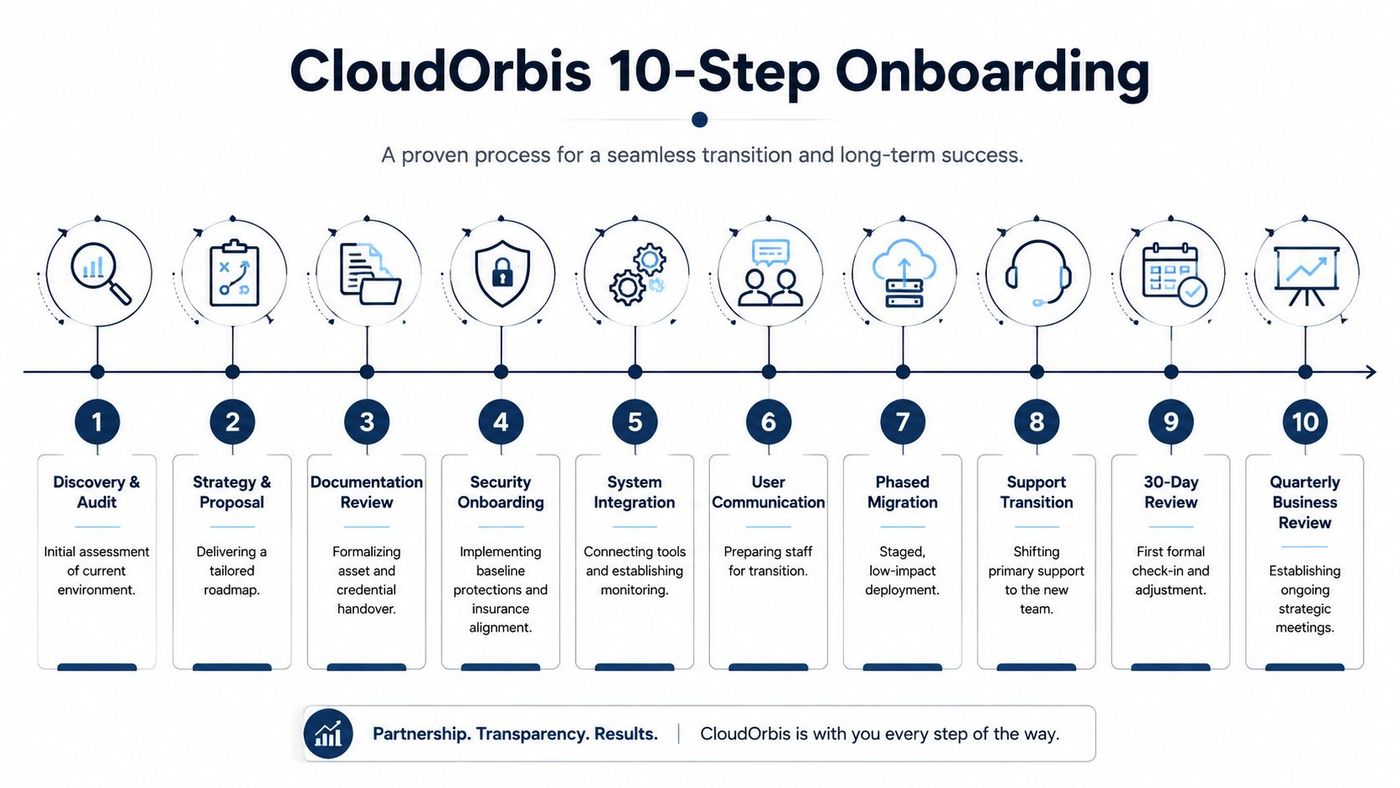
The engagement should begin with discovery and an audit of networks, endpoints, identities, applications, vendors, backups, and unresolved risks. The provider then presents a strategy and proposal, reviews existing documentation, formalises credential handover, and identifies what the client must supply. Missing assets, shadow IT, stale records, and undocumented dependencies need to appear in the risk register early.
Security onboarding follows the documentation review. The MSP deploys agreed protection tools, aligns controls with insurance requirements, and establishes monitoring. System integration connects ticketing, monitoring, endpoint management, identity systems, backup platforms, and reporting so technicians aren't working from disconnected information.
User communication matters as much as tooling. Employees need to know how to contact the helpdesk, what changes to expect, how urgent incidents are handled, and why the new workflow exists. Staff resistance often appears when a provider launches a ticketing process without explaining how it improves response and accountability.
By day 30, leadership should have a current asset and access picture, an onboarding risk register, documented escalation contacts, and a clear deployment plan. Critical unknowns should be visible, even if they aren't solved yet.
By day 60, core monitoring, support workflows, endpoint controls, backup review, and user communication should be operating in phases. The client should know which gaps remain, who owns them, and whether project work is included or separately approved.
By day 90, the engagement should be moving toward steady-state service. A first formal review should examine ticket trends, unresolved risks, security coverage, backup evidence, documentation quality, and the roadmap for the next quarter.
Governance test: If the provider can't show what changed, what remains exposed, and who owns the next action, onboarding is drifting into project limbo.
The client has responsibilities too. Provide accurate inventories, approve access, make decision-makers available, notify staff, identify business-critical applications, and respond to remediation decisions. A strong transition is shared work with visible milestones, not a handoff where the customer disappears after signing.
The right outsourced IT Calgary decision begins with the model. Keep a capable internal function when it has enough depth and coverage. Choose co-managed IT when internal knowledge is valuable but specialist capacity is thin. Choose a fully outsourced arrangement when you need one accountable operator for support, security, infrastructure, and planning.
Then fund the baseline before buying extras. Inventory assets, secure identities, harden endpoints, protect email, validate backups, prepare an incident process, and document privacy responsibilities. Use cyber insurance requirements to sharpen the scope, not to replace your own risk judgement. A policy is useful only when the controls behind it work during a real incident.
Finally, evaluate the provider like a critical supplier. Review service levels, staffing, escalation, security evidence, pricing definitions, contract exit terms, co-managed flexibility, and local references. Reliable IT isn't about finding the cheapest provider. It's about aligning technology governance with business risk, compliance obligations, operational continuity, and the direction of the company.
CloudOrbis Inc. is one option for Calgary organisations that need managed IT support, cybersecurity, cloud and Microsoft 365 management, backup and disaster recovery, VoIP, and vCIO guidance. Its structured 10-step engagement model supports assessment, strategy, implementation, employee training, and ongoing optimisation, while its Canada-based helpdesk provides an operating framework for businesses that want local accountability without building every capability internally.
Start with a no-obligation assessment that identifies immediate vulnerabilities, documentation gaps, recovery concerns, and long-term cost exposure. That conversation should give leadership a clearer basis for choosing in-house, co-managed, or fully outsourced IT, even if the final answer isn't a full MSP contract.
CloudOrbis Inc. provides managed IT, cybersecurity, cloud management, backup and disaster recovery, VoIP, and strategic vCIO services for Canadian SMBs. Visit CloudOrbis Inc. to schedule a no-obligation consultation and replace IT uncertainty with a practical, accountable technology plan.
Book a 30-minute call with a senior engineer. No sales script, just straight answers about your environment.


