Cybersecurity Calgary: A Practical Guide for SMBs
Explore cybersecurity Calgary SMBs can rely on, with local threat data, compliance tips, key controls, and a practical provider evaluation checklist.

Explore cybersecurity Calgary SMBs can rely on, with local threat data, compliance tips, key controls, and a practical provider evaluation checklist.

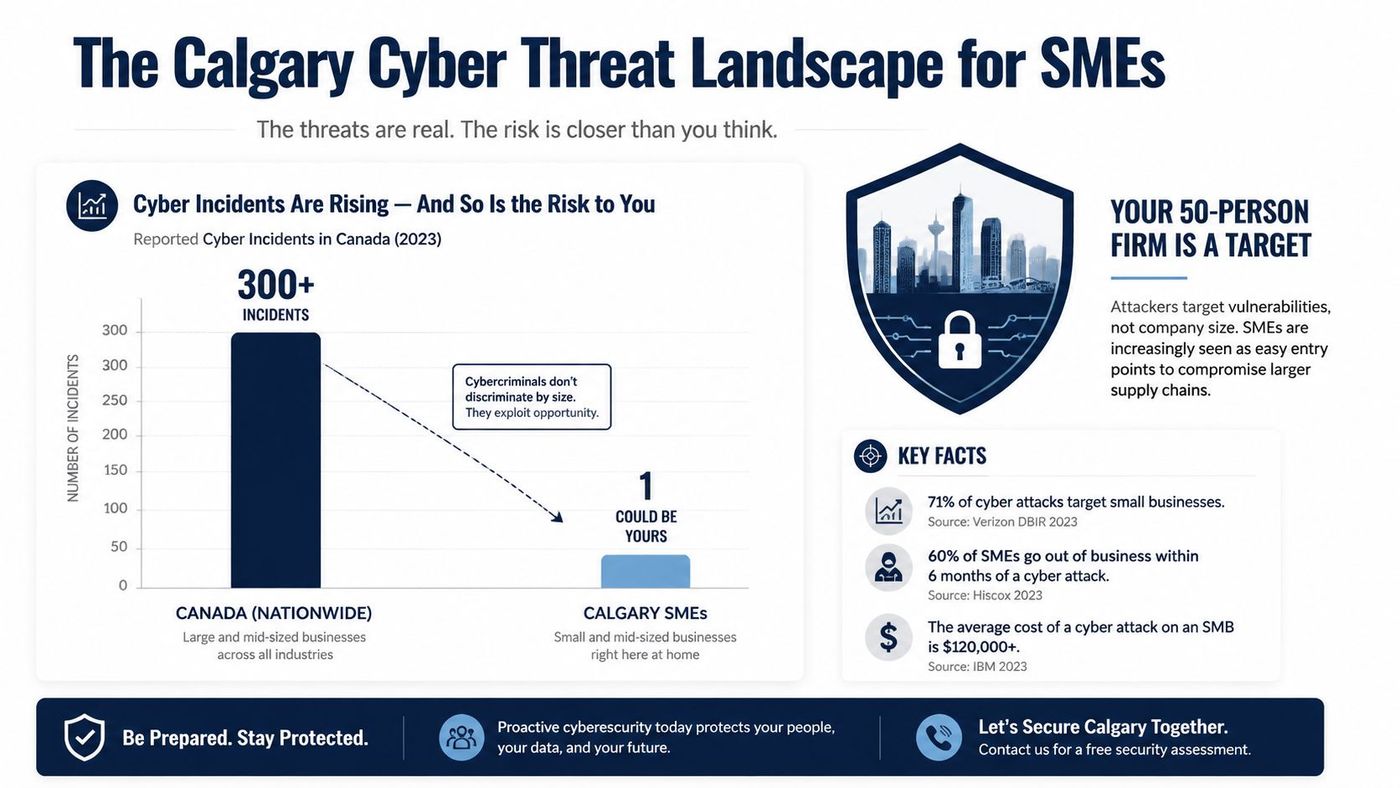
Calgary police reported that cybercrime in the city increased 174% between 2017 and 2021, while only 5% to 10% of cybercrimes are believed to be reported. The uncomfortable conclusion is that the official numbers understate the risk facing local businesses, particularly firms handling financial, health, legal, or client data. Calgary police reporting on cybercrime growth and underreporting gives Calgary owners a better starting point than another generic ransomware warning.
For most small and mid-sized businesses, the first practical concern isn't a dramatic encryption event. It's a fraudulent invoice, a compromised mailbox, an altered payment instruction, or stolen identity information. This guide focuses on the controls a Calgary business can choose, fund, and implement over the next 90 days.
Calgary's cyber risk has grown faster than many owners' internal processes. Police reported a 174% increase in cybercrime between 2017 and 2021, and the service had investigated 100 ransomware attacks since 2016. Yet police estimated that only 5% to 10% of cybercrimes are reported, so the visible count is only part of the local problem. Calgary police data reported by CBC points to a business environment where fraud, ransomware, and organised cyber activity already affect day-to-day operations.
That doesn't mean every Calgary SMB needs a large internal security department. It means the owner, controller, or operations lead needs to make a few decisions clearly:
Local reporting has highlighted that more than 1,700 Calgary crimes in one year had a cyber component, with about half involving fraud or identity theft. CBC's Calgary cybercrime coverage supports a more useful conclusion than “buy ransomware protection.” Your finance team needs a verification workflow for payment changes. Your staff need a reliable way to flag suspicious messages. Executives need separate approval for unusual transfers, even when the request appears to come from a familiar person.
Oilfield service firms, agri-food companies, construction contractors, and professional practices also inherit risk through vendors. A compromised subcontractor, payroll provider, cloud application, or shared document platform can expose your business without an attacker entering your office directly. Supply-chain security therefore belongs in operations meetings, not only IT meetings.
Practical rule: Treat every payment-change request as untrusted until a second channel confirms it.
A Calgary business owner doesn't need to predict the next attack. You need to identify the highest-consequence workflow and put friction around it. A 90-day plan should establish identity controls, email protection, endpoint visibility, tested recovery, and a named response owner.
| Incident Type | Typical Direct Loss (CAD) | Recovery Time |
|---|---|---|
| Email compromise and payment fraud | Varies by transaction and recovery success | Immediate investigation through extended financial recovery |
| Identity theft and account misuse | Varies by account and data exposure | Account remediation and business-process review |
| Ransomware or destructive malware | Varies by systems affected and recovery path | Operational disruption until systems are restored |
| Data exposure | Varies by records, legal duties, and affected parties | Containment, assessment, notification, and remediation |
The table deliberately avoids invented cost bands. Calgary owners should use their own payment volumes, payroll exposure, regulated data, and recovery dependencies to set an impact threshold. The job of this guide is practical: help you select sensible controls, evaluate a provider, and begin a defensible roadmap within the next 90 days.
Canadian cybercrime data points to a working assumption for Calgary owners: email compromise, payment fraud, and identity theft deserve attention before ransomware headlines do. A Calgary firm with 25 to 250 employees may control payments, customer records, engineering documents, health information, or privileged legal material without having a dedicated chief information security officer. Attackers need one useful identity, one convincing message, or one unpatched device.
The Canadian Centre for Cyber Security recorded 2,561 incidents across the Government of Canada and critical infrastructure in 2024–2025, up from 2,192 the prior year. That total included 1,406 incidents affecting critical infrastructure. The Cyber Centre's 2024–2025 annual report gives Calgary healthcare, logistics, industrial, and energy-related organisations a useful national reference point.
Statistics Canada reported 40,437 police-reported cybercrime incidents in the first half of 2025. A separate summary of Statistics Canada business data reported that 16% of Canadian businesses experienced a cybersecurity incident in 2023, compared with 21% in 2019. Businesses with 250 or more employees had a 30% incident rate. The Canadian business cybersecurity statistics summary puts company size into context. Smaller firms still attract attackers, while often having fewer controls and less capacity to investigate.
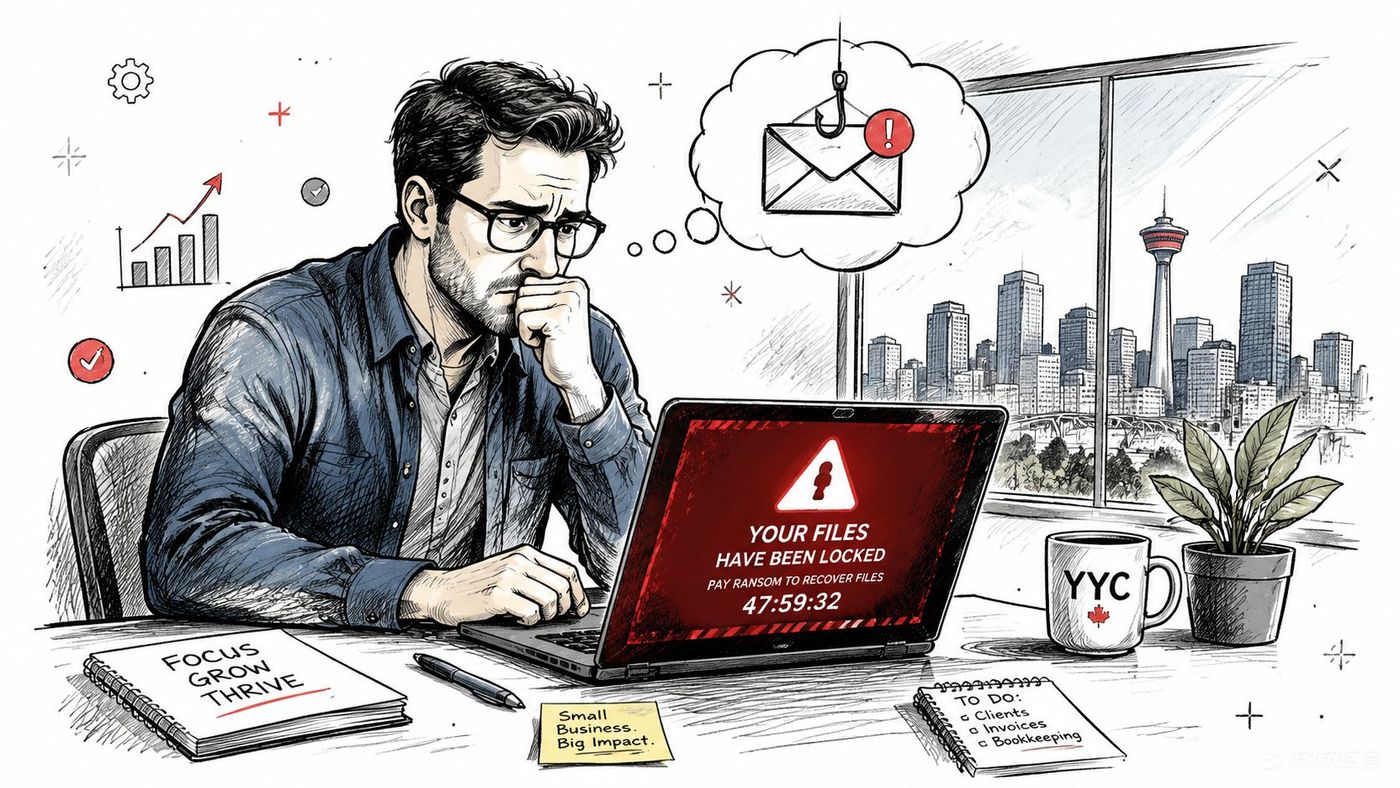
Ransomware can disrupt operations, but email compromise and fraudulent payment instructions create a faster risk for a controller or owner-manager. Hybrid work spreads access across home networks, personal devices, cloud applications, and shared credentials. Suburban offices and field teams face the same control problem in different settings. Staff need access from many places, while managers must verify that the person approving a change is genuine.
Professional services, oil and gas field services, construction, healthcare clinics, and education warrant close review. Calgary's security workforce is growing too. A Calgary-focused talent report said CBRE identified the city as an emerging cybersecurity market and the only Canadian city on that list, with the local cybersecurity workforce growing more than 40% annually and exceeding 4,000 workers. Calgary's cybersecurity talent-market coverage links that regional growth to specialised security operations and response capacity.
Threat-intelligence vendors use different counts and classifications. Owners should therefore prioritise Canadian primary sources, defined internal risk, and controls they can observe, rather than marketing dashboards. CloudOrbis's guide to top cybersecurity threats for SMBs provides a practical review of common attack paths.
Privacy compliance isn't a substitute for security, but it tells you what information deserves protection and what happens after exposure. Calgary businesses often operate under more than one regime, depending on their industry, customers, and data flows.
The federal Personal Information Protection and Electronic Documents Act, or PIPEDA, generally applies to private-sector commercial activity in Alberta where the business falls within federal privacy requirements or handles information across provincial or national boundaries. It governs collection, use, disclosure, safeguarding, access, and accountability for personal information.
The practical implication is simple. Your business should know what personal information it holds, why it holds it, which vendors can access it, and how it will assess and document a breach. Don't assume a cloud platform's security settings answer your accountability obligations.
Alberta's Personal Information Protection Act, or PIPA, covers many Alberta-regulated private organisations. It matters to professional firms, retailers, contractors, and other businesses that collect personal information in the course of commercial activity. PIPA sets expectations around reasonable safeguards, transparency, access, and breach handling.
A business owner should confirm whether PIPA applies directly, whether another statute governs the same records, and who has authority to make a breach decision. The practical implication is that your incident plan must identify the privacy lead and provide a route for urgent assessment and reporting, including the 72-hour breach reporting clock under PIPA where applicable. That deadline should be verified against the current legal facts of the incident, not guessed during a crisis.
The Alberta Health Information Act, or HIA, applies to custodians such as physicians, pharmacists, and dentists, as well as service providers handling health information on their behalf. That includes IT and technology vendors when their work gives them access to protected health information.
Healthcare clinics need stronger discipline around access, auditability, retention, vendor agreements, and breach escalation. HIA also creates a mandatory breach reporting duty in applicable circumstances. A clinic shouldn't wait for its IT provider to explain the legal position after an incident. The owner or privacy officer needs a documented decision path.
| Statute | Applies To | Key Obligation |
|---|---|---|
| PIPEDA | Applicable private-sector commercial activity | Safeguard personal information and manage breaches responsibly |
| Alberta PIPA | Many Alberta-regulated private organisations | Reasonable safeguards, privacy accountability, and breach handling |
| Alberta HIA | Health custodians and service providers handling health information | Strict controls, access management, and mandatory breach reporting in applicable cases |
Sector rules sit above these foundations. Retailers handling card payments need PCI DSS controls. TSX-listed issuers may require SOX-style internal controls around financial reporting. Law firms must consider Law Society of Alberta recordkeeping and confidentiality expectations. For businesses managing hiring data across provinces, WorkSignal AI hiring compliance offers useful context on employment-related compliance workflows. CloudOrbis's overview of Canadian data privacy laws is a useful starting point, but regulated organisations should obtain legal advice for a specific incident or data map.
Buy controls that close a known gap. Don't buy a long product list because a salesperson used the word “enterprise.”
MDR gives your business security monitoring and analyst oversight, often through a security operations centre. It helps when suspicious activity occurs outside office hours or when internal staff can't interpret alerts. A law firm with confidential files and a small IT team should put MDR near the top of the list. The trade-off is recurring service cost and the need to define who can authorise containment.
EDR places a behavioural security agent on laptops and servers. It looks for suspicious processes, persistence, credential theft, and lateral movement rather than relying only on known malware signatures. EDR is valuable for field-service companies, professional firms, and clinics with distributed devices. It won't replace patching, identity controls, or response procedures.
Recurring vulnerability assessments examine exposed systems and internal weaknesses. Authenticated internal scans can identify missing updates and configuration problems that an external scan won't see. Oilfield service companies with operational technology dependencies, remote access, and vendor connections should require a clear remediation register, not a report that sits unread.
Backups matter only when your team can restore the systems the business needs. Test files, applications, permissions, and recovery sequencing. A clinic may prioritise scheduling and patient records. A contractor may prioritise project files, payroll, and accounting. Ask for evidence of restore testing, retention design, and recovery ownership.
Email controls should address impersonation, spoofing, malicious links, and unsafe attachments. Anti-spoofing policies, DMARC enforcement, mailbox protections, and phishing-resistant link scanning reduce the chance that a familiar-looking message reaches the person who can release funds. Staff training still matters, but training alone isn't a control strategy.
| Control | Law Firm (10-50 staff) | Oilfield Service Co. | Healthcare Clinic | Professional Services |
|---|---|---|---|---|
| MDR | High priority | High priority | High priority | Strongly recommended |
| EDR | Essential for managed devices | Essential across office and field endpoints | Essential | Essential |
| Vulnerability assessments | Recurring external and internal review | High priority | Required as part of broader risk management | Recurring review |
| Backup and disaster recovery | Protect matter files and practice systems | Test operational and business restores | Test clinical and administrative recovery | Protect finance and client systems |
| Email security | Highest priority with payment verification | High priority for invoices and vendors | High priority with privacy controls | High priority |
There are no honest universal Calgary cost bands without knowing your device count, licensing, data obligations, response coverage, and existing Microsoft environment. Get a written proposal that separates implementation, licensing, monitoring, incident response, and recovery testing. Physical security and counter-surveillance are different disciplines, so a business assessing sensitive meeting spaces should treat services such as bug sweeping Birmingham as a separate specialist category, not as a substitute for cyber controls. CloudOrbis's guide to cybersecurity best practices for business provides a broader baseline. CloudOrbis Inc. also offers managed IT, threat detection, vulnerability assessments, endpoint protection, compliance support, and backup and disaster recovery for Canadian SMBs.
Your provider should make security easier to operate, not harder to understand. Take this checklist into every vendor meeting and ask for evidence.
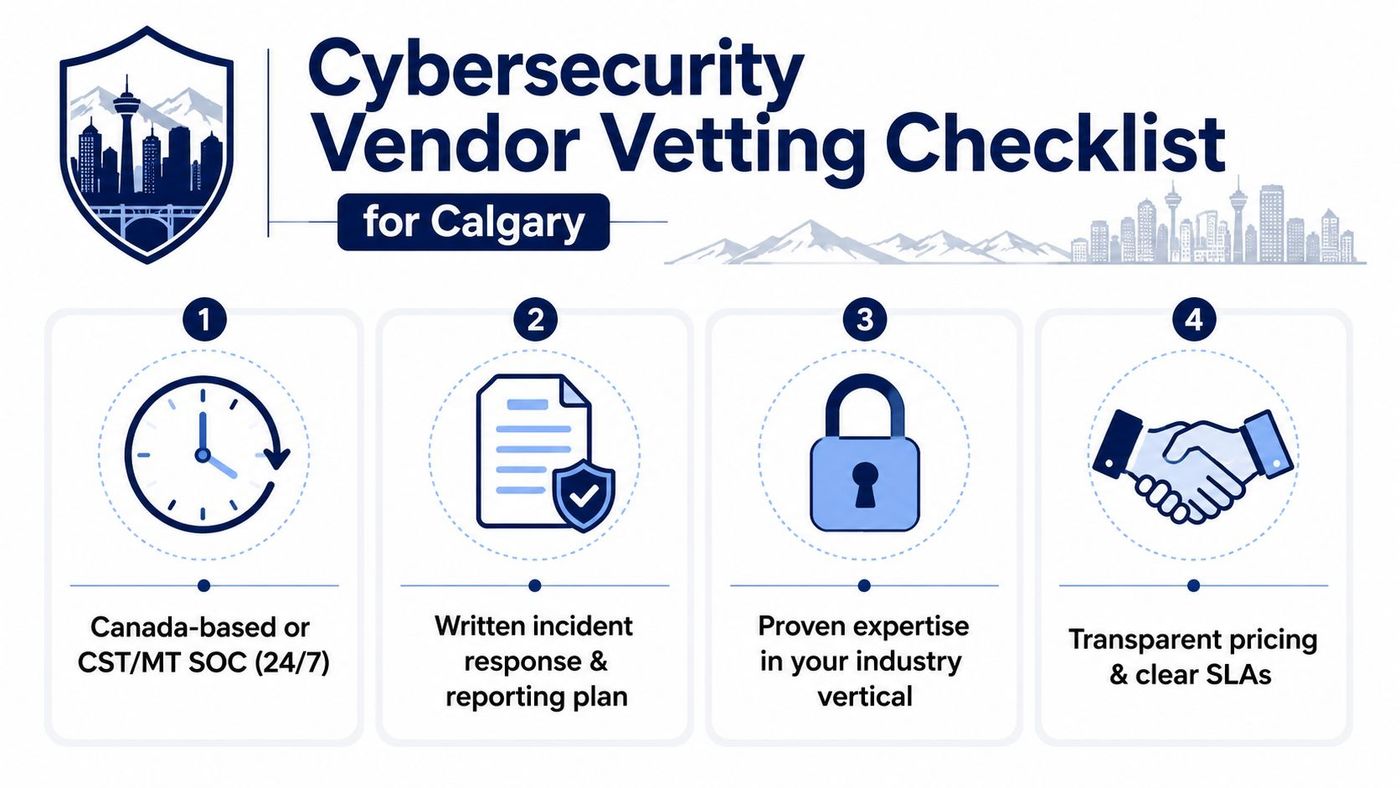
Ask where the security operations centre is located and who watches alerts during Calgary nights, weekends, and holidays. A Canada-based or Canadian-time-zone SOC may fit your privacy and escalation needs better than offshore-only coverage, but location alone isn't proof of quality. Require written service-level agreements covering mean time to detect, mean time to respond, escalation paths, and customer notification.
The provider should name your technical contact and explain who takes over when that person is unavailable. Ask for a sample monthly report, a sample vulnerability assessment, and a sample phishing-simulation summary. If the provider won't show you what you'll receive, you can't judge whether the service will help leadership make decisions.
Look for evidence of CyberSecure Canada participation or alignment with SOC 2 practices, then ask how those standards affect the actual service. Request references from Alberta organisations in your sector. A law firm should ask about confidentiality and matter data. A healthcare clinic should ask about HIA responsibilities. An oilfield service company should ask about remote access, vendors, and recovery from operational disruption.
Pricing should separate monitoring, response, licensing, onboarding, assessments, and recovery testing. Hidden monitoring fees make an apparently affordable proposal impossible to compare.
Ask first: Who calls me at 2 a.m. when something fires?
Three red flags deserve an immediate explanation:
Use CloudOrbis's resource on cybersecurity companies in Calgary to frame your shortlist, then test each provider with a realistic scenario. Ask what happens when a finance employee reports an altered invoice, an executive's mailbox shows suspicious forwarding, or a laptop disappears from a job site.
The City of Calgary's own experience shows why human behaviour needs technical measurement. City risk reporting found that, from May to August 2024, engagement with harmful links was up to 15 times higher than at other regional or similarly sized organisations. CBC's report on the city risk assessment also identified cybersecurity as a major concern.
The sequence is familiar. A user receives a convincing message, follows a harmful link, and creates an opportunity for credential theft or broader phishing activity. The lesson for a private company isn't to blame employees. It's to instrument email, block dangerous destinations, make reporting easy, and review the results with managers.
Alberta's education incidents reinforce the recovery lesson. Recent Calgary-area breaches at Mount Royal University and the 2025 PowerSchool incident affecting Alberta schools show how education organisations can face sensitive data exposure and third-party risk. The issue for a private SMB isn't whether its IT team has a polished security programme. The issue is whether the organisation can contain an incident, determine what data was affected, and restore essential services.
A binder on a shelf doesn't contain an incident. People do. Your plan needs decision thresholds, authority, and a communication sequence that works when normal systems are unavailable.
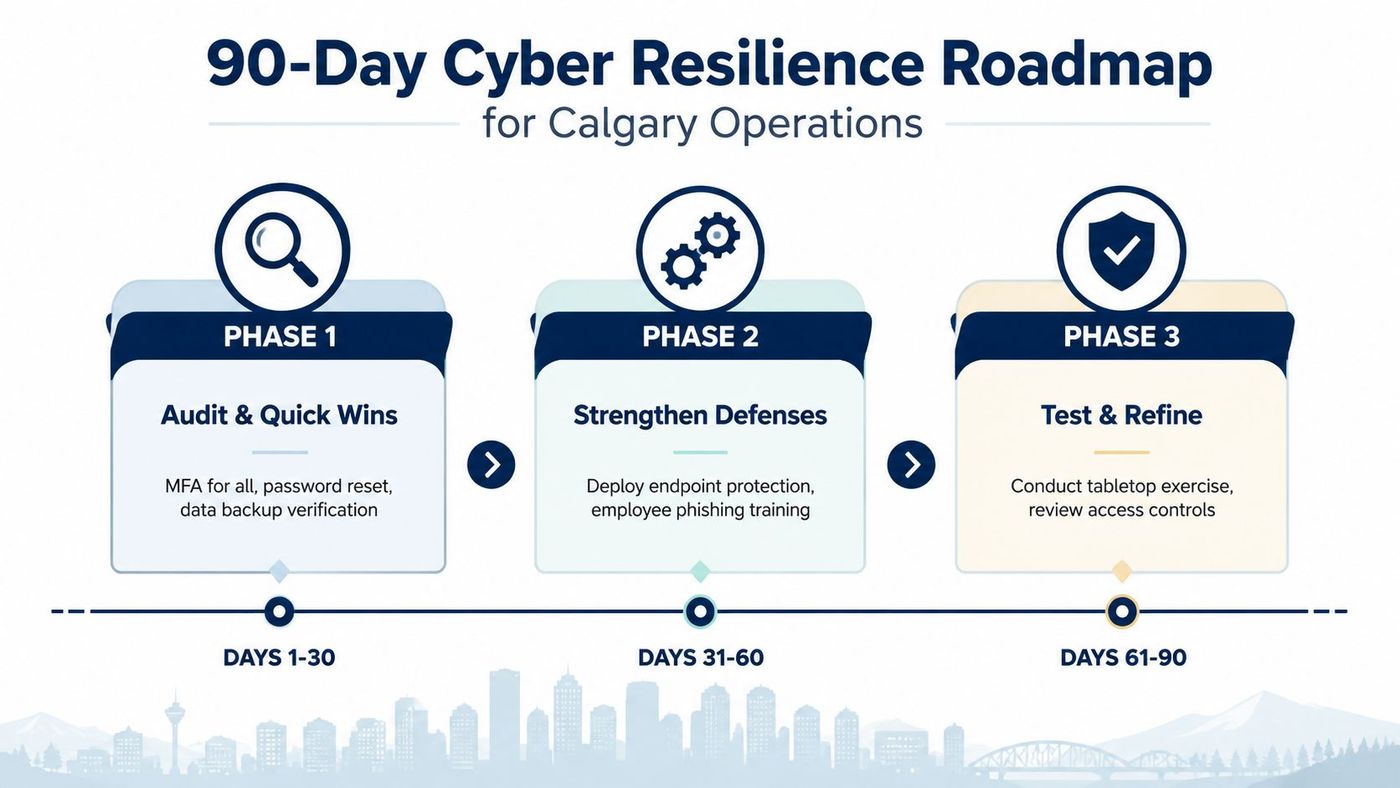
A practical roadmap gives an operations leader owners, deliverables, and deadlines. Assign one accountable executive, involve IT and finance, and use Friday checkpoints to remove blockers before the project loses momentum.
Start with an account and access audit. Enforce MFA on every email and VPN login, prioritising administrators and finance users. Run a baseline phishing simulation with Calgary employees, then inventory critical data, applications, owners, vendors, and storage locations.
Deliverables: an account register, MFA exception list, phishing baseline, critical-data map, and backup verification record.
Owners: operations or executive sponsor, IT lead, finance lead, and department owners.
Friday checkpoint: review unresolved MFA exceptions, high-risk accounts, payment workflows, and data owners.
Deploy EDR across laptops and servers. Configure business email security with banner tagging and reporting. Restrict local administrator rights, review privileged accounts, and select an MDR partner or formalise an internal response runbook.
Don't turn this phase into a technology-only project. The finance lead should test payment verification. HR should confirm onboarding and offboarding steps. Operations should identify the systems that would stop work if unavailable.
Deliverables: EDR coverage report, email-control configuration, privileged-access register, MDR decision or response runbook, and escalation contacts.
Friday checkpoint: inspect uncovered devices, test alert routing, and walk through one suspected mailbox compromise.
Validate backups through actual restores. Run a documented disaster recovery test and a leadership tabletop exercise. Review vendor access, access-control exceptions, and the response plan for a 25- to 250-person Calgary SMB. Include an annual vendor review so suppliers don't become permanent blind spots.
Deliverables: restore-test results, recovery priorities, tabletop actions, updated access review, vendor register, and signed incident response plan.
Friday checkpoint: assign every gap an owner and due date. The backup and disaster recovery guide for Calgary businesses can help structure the recovery discussion, but your own systems and priorities must determine the final plan.
Cybersecurity doesn't belong in a quarterly outage update that nobody reads. Calgary leaders should discuss it alongside cash flow, hiring, insurance, customer trust, and operational continuity because each of those areas can suffer when an employee account, vendor connection, or critical system is compromised.
The national context supports that shift. The Cyber Centre recorded more than 3,200 cybersecurity incidents affecting federal institutions and critical infrastructure in 2025–2026, sent more than 97,000 notifications to organisations across Canada, and handled 1,688 incidents affecting Canadian entities. The Cyber Centre's 2025–2026 annual report shows why early warning and response capacity matter beyond federal departments.
Name one accountable executive. Set a written risk appetite. Decide which events require immediate leadership involvement, such as a payment diversion attempt, a suspected privacy breach, or loss of access to a critical application. Then tie spending to outcomes your company understands: fewer unverified payment changes, faster isolation, reliable restoration, and documented compliance decisions.
Canadian breach costs also make the financial case concrete. A 2026 Canadian report citing IBM research stated that the average Canadian data-breach cost was CA$6.98 million in 2025, up from CA$6.32 million in 2024, while another Canadian source reported CA$7.11 million as a later record figure. The Canadian cybersecurity compliance statistics report provides those figures, but an owner should treat them as national averages, not a forecast for one Calgary SMB.
Book a one-hour session with a senior advisor to map the three risks most specific to your sector and revenue size. Commit to the first 30 days of the roadmap before the next budget cycle, while the decisions are still manageable and the business context is clear.
CloudOrbis Inc. helps Calgary SMBs assess risk, strengthen email and endpoint security, manage vulnerabilities, and build tested backup and disaster recovery plans with Canada-based support. Visit CloudOrbis Inc. to start a focused conversation about your first 30 days, without a jargon-heavy sales process.
Book a 30-minute call with a senior engineer. No sales script, just straight answers about your environment.


